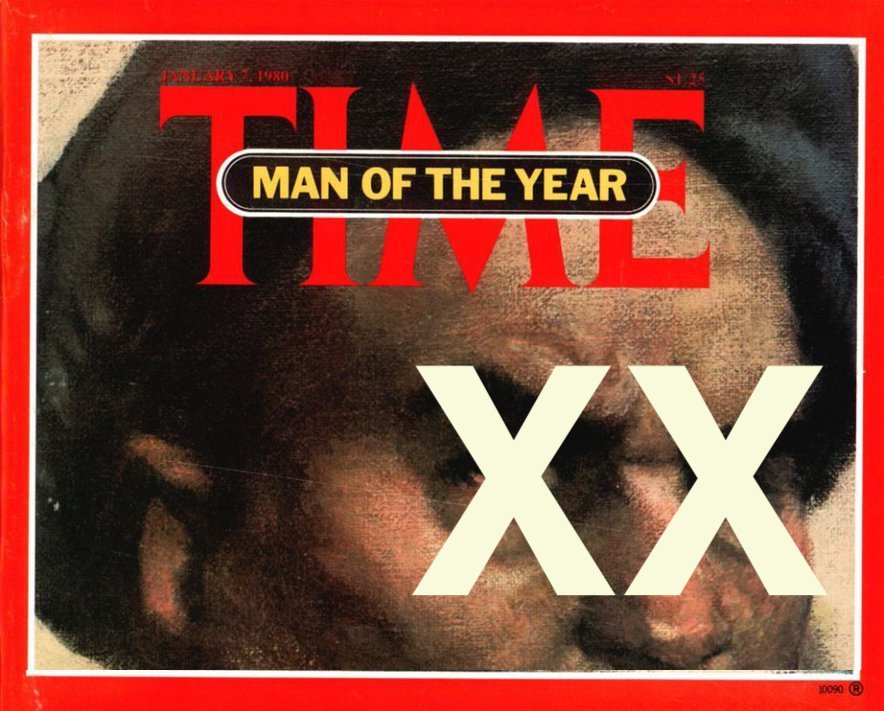
1- The Iranian Revolution of 1979 was an Islamic formation, even though at the moment of its victory in 1979 some of the groups and political forces that made up its body were secular and non-Islamic. The Islamic essence of the Revolution was cemented once the Iranian seculars A) accepted Khomeini’s leadership B) agreed and promoted the Revolution’s Islamic slogans and virtues against modernity, the west, and, subsequently, the anti-women and anti-queer essence of political Islam C) agreed to vote yes for an unknown political system called the Islamic Republic in the February 1979 referendum meant to determine the political form of the new regime.
Any other narrative about the nature and essence of the Revolution which ignores or denies these obvious facts is a falsification, stemming from the non-Islamist forces admitting to their historical complicities. While Iranians have overwhelmingly understood the Revolution retrospectively as a disaster, most opposition groups except the Monarchists still hold on to the event as an inevitable and/or positive development. The rejection of these two false notions is the first step towards developing a sound and secure method for replacing the Islamic Republic system with a secular and democratic state.
2- The Iranian Revolution was a global/regional/geopolitical affair and not solely a national and local one. The causes of discontent amongst the Iranian people were obviously local, but the Revolution as a whole stretched outside of the Iranian geography and history towards developments in the region and the world since 1967 and the 6-day war in Palestine than solely local developments.
3- Khomeini formed his concept of the Guardianship of Jurisprudent in a semi-secretive setting for his close students and confidants in Iraq. It was a political response by an Islamic scholar to anticolonial failures of nationalism in the region (Iran: 1953, Arab world: the 6-day war). It promised to be the only practical path forward for defeating Israel and the Saudis, opening up the possibility of Muslims’ self-rule. Khomeini believed that Islam as a new political force could play the leading role in uniting nationalists who weren’t anti-religion with traditional Muslims ready to implement an Islamic programme to fight corrupt Arab Monarchs and Israel. However, for this to happen and for Islam to live up to its political potentials in the 20th century, Khomeini believed that Islamic cultural and moral values had to be hegemonized using modern means of communication and governance. Before tapping into the Iranian society’s resources after his victory to fulfill this task, Khomeini’s power abroad was based on the trinary support he received from the Libyan and Syrian governments and the Lebanese Shia movement. These forces were all more or less engaged in Lebanon’s civil war. Isolated in Iraq and caught off from Iranians, Khomeini could have never sustained his movement and grew his networks amongst the Shia population inside and outside the country without receiving help from Israel’s enemies.
4- In this large swath of land mostly occupied by pious and observant Muslims, Khomeini’s geopolitical design’s weakest link was his original home country of Iran, which had accelerated towards secularism and westernization since Khomeini’s departure and on exile in Iraq. This process had never faced a serious and organized resistance, not at least by the emerging educated middle class of Iranians in the decades prior to and after World War II. Iranians had seen no contradictions between modern and westernized life and traditional Iranian Islam, which had gradually reduced the political power and the moral weight of Shia doctrines, ceremonialaizing and carnivalizing the religion and limiting their observation to certain annual ceremonies and rituals (Muharram, Ashura, Arbaein, etc). However, thanks to the influence of nativism, Heideggerian philosophy, Fanonian anti-colonial rhetoric, and their vernacular varieties, which critiqued modernity and the West from a Persian perspective, the 1970s witnessed the opening up of a socio-cultural window in the country’s public and intellectual space which Islamist would later exploit for hacking into the educated middle class’ sense of political social and cultural identities.
5- Scattered in different university departments and intellectual circles, these ideas were associated with certain individuals like Ahmad Fardid, Ali Shariati, Jalal Ale-Ahmad, and Hassan Nasr. While holding different political opinions, overall, these intellectuals advocated a break with the culture of modernity and a “return to one’s self”, guided by the rich cultural heritage of Iran’s Islamic past which was intentionally ignored by the Monarchy and its policymakers. Strange enough, by the mid-1970s, some of these ideas had found their way into the close circle of people around Queen Farrah (ie, Ehsan Naraghi ala Foucault) and were being advocated by those who saw potentials in Islamic identity as a weapon against the spread of atheism and Marxism amongst the university-educated youth.
6- Prior to the Revolution, the Monarchy was already moving towards pluralism and openness in a process that began with the resignation of Hoveida, Shah’s long-term Prime Minister in August 1977 and the Premiership of Hooshang Amuzegar. Over the course of 1978, this reform process was radicalized by communists of the Tudeh Party and the moderate Islamists of the Liberation Movement, ushering both discursive and physical violence in the society, a catastrophe for which the Iranian people are still paying a high price. Using their networks in the culture industry, the Iranian Stalinist Tudeh Party and the Liberation Movement played a major role in establishing Khomeini’s cult of personality amongst the masses. However, the Liberation Movement’s cowardice in playing up Khomeini pales compared to the Tudeh Party’s betrayal of Marxism and secularism. After all, they were the largest and one of the oldest communist parties in the Middle East.
7- Tudeh Party’s support for Khomeini was the result of a 180-degree shift in their attitude towards constitutional Monarchy marked by a forced change of leadership initiated by Moscow in a process that saw the secular democratic first Secretariat of the party Iraj Eskandari replaced with the Stalinist and religiously inclined Noureddin Kianoori. The repercussion of the Tudeh party’s support for Khomeini within the Iranian society galvanized the intellectual community who until then were only demanding freedom of expression, rule of law, and free parliamentary elections but now were forced to upgrade their demands and want nothing short of an end to the Monarchy. Despite the Shah’s reconciliatory gesture of removing the military cabinet from power in December 1978 and appointing Shahpoor Bakhtiar, a nationalist secular, to the office of the Prime Minister, the unity behind Khomeini’s leadership amongst the pro-Khomeini Islamists, the moderate Islamists of the Liberation Movement, the Tudeh Party communists and the intellectual left sealed the fate of the Revolution and handed Khomeini the victory. In fact, Bakhtiar’s appointment was the country’s last chance to turn things around and prevent the takeover of the State by Islamists. However, the secular and moderate opposition to the Shah, unaware or careless about the risks, did not support the Shah’s last Prime Minister. Bakhtiar was eventually murdered in Paris by the agent of the New Government a few years later. Overall, at the beginning of the Revolution, Ayatollah Khomeini relied solely on the urban middle class and the intellectuals and not the uneducated and oppressed city dwellers who were later utilized on a massive scale to fight off the unsatisfied intellectuals and the urban. But at the height of the Revolution and the days of his final victory approaching, he gradually changed his audience from the former to the latter; intellectuals and the urban middle class who were once his primary audience were the new enemies of the Revolution and the incoming Islamic State.
8- The long-stretched strike by the country’s main newspapers, advocated by the Tudeh Party network in the press, was a major factor in weakening the voices of reason and secularism, forcing the population to depend on Foreign news services like BBC and Moscow Farsi radio as well as Khomeini’s rumor mill in the form of photocopied materials and recorded cassettes which spread his latest speeches from Abroad. By the time of Bakhtiar’s appointment and the end of the press strikes, it was too late for anybody in the press to make arguments favorable of Monarchy or against Khomeini; efforts to reason against the incoming system would have been seen as anti-revolutionary, if not also suspected of being organized by the Monarchy and suppressed by most if not all of the opposition forces.
9- The last blow to the Monarchy came in the form of the American military support for regime change via General Hoizer, the special envoy of Jimmy Carter who had come to Tehran in the early days of 1979 to prevent the pro-Shah military leaders from attempting a coup against Bakhtiar and the Revolution. The American message was clear; Khomeini’s circle in Paris had promised them to keep Iran in the US alliance against the Soviets. The only time a coup would be necessary was if the Tudeh Party were about to take over the State. The abiding generals of Shah, against their own best judgment, did not attempt a coup and were all executed in the first few weeks after the Revolution.
10- The gravest mistake of non-Islamist opposition to Shah was their delusional fantasies about sharing power with a supposedly aging and inexperienced clergyman whom they thought would sooner or later die and leave them running the Iranian State. Little did they know or care that Khomeini would come equipped with a new theory of State which was developed and had brewed right under their radar in Iraq; they couldn’t fathom that he needed neither the Islamic modernists of the Liberation Movement nor the communists of the Tudeh Party to maintain power; he was only using them in the time being as chips to unite the urban middle class, albeit temporarily to seize power. Once victorious, it didn’t take less than a year for the new system to dispose of the Moderate Islamists of the Liberation Movement and a couple of more years to cut off the sleeper cell Tudeh Party influencers amongst the Islamists. By 1982, the system was totally Islamicized and seized by those loyal to Khomeini and his theory of the State. Mojahedin-e Khalgh, the only viable opposition to Khomeini, was a radical leftist-Islamist organization that grew popular during and after the Revolution. However, in 1981, their hopes for powersharing with Khomeini via the first president of the Islamic republic Bani Sadre was dashed as he was impeached and removed from office by the pro-Khomeini parliament. In June of that year, the organization chose the fatal path of “armed struggle” against the Islamic Republic, which transformed them from the last hope of the Iranian people against Islamists, followed by the start of a new round of mass arrest and killing by Khomeini in the summer, into the stooges of Saddam Hossein in Iraq. This pathetic political party-cum cult now receives funding from the Saudis and lobbies the American Republicans for more recognition, hoping that in the chaos after a US-probable regime change war, they might have a chance to form the government in Iran.
11- During the forty-year iron rule of the Islamic Republic, people of Iran have risen several times (the Khatami’s reform movement in 1997, the Green Movement in 2009, and the Election of Rouhani in 2013) to demand their political rights which were promised to them, once in 1905 with the Constitutional Revolution and the resulting constitution and parliament, then again in 1953 with the selection of Dr. Mossadegh as the Prime Minister, then again in 1977 by Prime Minster Amuzegar under Shah in the eve of the Revolution. These were, and continue to be, fair elections, freedom of expression and the rule of law; But every time their demands have met with empty promises of openness and dialogue between the rulers and the ruled by the corrupt, turban-wearing autocrats in Tehran’s places of power. Forty years later, they are still demanding similar rights from a government that is increasingly unable to respond to them even superficially as it did before.
12- At this point, we ought to stop distracting from the crucial focus. we should abandon our expectation that the direct or indirect meddling of the so-called “international community” would ever improve the political situation in Iran. Our demands should be explicit and made to the rulers of the country: A) A referendum, monitored by international observers, to decide the fate of the system; B) An openly elected constitutional assembly which would take the 1906 and 1979 constitutions as the point of departure and write a new democratic constitution for the country regardless of the outcome of the referendum about the overall form of the system be it a new Islamic Republic, a Constitutional Monarchy or hopefully a Secular Democratic Republic. C) These elections ought to be open to all Iranians, including the members of the diaspora. D) The process of rebuilding the country’s political institutions in Iran needs to be augmented with a truth and reconciliation mechanism through which different Iranian society segments reconcile their understanding of our bloody history and write social rules engagement for an ideologically and religiously fractured society like Iran.
13- Down with the Islamic Republic, Long live the people of Iran.