Introduction
The ongoing war in Gaza has generated extensive polemic among scholars and the general public.1 Some have described this conflict as a novel form of warfare. The deeply asymmetric character of this war and the vast number of Palestinian civilian casualties have prompted some analysts to described Gaza as a “new urban warfare.”2 Others have used similar descriptions such as “new war of attrition” or “Israel’s new wars,” while Kaldor argues that her theory of “new wars” is fully applicable to the violent conflict in Gaza.3
Other analysts have challenged the idea that this conflict can be described as warfare. Instead, they argue that the mass killings of civilians represent an act of genocide, crimes against humanity, or an ethnic cleansing campaign. For instance, UN Special Rapporteur on the Situation of Human Rights in Palestine, Francesca Albanese, has described Israel’s military campaign in Gaza as an act that represents “genocide as colonial erasure.”4 She emphasizes that this conflict should not be called war but genocide, regardless of the military motives.5 Similarly, many commentators including activists and politicians have argued that the Gaza conflict is “not a war but genocide.”6
Nevertheless, as most genocides take place in the context of war and are generated by the ever-changing social dynamics of military operations, any sharp distinction between genocide and war is difficult to sustain.7 In other words, genocides and wars are not necessarily mutually exclusive phenomena. While many wars do not have genocidal outcomes, most genocides happen in the midst of war. In this paper, we argue that this distinction is likely to become even less sustainable as contemporary warfare becomes ever more brutal. As the scale and scope of organized violence continues to expand, warfare and genocide might become indistinguishable. In this context, the mass killings in Gaza are not an aberration, but in many ways indicate a possible long-term trajectory of contemporary warfare.
Our argument emphasizes the structural continuities in the character of modern wars.8 The paper focuses on the organizational, ideological, and micro-interactional dynamics of mass violence in Gaza. We explore this violent conflict using the analytical tools from the historical sociology of war. The first part of the paper zooms in on the transformation of warfare in the twenty-first century. We critically assess various theories of new wars to identify the key features of violent conflict in Gaza. The paper aims to show that the new war paradigm is not particularly useful in understanding contemporary warfare, including the conflict in Gaza. In the second section, we analyse the organizational, ideological, and micro-interactional dynamics of the Gazan war. The paper concludes that the genocidal character of this conflict is a litmus test of the even more destructive wars looming on the horizon.
Warfare in the Early Twentieth-First Century
Over the past several decades, scholars of war have attempted to make sense of the recent violent conflicts. While, during the Cold War, the focus was mostly on nuclear deterrence, proxy warfare, postcolonial wars of independence, and intercontinental defense strategies, the end of the twentieth century and the beginning of this century have shifted the focus towards civil wars, the military interventions of powerful states, and the use of new technologies to fight wars from a distance.9 This change of research interest was a consequence of large-scale geopolitical transformations, but it was also a product of the widely shared belief that intra-state wars will replace inter-state wars as the dominant form of organized violence in the twenty-first century. In this context, many scholars have devised novel theories and concepts to explain the changed character of warfare in the late modern era. Hence, Mary Kaldor and Herfried Münkler, for instance, developed the concept of “new wars” to describe the majority of violent conflicts taking place in the aftermath of state collapse.10 Both Münkler and Kaldor differentiate sharply between the old and new wars: while the former are mostly symmetrical conflicts involving national armies fighting pitched battles with the support of entire societies, the latter are asymmetrical and protracted civil wars dominated by warlords and mercenaries who privatize violence and target civilians. Kaldor links “new wars” to the proliferation of neo-liberal capitalism that erodes the power of states.11 In her view, under such conditions, paramilitaries use the remnants of the state structure to acquire material resources and politicize ethnic and religious differences to keep the population under control.
In a similar vein, Zygmunt Bauman argues that the era of solid modernity was characterized by old wars, while the contemporary period of liquid modernity has generated two principal forms of violent conflict: globalizing wars and globalization-induced warfare.12 While the former relates to the military interventions of powerful states who deploy new technologies to wage war at a distance, the latter involves civil wars emerging on the ruins of collapsing states. He argues that the globalization-induced wars are particularly brutal as they involve chaotic conditions of state collapse, where the local warlords deliberately target civilians. Many other scholars have embraced the view that contemporary warfare is profoundly different from its traditional counterparts and have coined different concepts to define such wars – “privatized warfare”, “wars among people”, “degenerate warfare”, “hybrid warfare”, “postmodern war”, or “uncivil wars.”13 More recently, some analysts such as Barbara Walter have developed the concept of a “new new civil wars.”14 Working within the same new war paradigm, Walter argues that, while most wars fought from the early 1990s until 2003 can be adequately described as “new wars,” many recent violent conflicts display some distinct features that were not present before. She identifies three key features of “new new wars”: (a) they are generally fought in Muslim majority societies; (b) religious ideological discourse permeates their combat motivations; and (c) these wars focus on achieving transnational rather than national war aims.15
Despite some conceptual and analytical differences between all these perspectives, what stands out in the new war paradigm is the idea that the acquisition of territory is not a primary target of new wars. For Bauman, new wars are predominantly extraterritorial hit and run affairs. They mostly involve reconnaissance battles whose aim is not to conquer a particular territory, but “to explore the enemy’s determination and endurance, the resources the enemy can command and the speed with which such resources may be brought to the battlefield.”16 In this understanding, new wars also do not require strong ideological commitment: “the times of mass conscription armies are over and so is the time of ideological mobilization, patriotic ecstasies and ‘dedication to the cause’.”17 Similarly, Kaldor downplays the relevance of territory, geopolitics, and ideology that allegedly only characterize old wars. In her view, “the goals of new wars are about identity politics in contrast to the geopolitical or ideological goals of earlier wars.”18
The new war paradigm has been extensively criticized for its historical short-sightedness, its empirical inaccuracies, its conflation of war and crime, and its anti-Clausewitzean view of organized violence. Scholars have demonstrated convincingly that there is not much that is profoundly novel in the scope, methods of fighting, strategy, and tactics of “new wars” when compared to many guerrilla wars and insurgencies of previous epochs. The scale of civilian casualties has also come under rigorous scrutiny, indicating that the extent of civilian deaths is hardly historically unique. The same applies to the alleged lack of Clausewitz trinity in “new wars,” as many contemporary violent conflicts seem to operate according to the well-established geopolitical principles. Even the privatization of violence and the blurring of lines between crime and war is something that has been present in many different wars over the course of human history.19
Nevertheless, what is most relevant in understanding the dynamics of recent major wars, including the war in Gaza, is whether such conflicts have changed their form, substance, and objectives. We would argue that, for the most part, there has not been a profound change in the way that many contemporary wars operate.20 Rather than witnessing a distinctly novel transformation of war, the recent violent conflicts follow the coercive-organizational, ideological, and micro-interactional logic of organized violence that has been in place for several centuries. In other words, none of the incarnations of the new war paradigm can adequately explain the dynamics of contemporary warfare, including the ongoing Israeli-Palestinian war. The idea that the annexation of territory and ideological commitments have lost their significance in contemporary wars, as argued by Bauman, Kaldor, and Münkler, is profoundly mistaken. On the contrary, both ideology and territory capture have played the central role in many recent conflicts, including the war in Gaza.
As argued previously, the contemporary warfare displays more organizational and ideological continuity than discontinuity with the wars fought in the nineteenth and twentieth centuries.21 To trace the key features of organized violence in the contemporary period, it is necessary to zoom in on the three historical processes that shape their direction: the development of the coercive-organizational capacities, the ideological penetration, and the envelopment of the micro-level solidarities. One of the central characteristics of modern warfare is its destructiveness. Historians and sociologists of war have documented extensively how inter-state and intra-state conflicts have become ever more destructive in the last several centuries.22 The advancement of science, technology, industry, and state power have all played a crucial role in making warfare more devastating. Modern wars are characterized by ever-increasing civilian casualties, the severe destruction of natural habitats, and the long-term desolation of social fabric in the societies affected by wars.
This outcome is a consequence of the enhanced coercive organizational capacities of states and many non-state actors. Although this process has been in motion for thousands of years, it has accelerated in the modern period, allowing many social organizations to expand their coercive powers and internally pacify the social order under their control. Once nation-states have attained the legitimate monopolies on violence, taxation, judiciary, and education, they have become the dominant vehicles of coercive-organizational power. Comparative historical sociologists have traced this process by zooming in on the impact of protracted warfare on the centralization of state power, the development of more effective administrative apparatuses covering entire societies, the growth of large-scale transport and communication networks, and the mass application of science and technology to enhance the structures of governance, including military, police, and judiciary.23 The rise of the coercive organizational power of states, and other social organizations, has increased their infrastructural reach, their societal dominance, and their capacity to implement their decisions despite opposition.
Nevertheless, as the reliance on coercion usually provokes resistance, efficient forms of organizational power tend to acquire political legitimacy that helps justify such societal dominance. Hence, most social organizations promote specific ideological doctrines through which they secure legitimacy. The content of such ideological narratives differs profoundly and can range from secular projects advocating socialism, liberalism, conservatism, anarchism, environmentalism, and nationalism to the religious ideologies such as Salafism, Christian protestant fundamentalism, ultra-orthodox Haredi Judaism, Hindutva doctrine, or some strands of Buddhist fundamentalism. However, what is more important, and is usually common to all organizational action, is not the content of specific doctrines but the process of ideological penetration of social order. Ideological penetration operates through the promotion of specific visions of social reality that invoke the promise of liberation, salvation, and emancipation, and are framed in the language of righteousness. This process is often centrifugal, in the sense that it radiates from the dominant social organizations towards its membership. Yet, this is not only a top-down process: its intensity and prevalence are dependent on popular reception and social reinforcement. Ideological penetration is dependent on organizational capacity including the control of mass media, education systems, judiciary, the public sphere, and, more recently, social media. It is through this process that social organizations, such as states or social movements, acquire legitimacy and mobilize social action of large populations.24
These two large scale processes provide durable social structures which create potential for mass scale destruction and make many major modern wars protracted and more deadly. Nevertheless, the scale of organized destruction is also dependent on the ability of social organizations to successfully penetrate the micro-universe of everyday life. Hence, the coercive-organizational and ideological power must permeate and utilize the micro-level solidarities that are generated in the networks of close kinship and deep friendships. By framing organizational demands in the language of inter-personal intimacies, states can successfully transform anonymous, cold, and detached bureaucratic units into warm, endearing, and personalized “motherlands” and “brotherhoods”. While almost nobody would be willing to die for the administrative apparatus that is a nation-state, many people can be incited to fight for their “fatherland,” “motherland,” or for their “brotherhood.”25 We will now try to show how the transformation of recent warfare, including the violent conflict in Gaza, can be adequately analysed using these three analytical parameters.
The War of Organized Callousness
The violent conflict in Gaza, which has so far resulted in 48,405 Palestinian and at least 1,200 Israeli deaths, has been characterized very differently.26 Some, mostly Israeli, German, and US, observers have described this conflict as a “military intervention,” “war against Hamas,” “iron swords war,” “Simchat Torah war,” “7 October war,” or “Israel-Hamas war.” Palestinian sources refer to this conflict as a “Second Nakba,” “Nakba 2023,” “battle of al-Aqsa Flood,” or “Gaza genocide.” In the international mass media, all these terms appear, depending on one’s political allegiances, but the most common reference is to the “Israel-Gaza war,” “Israel-Hamas war,” or “Israel-Palestine war.” In analytical and military terms, this conflict has been described as “asymmetric warfare,” “irregular war,” “new war,” “war of attrition,” “subterranean warfare,” “war of occupation,” “ethnic cleansing,” and “genocide” among others.27 Many genocide scholars including Amos Goldberg, Ernesto Verdeja, Martin Shaw, Nimer Sultany, Tamir Sorek, Camilla Boisen, Jessica White, Melanie Tanielian, Shmuel Lederman, Elyse Semerdjian, Mark Levene, and other authors contributing to this JGR forum, have made a case that the conflict in Gaza is a genocide.28
So, what kind of violent conflict is this? If one defines war as a protracted and widespread violent armed conflict between two or more social organizations resulting in significant social change, including substantive human casualties and the destruction of environment, then the Gaza conflict certainly qualifies as a war.29 Nevertheless, this war does not fit neatly into existing categorizations. The traditional distinction between the inter-state and the intra-state wars does not seem to apply easily to this conflict. Firstly, as Israel, US, Germany, and several other powerful international actors do not recognize the Palestinian state, the conflict is rarely understood as a war between the two states. Secondly, as this war is mostly waged between a regular, internationally recognized military – IDF – and armed organizations that lack international recognition (Hamas, Islamic Jihad, Hezbollah, and others), this conflict does not legally qualify as an inter-state war.
In a similar vein, this conflict also lacks the key attributes of a civil war. Israel and Palestine do not constitute a single polity but are composed of the two profoundly unequal political entities – a sovereign state and an entity under occupation or military control. Furthermore, the Israeli military does not systematically target all Palestinians, but the focus is predominantly on those living in Gaza. For example, the Palestinians with Israeli citizenship are not directly part of this war, while those based in the West Bank are not an object of the same military operations as the population of Gaza.30 However, it is important to emphasize that the question of whether Gaza de facto qualifies as “occupied territory” has generated furious political and legal dispute that shaped the conflict in profound ways.31 In political terms, the legal debate of Gaza’s status has been utilized both by the Israeli far right and Hamas to weaken the Palestinian Authority in the occupied territories, which in turn created the fertile ground not to treat Palestinians in Gaza and those in the occupied territories as one single political entity. The Netanyahu government has been criticized within Israel for granting work permits to Gazan residents and facilitating the transfer of funds to Hamas in buying off their compliances, in return for pursuing relative peace. These actions have been criticized as having backfired in light of the attacks on 7 October 2023.32 Israeli intelligence assessments supported the belief that Hamas had no interest in attacking Israel and limited ability to do so, other than by launching an occasional limited rocket attack to bolster its legitimacy among Gazans.33 This was also used by the right wing Israeli government to effectively produce and reinforce the narrative of the impossibility of a peace process.
The conflict has numerous elements of what many scholars refer to as asymmetric and irregular warfare, but it is also much more complex than typical asymmetric conflicts. The most atypical feature of this war is the fact that one side in the conflict has an overwhelming military superiority, which it deploys to indiscriminately kill civilians and destroy the human habitat of Gaza. In this, the IDF is also supported financially and militarily by the most powerful Western states such as the US, UK, Germany, and others. On the other hand, as indicated by the global support in the UN resolutions, the population of Gaza has the symbolic backing from the majority of the world population. The same applies to labels such as “war of conquest,” “war for the acquisition of territory,” or “war of occupation.” While the IDF occupation of Gaza has taken place, it is not clear yet if this is a temporary or permanent aim or whether a part of Gaza will remain under IDF control.34 Furthermore, this occupation is atypical since it was not planned in advance, but developed as a response to Hamas’ attack on Israeli territory. The issue of conquest and territorial gain is something that features prominently in the Israeli public discourse, but it is far from clear whether this war will end with the full occupation or annexation of the Palestinian territory. This categorization can be determined only after the end of this war.
Some commentators have argued that this conflict is not a war but a genocide, politicide, or ethnic cleansing.35 However, as most genocides take place during the war, describing this conflict as a war does not suggest that it cannot also be a genocide or a form of ethnic cleansing.36 Rather than treating these phenomena as mutually exclusive, it is important to recognize that they can and often do overlap. The historical trajectory of organized violence points towards many major wars being more brutal and destructive with ever more toleration of civilian deaths as collateral damage. In this context, warfare can become more genocidal and more merciless towards the loss of civilian life.37 Hence, the conflict in Gaza can simultaneously be a war and a genocide.
Nevertheless, despite all these notable complexities, we would argue that this conflict does not represent a new form of warfare, but is a part of the longer trajectory of organized violence. In modernity, performative cruelty has gradually given way to disengaged callousness.38 In contrast to the public displays of torture, or visible and extensive infliction of pain on human bodies that have characterized many traditional societies, modern social orders privilege depersonalized, disciplined, and detached violence.39
The cumulative bureaucratization of coercion fosters a social environment where individual moral responsibility is delegated to anonymous social organizations. The bureaucratic division of labour transforms human beings into two sets of cogs in a military machine. One set is responsible for implementing the military aims, such as the capture of specific territory or control of a particular population. The other set appears as a material obstacle that prevents the implementation of these military tasks. Hence, following the logic of instrumental rationality, the focus is on removing these obstacles as quickly as possible and in the most efficient way available. The fact that these material obstacles often appear to be little children makes no difference. The mass destruction of human bodies becomes reframed as “the humanitarian crisis” or “collateral damage.” Since the emphasis is on the implementation of specific ideological vistas, killing thousands of ordinary civilians in this process is not perceived to be a moral issue, but only a technical problem that can be solved through the use of excessive violence.
This is the key feature of callousness; it is a form of cruelty without passion.40 Organized callousness involves acts of killing that are centred on fulfilling a particular objective. A human being is destroyed not because of what she does, or what she believes in, but primarily because her existence obstructs the implementation of larger ideological vistas or some very specific military goals. Modern military organizations are designed to enact detached callousness: they operate using regulated delegation of tasks and responsibilities, they are rigidly hierarchical structures that demand obedience from their members, they prioritize instrumental rationality and discourage emotional reactions.
Since modern wars depend ever more on advancements in science and technology, military organizations tend to rely much more on remote-control devices – from high altitude bombing, long distance missiles, drones, and killer robots to AI navigated weaponry. These long-distance weapons foster further depersonalization of killing as they remove the perpetrators from their victims. In this way, mass slaughter becomes an object of highly detached everyday routine. A drone navigator destroys entire villages or highly populated buildings by habitually pressing detonation buttons, all while listening to the latest pop hits.
The violent conflict in Gaza is a war of organized callousness. By focusing on the coercive-organizational, ideological, and micro-interactional dynamics of mass scale violence in this conflict, it is possible to detect the key features of this war.
No war of this scale would be possible without the highly developed coercive organizational capacity of the Israeli state. This is a highly centralized state that successfully monopolizes the legitimate use of violence, taxation, education, and judiciary. The country’s six districts are administered by the Ministry of Interior while the occupied territories are governed by the Ministry of Defense. The districts do not function as managerial units but merely implement the decisions made at the central level. The State of Israel possesses a highly developed administrative apparatus that successfully permeates the entire society. The contemporary civil service has been built in part on the British mandate’s administration that governed Palestine from 1920 to 1948. This highly hierarchical top-down system was further developed to administer an ever expanding immigrant population. The public sector has grown substantially over the years: from 20.7 per cent in 2007 to 31.4 per cent in 2021.41 The country possesses a robust and very centralized transport network systems and highly developed scientific and technological hubs. The transport network spans over 18,000 km of roads that cover entire country. There are forty-eight highways. According to the Israel Railway website, the railway network spans 1,511 km that in 2017 had sixty-four million passenger rides. Since the 1990s, Israel has been the global leader in the development of telecommunication industry and the country has highly sophisticated and numerous communication networks including cellular, internet, and multichannel television platforms.
Many of these organizational developments have been pioneered in the military sector. The Israel Defense Force has spearheaded the drive to enhance the coercive organizational capacity of Israel. For much of its existence, Israel’s military was in a possession of a very large budget. In 2023, the military budget was $23.6 billion, which ranked it among the top fifteen countries in the world in terms of military expenditure. In addition, US military assistance to Israel is in the range of $3.8 billion per year. The US also provides the IDF with access to advanced weaponry and military equipment such as F-35 Joint Strike Fighters and advanced drone technology.42 Israel has also developed its own military industry, which is well known for its high-quality firearms, armoured fighting vehicles such as tanks, armoured bulldozers and APCs, unmanned ariel vehicles, and rockets.
The IDF is a very well trained and excellently equipped military force. Although the military authorities regularly describe their forces as the “most moral army in the world,” the IDF sanctions a variety of highly unethical military practices, including targeted killings and the Dahiya doctrine among others.43 The targeted killings include the planed assassinations of individuals deemed to be a threat to Israel where the protection of IDF soldiers takes priority over avoiding harm to enemy civilians. The Dahiya doctrine legitimizes the use of aerial or artillery fire against civilian infrastructure deemed to be used by the terrorist organizations and justifies the deployment of “disproportionate power” to achieve its aims.
This highly advanced coercive organizational capacity has been the backbone of the IDF’s warfare in Gaza. Since the start of this conflict, the IDF has deployed an unprecedented number of lethal non-nuclear weapons in the most densely populated areas of Gaza. The military has bombed more than 40,000 sites and has destroyed 4,700 tunnels in Gaza.44 With 70,000 tons of bombs dropped on the Gaza strip, this surpasses the combined bomb tonnage dropped on London, Dresden, and Hamburg during WWII.45 According to the satellite images, over seventy per cent of all buildings in Gaza have been destroyed or significantly damaged including all twelve universities, most of the schools, hundreds of cultural sites, numerous mosques, and many cemeteries.46 When choosing its targets for destruction, the military has deployed the artificial intelligence technology named “Gospel.” This AI system generates new targets for bombing at a much faster rate that any human could. In the words of Avi Kochavi, former IDF chief of staff, the Gospel system is “a machine that produces vast amounts of data more effectively than any human and translates it into targets for attack.”47 According to the IDF assessment, before, the Gospel analysts could produce up to fifty new targets in Gaza per year, while now the system can generate 100 targets per day.48 Another AI military system, Lavander, calculates a percentage score to predict which Palestinians are members of Hamas or other militant groups. This system generates a large number of potential human targets. The IDF also relies on several other algorithmic programmes such as Alchemist, Depth of Wisdom, and Hunter and Flow.49 According to a former IDF advisor, in 2014 the acceptable civilian casualty ratio was at the level of one civilian per high-level terrorist, while in the Gaza war this has grown to fifteen civilians per low-level Hamas member.50
The use of Gospel and other AI weaponry and navigation systems epitomizes the character of organized callousness. While the deployment of drones and other unmanned technology detaches humans from viewing the acts of killing and carnage that the IDF inflicts on civilians, the deployment of AI in selecting mass targets for destruction allows for moral detachment from the entire process. In this context, the human beings become the invisible and distant targets destined for elimination. The ever increasing coercive-organizational capacity of the Israeli state and military, makes organized callousness into an everyday practice.
However, this organizational detachment is also present in non-state organizations, such as Hamas or Islamic Jihad. Although their coercive-organizational capacity is miniscule when compared to that of the IDF, they too have devised a variety of military strategies to wage a war of organized callousness. By reverting to the guerrilla fighting mode, Hamas mostly deploys small cells of combatants who rely on hit-and run operations that target IDF soldiers and weaponry. They also successfully use the vast tunnel network to hide their combatants from the Israeli forces, to store weapons and equipment and to hold the hostages. Hamas has developed a very flexible but still highly hierarchical system of command that prioritizes its fighters and regularly uses Palestinian civilians as military shields. Despite its organizational weaknesses when compared to the IDF, Hamas and other paramilitary organizations have centred their action of fulfilling specific ideological vistas at the expense of civilian lives. Obviously, the lack of access to the advanced weaponry and other military devices has prevented Hamas from inflicting more damage on Israeli forces. However, the 7 October operation on Israeli soil indicates that the effective use of organizational power can successfully compensate for the lack of technological and military sophistication. A few thousand Hamas militants were able to breach the Israeli border in 119 places, and their unexpected attack resulted in 1,139 deaths, of which most were civilians (including thirty-eight children).51
Coercive-organizational capacity is indispensable but is rarely sufficient to successfully wage a war. What is just as important is the ideological justification. The social organizations involved in violent conflict must legitimize their use of violence against the enemy. This includes the process of self-legitimation centred towards one’s own members, as well as the external legitimation that is focused on the wider world. One of the key features of modern social organizations is their ability to ideologically permeate the entire social order under their control. Since nation-states possess a hegemonic role in the contemporary world, they tend to rely on nationalism as the principal model of political legitimacy. Hence, the military organizations fighting in Gaza regularly invoke nationalist principles to justify their use of violence. The four fundamental values of the IDF are all framed in the nation-centric terms. The IDF is described as “the people’s army,” trusted with the protection of “Israel and its independence” and driven by “patriotism and commitment and devotion to the State of Israel and its people.”52 These core ideological tenets are present not only in military institutions, but are disseminated throughout the state and non-state organizations. The nationalist ideology that prioritizes one’s own nation at the expense of everybody else is deeply ingrained in the Israeli public sphere, educational system, mass media, judiciary, and social media.53 With the rise of coercive-organizational capacity, the modern state can achieve deep ideological penetration across society. In this context, nationalism operates as a very potent ideological glue that binds different social strata of Israeli society together.54
In times of war, this ideological framework usually becomes radicalized and deployed to develop and sustain war propaganda. Propagandistic outlets tend to delegitimize the key ideological precepts of the enemy. Moreover, they often deploy discourses that dehumanize their opponents. Hence, during the Gaza war many Israeli political and military leaders engaged in the process of dehumanization, calling for Gaza to be “flattened,” “destroyed,” and “erased.”55 For example, Israel’s defense minister stated in the beginning of the war that “we are fighting human animals and we are acting accordingly.” Similarly, the Deputy Mayor of Jerusalem used the term “subhuman” to describe Palestinians. Prime Minister Netanyahu invoked the biblical Amalek that must be destroyed and said, “this is a struggle between the children of light and the children of darkness, between humanity and the law of the jungle.”56 Other ministers, military leaders, and journalists have made references to “the monsters in Gaza,” talking about “erasing the Gaza Strip from the face of the earth,” that the “enemy that should be annihilated with all means necessary,” and making Gaza into a “slaughterhouse.”57
Furthermore, as Israel has been attacked on 7 October 2023, the war rhetoric has depicted all aspects of violence in Gaza as a form of self-defense. Although the key target was Hamas and other militant organizations, many politicians and military officers have invoked the idea that there is no difference between the terrorists and the Palestinian civilians. For example, the President of Israel, Isaac Herzog, stated that “it is an entire nation out there that is responsible. The rhetoric about civilians unaware is absolutely not true. We will fight and we will break their backbone”; while the minister of agriculture said that “we are now rolling the Gaza Nakba. Nakba 2023. That’s how it will end.”58 The Israeli government and several cyber companies in Israel and abroad have used AI tools and bot farms to disseminate misinformation centred on dehumanizing Palestinians.59 For example, Israel’s Ministry of Diaspora Affairs paid the marketing company Stoic from Tel Aviv to engage in the campaign of misinformation.60
The radicalization of the nationalist sentiment was induced and magnified through continuous maintenance of grief, solidarity, and the need for revenge. Grief and bereavement, following the October attack, became the predominant feeling in Israel, shared both by those who suffered the attack directly, either on the day of the attack or during the extensive periods of Hamas and Hezbollah bombardment, or indirectly – through the relentless exposure to the testimonials of the survivors, the families of the hostages, those who got released, the soldiers, the wounded, those from the north and south that have been temporarily displaced. In short, objective and subjective feelings that everyone is under existential threat have been nourished and curated since the start of the war. Anxiety, depression, and PTSD have been vastly politicized and the nationalization of grief for political purposes successfully converged individual trauma into a collective one, thrusting it into a state of national bereavement. Furthermore, such profound national trauma, created and sustained via Israeli media and social platforms, purposefully blurs and merges the current sense of fear and terror with the memory of the Nazi Holocaust.61 The Israeli media here plays a crucial role – the pervasive implicit censorship, and in particular self-censorship to express, for example, even the slightest remark of empathy for the Palestinian civilians, became the main mechanism through which the grounding of nationalist habitus is shaped. Every emotional peak is exploited and abused, reality show style, to further recruit citizens into an ideological narrative.62
In the months after the October attack, the sheer shock was translated into extensive, even unprecedented networks of solidarity. Civilian emergency centres popped up, organizing anything from raising money for fighting gear for soldiers, to arranging hotels and housing for the thousands who had to flee their houses, or arranging agriculture field workers to replace the immigrant workers who had left because of the war.63 Protests and demonstrations, promoting various political agendas, initiated and construed sectarian solidarity, in particular pushing for the hostages release. Those solidarity efforts were solely focused on the release of the Israeli Jewish hostages, but gave little or no attention to, for example, the Thai hostages, and completely omitted solidarity with the Palestinian civilians – clearly marking the boundaries of the national project. While those efforts were bottom up, people-to-people efforts, the Israeli government also launched a solidarity propaganda campaign for international audiences, or “solidarity missions,” pushing for various initiatives in the dark tourism style, such as organized visits to destroyed Gaza Strip kibbutz, seeing firsthand the ruins and the surviving objects and personal items, meetings with the survivors, graveyards, and various donation packages.64
However, with the changing nature of the war, the solidarity induced feelings of national belonging changed into rage and open call for revenge. The “war of revenge” became not only a hidden agenda but an outspoken sentiment.65 An ethos of revenge “became deeply rooted in the IDF reservists” recruitment motivation. A former head of Israel’s Mossad spy service, Tamir Pardo, has accused the government of Prime Minister Benjamin Netanyahu of prioritizing revenge over the lives of Israeli hostages held in Gaza, accurately reflecting on the major societal split in the Israeli society, not between those who seek a revenge as opposed to those who do not, but instead, between different ideas of when the revenge should come.66
The ideological penetration of the social order is just as present in the Hamas-controlled Gaza Strip. Although the ideological apparatuses that controls Hamas are much smaller, and less organizationally sophisticated than those of the Israeli state, they are still highly influential. This was particularly visible during and in the aftermath of the 7 October attack. The October attack was highly coordinated via social media platforms. Hamas’s al-Qassam Brigades used its Telegram channel, first posting a video clip with Israeli buildings in flames (at 7:30 am), followed by a ten-minute propaganda video (at 8:47 am). At 9:50 am, al-Qassam shared the first gruesome images of the actual attack; at 10:22 am, a grisly video collage.67 Hamas and Hamas-adjacent groups would produce nearly 6,000 Telegram posts in the first seventy-two hours of the war, most of which were almost instantly posted on X (formerly known as Twitter), Facebook, Instagram, and TikTok, enabling millions of users the feeling of real-time monitoring the events related to Hamas’s attack on Israel.68 This, as a consequence, achieved the outcome Hamas desired – putting Gaza on the global agenda.
Before the war, Hamas maintained nearly full control of the mass media, educational system, the public sphere and even much of the social media. Since 2007, when it won the elections and militarily defeated Fatah in the battle for Gaza, Hamas has established its ideological hegemony within the Gaza Strip. The key ideological vistas of this movement are formulated in its 2017 and 1988 charters. While the former emphasizes nationalist principles, the latter is much more framed in religious discourses. Thus, the 2017 charter defines Hamas as “a nationalist liberation and resistance movement driven by Islam” that aims to liberate Palestine “from the river Jordan in the east to the Mediterranean in the west and from Ras Al-Naqurah in the north to Umm Al-Rashrash in the south.”69 The charter emphasizes the nationalist legitimacy of the struggle: “Palestine is an Arab Islamic land. It is a blessed sacred land that has a special place in the heart of every Arab and every Muslim.” The document defines the nation in strictly primordialist terms: “the Palestinian identity is authentic and timeless; it is passed from generation to generation.”70 These nationalist and religious focused principles also underpin the ideology of Hamas’s military wing – the Al-Qassam Brigades. This highly organized militia force defines its primary role as “liberating Palestine and restoring the rights of the Palestinian people under the sacred Islamic teachings of the Holy Quran, the Sunnah (traditions) of Prophet Muhammad.”71
While the 1988 Hamas charter is explicitly antisemitic and has also been characterized as inciting genocide, the 2017 charter uses a more moderate language. In 1988, Hamas advocated the struggle “against the Jews and calls for the eventual creation of an Islamic Palestinian state in all of former Mandatory Palestine, and the obliteration or dissolution of Israel.” In the 2017 charter, Hamas’s struggle was defined not as a fight with all Jews but with “the Zionist project.”72
With the outbreak of the 2023 war, Hamas also radicalized its rhetoric and regularly deployed dehumanizing language when referring to the Israelis. The use of antisemitic tropes in the depictions of the enemy has dramatically expanded in the Hamas controlled mass media but is just as present in many other Arab media outlets. Al Jazeera and the Israeli media both exchanged bitter accusations of biased reporting – the former being accused of being pro-Hamas, with antisemitic and anti-Israel sentiment, with an alleged pro-Qatar bias, Islamist position, and the latter accused of being pro-Israeli, obfuscating the realities of the civilians in Gaza.73 From the misinformation about mass rapes committed by IDF soldiers, to cartoons depicting Jews as rats, many mass media and social media outlets have engaged in the dehumanization of the Israeli population and the dissemination of antisemitic discourse. Although some of the propagandistic language deployed by both sides is highly emotional and centred on promoting hatred of the Other, much of the war rhetoric is in fact more detached and focused on justifying specific ideological vistas. In other words, although war propaganda regularly invokes personal tragedies of civilian suffering in war, these images are deployed to legitimize the implementation of distinct Israeli or Palestinian nationalist projects. Just as the coercive organizational capacity is employed through detached callousness, so are ideological messages used to rationally validate military actions of one’s own side. If the Others are depicted as subhuman or superhuman, the direct corollary is that they require no human treatment and must be removed. Once the enemy is completely dehumanized and ideologically transformed into an object that poses a constant threat, then mass destruction of such objects can be presented as the most logical and rational strategy for the implementation of specific organizational tasks that will lead towards the fulfilment of ideological vistas. This is predominately depersonalized and detached violence where civilians, including small children, are not killed for their individual actions, beliefs, or misdeeds but almost exclusively because they are perceived to be an obstacle that prevents the implementation of ideological goals. The ideological penetration of the social order fosters an environment where mass killing becomes dispassionate: an individual Palestinian or Israeli might be a good or decent person who does not deserve to die but in the discourse of ethno-nationalism all enemies are the same and they all equally must be removed. This further exposes the inner ethno-nationalist logic – not everyone is equal and there are clear hierarchies of belonging to the nation. Even the Ethiopian Jew and the Israeli Bedouin, who spent ten years as hostages in Gaza, both mentally unwell, were released, not on their own ethno-nationalist merit, but as a side gig of a hostage deal.
None of this is to say that there is any equivalence in the exposure to violence for ordinary Israelis and Palestinians. Obviously, this is a deeply asymmetric mode of mass killing, where Palestinian civilians die in the tens of thousands and whose entire habitat is completely destroyed, while the number of Israeli civilian casualties are substantially lower. The key point is that organized callousness is a structural phenomenon that is present in much of modern warfare and since Israel possesses much higher coercive-organizational capacities and can achieve deep ideological penetration of their social order, they are in a position to inflict much more destruction. Organized callousness is not a product of different cultural traditions, unique behaviours of evil elites, or some psychological aberrations. Rather this is a sociological phenomenon that is shaped by the large-scale structural processes that make contemporary wars so brutal.
Another crucial element for the operation of such wars is the micro social context of everyday life. Although the cumulative bureaucratization of coercion and the deep ideological penetration make wars of organized callousness possible, they cannot sustain mass violence without successfully enveloping the micro-interactional domain. As most human beings attain a sense of emotional fulfilment, ontological security, meaning, and personal attachment from their deep bonds with the close friends, family, peers, and other micro-groups, no social organization can effectively enforce their aims without penetrating this micro-universe.
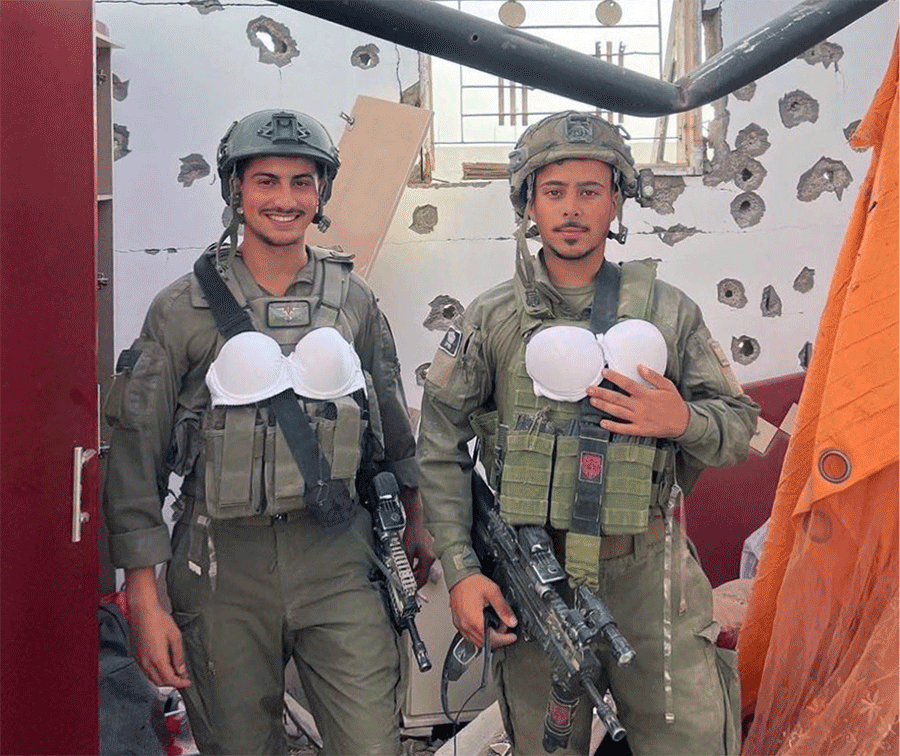
The war in Gaza is a quintessential example of a violent conflict where the micro-level solidarities are deeply integrated with the wider coercive-organizational and ideological structures. For one thing, the main armed forces of both sides, IDF and Hamas, are intensely embedded in the family and friendship networks of their societies. IDF is a conscript military composed of ordinary Israeli citizens who are required to complete the mandatory military service (thirty-two months for men and twenty-two months for women). In addition, all those who served in IDF under the age of forty are assigned for reserve duty. In this context, a shared military experience often fosters strong bonds of comradeship among former soldiers and their families that last for many years. In fact, it is a system that builds networks through which former army members get jobs and develop their social ties and prestige, but also those who were not serving the army, such as the Israeli Arabs, get automatically excluded from any governmental positions. Such strong and lasting social ties motivate many Israeli citizens to actively participate in wars. For example, after the Hamas attack on Israel on 7 October 2023, the IDF organized the largest military call-up in its history with more than 360,000 reservists being mobilized. According to the IDF, the recruitment cycle in 2024 showed a 120 per cent increase in overall enlistment compared to the same period in 2023. Notably, there was a twenty-eight per cent rise in the number of women joining combat roles.74 The women’s recruitment data for March and April was especially striking, showing that the artillery corps received 195 per cent of the female recruits that it had sought.75 The overwhelming majority of reservists answered this call, and many have travelled from abroad to join the military.76 Most reservists emphasized their moral duty to protect their families back home and to fight with their army friends in Gaza: “When we fight, I feel that I’m protecting my family, but ‘bottom line’ I look at the friend right beside me and I fight for him”; or “I jumped on the first plane I could, and I came here.77 It’s not easy to leave the family behind, especially because they are in the U.S., so it’s not easy. But I feel that it’s necessary.”78 Peer pressure to serve the army became more relevant and outspoken, with a clear understanding that refusing to do so places an extra burden on those who serve. The Hamas attack has also increased the social cohesion on the micro level across the Israeli society. The traditional deep divides between secular and the religious individuals have decreased because of the conflict, excepting the non-serving Orthodox Jews. For example, in a secular kibbutz attacked by Hamas fighters, the people have embraced the religious soldiers: “In walks a young soldier with a beard and peyot, his tzizit dangling from the sides of his pants, and the crowd gives out a roar of thanksgiving and appreciation. It is a scene that up to this point could never have been imagined – the kibbutz members hugging and crying and thanking this religious soldier for saving their lives. The soldier had never considered what the views of these people were. A Jew is a Jew! They are my brothers and sisters, and I will, if necessary, give up my life to protect and save them.”79
The Hamas kidnapping of Israeli hostages has further emphasized the significance of micro-level solidarities within the Israeli public space. The war in Gaza was often framed as a conflict centred on returning the daughters, sons, fathers, mothers, and grandparents of Israeli citizens. These familial images that were constantly reproduced in the mass media, social media, and many other outlets have tapped directly into the micro-emotional universe of everyday life. With the relatives of the hostages protesting regularly with the photographs of their loved ones, in an effort to personalize then and humanize them, the micro-world of deep inter-personal bonds was constantly intertwined with the wider ideological and organizational structures that sustain the war effort. Furthermore, the large-scale casualties generated by the Hamas attack on 7 October have also been framed through the prism of micro-level solidarities with the images of killed family members and small communities of people living together in kibbitzes near Gaza. Once the IDF war casualties increased, the images of fallen comrades galvanized support for continuous fighting among the IDF soldiers. These deep networks of micro-level solidarities provide legitimacy for the wider ideological project where the very existence of Palestinian state is depicted as an existential threat to all Israelis. In this context, the deployment of the massive coercive-organizational capacity of the IDF is framed as a struggle for survival. The systematic killings of thousands of Palestinian civilians together with the complete destruction of their cities, schools, universities, hospitals, mosques, and churches is justified as a defense of “our” mothers, fathers, sisters, daughters, brothers, or friends. In this way, the micro-level bonds underpin the war of organized callousness.
The envelopment of micro-level solidarities was just as strong on the Palestinian side. Hamas, Islamic Jihad, and other Palestinian military organizations are all composed of volunteers, most of whom have lost their family members and close friends in various conflicts with Israel. The military wing of Hamas, the Izz ad-Din al-Qassam Brigades, is a highly disciplined and hierarchical organization that fosters deep links of comradeship among its fighters. Its organizational structure with the small cells of four to five combatants, contributes towards development of strong micro-level bonds between its members. Although these cells are integrated into companies and battalions, they are led organically by local leaders and, as such, the cells are very cohesive with very loyal members.80 According to IDF sources, at the eve of 2023 Gaza war the Qassam Brigades had 30,000 combatants organized in five brigades, twenty-four battalions and one hundred and forty companies.81 According to a report by Amnesty International, since it gained power in Gaza in 2007, Hamas forces carried out brutal campaigns of abductions, torture, and unlawful killings against Palestinians accused of “collaborating” with Israel.82 This regime tightened even more during the Israeli military operation in Gaza since the 7 October attack.
In addition to its military and political wings, Hamas also operates a charitable social welfare division (dawah) which provides a variety of grassroot services including nurseries, schools, soup kitchens, orphanages, sport clubs, library services, and women activities. It also offers financial aid, medical assistance, and educational support.83 In this way, Hamas is deeply integrated in the everyday life of ordinary Palestinians in Gaza, which further helps Hamas build its loyalty networks among the civilians. Most Gazans have family members and close friends who work in one of the Hamas wings and even if they disagree with Hamas’s ideology or military strategy, they remain attached and loyal to their friends and family members.
The Hamas combatants regularly emphasize that they fight for their “Palestinian brothers and sisters” and for their own families and friends. In a recent interview with a Hamas soldier, he emphasized the centrality of brotherhood with his military comrades and their commitment to a shared fight against Israel: “If I die somebody else will take my place.”84 The Hamas fighters also regularly refer to the fact that seventy-five per cent of Gaza residents are refugees who have been expelled by the Israelis and as such have nowhere to go. The presence of over two million people within very small stretch of land (45 km) has also contributed to the development of very strong networks of micro-level solidarities. In such a densely populated place, much of everyday life operates through face-to-face interactions where people get to know each other well and where they often establish deep forms of comradeship. The residents of Gaza often emphasize their tight knit communities which have supported each other for years during the Israeli blockade. During these sixteen years, more than half of Gaza’s population lived in poverty and up to eighty per cent relied on humanitarian assistance. On top of this, nearly eighty per cent of the youth were unemployed.85 In such difficult living conditions, the networks of micro-level solidarities have sustained ordinary people. In the words of Youssef Salem from Gaza, who later lost 270 members of his extended family: “in Gaza, we’re all very close. We grow up together. We marry each other and we support each other.”86
The scale of destruction that has affected the population of Gaza in 2023 war has further intensified the micro-level solidarities of ordinary population. In an almost post-apocalyptic environment where over ninety-five percent of population, that is 1.9 million, has been internally displaced and where eighty-eight per cent live in makeshift shelters, ingroup solidarity becomes indispensable for everyday survival. With a very high death toll of 48,405 and at least 110,265 people with serious injuries, nearly every family in the Gaza strip has experienced a loss of a family member or a close friend.87 This huge loss of life is experienced through the prism of micro-level bonds. As Youssef Salem states: “these were my uncles, my cousins, my aunts, their children and grandchildren … A third of our extended family was wiped out.”88 These strong ties of micro-solidarity are the central ingredients of the coercive-organizational and ideological power of Hamas. In a rather similar way to the IDF, Hamas can tap into the micro-universe of the everyday life of ordinary people. Although the popularity of this para-military organization can wax and wane, the legitimacy of their ideological project is built through their promise to protect all Palestinians from the existential threat that Israel poses. While Hamas lacks the coercive-organizational and ideological structure of the IDF, it is still capable of successfully integrating these macro-level structures within the pouches of micro-level solidarities. Hence, they too can portray their struggle as a fight to preserve “our” brothers, sisters, and close friends and fight a callous war.
Conclusion
The ongoing war in Gaza has often been described either as a form of a new war or as an act of genocide. In this paper, we have tried to show that neither of these two frameworks adequately or fully captures the sociological trajectory of this conflict. We argue that, rather than being an exception, the war in Gaza represents a structural norm whereby the organized violence is becoming ever more brutal. By zooming in on the coercive-organizational, ideological, and micro-interactional processes that underpin this conflict, we aim to show that this is a war of organized callousness. With the ever-increasing expansion of destructive military capacity, the deeper ideological penetration of social order, and the envelopment of micro-level solidarities, contemporary warfare is becoming more detached, dehumanizing, dispassionate, destructive, and ultimately genocidal. In this context, war and genocide can become indistinguishable, and Gaza might be a reliable indicator for what many future violent conflicts could look like.
* Originally published in Journal of Genocide Research, 1–21.
Notes
1. We would like to thank the anonymous reviewers and Dirk Moses for their excellent comments on the early drafts of this paper.
2. Pablo Villar Bolanos, “Lawyers, Guns and AI: Gaza’s New Urban Warfare?,” The Security Distillery, 26 July 2024, https://thesecuritydistillery.org/all-articles/lawyers-guns-and-ai-gazas-new-urban-warfare.
3. Ezzat Ibrahim, “New Wars of Attrition,” AhramOnline, 7 May 2024, https://english.ahram.org.eg/NewsContentP/50/523216/AlAhram-Weekly/New-wars-of-attrition.aspx; Ehud Eilam, Israel’s New Wars: The Conflicts between Israel and Iran, Hezbollah and the Palestinians since the 1990s (New York: Peter Lang, 2024); New Lines Magazine, “How To End the Forever Wars — with Mary Kaldor and Lydia Wilson,” YouTube, 3 January 2025, https://www.youtube.com/watch?v=vZ7JEkmZAys.
4. Francesca Albanese, “Anatomy of a Genocide,” Report of the Special Rapporteur on the Situation of Human Rights in the Palestinian Territories Occupied since 1967, Human Rights Situation in Palestine and Other Occupied Arab Territories, Human Rights Council, 26 April 2024, https://www.un.org/unispal/document/anatomy-of-a-genocide-report-of-the-special-rapporteur-on-the-situation-of-human-rights-in-the-palestinian-territory-occupied-since-1967-to-human-rights-council-advance-unedited-version-a-hrc-55/.
5. Beyza Binnar Donmez, “‘Do Not Call It War, It Is a Genocide’ in Gaza, Says UN Rapporteur,” Anadolu Ajansı, 5 November 2024, https://www.aa.com.tr/en/middle-east/-do-not-call-it-war-it-is-a-genocide-in-gaza-says-un-rapporteur/3384799#.
6. Zehra Nur Duz, “Brazilian President Compares Gaza War to Holocaust,” Anadolu Ajansı, 19 February 2024, https://www.aa.com.tr/en/world/brazilian-president-compares-gaza-war-to-holocaust/3141295.
7. Michael Mann, The Dark Side of Democracy: Explaining Ethnic Cleansing (Cambridge: Cambridge University Press, 2004); Martin Shaw, War and Genocide: Organized Killing in Modern Society: Organised Killing in Modern Society (Cambridge: Polity, 2003); A. Dirk Moses, The Problems of Genocide: Permanent Security and the Language of Transgression (Cambridge: Cambridge University Press, 2021); A. Dirk Moses, “More Than Genocide,” Boston Review, 14 November 2023, https://www.bostonreview.net/articles/more-than-genocide/; A. Dirk Moses, “An Earlier Genocide Debate: Vietnam, International Law, and the Question of Gaza,” Law and Critique (in press).
8. Our focus is on large-scale modern warfare, as it is evident that many small wars still operate according to the traditional geopolitical logic.
9. This is not to deny the relevance of some major wars such as those in Korea (1950–53), Vietnam (1959–75), or Iran-Iraq (1980–88) which do not fit easily into these categories. Nevertheless, much of existing scholarship has focused on these four types of conflict. See Paul Chamberlin, The Cold War’s Killing Fields: Rethinking the Long Peace (New York: Harper Collins, 2018).
10. Mary Kaldor, New and Old Wars: Organized Violence in a Global Era (Stanford, CA: Stanford University Press, 2006); Mary Kaldor, “In Defence of New Wars,” Stability: International Journal of Security and Development 2, no. 1 (2013): 1–16, https://doi.org/10.5334/sta.at; Herfried Münkler, The New War (Cambridge: Polity, 2004).
11. Kaldor, New and Old Wars.
12. Zygmunt Bauman, “Wars of the Globalization Era,” European Journal of Social Theory 4, no. 1 (2001): 11–28; Zygmunt Bauman, Society Under Siege (Cambridge: Polity, 2002); Zygmunt Bauman, Liquid Times: Living in an Age of Uncertainty (Cambridge: Polity, 2006).
13. Elke Krahmann, “Privatization of Warfare,” in Routledge Handbook of the Future of Warfare (London: Routledge, 2023); Rupert Smith, The Utility of Force: The Art of War in the Modern World (London: Allen Lane, 2005); Shaw, War and Genocide; Frank Hoffman, “Hybrid Warfare and Challenges,” JFQ: Joint Force Quarterly 52, no. 1 (2009): 34–48; Chris Hables Gray, Postmodern War: The New Politics of Conflict (Hoboken, NJ: Routledge, 1997); Donald M. Snow, Uncivil Wars: International Security and the New Internal Conflicts (Boulder, CO: Lynne Rienner, 1996).
14. Barbara F. Walter, “The New New Civil Wars,” Annual Review of Political Science 20 (2017): 469–486.
15. Ibid.
16. Bauman, Society Under Siege, 88.
17. Bauman, “Wars of the Globalization Era,” 27.
18. Kaldor, New and Old Wars, 6.
19 Mats Berdal, “The ‘New Wars’ Thesis Revisited,” in The Changing Character of War, ed. Hew Strachan and Sibylle Scheipers (Oxford: Oxford University Press, 2011); Siniša Malešević, The Sociology of War and Violence (Cambridge: Cambridge University Press, 2010); Siniša Malešević, “The Sociology of New Wars? Assessing the Causes and Objectives of Contemporary Violent Conflicts,” International Political Sociology 2, no. 2 (2008): 97–112; Hew Strachan, Carl Von Clausewitz’s “On War” (London: Atlantic Books, 2007); Stathis N. Kalyvas, The Logic of Violence in Civil War (Cambridge: Cambridge University Press, 2006).
20. Obviously contemporary warfare includes a variety of very different conflicts in terms of size, duration, and the level of destruction. However, our analytical focus is on the major modern wars. As sociologists, we are interested in identifying the general patterns in the relationship between warfare and society. This is not to minimise the different historical experiences of individual wars.
21. Siniša Malešević, “Is War Becoming Obsolete? A Sociological Analysis,” The Sociological Review 62, no. 2 (2024): 65–86.
22. Michael Mann, On Wars (New Haven, CT: Yale University Press, 2023); Michael Mann, “Have Wars and Violence Declined?,” Theory and Society 47, no. 1 (2018): 37–60; Siniša Malešević, Why Humans Fight: The Social Dynamics of Close-Range Violence (New York: Cambridge University Press, 2022); Siniša Malešević, The Rise of Organised Brutality: A Historical Sociology of Violence (Cambridge: Cambridge University Press, 2017); Philip Dwyer and Mark Stephen Micale, eds., On Violence in History (New York and Oxford: Berghahn Books, 2020).
23 Malešević, The Rise of Organised Brutality; Malešević, Why Humans Fight; Mann, On Wars; Charles Tilly, Coercion, Capital, and European States, AD 990–1992 (Cambridge, MA: Blackwell, 1992); Anthony Giddens, The Nation-State and Violence: Volume Two of A Contemporary Critique of Historical Materialism: 2 (Cambridge: Polity, 1986).
24. Malešević, The Rise of Organised Brutality; Malešević, Why Humans Fight.
25. Siniša Malešević, Grounded Nationalisms: A Sociological Analysis (Cambridge: Cambridge University Press, 2019); Sinisa Malesevic, Nation-States and Nationalisms: Organization, Ideology and Solidarity (Cambridge: Polity, 2013).
26. Correct for 4 March 2025, see: United Nations Office for the Coordination of Humanitarian Affairs, “Reported impact snapshot | Gaza Strip (4 March 2025),” https://www.ochaopt.org/content/reported-impact-snapshot-gaza-strip-4-march-2025; AJLabs, “The Human Toll of Israel’s War on Gaza – by the Numbers,” Al Jazeera, 15 January 2025, https://www.aljazeera.com/news/2025/1/15/the-human-toll-of-israels-war-on-gaza-by-the-numbers#:~:text=In%20the%20past%2015%20months,number%20killed%20is%20far%20higher.
27. Majd Abuamer, “Gaza’s Subterranean Warfare: Palestinian Resistance Tunnels vs. Israel’s Military Strategy,” Studies in Conflict & Terrorism (19 April 2024): 1–26; Eilam, Israel’s New Wars; Jim Petrila, “Conflict in Gaza: The Law of War and Irregular Warfare in Urban Terrain,” Foreign Political Research Institute, 5 March 2024, https://www.fpri.org/article/2024/03/conflict-in-gaza-the-law-of-war-and-irregular-warfare-in-urban-terrain/; Mat Nashed, “Is Israel Committing ‘Ethnic Cleansing’ in Gaza?,” Aljazeera, 13 November 2024; Marshall Poe, “History Shows Israel May Never Win a ‘War of Occupation’,” Responsible Statecraft, 19 December 2023, https://responsiblestatecraft.org/israel-gaza-war-occupation/.
28. Amos Goldberg, “The Problematic Return of Intent,” Journal of Genocide Research (15 October 2024): 1–10, https://doi.org/10.1080/14623528.2024.2413175; Ernesto Verdeja, “The Gaza Genocide in Five Crises,” Journal of Genocide Research (20 January 2025): 1–23, https://doi.org/10.1080/14623528.2025.2452707; Martin Shaw, “Inescapably Genocidal,” Journal of Genocide Research (3 January 2024): 1–5, https://doi.org/10.1080/14623528.2023.2300555; Nimer Sultany, “A Threshold Crossed: On Genocidal Intent and the Duty to Prevent Genocide in Palestine,” Journal of Genocide Research (9 May 2024): 1–26, https://doi.org/10.1080/14623528.2024.2351261; Tamir Sorek, “Mainstreaming a Genocidal Imagination in Israeli Society: Settler-Colonialism, Settler Anxiety, and Biblical Cues,” Journal of Genocide Research (6 February 2025): 1–24, https://doi.org/10.1080/14623528.2025.2456321; Camilla Boisen, “Israel’s Punitive War on Palestinians in Gaza,” Journal of Genocide Research (26 September 2024): 1–22, https://doi.org/10.1080/14623528.2024.2406098; Jessica Whyte, “A ‘Tragic Humanitarian Crisis’: Israel’s Weaponization of Starvation and the Question of Intent,” Journal of Genocide Research (17 April 2024): 1–15, https://doi.org/10.1080/14623528.2024.2339637; Melanie S. Tanielian, “The Silent Slow Killer of Famine: Humanitarian Management and Permanent Security,” Journal of Genocide Research (5 February 2024): 1–9, https://doi.org/10.1080/14623528.2024.2310866; Shmuel Lederman, “Gaza as a Laboratory 2.0,” Journal of Genocide Research (29 January 2024): 1–6, https://doi.org/10.1080/14623528.2024.2309706; Elyse Semerdjian, “A World Without Civilians,” Journal of Genocide Research (24 January 2024): 1–6, https://doi.org/10.1080/14623528.2024.2306714; Mark Levene, “Gaza 2023: Words Matter, Lives Matter More,” Journal of Genocide Research (21 January 2024): 1–7, https://doi.org/10.1080/14623528.2024.2301866.
29. Malešević, The Rise of Organised Brutality, 143.
30. Obviously, this is not to say that Palestinians in the West Bank do not experience almost daily abuse and irregular killings by the Israeli settlers and IDF. The recent ceasefire agreement was used to initiate more aggressive military operation in Jenin, destroying multiple buildings and triggering mass displacement. See Al Jazeera, “49th Day of Conflict: Ongoing Israeli Attacks on Jenin Leave Devastation and Mass Displacement,” Human Rights & Public Liberties, 10 March 2025, https://liberties.aljazeera.com/en/49th-day-of-conflict-ongoing-israeli-attacks-on-jenin-leave-devastation-and-mass-displacement/.
31. Elizabeth Samson, “Introduction, Is Gaza Occupied?: Redefining the Legal Status of Gaza,” Begin-Sadat Center for Strategic Studies (1 January 2010): 1–4, https://www.jstor.org/stable/resrep04760.3; Yuval Shany, “Faraway, So Close: The Legal Status Of Gaza After Israel’s Disengagement,” Yearbook of International Humanitarian Law 8 (2005): 369–383, https://doi.org/10.1017/S1389135905003697; Yuval Shany, “Binary Law Meets Complex Reality: The Occupation of Gaza Debate,” Israel Law Review 41, nos. 1–2 (2008): 68–86.
32. Tal Schneider, “For Years, Netanyahu Propped up Hamas. Now It’s Blown up in Our Faces,” The Times of Israel, 8 October 2023, https://www.timesofisrael.com/for-years-netanyahu-propped-up-hamas-now-its-blown-up-in-our-faces/; Ronen Bergman, Mark Mazzetti, and Maria Abi-Habib, “How Years of Israeli Failures on Hamas Led to a Devastating Attack,” New York Times, 1 November 2023, https://www.nytimes.com/2023/10/29/world/middleeast/israel-intelligence-hamas-attack.html.
33. Mark Mazzetti and Ronen Bergman, “‘Buying Quiet’: Inside the Israeli Plan That Propped Up Hamas,” New York Times, 10 December 2023.
34. With the vaguely articulated plans of the new US administration for the complete takeover of Gaza, this issue seems even less clear.
35. Albanese, “Anatomy of a Genocide”; Nashed, “Is Israel Committing ‘Ethnic Cleansing’ in Gaza?”; Mohammed Nijim, “Genocide in Palestine: Gaza as a Case Study,” International Journal of Human Rights 27, no. 1 (2023): 165–200.
36. Mann, On Wars; Mann, The Dark Side of Democracy; Shaw, War and Genocide.
37. Mann, On Wars; Randall Collins, Violence: A Micro-Sociological Theory (Greenwood Publishing Group, 2009); Randall Collins, “Three Faces of Cruelty: Towards a Comparative Sociology of Violence,” Theory and Society 1, no. 4 (1974): 415–440; Zygmunt Bauman, Modernity and the Holocaust (Cambridge: Polity, 1989).
38. Collins, “Three Faces of Cruelty.”
39. This is not to say that performative acts of violence have completely disappeared. They are still present, but an overwhelming majority of human casualties in modern wars are generated through depersonalised and detached violence.
40. Randall Collins, “Three Faces of Cruelty: Towards a Comparative Sociology of Violence,” Theory and Society 1, no. 4 (1974): 415–440.
41. International Labour Organization (ILOSTAT), https://ilostat.ilo.org/data/country-profiles/.
42. “What to Know About Israel’s Military Strength,” Axios, 21 October 2023, https://www.axios.com/2023/10/21/israel-military-capabilities-explained.
43. “Explainer: The Dahiya Doctrine & Israel’s Use of Disproportionate Force,” Institute for Middle East Understanding, 31 July 2024, https://imeu.org/article/the-dahiya-doctrine-and-israels-use-of-disproportionate-force.
44. “Israel Tallies a Year of Gaza War: 40,000 Targets Bombed, 4,700 Tunnels Hit,” Reuters, 7 October 2024, https://www.reuters.com/world/middle-east/one-year-war-israel-strikes-40000-hamas-targets-gaza-2024-10-07/.
45. Robert A. Pape, “Hamas Is Winning,” Foreign Affairs, 21 June 2024.
46. Evan Dyer, “Israel’s Gaza Bombing Campaign Is the Most Destructive of This Century, Analysts Say,” CBC, 30 December 2023, https://www.cbc.ca/news/politics/israel-gaza-bombing-hamas-civilian-casualties-1.7068647.
47. Ibid.
48. Elisabeth Dwoskin, “Israel Built an ‘AI Factory’ for War. It Unleashed It in Gaza,” Washington Post, 29 December 2024.
49. Ibid.
50. Ibid.
51. The Times of Israel, “38 Children Were Killed, 20 Orphaned on October 7: ‘The State Did Not Pass the Test of Protecting Them’,” Times of Israel, 3 March 2024.
52. The Israeli Defence Forces, “Our Mission,” https://www.idf.il/en/mini-sites/our-mission-our-values/, accessed 14 March 2025.
53. Alon Helled, Israel’s National Historiography: Between Generations, Identity and State (London: Palgrave Macmillan, 2024); Uri Ram, Israeli Nationalism: Social Conflicts and the Politics of Knowledge (London: Routledge, 2010).
54. Helled, Israel’s National Historiography; Ram, Israeli Nationalism.
55. Eric Cortellessa and Vera Bergengruen, “Inside the Israel-Hamas Information War,” Time, 22 December 2023.
56 “Israeli Officials’ Statements on Gaza: Dehumanization and War Crimes Against Palestinians,” Arab Center Washington DC, 30 November 2023, https://arabcenterdc.org/resource/israeli-official-statements-on-gaza-dehumanization-and-war-crimes-against-palestinians/.
57. Tia Goldenberg, “Harsh Israeli Rhetoric against Palestinians Becomes Central to South Africas Genocide Case,” AP News, 18 January 2024, https://apnews.com/article/israel-palestinians-south-africa-genocide-hate-speech-97a9e4a84a3a6bebeddfb80f8a030724.
58. ACW, “Israeli Officials’ Statements on Gaza.”
59. Sheera Frenkel, “Israel Secretly Targets U.S. Lawmakers With Influence Campaign on Gaza War,” New York Times, 5 June 2024.
60. Derek Johnson, “Israeli Influence Operation Highlights Global Disinformation Industry,” CyberScoop, 5 June 2024, https://cyberscoop.com/israel-influence-operations-stoic/.
61. Naomi Klein, “How Israel Has Made Trauma a Weapon of War,” The Guardian, 5 October 2024, https://www.theguardian.com/us-news/ng-interactive/2024/oct/05/israel-gaza-october-7-memorials.
62 Rogel Alpher, “For Israel’s Banal Media, Hostages Being Released Is Reality TV,” Haaretz, 18 February 2025.
63. Felix Tamsut, “Israel since October 7: From Solidarity to Deep Divisions,” DW, 6 October 2024, https://www.dw.com/en/israel-since-october-7-from-solidarity-to-deep-divisions/a-70305588.
64. Aaron Snyder, “The Solidarity Mission: Inside Israel’s New Tourist Industry,” Times of Israel, 24 April 2024; Klein, “How Israel Has Made Trauma a Weapon of War.”; Lea David, A Victim’s Shoe, a Broken Watch, and Marbles: Desire Objects and Human Rights (New York: Columbia University Press, 2025).
65. Stephanie van den Berg, “Israel Is Waging War of Revenge on Gaza, Palestinian Minister Says Reuters,” Reuters, 26 October 2023, https://www.reuters.com/world/europe/israel-is-waging-war-revenge-gaza-palestinian-minister-says-2023-10-26/; Gina Abercrombie-Winstanley, “For Israel’s War in Gaza, Vengeance Is a Downward Spiral,” Atlantic Council, 5 April 2024, https://www.atlanticcouncil.org/blogs/new-atlanticist/for-israels-war-in-gaza-vengeance-is-a-downward-spiral/; Mark O’Connell and Rashid Khalidi, “Israel’s Revenge: An Interview with Rashid Khalidi,” New York Review of Books, 19 December 2024.
66. Zein Khalil, “Israeli Government Chose Revenge, Not Hostages: Ex-Mossad Chief,” Anadolu Ajansi, 22 September 2024, https://www.aa.com.tr/en/middle-east/israeli-government-chose-revenge-not-hostages-ex-mossad-chief/3337376; Jon Haworth, Morgan Winsor, and Nadine El-Bawab, “Netanyahu Vows ‘Revenge’ after Israel Says Hamas Sent Back Wrong Body for Shiri Bibas,” ABC News, 21 February 2025, https://abcnews.go.com/International/netanyahu-vows-revenge-after-israel-accuses-hamas-sending/story?id=119033790.
67. Emerson Brooking, Layla Mashkoor, and Jacqueline Malaret, “How Social Media Platforms Shaped Our Initial Understanding of the Israel-Hamas Conflict,” DFR Lab, Distortion by Design, 21 December 2023, https://view.atlanticcouncil.org/social-media-gaza.
68. Ibid; Caitlin Chin-Rothmann, “Social Media Platforms Were Not Ready for Hamas Misinformation,” Center for Strategic and International Studies, 12 October 2023, https://www.csis.org/analysis/social-media-platforms-were-not-ready-hamas-misinformation.
69. Khaled Hroub, “A Newer Hamas? The Revised Charter,” Journal of Palestine Studies 46, no. 4 (2017): 100–111.
70. Ibid.
71. Al-Qassam, “Ezzedeen Al-Qassam Brigades – About Us,” http://www.qassam.ps/aboutus.html, 11 November 2014; https://web.archive.org/web/20141111223719/http://www.qassam.ps/aboutus.html. accessed 15 March 2025.
72. Hroub, “A Newer Hamas?”; However, it is important to state that Hamas never repudiated the original charter and many key issues have been defined in a very vague way.
73. They were both biased, not so much in terms what they were broadcasting, but what they were choosing to omit; Linda Gradstein, “Al Jazeera Only Reports the Arab Side of the Gaza War – Comment,” Jerusalem Post, 9 March 2024.
74. Yoav Zitun, “More Recruits Enlisting in Combat Units, IDF Figures Show,” Ynetnews, 16 December 2024, https://www.ynetnews.com/article/sjp0wiavkg.
75. Seth Frantzman, “IDF Combat Unit Recruitment Attracts Record Number of Israeli Men and Women,” FDD’s Long War Journal, 2 May 2024, https://www.longwarjournal.org/archives/2024/05/idf-combat-unit-recruitment-attracts-record-number-of-israeli-men-and-women.php.
76. Caitlin Burke, “From Civilian Life to War: Hundreds of Thousands of Israeli Reservists Answer Call to Fight,” CBN, 13 October 2023, https://cbn.com/news/israel/civilian-life-war-hundreds-thousands-israeli-reservists-answer-call-fight.
77. Israel Defense Forces, “Israel Defense Forces’ Post,” Facebook, 19 March 2024.
78. Burke, “From Civilian Life to War.”
79. Rabbi Mordechai Weiss, “MiK’Amcha Yisrael – Who Is Like Our People, Israel?,” Jewish Press, 2 November 2023, https://www.jewishpress.com/judaism/torah/mi-kamcha-yisrael-who-is-like-our-people-israel/2023/11/02/. accessed 25 March 2025.
80. Lihi Ben Shitrit, Righteous Transgressions: Women’s Activism on the Israeli and Palestinian Religious Right (Oxford: Princeton University Press, 2015).
81. Emanuel Fabian, “Gallant: Hamas Has Lost Control in Gaza; Gunmen Who Fired from Hospital Entrance Killed,” Times Of Israel, 13 November 2023.
82. Amnesty International, “Gaza: Palestinians Tortured, Summarily Killed by Hamas Forces during 2014 Conflict,” Amnesty International, 27 May 2015, https://www.amnesty.org/en/latest/news/2015/05/gaza-palestinians-tortured-summarily-killed-by-hamas-forces-during-2014-conflict/.
83. Richard Davis, Hamas, Popular Support and War in the Middle East: Insurgency in the Holy Land (London: Routledge, 2016).
84. Debora Patta, “Behind the Scenes of CBS News: Interview with a Hamas Commander in the West Bank,” CBS News, 15 February 2024, https://www.cbsnews.com/news/cbs-news-interview-hamas-commander-west-bank-jenin-behind-the-scenes/.
85. Stephane Dujarric, “Fifteen Years of the Blockade of the Gaza Strip,” UNICEF, 3 July 2022. https://www.unicef.org/mena/press-releases/fifteen-years-blockade-gaza-strip.
86 Ghazal Golshiri and Clothide Mraffko, “In the Gaza Strip, Four Generations Wiped out in Seconds,” Lemonde.Fr, 11 October 2024, https://www.lemonde.fr/en/international/article/2024/10/11/in-the-gaza-strip-four-generations-wiped-out-in-seconds_6729106_4.html.
87. AJLabs.
88. Golshiri and Mraffko, “In the Gaza Strip, Four Generations Wiped out in Seconds.”