1. To Sort
I find myself at a furniture factory, in the seaming department, surrounded by the pneumatic humming of sewing machines. All around me, industrious hands are swift in joining odd parcels of hide, textiles and other soft surfaces according to flat templates. Although the individual steps they carry out are familiar to me, here the whole process of stitching is integrated into a single, automated motion. The same needle that punctures the fabric also carries the thread for the seam, uniting disparate fragments with agility.
The speed of the industrial ensemble minifies the effectiveness of my workshop, where I sew each seam by hand. Yet I do not understand these two realms as inherently opposed. At this precise moment, evidence of their congruity lies just before me. While handling pre-cut patterns with dexterity, a pair of busy hands deploys a repertoire of techniques in quick succession. Fingertips delicately realign overlapping hides as the sewing direction changes, while pedals controlled by feet modulate the speed of the process. In the presence of this intricate spectacle, it would be naive to assume that the automation of labour granted by the factory is synonymous with the loss of skill. The human who orchestrates the movement of these machines must be as accurate as the alternating needles are fast.
It may be argued that the main difference between craft and industry lies not in skill, but in the standard. The essential distinction between these two spheres of material production is to be found in the possibility for mechanical reproducibility, which is afforded by the machine. While the assembly line can repeat the same output every time, the workshop cannot, or will not. This may be partly true. Handmade things tend to be diverse, whereas mass-produced ones are usually identical. My intent in dismantling this stereotype is not to endorse the precision of the hand, but to point to the possibility of corrupting the machine with our inescapable humanity. Even if the condition of standardization in the assembly line seems like a structural consequence of industrialization, it need not be taken as its inevitable fate. Disputing this paradigm leads to the central question of this enterprise: could the forms coming from the factory floor be tailored according to an artisan’s intuition?
My material of choice is leather. Because this matter grows from the flesh of living beings, it embodies particularities that manifest as varieties in thickness, stretch patterns and surface imperfections. To an industrial mindset, these characteristics might be seen as noise; in an artisanal setting, such traits can be approached as information. Out of principle, I deliberately work with scraps, which are rejected parts from bigger chains of production. These pieces are mostly small odd ends, which come into my workshop in unpredictable shapes. In this originary difference lies an untackled potential for individuation. Unlike standardized supplies, the irregularity of refused offcuts suggests an operationality aimed towards the diversification of results. This is the premise from which a scrap theory of form begins to take shape.I came to the factory today to follow the execution of a prototype. Cristina will help me do that, for industrial sewing machines are something foreign to me. In our exchange, her experience is quick to anticipate solutions before I am able to articulate the problems ahead of us. Between us, there is a pile of numbered, odd shapes, cut from production scraps. She begins by folding surfaces in half and making a small dent with her scissors, orienting herself while steadily sewing the irregular pieces. “Usually the cutting machine does that,” she remarks, but here we are on unfamiliar ground. Whenever she stops to situate herself amid half-assembled work, I am able to catch up with the pace at which things move in this setting.The contrast between my workshop and the factory floor is immediate, but not absolute. As embodied by Cristina’s hands, the difference is not so much a matter of skill, but concerns the way in which skill is organized. In this industrial facility, gestures are calibrated to the rhythm of machines fed by a constant chain of homogeneous materials. In the workshop, my grasp must remain adjustable to the contingencies of raw matter. This operational distinction has one important consequence: even when the same techniques are employed in both contexts, the change in method becomes apparent in the result. Because the machine cannot interpret the singularities of the supplies that pass through it, these must undergo a prior transformation in order to become predictable. To be incorporated by the industrial process, the variable character of natural resources must first be reduced to uniformity.
When I first visited this factory, I was drawn to a cardboard box lying by the cutting machine. The purpose of this container is to collect pieces of hide which are regarded as unsuitable for production. Rejection at this early stage is usually due to the fact that pieces are too uneven, not big enough or bear surface imperfections. The scraps collected here come straight out of the cutting machine, which begins each run by scanning the hide in order to optimize the extraction of regular shapes from its organic geometry. Whatever material remains after the cutting is done is deemed useless. Every so often, the box is packaged and leaves the factory full of discarded hides. As I went through its forsaken contents and examined the peculiar shape of the offcuts, an intuition took hold: what if the randomness that generated these odd pieces were adopted as the foundation for an iterative design practice?
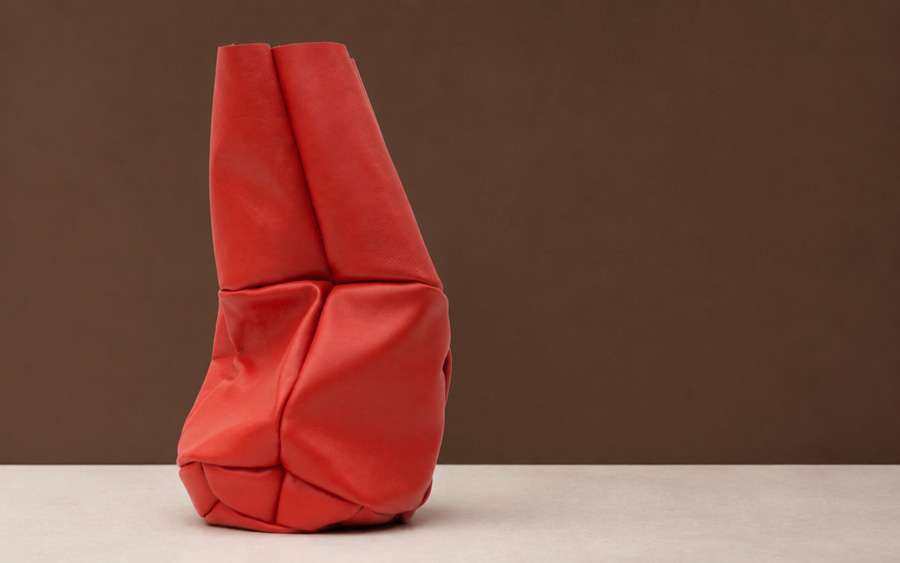
A few months later, here I am again, working with Cristina on fragments from that same pile of scraps. Since the pieces she is now sewing were designed after the shape of offcuts, their forms are purposefully irregular. At first, she takes time to familiarize herself with the crooked logic of these fragments, but soon gets the hang of their changing shapes. As she stitches through surfaces of different sizes, the finished pieces begin to cluster on a table nearby. Although they just came out of an industrial sewing machine, these vase-like objects feel out of place, as if they don’t belong here. Their objecthood is not ruled by uniform dimensions, like other factory-made things around them, but is defined by subtle differences in anatomy. Their forms are tilted and distorted in ways that feel voluntary, and each artifact seems adjusted to the specific conditions of its own making.
As I look at the loose group of objects gathered on the table, I have the impression that they are trying to communicate something. Why does it feel like their message is both new and old? While watching Cristina’s hands move steadily behind them, the insight sharpens: what I am trying to grasp by attending to their diversity is something artisans have always known, but rarely articulated beyond practice. Not so much a doctrine, but a disposition. The singularity of each iteration attests to a tacit agreement between maker and matter. In this process of reciprocity, form is not achieved by the obstinate imposition of an idea, but disclosed through a relation that gradually reveals what the material affords.
One after another, different pieces come out from Cristina’s sewing machine. As I bear witness to their diversity, I begin to come to grips with what it means to couple craft with industry. What lies before us is the result of a sustained exchange between the workshop and the factory floor. Throughout this movement, thinking must try to keep pace with making, and vice versa. I am well aware that in attempting to recount this process something of that experience will inevitably be displaced, for what is held in the hands resists full articulation by words. Yet it is precisely in this gap, between theory and practice, that another kind of understanding may emerge. And so we begin, committing to the process of making, one step at a time.
2. To Cut
I am standing in my workshop, materials and tools arranged before me, ready to start a day of labour. In deciding what to make, I do not deceive myself. Whatever may emerge here is not solely determined by me, but ultimately hinges on the things I have at hand: skills, tools, materials and time. Before work ever begins, I engage in an imaginary conversation with the matter in front of me, as I silently ask it: what forms may you hold? And how can the traits you already possess be informed by the tools I can handle?
As a participant in secular modernity, I do not expect an answer to my questions (not one that would be semantically articulated anyway). But I do expect something out of asking, and I usually get a response by animating the matter in front of me by manipulating it. In discovering material affordances, the hand is sharper than the head.
With blade in hand, the first action in transforming raw matter into artifice is to partition it into workable sizes. A tangible sign of this necessity lies on the workbench before me, in a pile of irregular hide scraps. Before these pieces arrived in my workshop, they were subject to a long chain of operations. From collecting the animal’s skin and tanning it, to moving it to the factory, until it was eventually rejected for not fitting standards, every step in the transformation of this material has left a trace on it. This is evident in the odd hole through the hide, the sinuous silhouette and the variations in grain direction, but also in the uneven cuts and voids left by previous handling. All of these vestiges make each piece something specific. Interpreting these marks leads me to the conclusion that what is usually called raw matter is never really unformed, but already indexed by the processes of extraction that brought it into being. How might the features that inevitably characterize scraps inform the process of working with them?
As the cold metal edge slices through the surface of the hide, I wonder about how to dissect what is happening before my eyes while I take part in the splitting event. Philosopher Manuel de Landa is surgical in noting that this kind of occasion “[…] is always double, to cut–to be cut, because a capacity to affect must always be coupled with a capacity to be affected […].” [1] In order to cut, a blade must encounter a material which can be cut by it. If this observation seems tautological at first, it is because Western metaphysics effectively disguised the symmetrical character of technical mediations by conceptualizing them under the subject/object opposition. Within this schema, the activity of the former always exercises agency over the passivity of the latter: humans impose their wills on materials.
Over the last three centuries, however, industrialization gradually disrupted the linearity of this narrative. The growing autonomy of machines slowly unsettled the idea of unilateral mediation, as different mechanisms became protagonists in the unfolding of technical processes. Back at the factory, signs of a redistributed relation between human and non-human appear at the first stages of production, in the cutting department. As a laser scan runs through the surface of a flattened hide before slicing it into multiple pieces, its program identifies the most suitable organization for sectioning the material. Although a person is in charge of setting the parameters, the skill they mobilize is altogether different from what I am used to when cutting hides by hand. The operator’s know-how does not concern direct material engagement, but the calibration of a digital interface that coordinates physical actions. A human is responsible for overseeing the operation, but is not directly involved with the cutting itself.
This ordinary episode in the industrial routine helps establish an important distinction between the factory and the workshop. For a long time, the decision of where to cut a hide could be attributed to the individual carrying out the operation, as they were in charge of both deciding and acting. To exercise such a task, one first had to learn the trade from first-hand experience. In the words of scholar Stephan Epstein, “the technical knowledge of premodern craftsmen and engineers was largely experience-based. Thus, practically all premodern technical knowledge was, and had to be transferred in the flesh.” [2] Despite the use of an array of tools, no technical mediation could take place in the absence of a person prior to the industrial revolution.
This changed as production became mechanized. The automation of labour meant that production no longer relied on the human body as the primary locus of knowledge, as know-how became progressively lodged in machines. If the displacement of people from material processes alleviated dangerous or burdensome tasks, it also deskilled workers and redistributed expertise, partly embedding it in the industrial apparatus. As empirical knowledge was transferred to inorganic components, its holding by people became concentrated on a few specialists, in this case, Alex.
When Alex unrolls pieces of hide onto the cutting surface, he does not need to understand the internal workings of the machine he runs. He needs to know enough to keep it going, or to call for a technician if something goes wrong. This renders the machine into what philosophy refers to as a black box: a device in which one knows what goes in and what comes out, without grasping the intermediate processes.
During prototyping, when we realized that a few CAD files were missing from the system, Alex could not insert them into the computer himself. This task belonged to another role within the production chain, someone who happened to be absent that day. Yet, having worked at this factory before the arrival of computerized cutting, Alex was able to assist me in trimming the missing pieces by hand. As an exception to the rule, this outmoded technique revealed what is today a residual condition in the industrialized world: individual knowledge, once spanning the whole process of production, becomes segmented with the mechanization of labour. As machines are developed to carry out material processes, their operation requires a particular knowledge that renders specific steps of assembly differentially accessible. Tied to the alienation of labour, this process is nothing new. According to craft theorist Glenn Adamson,
By the nineteenth century, it had become common wisdom that (in the words of an industrial historian) “the slow and laborious process of making things by hand” was gradually superseded by an efficient and automatic “copying principle” in which the forms of (mass) production were more and more “contained within the machine itself.” As a result, “for the first time, ‘technique’ was formulated as something that could operate on its own, independently from the work of human hands.” [3]
As Adamson argues, this shift marks the emergence of a new condition of self-reflexivity in making. It was only once technical mediations could be carried out independently of the hand that handwork could be acknowledged as a modality in its own right. Paradoxically, artisanship depended on the advent of industry in order to be recognized. Although craft may historically precede industrialization, it could only become legible as a distinct category once factory production established itself as its counterpart. Rather than implying substitution, this framing allows both modes to be understood as coexisting regimes of technical mediation, making possible their articulation and even convergence across different contexts of production.
When Alex switches from machinework to handwork, he begins by tracing the edges of a pattern with a dermograph, creating a visible line to serve as a guide for his scissors. As he manually cuts the hide, his previously unannounced skill becomes invaluable, not only for the pieces he trims, but for the way his gesture reframes the problem at hand. Seen from the breach cut open by Alex, craft appears as one of the last sites where knowledge of an entire process can still be held together. By watching him partition material, this much becomes evident: the coupling of making and knowing can only be fully expressed through work.
The obstacle posed by the machine that morning, which would not accept the latest set of computer drawings, made clear that the know-how often associated with craft does not constitute an alternative to industry, but it does lay bare a tension internal to the paradigm of standardization itself. The more a system is optimized for repetition, the less equipped it becomes to handle what deviates from the norm. The demands of regular output lead to an inability to register situations that fall outside pre-assigned protocols. When something breaks or does not work properly, the whole process comes to a halt. In our case, the solution proved to be low-tech: scissors and x-acto knives when the computer became overwhelmed by the diversity of pieces to be cut. The question that follows this anecdotal episode is how might a broader understanding of the singular actions undertaken in the assembly line find its way back into a system structurally oriented toward repetition? Answering this depends on identifying how the specificity of empirical knowledge might operate within the industrial regime without being neutralized by it.
In searching for an answer, I begin by cutting together with Alex from what has already been cut. Persistently adopted in this process, the offcut matters not only as a means of reducing waste, but as the negative imprint of standardization. Its irregular form results from the extraction of predictable pieces, turning raw matter into a byproduct of the industrial process. To reappropriate the hide scrap is therefore to work both within and against the logic that produced it in the first place. The end goal behind this exercise is not to invent new forms, but to enact a new form of working, which, if novel at all, is so only in this context. For industry, adapting form to available materials may appear as an innovation; in craft, scrap theory is a long established practice.
3. To Fold
Leather is a pliable material that may be twisted in different directions in order to acquire spatiality. When I fold the hide, I do not expect it to curve in the same way every time. Each piece of skin has a particular thickness and stiffness, which informs how tight a pleat can be. Because I anticipate this uncertainty, the artifacts I make can sustain a degree of variability. Rather than imprecision, I acknowledge this tolerance as a generative feature.
This understanding did not emerge from a detached reflection, but began with the challenge of structuring soft, irregular fragments. While working with offcuts, I realized that folding allowed pieces to resist the tendency of collapsing under their own weight. Small as they were, their capacity to hold form depended on how seams were turned at their edges, creating a point where material doubled back onto itself. This organization of structure is most effective at the seams, where different scraps are joined together.
As it turned out, the irregularity that rendered these hides unusable within the logic of the assembly line became precisely what made them operative within the space of the workshop. With this new approach, the question was no longer how to correct deviations, but how to articulate them into their own kind of architecture.
Incorporating heterogeneous materials into the design process means relinquishing the possibility of fully prefiguring outcomes. Within this procedure, what gets made is dependent on what is available, and the path toward a finished artifact remains open until the moment of its resolution. This sits uneasily within mass production, where design is typically concluded well before fabrication begins. By countering the ideal of a fixed and predetermined result, this method reclaims the principles of craftsmanship without succumbing to a nostalgia for outmoded techniques. It allows for a responsive framework of making, brought into being by contemporary means of production. At the same time, this process points to something that the contemporary industrial complex has largely yet to reckon with: how to meet materials on their own terms.
The tendency to frame any departure from a pre-assigned plan as a mistake is largely a byproduct of mechanized modernity. The obsession with precision, instantiated by the assembly line, arises from the need for exchangeability between parts. As historian Lewis Mumford observed, [4] the standard first arose as a civil technology in the printing press, where interchangeable typesets required strict dimensional consistency in order to be rearranged into different compositions of text. Standardization later extended to other domains of production, particularly where maintenance and repair depended on the uniformity of components. In such contexts, variation becomes something to be suppressed altogether.
Notwithstanding standardization, which ultimately is a constraint imposed by humans in order to better articulate production, there are structural conditions which work as forces of homogenization in mechanized technologies. Such a tendency can be observed in the evolution of technical objects as described by philosopher Gilbert Simondon. In his On the Mode of Existence of Technical Objects, [5] Simondon develops a theory of mechanology based on the concept of overdetermination, which helps explain why technical lineages tend toward decreasing variability. In a highly integrated technical ensemble, each part must respond to multiple solicitations simultaneously. Because parts are increasingly embedded within larger systems, their possible manifestations become more restricted. As the chain of causality intensifies, technical parts become more “concrete”, meaning that their form becomes tightly defined by the demands of systemic performance. Concreteness, for Simondon, means that the function of a part is inseparable from its integration into a coherent whole, whose internal resonance specifies its conditions of possibility.
Simondon’s account captures the sophistication of modern technical objects with considerable precision. Yet his framework tends to privilege overdetermination as the direction of technical maturity, such that concreteness comes to function as an implicit goal. Concreteness, in his framing, seems to represent an ideal state of technical evolution, as if the more integrated a system becomes, the more fully realized it appears. This emphasis, while illuminating for the analysis of industrial machinery, leaves the ontological richness of less determined technical objects underexplored. Historically, abstraction precedes concreteness chronologically, but this sequence need not be read as an evolution in the teleological sense. The looseness characteristic of abstract technical objects allows for an individuating nature that is different from (but not lesser than) that found in more concrete, overdetermined ones.
Although Simondon refers to craftsmanship in several of his texts, he does so only in passing, using it to clarify modern techniques by contrast. This omission leaves open a field that his own conceptual apparatus is well equipped to address. While Simondon describes the overdetermined character of technical concretization, he does not account for the analogous processuality at work in craftsmanship. Following his terminology, this might be understood as underdetermined concretization: a mode in which form is not thoroughly specified in advance, but arrives through a progressive negotiation between operative principles and the particularities of available matter. Where overdetermination tightens the relation between part and system until little variation is possible, underdetermined concretization holds that relation open, allowing the specific character of each material encounter to leave its mark on the result.
In contrast to the assembly line, craft operates through procedures that remain flexible in their application. Though structured and technique-bound, these operations cannot be fully anticipated, as they depend on the specificities of the material at hand. Techniques must be adjusted to the haecceity of matter, or its thisness (that is, the qualities which make each piece of material unique). [6] Within this context, the deployment of skill can be understood as a recursive operation, dependent on the ability to interpret materials and respond to their feedback. For this reason, and extending Simondon’s argument in a direction he did not pursue, craft may be understood as abstract in his technical sense. While its forms are guided by function, its production remains contingent on the medium. The artisanal artifact will not become concrete until it meets a material which can translate one of its virtual forms into actuality.
Because of its abstractness, craft concretizes under a softer form of determination than that of modern techniques. This does not entail freedom without constraints, as material properties still delimit what can take form. Folding makes this evident: when pieces exceed a certain size, they collapse; when they fall below it, they impede the following steps of assembly. Between these extremes lies a workable range, an interval of possible forms that is diagrammatically structured but cannot be exhausted in the actual world.
The methodology of craft, rooted in the interpretation of material specificity, demands an embodied intelligence that cannot be fully automated, and this may be craft’s most consequential contribution to industry today. At the workbench, the prolific variety of the fragments I fold stands as constant evidence of what would be erased elsewhere. In the factory, materials are processed to eliminate uncertainty and nonconforming pieces are promptly discarded. Here, with no predefined form to follow, gestures are free to respond to what is given. The question is whether this disposition can be made to persist beyond the workshop, and whether the means of industrial production might be turned toward that end.
4. To Sew
With the precise blow of a mallet, I pierce the hide and make holes for the thread. Repeated along a continuous line across the surface, each strike performs the same operation, which is followed by the laborious work of stitching by hand. At the factory, the sewing machine executes this sequence much faster than my fingers because it integrates two operations at once: it punctures the skin and carries the thread through the opening. Because of its speed, using this equipment requires a skilled operator, whose gestures must be steadily adjusted in response to the material that passes beneath the needle.
As described so far, working with natural hides suggests an adaptive practice because each piece calls for a circumstantial resolution. Given its fortuitous character, it would be wasteful to approach this medium based on a model to be strictly copied, as this would fail to account for the inherent variability of leather. Yet this is precisely what industrial design currently does, insofar as it approaches mechanical reproducibility as if it were synonymous with standardization. As a consequence, the gap between mass production and organic matter gives rise to a considerable amount of waste.
Any material transformation inevitably produces leftovers. In the industrial complex, this is often addressed by recycling, which reintroduces discarded resources into the productive chain to create composite elements. Synthetic agglomerates are usually second-grade materials and chemically compromised by the binding agents required to hold them together. This strategy may give waste a second life, but it intervenes too late. The more consequential opportunity lies upstream: to act before the offcut is even produced.
Animal hide is a renewable resource, yet it never comes into the world in the same form and its use at the factory remains bound to a logic of homogenization that squanders much of what it offers. This raises a question less of technocratic efficiency than of ontological orientation. How might a raw material, with all its variation and particularity, be engaged according to what it actually is? Just as the hands tailor the process of sewing according to the pattern before them, a responsive processuality is demanded in order to follow the proclivity of materials rather than suppressing it.
The problem, framed this way, is how to transfer an adaptive method of manufacturing, already employed in certain sectors of industry, into the very conception of artifacts. In terms of design, this would mean envisioning a fluctuating form which is able to adapt to material, instead of adapting the variable material to a fixed form. This approach is already present in the craftsman’s workshop, where each instance of an object accommodates minor variations in shape and size. But could a process grounded in specificity be made operative at scale? And has anything like it been attempted before?
In the long shadow cast by industrial design, the notion of type has often been flattened into an instrument of homogenization, deployed to sustain endless replicas. Within this narrow interpretation, the pursuit of form comes to demand the elimination of difference. Yet the origins of typology point toward a more generative approach. As the French architectural theorist Quatremère de Quincy famously defined in his 1825 entry for the Encyclopédie Méthodique, [7] the notion of type must not be confused with that of a model, which is meant to be imitated. Rather, type is a conceptual seed, “which ought itself to serve as a rule for the model.”
Quincy offered one of the earliest and most enduring formulations of type within architectural theory, a field whose pronounced vicinity to manufacture makes the notion all the more consequential. Coined at the dawn of the industrial revolution, the concept nonetheless proves remarkably relevant today. While the model is “an object that should be repeated as it is,” the type is “an object after which each artist can conceive works of art that may have no resemblance.” Stated differently, the model is prescriptive, whereas the type is projective. Where the model is fixed and precise, the type remains open and transformable.
Jean-Nicolas-Louis Durand, one of Quincy’s disciples, was acutely aware of the abstracting potential of type and, in the aftermath of the French Revolution, developed a method for architectural composition based on permutations within a prescribed grid. The apparent rigidity of his system may be less a theoretical limitation than an effect of the representational tools available to him. Bound to Euclidean geometry, his proposal relies on regular prisms and spheres, forms that can be readily inscribed through straight lines in space, which facilitated both the communication and construction of a design. But what would typology look like if its instruments were no longer limited to representable space?
If typological imagination once operated within the constraints of analog notation, as illustrated by Durand’s systematization of Quincy’s ideas, computational tools promised to expand this logic with far greater scope. [8] In the 1990s, architecture was seized by a wave of parametric design that transcribed unprecedented geometric forms from digital space into built reality. That this aesthetic now looks rather dated has less to do with the forms themselves than with the incomplete revolution of means that drove them. Unfamiliar with the new tools, architects drawn to the virtuality of space held the knife by the blade. Computational power was directed toward the production of idiosyncratic shapes, while the underlying logic of complete formal prefiguration remained untouched. Designers actively sought novel forms for their buildings, only to erect them through standardized materials and conventional construction processes. This tendency, compounded by the consolidation of the starchitect system under neoliberalism, rendered parametric architecture difficult to defend in critical architectural discourse for decades to come.
To wholly abandon parametrization, however, would be to discard something whose potential has not yet been fully explored, particularly when considered within the longer genealogy of typological thinking. The missing piece in that incomplete paradigm revolution was not formal innovation but material responsiveness, and this is where the most original contribution of a reoriented parametric practice lies. Where the 1990s wave directed its attention toward spectacular form-making, the same computerized tools, when turned toward material haecceity, become capable of something far less visible but far more consequential. Rather than assuming the ideal homogeneity of matter, design can now register and process its concrete variability, integrating contingent data into the very structuring of form. The project ceases to be a static abstraction and becomes an operative simulation, conveying a set of relations capable of adjusting to the specific conditions of the real world. What was once a conceptual openness in typology can now be enacted with far greater resolution.
Paratypology stakes its claim at the intersection between craft’s attentiveness to material affordances and industry’s capacity for systematic production. Neither a return to artisanal production nor a capitulation to the logic of standardization, it proposes a third position where the looseness characteristic of craft practice is made operative through contemporary means. In this dynamic framework, abstract forms do not precede their realization but become concrete as they encounter the constraints inherent to fabrication.
When it comes to the design process, the question paratypology tackles is how to reclaim type as a strategy for situated individuation through parametric scripting. The importance of such a methodology lies in its capacity to generate families of related morphologies without succumbing either to the frictionless proliferation of forms often associated with parametric design, or to the erasure of difference that overwhelmingly characterizes industrial production. To think paratypologically means to work with admissible ranges rather than fixed instances. Design unfolds as an interval of variations sustained by a shared logic.
Back at the sewing machine, Cristina guides another fragment toward the needle. The piece curves unexpectedly at one edge, a consequence of the scrap’s uneven shape. Her hands follow the deviation without hesitating and ease the material into a seam that accommodates it. The finished artifact joins the others on the table, tilted slightly differently from its neighbors, yet unmistakably of the same lineage. The form is unique, but its cause is not. Split between the script, the scrap and the grasp, it dissolves well before it can be discerned.
‘5. To Reverse
After the material has been sorted, cut, folded, and sewn, the final step in the making of hide artifacts is reversal. By turning each piece inside out, the connecting seams are both protected and concealed. Owing to the plasticity of the material, this moment reveals the object’s true geometry, which until then remained partially deceptive. Before reversal, the linear edges may suggest a regular form. Only once the piece is turned does its organic configuration fully express itself.
There is something instructive in this final gesture, as reversal does not add anything to the object, but simply discloses what was already implicit in the process of manufacturing it. Because each artifact emerges from a concatenation of situated decisions, the precise way it opens into space can never be fully anticipated. Yet this unforeseeable outcome does not erase its own history. Even once completed, the piece may always be turned back inside out, returning to the sequence of folds and seams from which it arose. Reversal thus carries a double temporality: it releases a form that was not fully planned while allowing that same form to be read backwards, as the object retains the traces of its making.
I am now in Milan, at Salone del Mobile, in the showroom where prototypes are being presented to the public for the first time. Between conversations, a stranger stops in front of the artifacts and tells me of her father, a woodworker who only uses scraps. When I confess that the greatest satisfaction in this process comes from being surprised by its results, she pauses, as if finding something familiar in an unexpected place. Nothing further needs to be explained. The stranger’s recognition was immediate and wordless, but it nevertheless transmitted her acquaintance with a poetics of chance. What she recognized in the objects, without needing it told, was precisely what resists anticipation. These forms follow their own propensity. Across different operations in the process, agency is displaced toward the material and the output is shaped by the singular condition of each fragment. Thus, the small hide artifact, assembled from erratic leftovers, embodies a logic larger than itself. The stranger’s brief acknowledgment suggests that the artisan’s disposition may persist even when carried into the foreign context of industrial production.
The difficulty, of course, lies in the transition. By recognizing the haecceity of matter, paratypology is able to engage with its irreducible particularity. Yet there is an inherent tension in this enterprise. As tacit knowledge is abstracted from its localized context, its explication risks reducing empirical experience to measurable parameters, potentially usurping the role of human judgment. To automate embodied skill is, to a certain extent, a self-defeating proposition. Not only does it substitute the living density of practice with the thinner currency of abstraction, but it also risks replacing what was once a form of experienced authority with a set of parameters that anyone can run, but no one truly owns. This is why paratypology depends on the simultaneous cultivation of both registers: the abstract knowledge that structures design, and the empirical knowledge that substantiates it. Therefore, the productive heteronomy that paratypology invites is deliberate rather than incidental, as it constitutes a considered reaction to the structural alienation of segmented labour at the factory.
To think about the production of material reality is to confront the histories through which it has been shaped, which implies the progressive delegation of knowledge to instruments. The computer is the latest and most powerful instance of this tendency: a surrogate intelligence to which the faculty of memory is conceded. In this regard, it differs from earlier machines in degree rather than kind. Every tool carries within it an inheritance of the practices that produced it, which, in turn, shapes the gestures it enables. The question to keep in mind when employing them is what kind of thinking a tool invites, and, by consequence, what kind it implicitly forecloses.
For a long time, parametricism remained dangerously close to self-referentiality. Being an abstracting tool by its own nature, it distanced itself from the inherent friction of the physical world. Yet the conceptual resources for a grounded approach were already available from the moment of its inception. Writing in the 1990s, architect Bernard Cache could visualize this and argued that “[…] the primary image is no longer the image of the object but the image of the set of constraints at the intersection of which the object is created.” [9] As Cache’s early theorization of a non-standard mode of production demonstrates, computer tools were never the problem. The problem was the questions being asked of them.
To let design processes be informed by the physical world rather than purely defined by digital instruments does not mean abandoning computation altogether, nor does it require better software. Instead, it means operating with a different methodology, asking not what forms a parametric script can produce, but what material conditions it can be made to register. This reorientation is the most significant contribution a paratypological practice can make as the notion of paratype inherits the lineage of typological thinking while extending it. It radicalizes the openness already implicit in the concept of type by simulating virtual possibilities while remaining attuned to material properties. What is defined in advance is not the form itself, but the interval within which it may take shape.
Less a coincidence than a consequence, there is a certain irony in the fact that a methodology conceived to address the abstractions of industrial production should find its footing in the ancient practice of leatherworking. As Glenn Adamson observes, leatherworkers are among the few remaining artisans who operate within a genuine ethic of reuse, working with waste out of respect for the animal and effectively extending the life of materials through skill. [10] Paratypology attempts to make this same disposition operative at scale, but this idea can only be realized through friction. Without material feedback, the parametric script risks becoming its own closed loop, generating a proliferation of digital outputs that is sterile precisely because it lacks resistance. Yet, when parametric systems are reinserted into the physical world, when scripts meet scraps, a different mode of conception becomes possible.
By orienting computation toward material concreteness rather than formal abstraction, paratypology mobilizes the intelligence embedded in manual skill within a wider field of operation. Beyond the new formal horizon it reveals, this hybrid approach discloses a novel way of approaching form itself. Design ceases to be about the purification of an idea and becomes instead about the structuring of openness. To design paratypologically is to accept that the most consequential decisions in making are not always the ones taken at the author’s desk. By strategically abdicating certain choices and delegating them to a labouring process informed by materials, form is allowed to find its own resolution. Thus, design moves ever closer to the autopoiesis of form.
This shift in thinking is itself a kind of revolution. Just as the sewn object must be turned inside out before its true geometry can express itself, the assumptions underlying design, whether industrial or otherwise, must be similarly inverted before a different kind of production becomes conceivable.
[1] DeLanda, Manuel. Assemblage Theory. Edinburgh: Edinburgh University Press, 2016, 73.
[2] Epstein, Stephan R. “Transferring Technical Knowledge and Innovating in Europe, c.1200–1800.” Working Papers on The Nature of Evidence: How Well Do ‘Facts’ Travel?, No. 01/05. Department of Economic History, London School of Economics, 2005, 1.
[3] Adamson, Glenn. The Invention of Craft. London: Bloomsbury Academic, 2013, 88–89.
[4] Mumford, Lewis. Technics and Civilization. Introduction by Langdon Winner. Chicago: University of Chicago Press, 2010.
[5] Simondon, Gilbert. On the Mode of Existence of Technical Objects. Translated by Cécile Malaspina and John Rogove. Minneapolis: Univocal Publishing, 2017.
[6] While one could argue that every instance of industrial material is unique despite its standardization, the haecceity of matter is more apparent in natural materials, whose form and structure are inherently heterogeneous.
[7] Quatremère de Quincy, Antoine-Chrysostome. Encyclopédie Méthodique: Architecture, vol. 3. Paris: Agasse, 1825, p. 544. Translated by Anthony Vidler as “Type.” Oppositions, no. 8 (Spring 1977): p. 148.
[8] An understanding of the virtual potential of type finds a striking resonance two centuries after Quincy, in the work of craft theorist Malcolm McCullough. In Abstracting the Hand, McCullough describes how the structuring logic of craft may be conceptualized in the computer age. He writes: “[…] formal type reflects the identity of design conception as well as the nature of artifact production. It is the shared essence of several incidentally dissimilar objects. Not surprisingly, then, type is an expression of structure.” McCullough, Malcolm. Abstracting Craft: The Practiced Digital Hand. Cambridge, MA: MIT Press, 1996, 180.
[9] Cache, Bernard. Earth Moves: The Furnishing of Territories. Translated by Anne Boyman. Edited by Michael Speaks. Cambridge, MA: MIT Press, 1995, 97.
[10] Adamson, Glenn, ed. Material Intelligence. Milwaukee: Chipstone Foundation, 2023.