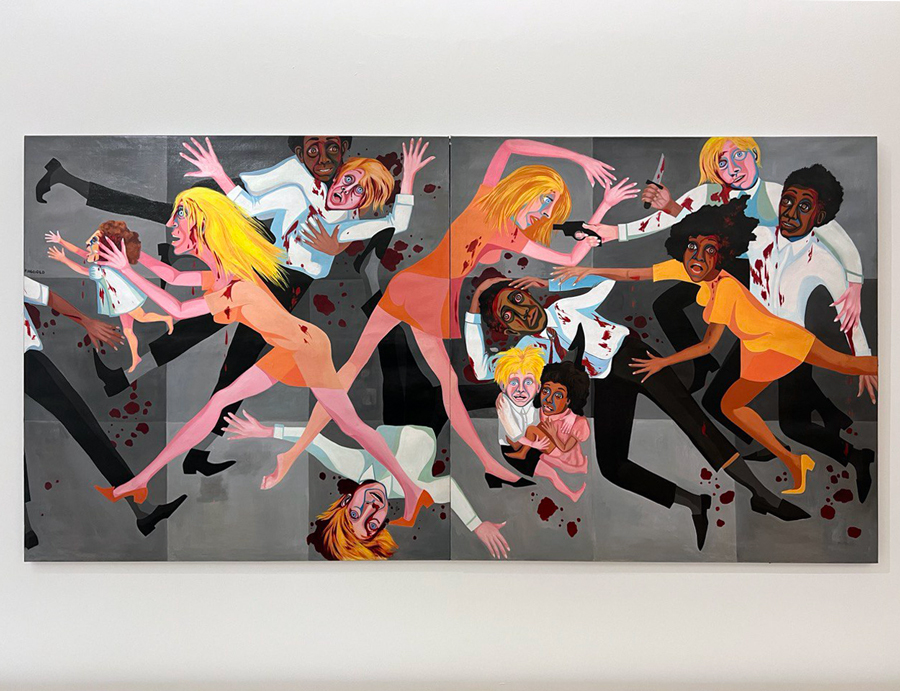
There have been rumors about the disappearance of desire from cinema and even museums or art spaces in general, leaving us with a sheer mirror of what reality is, or feeding us with constant information about the world being an unsavory place: climate catastrophes, migrant crisis, Taliban in Afghanistan, the rise of nationalism throughout the EU, etc. We’re taught in a very obvious way that the world is a bad place not in spite, but because of humans.
Recent thinking in ‘OOO’ (Object-Oriented Ontology: a branch of philosophy that does not privilege the existence of human experience over the existence of other, non-human objects) and the speculative materialism of Quentin Meillassoux (a philosopher claiming that “there can be a way to attain reality in itself”, or that “there are objects, events, laws, and beings that are not always already correlated with a subjective access…existing independently of his viewpoint, or his categories, or his epoch, or his culture, or his language, etc.”[1]) have offered suggestive alternate paths for decentering the human’s necessity for understanding objects and the world. This of course has raised concerns amongst the general audience, as it could be read as a reason for further “giving up on humans”. But it could also be an opportunity to rethink what it means to be human as a decentered being, as existing on the same ontological level as any other thing or object, and, as such, to establish positions producing new types of relations with our world-in-crisis. One discipline that can perhaps best explore these problems is art.
In a series of lectures, Suhail Malik has urged for exit from contemporary art, as it has now become more predictable than ever: “smuggling, exchange without appropriation, deterritorialization, in-betweenness, border crossing, unpolitical-politicality”[2] – these clichés run amok. But even worse, as long as contemporary art appreciates experience as its primary condition, art is only ever correlationist. It is always connected to the position of the subject (point of view, cultural background, subject’s identity) through thought.
To imagine an exit from contemporary art, it is perhaps necessary to think of a bigger escape: that is, from the circle of Kantian thought as well as the circle of transgenerational trauma, but also, from the god-like created universe, an exit from a universe of probability and necessity itself. The issue would be to offer a true critique of anthropocentric subjectivity, i.e. without focusing only on the critique of universal subjectivity through an affirmation of a singular auto-centric subjectivity, but also through a critique of the very identity of the subject itself (especially as regards the art world’s obsession with identity politics and aesthetics). This would imply conceptualizing a post-correlationist art.
Springboarding from an analogy, this would be a terrain with no interest in the sport being played or in the number of goals being scored, but with an interest in the tools used in the process of dissolving existing discourses and allowing for new positions from which it is possible to dismantle the concept of the “big other”[3]: to bring about the end of colonialist structures, ones based upon the idea of the “other” (as a fantasmatic tool of projective identification in the process of confirming one’s own subjectivity, and, with it, necessity). A post-correlationist position would not seek to be recognized by the artwork (undo the expectation of art being responsible for confirming existing knowledge, ideological convictions, subjective dispositions) nor would it be interested in accumulating power, but it would perform responsibility by giving power away. The art space has to allow for a human that is open to contingent experiences: one that stops performing their individual identities.
Still, what does it mean to be human after all? Aren’t we success-fuelled, progress-oriented animals building societies where the fittest and toughest survive? The anthropologist Margaret Mead famously said that the biggest evolutionary moment in human history is a moment from 15,000 years ago when one human healed the leg of another: a moment that did not have to happen, yet it contingently did. An early example of a contingent event: human beings, the kind we still know of today, exist in part because of a contingent form of care.
In what follows I will try to exemplarize an artwork that proposes a break with the circular movement of thought, a proposition that goes hand in hand with the possibility of breaking another vicious circle existing in the arts and beyond: that of the transgenerational transmission of trauma. The work proposes a connection to a contingently different relation to the being of the other (the de-centered subject must not confirm existing relations by reenacting them in a manner of repetition compulsion), and towards a post-correlationist, concept-oriented art as an exit from established positions, language, and spatial configurations.
If we don’t want to give up on humans, but if in the meantime humans should lose their anthropocentric identity, don’t we have to give up on the circularity of subjective identities?
LAMB is a performance project that took place in Kosovo, from the 27th of March to the 3rd of April (7 days; 150km) in 2021, in which I carried and cared for a lamb from Jarinje (an ethnically Serbian village in the North) to Kachanik (an ethnically Albanian village in the South of Kosovo) where the lamb continues to live with an Albanian-Kosovar farmer to this very day. The performance was documented from, or better yet is the lamb’s perspective, as the main idea was to raise the question of subjectivity against pre-existing narratives, concepts, projections, and to bring into discussion a new, un-politicized, and uncorrupted view to frame an understanding of reality, or how reality is performed onto us. What I wanted to propose with this perspective is an opportunity to accept the being of the other without human subjectification, without our needing to exist so that the reality of the other could take place. This view can serve as a starting point to think of events outside necessity and predictability, outside the need of human subjectification, events that decenter the human subject and offer ways of forming contingently new relations to the being of others. Through this alternate perspective it may then be possible to further decolonize ourselves from the status of humans compulsively performing nationality, territorialism, religious dogma: in broader terms, it relaxes viewers from having to recognize and perform identity positions, so that they might leave them and acquire new positions to negotiate relations from.
The performance then tackles issues of territorialism, borders, division, memory, nationalistic mythology, and ecology, and, at the same time, it does so by attempting to produce new, contingent forms of care. It potentiates the creation of a space that exists at the end of the circle of transgenerational trauma, offering an open discourse without deliberate victimization (victims and perpetrators), survival messages, heroes and villains, Christianity or Islam, nationalistic mythomania, or geographical determinism.
The project took place in Kosovo, and this land can be understood from different perspectives as it exists in divided realities – ‘disputed territory’, ‘republic of Kosovo’, ‘republic of Serbia’, Serbian national mythology, Albanian national mythology, ‘big Albania’, ‘semi-recognized state’, ‘post-war land’, ‘divided territory’, ‘Slavic colonialism’ – these are just some to mention with heavy political contexts. The clash of these competing concepts, rather than truthful facts, is what then became a scenography for the performance. It was not just a question of the Serbian-Kosovo-Albanian relationship, but it was through a localized event that I tried to engage the subject on a much larger, global scale, regarding the widely divided world fuelled by issues of transgenerational traumas. Questions of territorialism, trauma, geopolitical history, and so on are equally important in China-Hong Kong/USA – Cuba/USA – Mexico/Rwanda – Congo/Belgium-Congo/France – Burundi – France/Libya – Libya/Syria – North Macedonia/Bulgaria and countless more relations.
Yet new generations don’t have the right to turn to national mythologies for a safe place; we cannot hide under national traumas or afford the belief system that supposes superiority of certain “ones” over certain “others” or a geographical determinism that imposes division between peoples. These questions need to be looked at from a fresh point of view, from someone who doesn’t have presumptions. It is through an almost alien-like perspective (one that humans cannot relate themselves to, but are still curious about) that we might again rediscover, and reinvestigate these concepts. The Lamb is, in that sense, the perfect “alien” on the earth. It is fuelled with unnecessary, preexisting symbolism and codes of meaning (arriving either through Christianity, Islam, or Judaism or through common belief, fairy tales, storytelling, but also as the first ever farmed animal). And yet, it is a living being, subject to its values which exist without these connotations, outside of the human mind and experience. This duality enabled the lamb I carried to always be an ultimate object of human projections and connotations, fantasies, etc. especially while it encountered nature, borders, divided cities, comments of people of different ethnicities, buildings of KLA (Kosovo Liberation Army), and the city of Obilic (Serbian national hero from 1389), or any other object, and to always remain a being without the necessity of human subjectification.
We cannot go into the future with our backs turned against it, constantly looking to the past and mourning it. There needs to be an antithesis to the Angelus Novus (Walter Benjamin’s ‘angel of history’), a creation instead of new memory and the discovery of new geographies, ones that are relaxed from human subjectivity. On our current bent, there is no “new time” that will come. The future (at least the one we care for) is a temporal difference between what we perform as humans and what contingently changes the notion of humans: the future is contingent.
I belong to a generation of people that carries a difficult task of ending the cycle of transgenerational trauma, and to do this we would have to leave the positions that exist through the discourse of historical victimization, the discourse of the big other, and finally, the position that performs power by accumulating it. We must not imagine or envision a new discourse (the exit strategy is always conditioned by the limits of reality it tries to escape) but rather produce time and space for any outcome, for whatever[4] realities, for new relations performed in/as these new realities.
For a genuinely different discourse to be possible to emerge, something extraordinary needs to happen, an event that doesn’t exist based on the condition of colonialism (it would refute the aggressive line that separates), nor on the concept of absolute contradiction (a god-like universe) or one falling into a set of given probabilities: instead, it would require an event that is entirely contingent. Only that condition leads towards a space enabling a different articulation of the concept of the other, along with the possibility of a rational acceptance of the existence of an experience of the object without subjectification. This is why I propose that breaking the circle of correlationist thought has to go hand in hand with the breaking of the circle of the transgenerational transmission of trauma. Eternity is a form of repetition, and contingency is a fraction of a single moment. And yet the contingent makes the rules of the game endlessly different. This “endlessly different” is again not on the image level of reality, and therefore art cannot perform the change, as this would only bound itself within the given limitations of malfunctioning parts of reality it is negotiating with, therefore producing more of a different kind of the same.
Art’s job, rather, is to jaunt the circulation of cyclicity, to abruptly puncture eternity, which, for humans, must take into consideration a production of contingent forms of care; after all, a future without care for anyone, or for whatever thing, non-human or not, is not a future but a reproduction of the contemporary, the now. And isn’t that precisely what we have been trying to escape from all this time?
Still, there is a certain danger that a new classification of the object, one rejecting the privileging of human existence over the existence of non-human objects, can slip into a somewhat Heideggerian trope, where the decentered subject will simply tend to reproduce already known patterns, paths and (circular) movement pre-established by the transgenerational transmission of traumatic content. As we know, humans are not just born into the circumstances that reproduce the circulation of trauma: they are the primary condition for its transmission. This is why it does start with you.[5] On another note, the discourse of transgenerational trauma can never be brought to an end without the production of a contingently different relation to the being of others. If we take “human” out of the equation, from any field of human interest that in one way or another touches upon social dynamics, power relations, or knowledge (let’s say OOO and art) what we really take out is not the human, but responsibility.
We want art to set us free. We want it to liberate us from performing a matrix of identities. We want art to eradicate the border between ourselves and the world, we want it to make us lose touch with reality. We don’t need art to teach us the truth, but rather to let us experience a truth, whatever truth, one with no particular interest in our human-made game. And still, this truth in art must make an opening for contingent experiences to arise, for a real form of magic to appear beyond reasonable doubt, one which, without us knowing or without any idea of doing so, proposes changes to the notions of who we are. Or at least, who we are as humans performing care.
Notes
[1] see MEILLASSOUX, Quentin, Time Without Becoming ed. Anna Longo (London: Mimesis International, 2014), pg.10.
[2] see MALIK, Suhail, Exit not escape – On The Necessity of Art’s Exit from Contemporary Art (2013), exit, not escape.
[3] Here and for the rest of the text I refer to the concept of the Big Other as a merger of projective identification (psychological process introduced by Melanie Klein) that operates under the conditions of the Lacanian Big Other, dictating unconscious and invisible processes in a society and constituting self in relation to the other (often one that is evil, scary, maleficent, barbaric etc). This is the big other that is embodied through separation (of the self and the world).
[4] See AGAMBEN, Giorgio, The Coming Community (Turin: La comunita che viene, 1990, Copyright University of Minnesota Press), pg. 1-87.
[5] For an antithesis to Wolynn’s 2017th book on the psychological legacy of historical trauma, see CHERAPANOV Elena, “History Always Begins With You” in Understanding the Transgenerational legacy of Totalitarian Regimes (New York: Routledge, 2021), pg. 18.