
In the brief essay that follows, I consider art as an event that de-privatizes the subject by exposing us to the hyperobjects constituted by the circulation of transgenerational trauma, power, and subjective identities. I also examine the role of contingency in this process and argue for art as a tool of indifferent future production.
What may be useful for understanding what is meant by contingent time, or indifferent future, is simply the difference between the probable and the possible.
Probability is a space of expectation for a certain outcome of an action, already inscribed within the logic of, or better, a condition of, a universe in which events happen out of necessity. It is a consequence of humans’ experience of time as a series of causal relations. This is also a time choreographed by three hyperobjects: trauma, power, and subjective identities.
Therefore, events that are probable, or experiences that are prewritten, will accumulate already existing knowledge, reproduce it, and confirm our present conditions and relations, and, as such, carry zero potential for an actual future time.
We are almost always, in one way or another, reconfirmed as anthropocentric subjects, valuing our existing experience of reality as central in relation to other objects, when we nurture the circumstances for such events to take place. If art is an end of things (the circulations of the previously mentioned hyperobjects), then the event that follows cannot have any yet-known power, cannot be controlled, cannot reproduce meaning, cannot reproduce existing relations, and is outside language, meaning it is indifferent to the human subject’s experience and to the contingently different relations of one to the being of the other.
If we agree that art has the power to produce the future, artists not only have a responsibility to make such events possible but also to avoid reproducing past and present conditions. The probable is a generic realm of potentiality and is defined through the questions what, how, where, and who. The possible is more a humbling part of that realm, as it involves humans as part of something bigger than themselves, not confirmed for who they are, what they know, whom and how they love, what they remember, how they relate to others, and what kinds of power they exercise. The possible is a scary, noisy, unknown generator of experience that is never about security, and because it is de-privatizing as an event, it cannot take part in the time of traumatic subjectivity. This would allow us to think of the possible as those experiences outside knowledge and language, as events that happen but do not need to, and also those that do not happen but could.
This understanding of the reality of the possible as a contingent, indifferent, future time generator, as a realm of aesthetics, which is the realm of art and love, would mean that art is a question of when rather than anything else.
A timeframe, that is, through which one seemingly “gives away” permission for things to show up under given circumstances. Not because it makes it easier to focus, or because it is more fun to do things under the pressure of, for example, an awaiting deadline (it is not), but rather because, similarly to psychoanalytic processes, our understanding of humans expands to humans as unconscious beings.
Contrary to popular belief, humans actually are unconscious beings, all of the time. It is only on certain occasions that the unconscious manages to rise above the plane of the unconscious, actualize itself, or see itself as the unconscious, and in that brief moment become aware. This “becoming aware” is called consciousness. It is, following Husserl, co-constituting time and then falling back into the plane of unconsciousness. And again, before it becomes self-affected through a series of inner motivations, reflections, and so on, it allows human subjects to experience time as a sequence of causal relations inherent to the movement of objects in space.
This may be why things do not show up to us for what they are “when” we do not expect them, but “where” we do not expect them. Expecting, waiting, or desiring is always already under the influence of the human, subjective, probability-driven experience of time, a “causality-driven” time, and, as such, corrupts our perception of time, rather than allowing an understanding of time as contingent in itself, interwoven with the fabric of reality, both human and simply out there.
So yes, allowing for a time and space in which things can “just be themselves” or “become what they are” can happen when we understand “museum time,” “dance performance,” or “from 7 to 9 pm” (or any other time) not as a when but as a where.
A seemingly paradoxical situation follows: the question of art is neither what art is, nor how art is, nor where art is, but when art is. And the answer could be one and multiple at the same time: “when things become possible.” What that “possible” is can be understood as “refuting retrospective experience of time,” “intervening directly in the realm of causes and effects,” “producing time and space when things can just be themselves,” or “when the human subject is decentered from the circulation of subjective identities, the circulation of power, and transgenerational trauma.” The last example would be my addition to the already multiple frames through which new ontology and post-Kantian thinkers understand aesthetics: Meillassoux, Mårten Spångberg, Timothy Morton, and Steven Shaviro. I will later return to the understanding of art as becoming possible, or art as the production of future, by making different spatiotemporal dimensions through decentering from what I, following Timothy Morton, call “hyperobjects,” thus allowing a human to take part in contingent experiences. But the paradox that came to the fore is that art is generally understood as a question of when, yet when speaking of a certain organization of the possibility of art experience, the question immediately becomes a question of where.
Why does it feel more right to name the time art is experienced a where and art itself a when? Is this the difference between the human perception of time inside a binary, probabilistic universe and humans as taking part in a universe of contingent reality, or a bridge between them? I will try to clarify with a drawing:
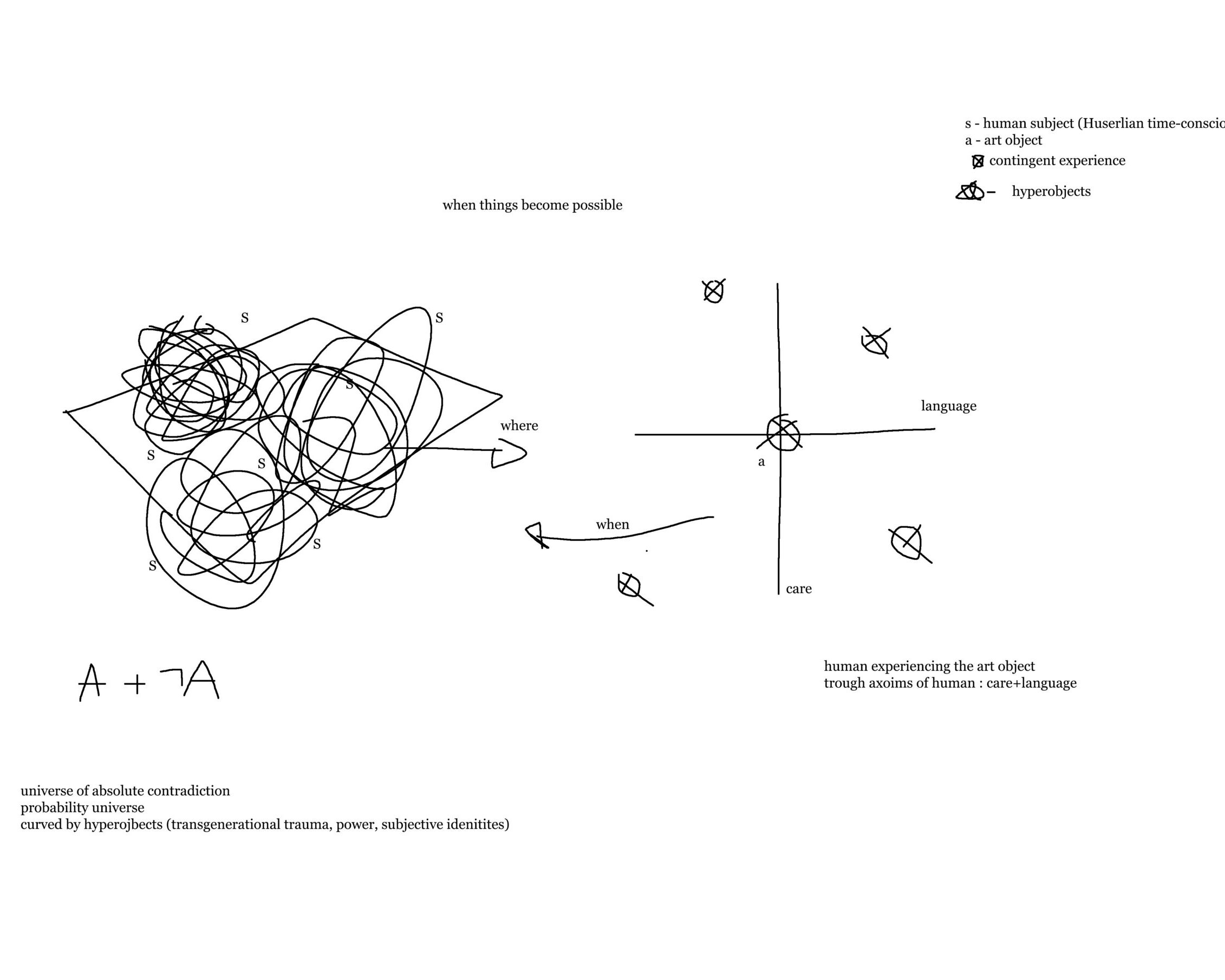
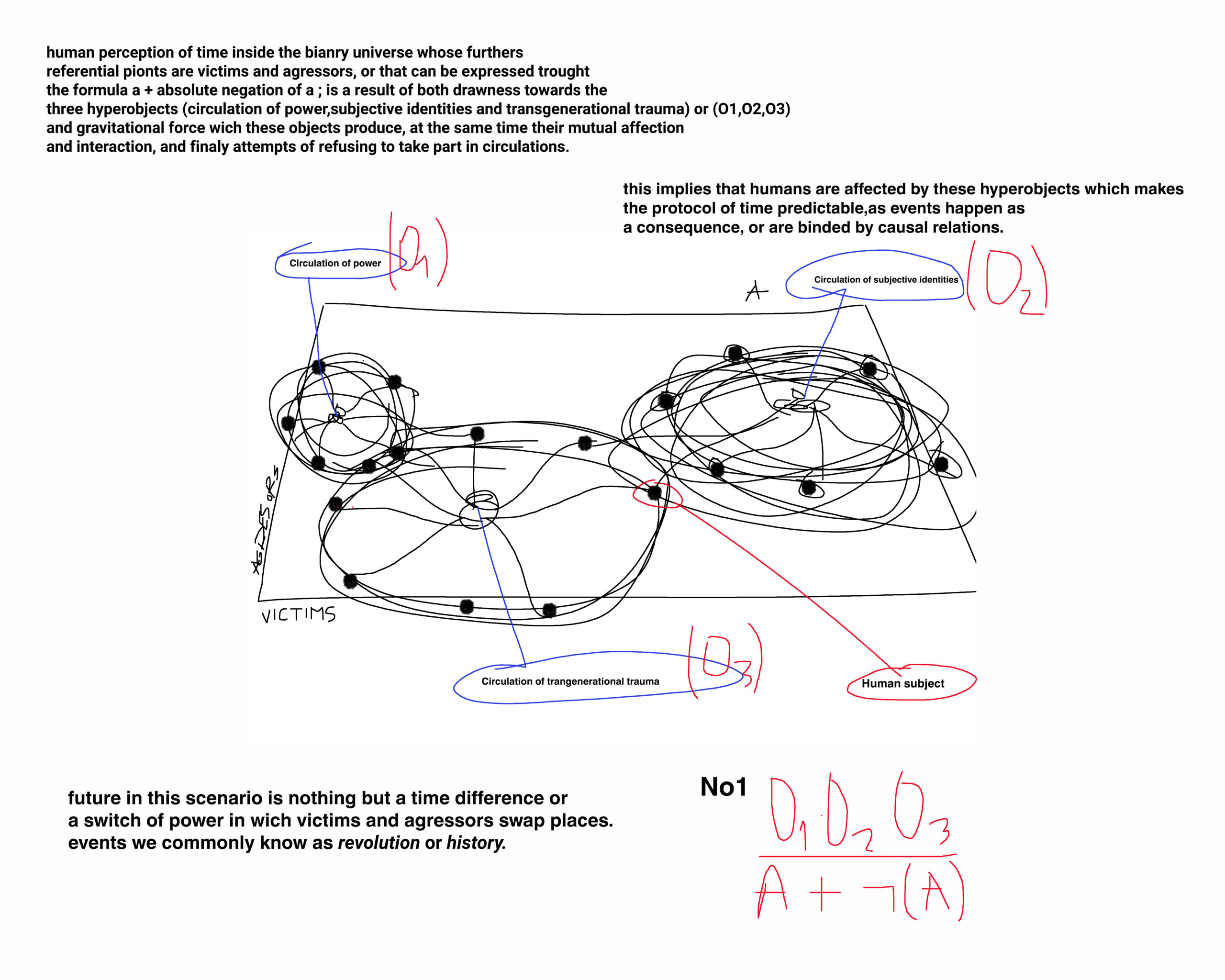
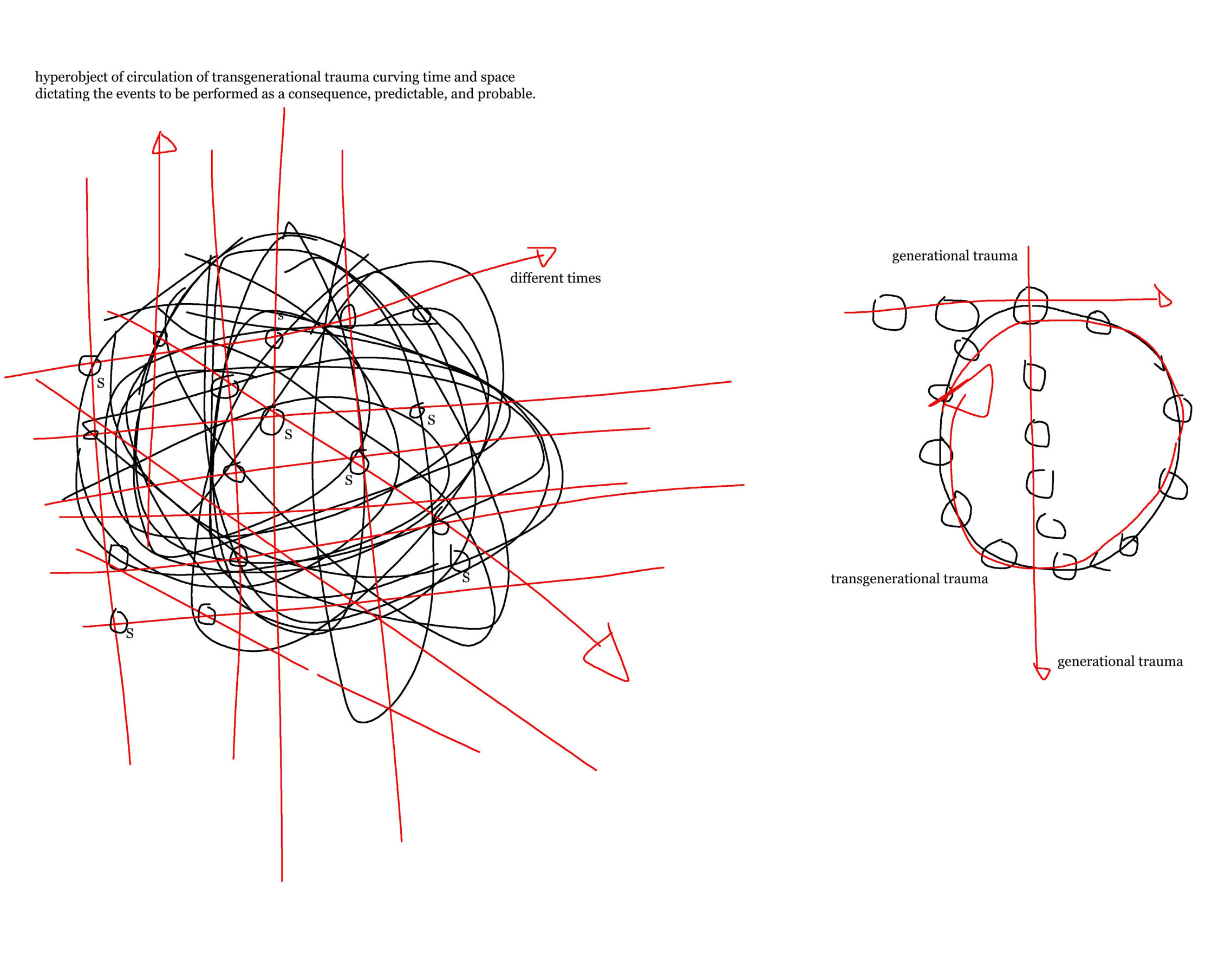
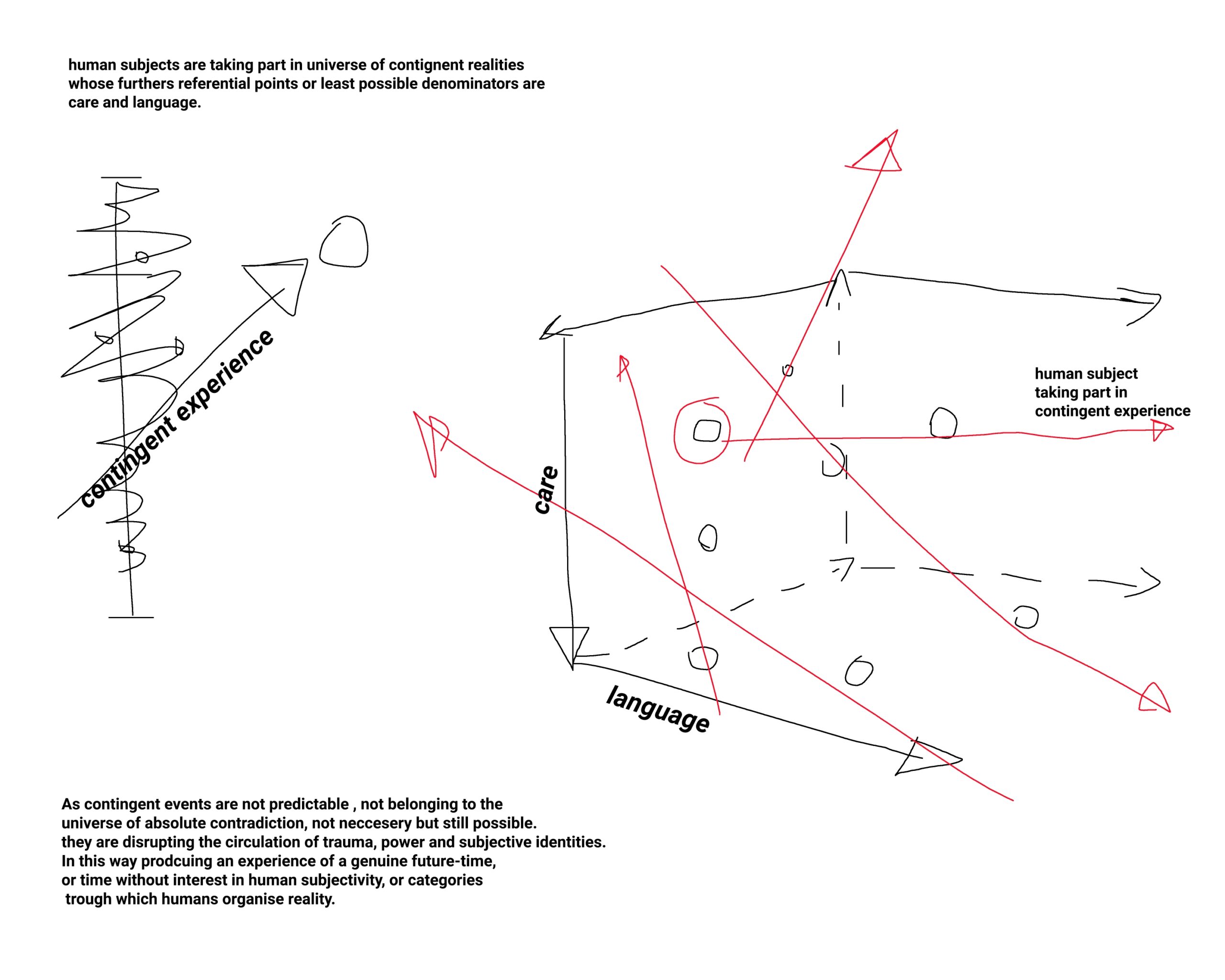
But how does this make encounters with art produce the future? Below is a small attempt to grasp what happens when a human subject existing through axioms of care and language encounters an incomprehensible object (an art object or a love object):
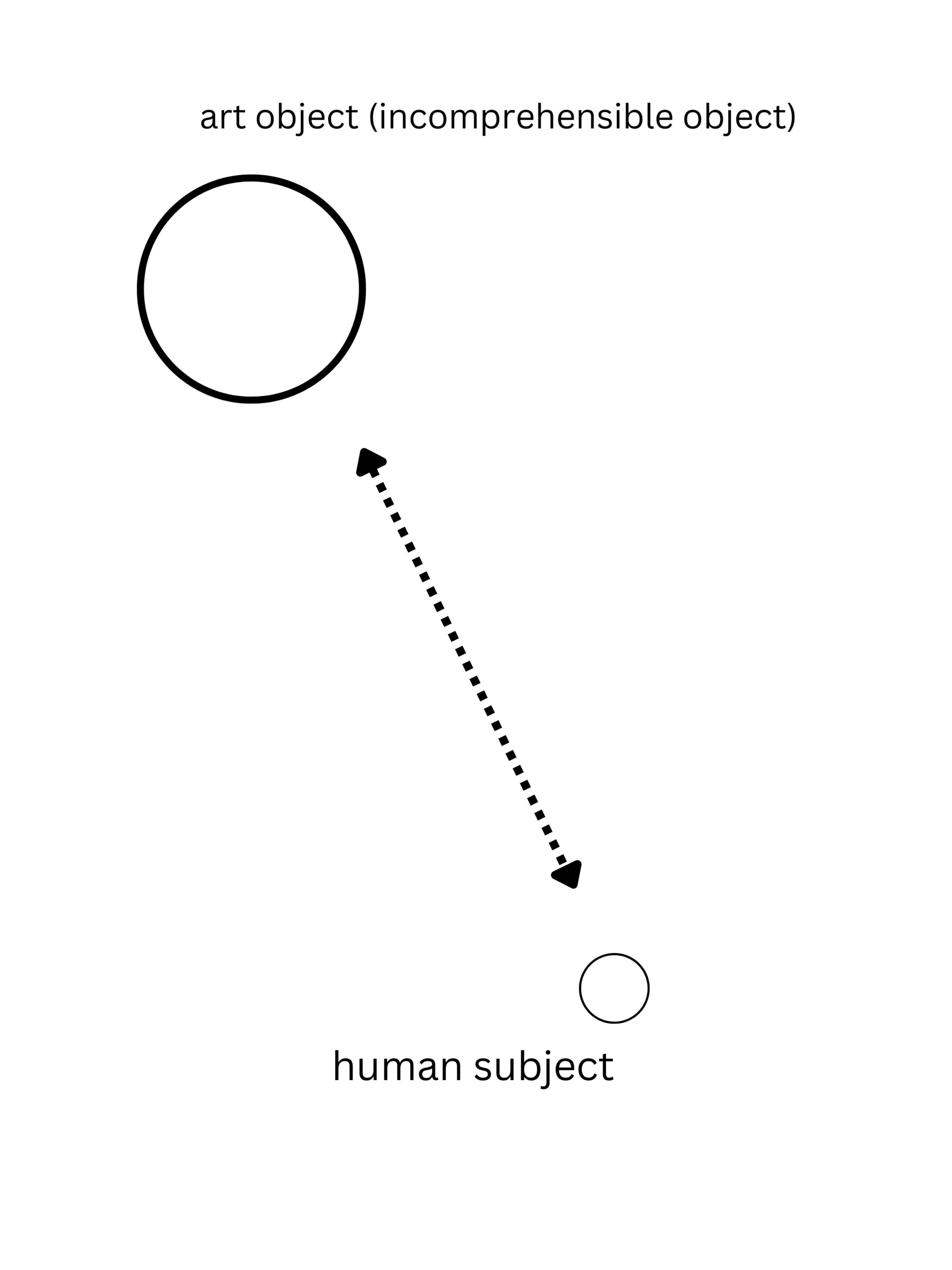
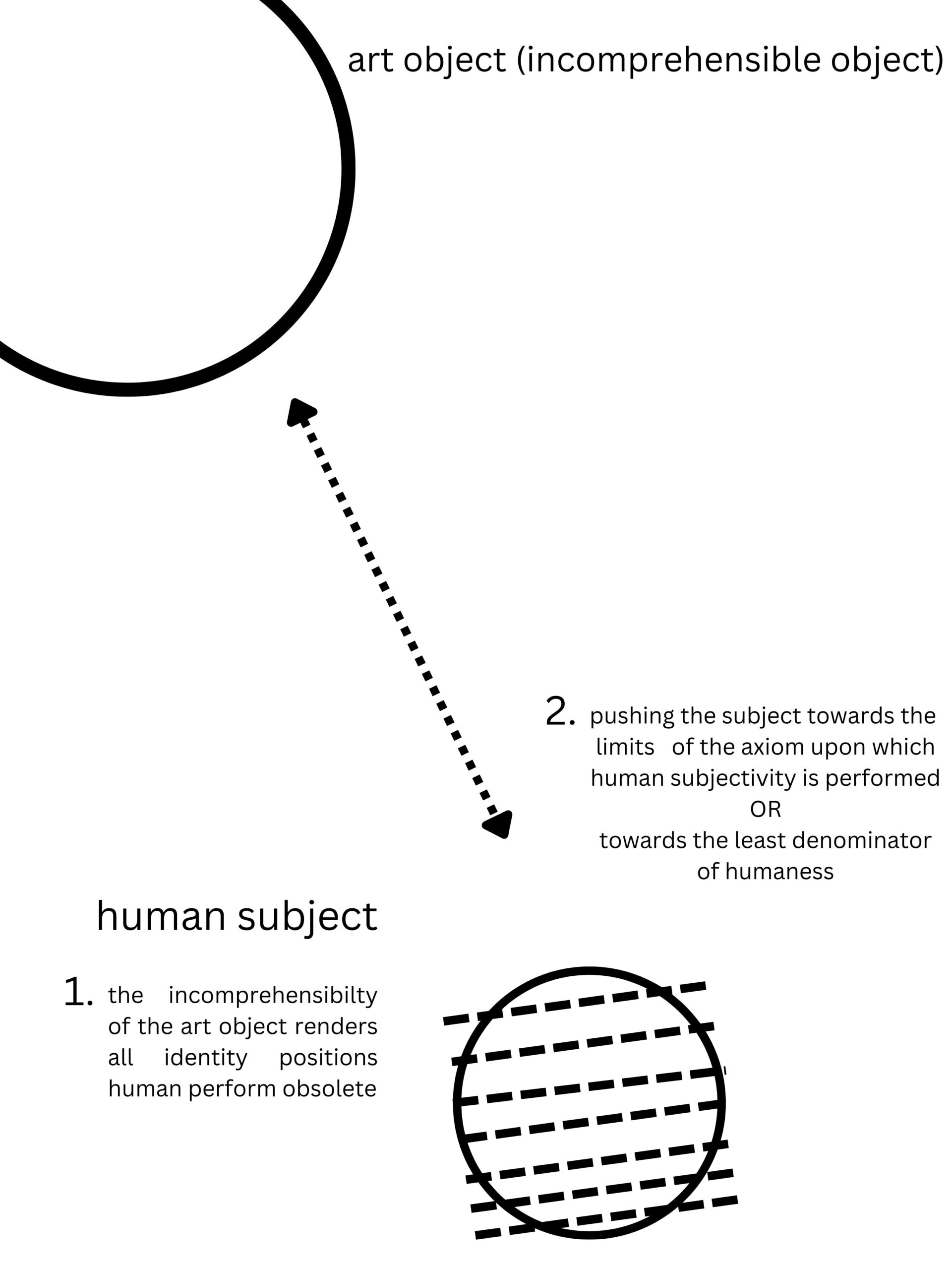
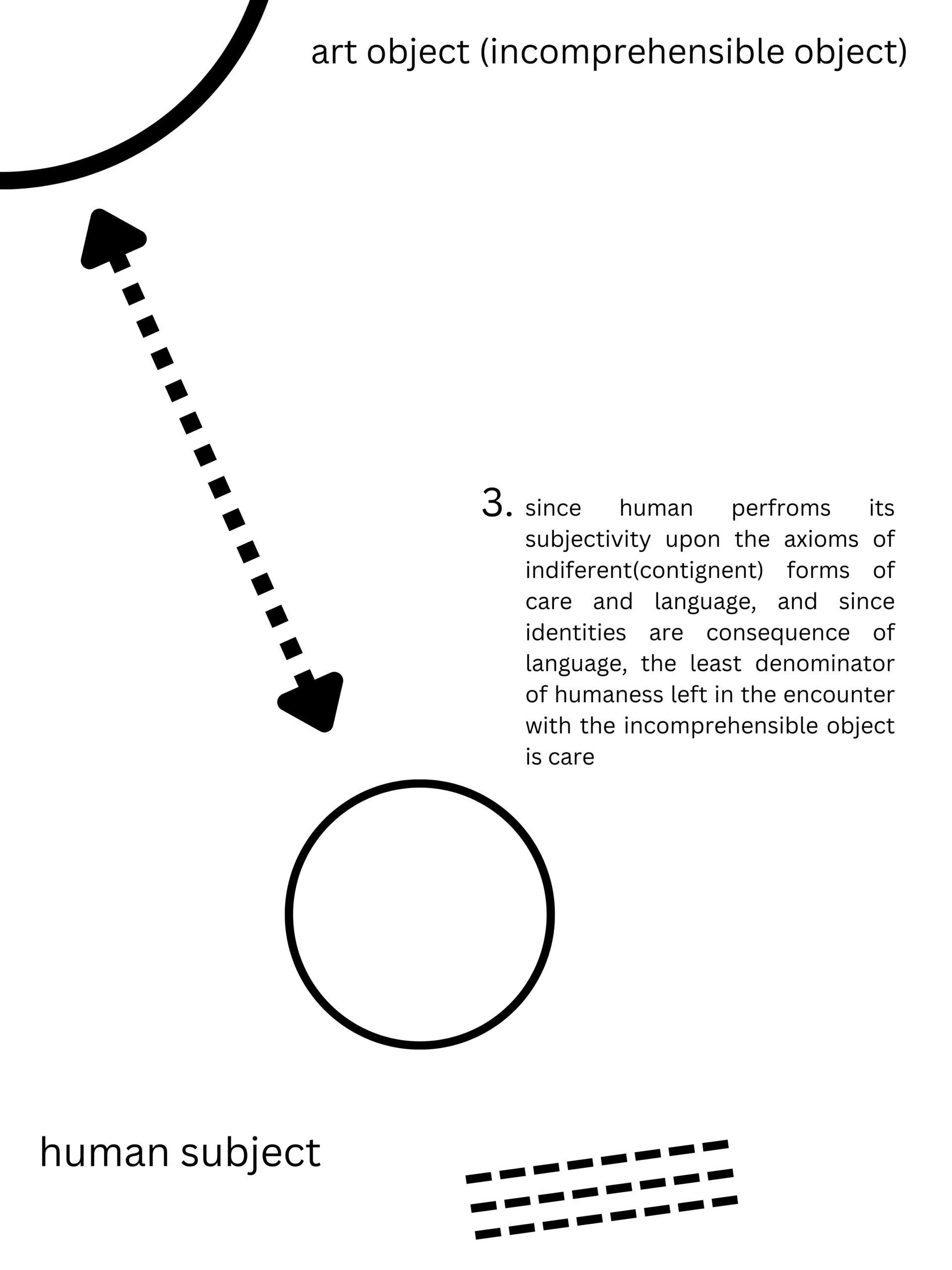
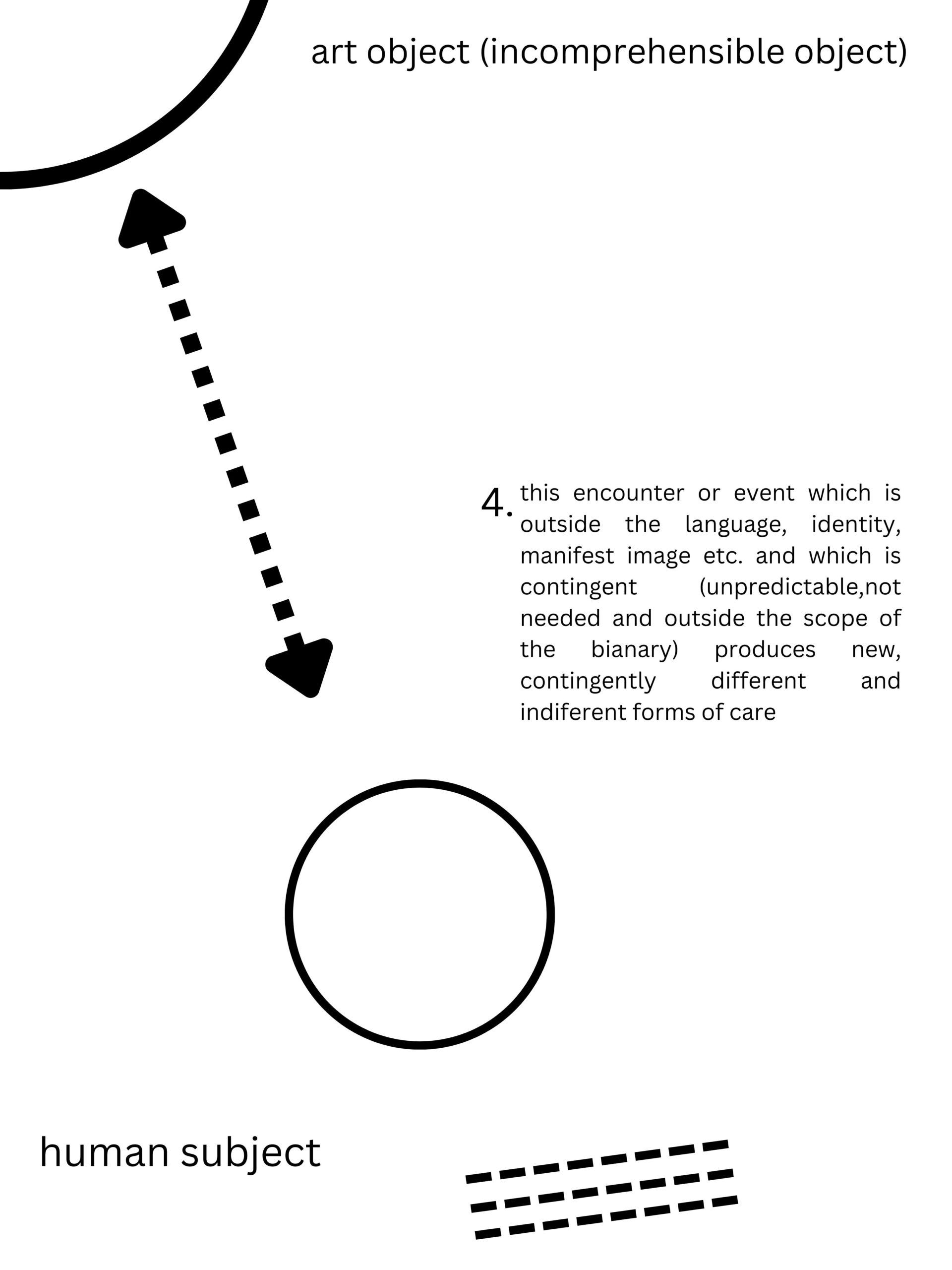
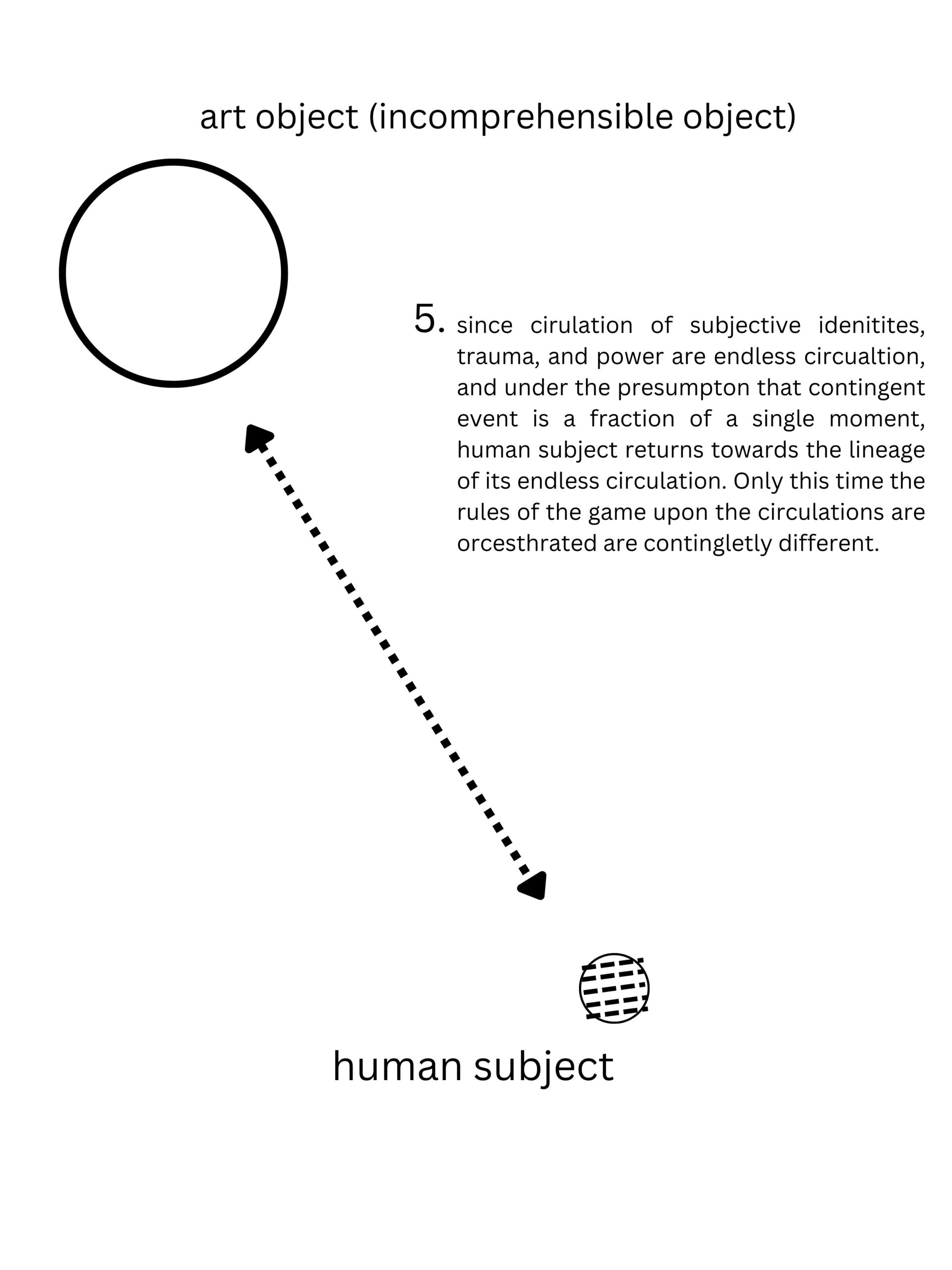
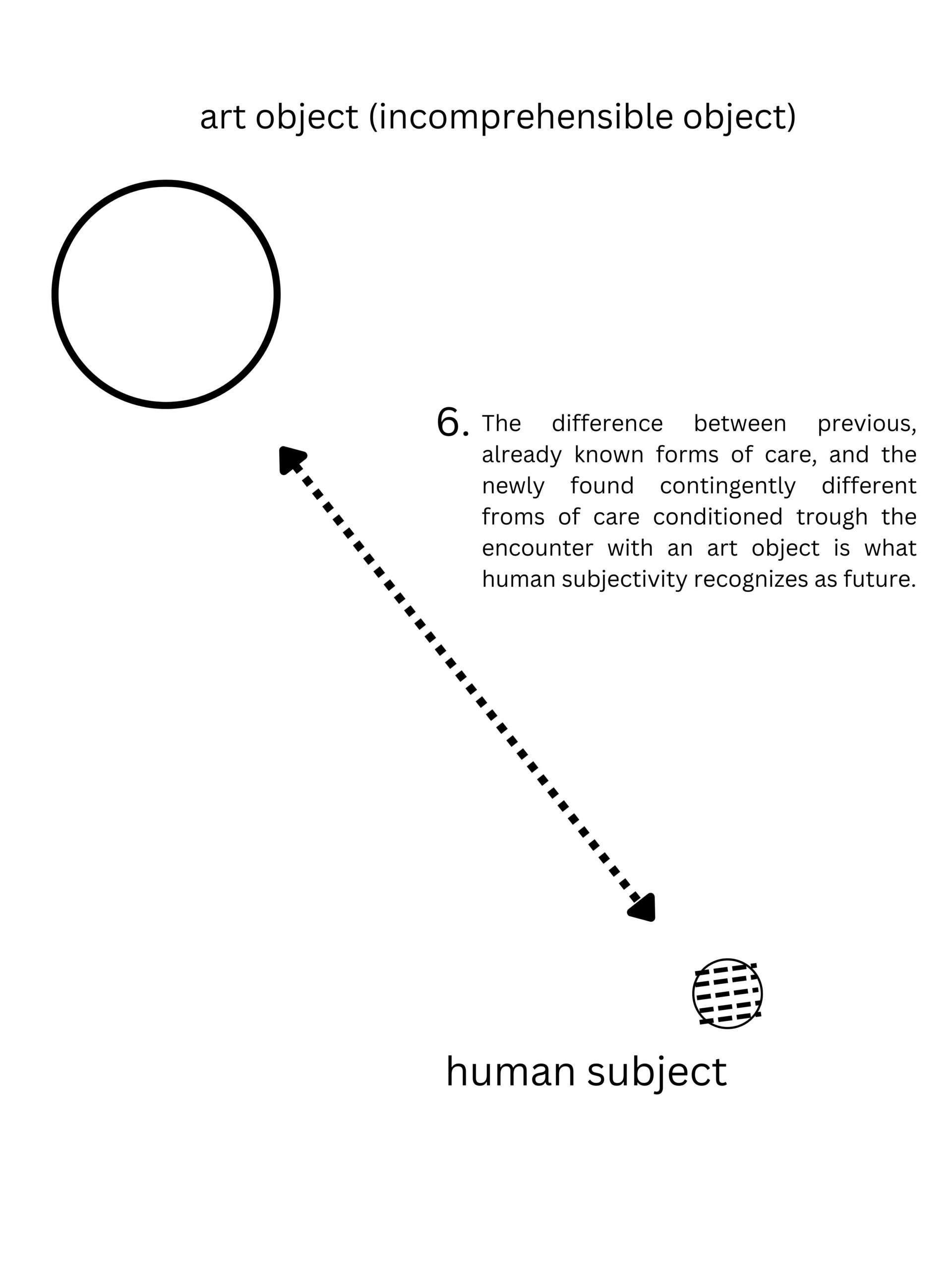
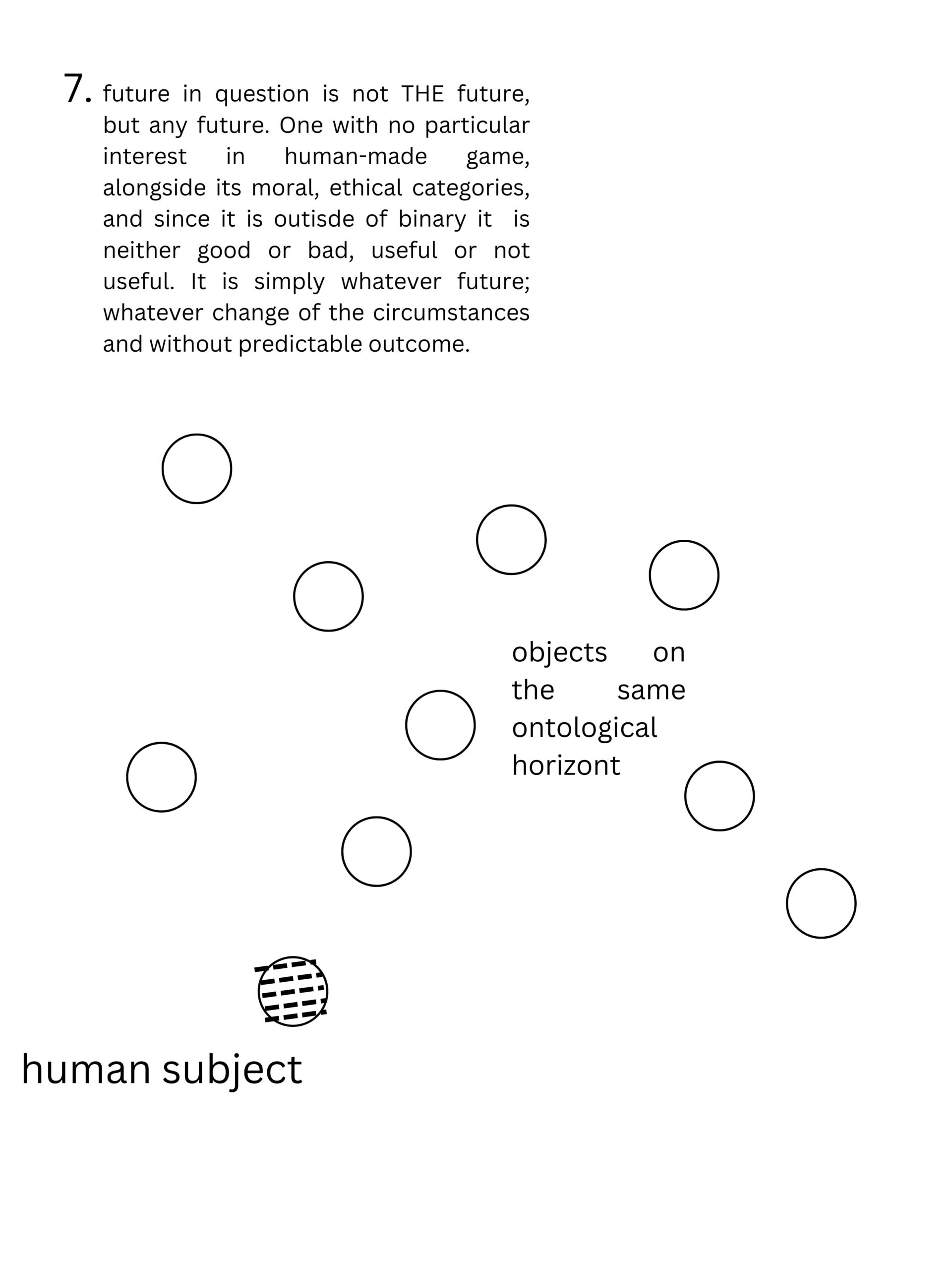
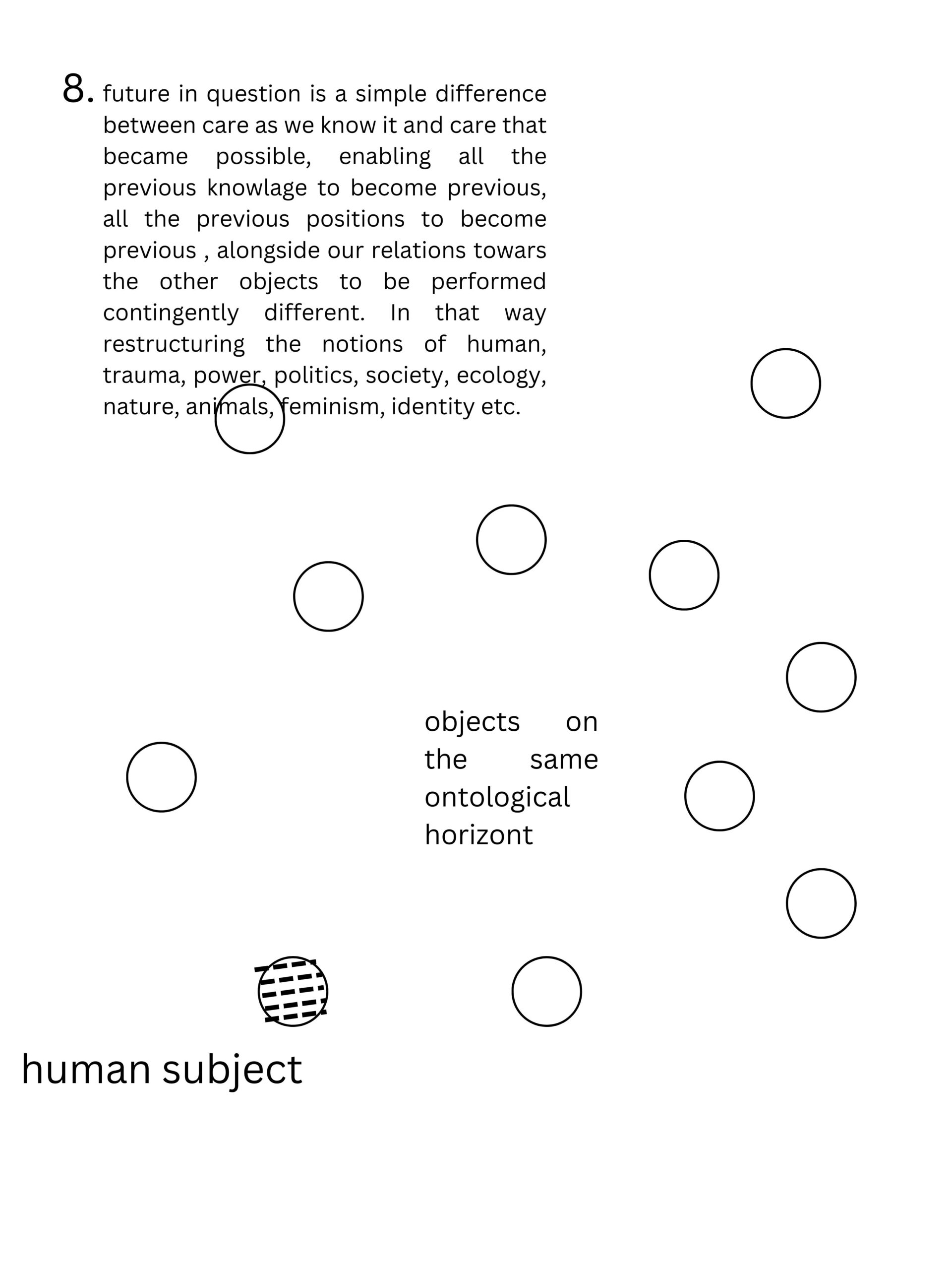
The distinction between the probable and possible futures serves as a crucial pivot in understanding differences in the human experience of time in a universe of absolute contradiction and a universe of contingent events. The probable future, bound by necessity, trauma, and power, repeats the past under the guise of progress, entrenching existing structures and identities. Art, following this line of logic, surrenders itself to the powers of three hyperobjects. In contrast, the possible future offers a rupture in this cycle, a space where unforeseen contingencies can emerge. This realm of possibility, while destabilizing, is where true freedom lies, beyond the limitations of human-centric frameworks. Artists must produce space where contingent experiences can arise, breaking from the predictable narratives of trauma and power that constrain the human experience. By refusing to affirm the probable and instead generating conditions for the possible, artists become creators of futures not bound by necessity. The contingent future, in its openness, provides a radical potential to transcend existing orders, offering a space where identities can dissolve and new forms of being can emerge. To embrace this future is to embrace the unknown, and it is through this act that art unknowingly reaches maximum capacity for any unintentional and accidental dissolution of trauma, changes in existing power relations, and disturbances to any dominant protocols of knowledge.