March 19, 2026
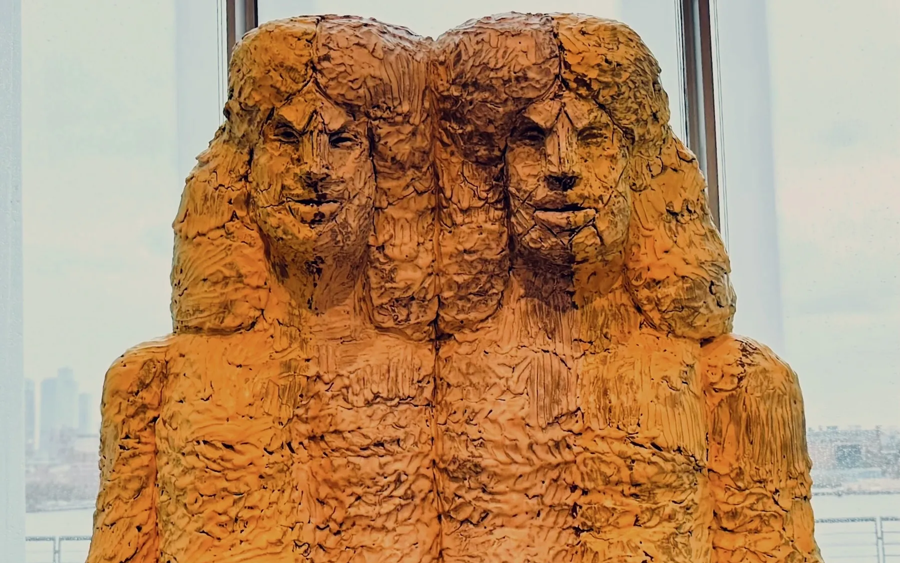
IMAGE: Half Moon, Sun Twins, 2025.

Biennialese Blues: Review of Whitney Biennial 2026

ARTISTS: Basel Abbas & Ruanne Abou-Rahme, Kelly Akashi, Kamrooz Aram, Ash Arder, Teresa Baker, Sula Bermudez-Silverman, Zach Blas, Enzo Camacho & Ami Lien, Leo Castañeda, CFGNY, Nanibah Chacon, Maia Chao, Joshua Citarella, Mo Costello, Taína H. Cruz, Carmen de Monteflores, Ali Eyal, Andrea Fraser, Mariah Garnett, Ignacio Gatica, Jonathan González, Emilie Louise Gossiaux, Kainoa Gruspe, Martine Gutierrez, Samia Halaby, Raven Halfmoon, Nile Harris with Dyer Rhoads, Aziz Hazara, Margaret Honda, Akira Ikezoe, Mao Ishikawa, Cooper Jacoby, David L. Johnson, kekahi wahi, Young Joon Kwak, Michelle Lopez, José Maceda, Agosto Machado, Oswaldo Maciá, Emilio Martínesz Poppe, Isabelle Frances McGuire, Kimowan Metchewais, Nour Mobarak, Erin Jane Nelson, Precious Okoyomon, Aki Onda, Pat Oleszko, Malcolm Peacock, Sarah M. Rodriguez, Gabriela Ruiz, Jasmin Sian, Jordan Strafer, Sung Tieu, Julio Torres, Anna Tsouhlarakis, Johanna Unzueta

First things first, I liked Pat Oleszko’s Blowhard (1995), a giant inflatable goblin jester head playing a fire-breathing horn, Aki Onda’s presentation of José Maceda’s Ugnayan (1974), a composition for indigenous Filipino instruments played over 20 vintage radios, and Mo Costello’s gelatin silver prints of staples in telephone poles, although her Readers thrown haphazardly in a vitrine feel like an unfortunate collision of self-consciously unprecious art objects with museum protocol, like the artworks aren’t really artworks unless you can flip through them but the Whitney couldn’t handle that logistically and settled for this dumb half-measure.

I didn’t exactly hate every other thing, but those three are the only moments where I felt the art broke through the fog of biennialese. That’s about par for the course with the three Whitney Biennials I’ve seen and, in spite of the rote discourse about this show being different from the last two, I find it to be more of the same with only a thin veneer of change. The main keywords I’ve picked up on this year are that this is a “weird” biennial that’s focused more on “mood” than overt political orientation. I have the impression that “mood” is a term taken from this article as the institutionally-vetted avenue of response to “The Painted Protest” now that curators have finally had to at least acknowledge the non-revelation that the identity-political script was wearing thin with their audience. As far as I can tell, “mood” is a half-baked rebrand of “aesthetics” without going so far as to accept that artworks might not actually be inherently powerful talismans for enacting social change, i.e. trying to take a half-step back from the worn-out, mangled heritage of post-conceptual art and institutional critique while avoiding any consideration of where that artistic ideology might be mistaken on the ontology of art.

Thus the ironic result is that the exhibition continues to do exactly what’s wrong with identity art with only a perfunctory shift in surface appearance and emphasis. The paradigmatic mistake of this art isn’t identity or even politics, but the misappropriation of art’s meaning away from the art object into the wall text. An artwork means something by first and foremost being an artwork: If Courbet’s early masterpieces like A Burial at Ornans are political artworks by signifying an engaged consciousness of the state of French peasant life, they are masterpieces because that political content is inextricable from his revolutionary approach to painting that could express that consciousness while making a great painting. The artworks here may not be as obsessively concerned with the identities of the artists as the last two biennials, but the sleight of hand is exactly the same when the material components of the artworks are treated as allegorical totems that intrinsically contain an artwork’s symbolic meaning. Andrea Fraser’s unset wax sculptures of babies are supposed to symbolize the care and maintenance the art object receives from the art system, and the signifier of childbirth relates to the intergenerational presence of her mother’s work in the same room, as well as Nour Mobarak’s work that incorporates casts of her pregnant body. (As an aside, Fraser’s retreat from critiquing institutions into the psychoanalytic constellation of the familial is glaringly tepid, if unsurprising, considering the biennial’s proximity to the suspension of the Whitney ISP, her alma mater.)

Other artists utilize nature and the ecological, or technology and the virtual, or nostalgia, or regionality, or tradition, or personal loss, or surveillance, or conceptuality, but almost everything feels as if it’s using these narratives as a means to an end, and the end isn’t the artwork itself but an armature that institutional curators like. If one simply doesn’t care about the associations the artists are sticking onto their work (and I, as you know, don’t), a whole lot of the show immediately becomes inane and ridiculous. At some point I was struck with the realization that this biennial looks worse than the last two iterations. The art doesn’t look like art, which at least here gives it the negative, amorphous quality of slop. Is that what people mean when they say the show is “weird”? There’s aesthetic content, like doilies, video games, purple and neon green, colored glass, reflective surfaces, driftwood, affectations of conceptual-austerity-as-aesthetic, whatever, but it’s all flashy, superficial, and overeager, like fishing for likes on social media, those viral cakes that look like fairies made them out of mud, or Gen Z star-shaped pimple patches.

The prevailing stylistic “mood” is downstream of pop culture, appropriative of the kitsch everyone already gets too much of on their phones. What the show mostly feels phobic of is any kind of art history before the ’60s, which isn’t inherently a problem except precisely in terms of aesthetics. If I liked Oleszco, Maceda, and Costello’s works it’s because it was extremely glaring how those older artists in the first two cases had some sensibility about what the fuck they wanted their end product to be like (every other audio component in the exhibition is slapdash junk), and Costello’s photos were an effective, simple use of the inherent qualities of retro technology. Otherwise almost everyone seems to be recklessly unconcerned with and perhaps oblivious to the things artists used to spend all their time doing, like scrutinizing a painting to decide if it works or not, or developing their skills, or thinking about art as something that doesn’t immediately spiral off into references to something that isn’t art. And who can blame them?

This is a systemic problem. It’s not like the curators could turn on a dime and find enough viable artists to do anything other than a show like this if they wanted to, and the current generation of artists has been hemmed-in from the start by the demand that they’d better get with this program or get a different job. Maybe the most indicative moment for me was Isabelle Frances McGuire, one of the only artists in the show who seems to have any earnest artistic influences; her interview in the catalogue is with Charles Ray and her connection to his work is obvious without being slavishly derivative. For her to “qualify as a serious artist” in 2026 she has to slap her spooky figures with nested narratives: The scene is Salem, Massachusetts during the witch trials, the witchy figures are made from open-source CT scans, the evil villagers are from Doom, the wall is based on Abraham Lincoln’s house. If you have to jump through that many self-justifying hoops to be allowed to make figurative sculptures today, what hope does anyone have of actually trying to get good enough at anything that it might actually be exciting?

The strictures of the system that holds together the art world’s sense of self-importance are suffocating the life out of art, and at this point I might be more sympathetic with the plight of artists than I am dismayed by the quality of the art. It still sucks though. I could go on about specifics, but this is exhaustingly dull and I’m not saying anything that I haven’t said before. I got a similar feeling from all the press the show has received, as if the writers are desperately trying to divine some sort of new trend or basic difference from the last ones but it’s impossible to hide the universal fatigue at this point. To finish I’ll just point out that Ash Arder is slavishly derivative of Josh Kline, David L. Johnson is slavishly derivative of Cameron Rowland, and, as I’ve said before, Josh Citarella isn’t an artist. I think it’s safe to say you shouldn’t be in a biennial at all if your contribution is doing your podcast on site.

I really don’t care at all about Doomscroll and have no particular animus towards him but, as someone who prides himself on the depths of his pessimism about the state of the art world, even I’m astounded at the level of cynicism that went into him deciding to pretend to be an artist (for clout? What clout?) and into the curators deciding it was a good idea to let him pretend. Oh, and this October roundtable on the 1993 Whitney Biennial is startling to read 33 years later, if only because the biennial playbook is almost exactly the same and in the meantime the critical discourse has atrophied completely.

More Articles from &&&

Socialism after Socialism, A Response to Conrad Hamilton

In the spirit of dialogue, I am responding to the observations in Conrad Hamilton’s recent expansive review of my book The Political Theory of Liberal Socialism. I will be concentrating on Hamilton’s three main claims, that there is a gap between the form and content of socvialism, invoking Marxist theories of struggle before coming down… Read More »

Biennialese Blues: Review of Whitney Biennial 2026

ARTISTS: Basel Abbas & Ruanne Abou-Rahme, Kelly Akashi, Kamrooz Aram, Ash Arder, Teresa Baker, Sula Bermudez-Silverman, Zach Blas, Enzo Camacho & Ami Lien, Leo Castañeda, CFGNY, Nanibah Chacon, Maia Chao, Joshua Citarella, Mo Costello, Taína H. Cruz, Carmen de Monteflores, Ali Eyal, Andrea Fraser, Mariah Garnett, Ignacio Gatica, Jonathan González, Emilie Louise Gossiaux, Kainoa Gruspe,… Read More »

No View from Nowhere: On Discourse, Différance & Functorial Semantics of Micro-Communities

This essay argues that natural language semantics admits no global orientation—no ‘view from nowhere’—but only local positions within psychoanalytically and sociologically embedded discourse communities. Drawing on Derrida’s concept of différance, I demonstrate that meaning is constitutively deferred across the differential play of signs, precluding any meta-linguistic standpoint from which all local meanings could be adjudicated.… Read More »

Liberalism Is Dead, Long Live Liberalism!

Matthew McManus’ The Political Theory of Liberal Socialism is a powerful attempt to merge two disparate traditions, parlaying reformist compromise into a coherent political program. It also rests on the assumption that socialism is inherently illiberal, an assumption that deserves to be questioned. While often hailed as the single-minded son of America, perhaps the best… Read More »

Luxury Activism: Art, Fashion & Capital

[This text was previously published by the author in Portuguese on Contemporânea Magazine — Ed.] I don’t want to work with fashion. Beauty must be preserved from capitalism. Fashion favours the escape into personal, private, selected, chosen space, as a form of false self-determination. Fashion reflects the fear of losing’ identity. — Thomas Hirschhorn The purposelessness… Read More »

The Questions Concerning the Ethics of AI

With recent articles in &&& concerning the status of what is or is not Marxism, I took it upon myself to write a piece that I consider firmly placed in that tradition. I am not being paid by the CIA, I promise. Furthermore, despite appearances, my article is not an article in the “ethics of… Read More »

The Best Ever Art Basel Review that Qatar Money Can Buy

During the Art Basel Qatar’s VIP preview of Sweat Variant’s durational performance My Tongue is a Blade on February 4, two special seats up in front of the stage stayed empty for a while.  Empty with intent.  People hovered, looked, and reconsidered occupying them in their head at the last minute like they were about… Read More »

SUPPORT THE IRANIAN REVOLUTION 2026!

SIGN THE STATEMENT HERE The past several weeks have borne witness to a bloodbath in Iran amidst images of systematic massacre and horrific abuses of power by the Iranian government against its own people. As a united front, we stand together to uphold the following convictions: 1- That the Islamic Republic of Iran must come… Read More »

Rhetoric vs Reality: Iranian Regime Is an Imperialist Project Preventing a Free Palestine!

Since its founding, the Islamic Republic of Iran has cultivated legitimacy by embedding itself within global progressive movements—particularly those oriented around anti-imperialism and racial justice. Rhetoric, repeated, obscures reality: the Islamic Republic of Iran (IRI) is an imperialist project that will not enable a free Palestine. The IRI is built on an expansionist doctrine resembling… Read More »

On State Collapse & Democide in Iran

1. Middle Eastern Islamisms and Islamists are reorganizing in a post-jihadi/takfiri Muslim/Arab world within their national boundaries. First of all, the Taliban’s path back to Afghanistan was facilitated by the USA. Afghan Islamists were swift in adopting a more Afghanistan-focused vision and dismantling any public state capacity, especially in social and women’s affairs, built under… Read More »

How Was This Monster Born? Contemplations on the Ontology of the Iranian Islamic Republic

By Asal Mansouri and Borna Dehghani, writing from Tehran How can survival turn into something shameful? How does breathing itself become a burden – one that a person no longer dares to carry, a weight that grows heavier by the moment, with no path of escape left open? What took place across Iran in January… Read More »

The Human Centipede II: Qatar & the Broker’s Cut

If my first The Human Centipede: A View From the Art World (2013) traced the art world as a closed alimentary circuit, this sequel begins where that circuit was sublimated into brokerage as a state-form with unmistakable political aspirations.[1] The same logic is now in the open for everyone to witness, wearing the grimace of… Read More »

الغای زیر ساخت‌های شیعه اسلام در ایران 

ENGLISH VERSION در لحظه‌ای که این سطور نوشته می‌شود، ایران با زخمی باز زنده است. جامعهٔ ایران یکی از تاریک‌ترین مقاطع تاریخ معاصر خود را از سر می‌گذراند. ده‌ها هزار نفر در خیابان‌ها کشتار شده‌اند؛ معترضانِ زخمی توسط نیروهای امنیتی از بیمارستان‌ها ربوده می‌شوند؛ و اعدام‌ها در زندان‌ها به شکلی صنعتی ادامه دارد. خانواده‌ها آیین‌های… Read More »

Abolition of Infrastructural Shia Islam in Iran

FARSI VERSION As I write this, Iran is an open wound. Iranians are living through one of the darkest moments of their country’s contemporary history. Thousands upon thousands upon thousands have been massacred in the streets; wounded protesters are being removed from hospitals by security forces, and executions are taking place on an industrial scale… Read More »

ایران، بزرگترین دردسر: دربارهٔ سکوتِ مزمنِ بخشی از چپِ معاصر

با چیزی آغاز می‌کنم که در نگاه اول شبیه یک حاشیه‌روی است، یک خاطرهٔ قدیمیِ تلویزیونی که زمانی لبخند روی صورتِ ما می‌آورد. اما همین خاطره، مدلِ فشرده‌ای از یک واکنشِ سیاسی است که مدام در ایران تکرار می‌شود. وقتی جوان‌تر بودم، سریالی بود به نام «روزی روزگاری». یک پدیده شد و واقعاً هم عالی… Read More »

Regarding the Erasure of Iranian Uprising

The most recent state crackdown on Iranian protesters stands among the most violent suppressions of public dissent in Iran’s modern history. Protesters have been killed, blinded, and mass-arrested. As the state imposed a sweeping information blackout and advanced claims blaming foreign agents for the violence, this brutality has nonetheless been met with a striking absence… Read More »

Why Critical Theory Isn’t Marxism & Why Western Vs. Eastern Marxism is an Illusory Dichotomy?

I have almost finished Gabriel Rockhill’s “Who Paid the Pipers of Western Marxism?” (Monthly Review Press, 2025) amidst the uproar among the so-called progressive left academia and publishing. Rockhill has said the quiet truth out loud: the so-called critical theory has in fact nothing to do with Marxism. Its path has been paved by former… Read More »

Applied Collapse in Venezuela

The recent decapitation of the Venezuelan regime by the US military is part of a longer history of induced collapse: from Iraq to Afghanistan to Palestine, the techniques of empire have been wielded to destroy societies. But behind the Maduro extradition may be a kind of new American weakness.As you know, Nicolás Maduro and his… Read More »

Hard Habit to Break: On Political Readings of Art & Marxist Citationalism

I want to talk about a habit in contemporary art writing that I keep running into, especially in Marxist-inflected theory, where interpretation is substituted with citation and judgment is treated as an embarrassment. The pattern is familiar: the artwork becomes an occasion to rehearse a framework, the framework becomes a moral sorting machine, and the… Read More »

Computational Contemplation of
Burg of Babel

To watch a one-minute version of the film, please click here. Burg of Babel (2017-2024) is built on a very simple but unusual structure. On the screen, instead of one large moving image, the viewers see a grid made up of twenty-five rectangles, five across and five down, each playing the same 25-minute film, with… Read More »

Organized Callousness: Gaza & the Sociology of War*

Introduction The ongoing war in Gaza has generated extensive polemic among scholars and the general public.1 Some have described this conflict as a novel form of warfare. The deeply asymmetric character of this war and the vast number of Palestinian civilian casualties have prompted some analysts to described Gaza as a “new urban warfare.”2 Others… Read More »

Postcards from Mitteleuropa: Reviews from Sean Tatol’s European Tour*

Chris Sharp, Los Angeles slop-gallerist extraordinare, once scolded me on Instagram for comparing Raoul de Keyser to Peter Shear, evidently because he thinks it’s wrong to see connections between artists if they’re not from the same generation, which is a novel opinion if I’ve ever heard one. When I asked why that would be a… Read More »

Two Futures

In the brief essay that follows, I consider art as an event that de-privatizes the subject by exposing us to the hyperobjects constituted by the circulation of transgenerational trauma, power, and subjective identities. I also examine the role of contingency in this process and argue for art as a tool of indifferent future production. What… Read More »

9/11 & Televisual Intersubjectivity

The six-channel work I presented at Art In The Age Of…Asymmetrical Warfare exhibition reconstructs from video archives of the September 11th attacks the televisual unfolding of the event on CNN, Fox, NBC, CBS, ABC and BBC news networks. The synchronic and uninterrupted footage which is playing on a continuous loop starts with the networks’ mundane… Read More »

Exotopy, Neo-Orientalism and Postcolonial Curation

After visiting the Ordinary Moments exhibition, curated by Mansour Forouzesh and featuring a collective of Iranian independent photographers at the FUGA Gallery in Budapest, I was once again convinced that the consumption of modern Iranian visual culture in the West is essentially orientalistic. Precisely through the contrast this exhibition provides, one can see more clearly… Read More »