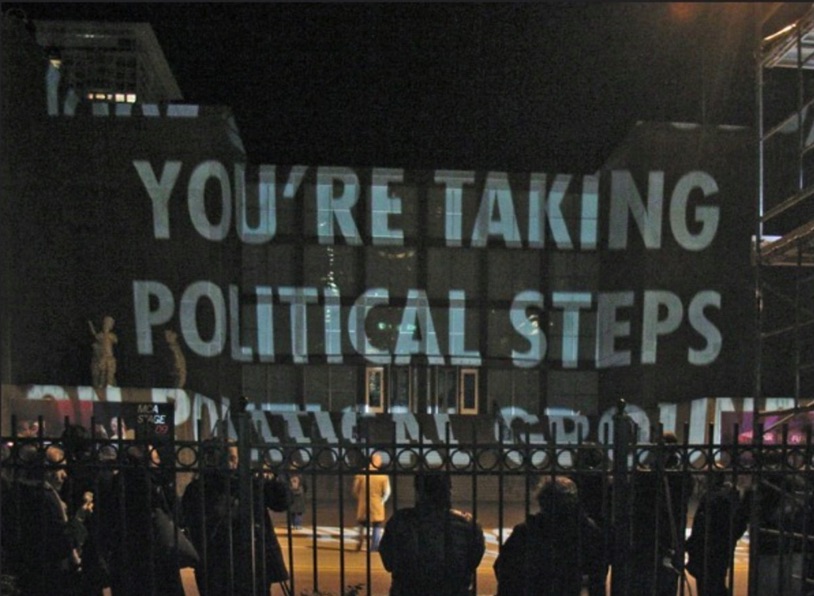
#MeToo
The final months of 2017 saw campaigns against sexual harassment in the workplace. #MeToo—initiated within the American blockbuster industry—swept social media, sending many male gatekeepers packing (for the time being). A backlash followed when a letter co-written by five French women denounced #MeToo as a reactionary regression towards an antiquated puritanism.
Beyond a conservative short-sightedness and a sexual-liberationist politics, a third group has attempted to characterize these recent episodes as constitutive of the preconditioning of power dynamics by a precarious capitalist labor market. They have, for instance, pointed to the infrastructures that produce abusive job environments, with sexual harassment as but one dominant symptom.[1] What these discursive exchanges often neglect, however, is the libidinal economy on which apparatuses of domination are founded. “Every political economy is,” as Jean-François Lyotard notes, “libidinal” (108). If we seek to analyze the entangled exchange between desire and debt-financialization through Lyotard’s optic, we encounter, instead, the limits set by the movements and countermovements #MeToo generates. This deadlock complicates the quick fixes offered so far; i.e., behavioral modifications in the workplace. In short, desire is so caught up in capitalism that it has no choice but to engage in libidinal transactions on uneven terms—even when it wants to exceed capitalism.
What does a political understanding of this libidinal economy enable? For one, such an investigation might help us realize why our need for a livable income is so susceptible to being confused with our desire to be fondled by unlovable patriarchs.[2] The sexual dynamics of power cannot, then, be separated from the career dynamics of power. The women’s testimonies are enlightening, since they voiced their concerns to the companies’ HR departments and board members (including other women in secure positions) to no avail. In better scenarios they lost their cases—not counting pockets of cash—to defense dream-teams. In a few best case scenarios they managed to settle out of court. As victorious as it may seem, this final result marks, in fact, a kind of future-fatalism in the light of careers situated in a dangerously flexible job market. The price set for non-disclosure is, strictly speaking, what plaintiffs are willing to give away of a prospective future once the Weinsteins pull their wires. We all know that the future favors the financially robust, and that both ignominy and infamy can be paid for in sweet cash—but a job lost places a sustainable existence in jeopardy.
Wage compensation is currently volatilized into deferred pledges and jackpot promises in various sectors, while job precarity overrules almost every workplace policy. A question therefore comes immediately to mind: What kind of legal framework can protect our future credibility? Because neither law nor physics can wholly rationalize an unknown future, we could consider, as the first step, a radical refashioning of the time-narrative on which our current paradigm of jurisdiction is based. According to this old-fashioned construction of time, a past event of harassment is apprehended as a backward-looking accusation. If, however, the future is relentlessly causing our present living conditions, as anxieties over job security verify, then the real question is this: How to legally engage, rather than evade, the risk-chronology of late-capitalism in which the future (or futures) always loom larger than the present or the past?
The financial sector, together with profiling technologies and preemptive policing, seem to be the sole entities that calculate the future based on present-day protocols, provoking aversion to this calculation from the technophobic left. In “The Speculative Time Complex,” Malik and Avanessian, in contrary, formulate the question emerging from this reverse time-construct as “what kind of policing is needed to apprehend people even before they do something, with what they will do—as if the future-position promises more power, which creates a future-paranoia?” (13). Precisely because such future-paranoia exists within profiling mechanisms and is indemnified and monetized via real-estate, insurance and derivative markets, it is evermore necessary to regulate such freeholds of the future’s commons in the name of social justice.
Exposure
Last year I was a participant in a group exhibition themed around the keyword Exposure. To the thematics’ credit, the show was exactly that—a platform where young artists were obliged to expose their works to the detriment of their principles. The institution being not-for-profit, the initial agreements between artists and the director/curator were couched in the vague, friendly verbalizations typical of the art world, rather than in good old written contracts. The result was a snowball effect. There were so many breaches of that initial informal agreement, so many uncalled for and unjustified favoritisms, and much patronizing manipulation of the production budget. The participating artists were not able to reach a consensus in response to these circumstances. And those of us who pursued one-on-one conversations with the director (based on principle and verbalized in civil terms) were shunned, if not bullied and verbally humiliated. We were advised by insiders in the local art scene to drop the case, and rightfully so, since this was too unsubstantial a skirmish to put our future careers in jeopardy by making a name for ourselves as “difficult”. What, at the end of the day, does a petty artist-curator brawl signify given daily global disasters, even in comparison to more immediate art world mega-affairs such as widely mediated biennials?
We could, however, argue the opposite—namely, that the informal economy of art, as insignificant as it seems next to worldly shenanigans, is exemplary of a general becoming-informal of regulatory frameworks that is itself a direct result of debt-financialization in diverse sectors. There are, however, disparities that differentiate art and industry, for example, in contrast to the corporate universe, there has never been an HR division in art. As the unabating ethos of modern art dictates, the art field routinely negates fixed institutional canons, along with their statutory supervision, while delegating corporate responsibility for the system to individual art actors. The result is the widespread substitution of an enervating personal virtue for an overarching category of social law. Because art is so good at mimesis, its current state is arguably adapting to the dominant megaform of financialization characterized by a gain-oriented deregulation minus the membrane of legal justice. Insofar as credit stands as our new physiognomy, the problems confronting contemporary art’s inner (de)regulatory structures strangely resemble those that arise from sexual-career predicaments in the workplace. Being constantly in peril of our future monetizability dictates the reign of short-sighted opportunism, which, besides weakening long-term planning, puts the servicable force of law in peril. In this self-serving cycle, an individualistic optic remains the only game in town.
Preis der Nationalgalerie
The recent edition of the Berlin-based Preis der Nationalgalerie ended on a sour note. The four artists nominated for the prestigious award—Sol Calero, Iman Issa, Jumana Manna and Agnieszka Polska—criticized the organizers, in a public letter, for extorting cultural capital from the nominees’ gender and ethnic backgrounds. The awards ceremony was further undermined by the spectacular game-show format and the failure to reward artists’ labor in Euros rather than in the speculative currency of exposure.
The nominees’ collective action is commendable, yet it is necessary to position their situation against a systemic backdrop if we are to build a constructive and polemical critique of the main points their argument rests on—namely, the competitive underpinnings of the award alongside biographic exoticizations and exploitations. The artists assert that “some conventions, which might function in the corporate world and entertainment industries, seem out of place when applied to the field of art. The award does not need to be structured in a manner that implies a sense of competition between people who are not in fact competing. Structuring it in this manner results in the creation of obstacles to solidarity, collectivity and mutual support among artists.” This characterization of the conviviality of the art field is a clear case of misallocating systemic culpability to individuals who find themselves trapped in collective pangs of conscience if they inadvertently express the dominant psychopathology of capitalist rivalry— that is, envy. Art or not, it is plain to see what the prize economy entails in this larger picture. If anything, the art field renders a starker image of competition in which the entire socio-monetary matrix is built upon a seemingly “friendly” community with very few spots around the global table—where transparency is nicknamed surveillance and deals are made after hours often over pints of beer.
Secondly, the proclaimed intentions of the award—a joint venture between a German museum-gallery complex underwritten by BMW—is taken by the nominees at “face value”: “To support and give voice to serious artistic positions and practices based in Germany.” “With this in mind,” the artists write, “we have been troubled by the constant emphasis, in press releases and public speeches, on our gender and nationalities, rather than on the content of our work.” Furthermore, “The self-congratulatory use of diversity as a public-relations tool risks masking the very serious systemic inequalities that continue to persist at all levels of our field.” This line of argument is disingenuous, as I will flesh out below, because it is based on a conception of art market that ignores class and power relations.
As a mobile social habitat and a global marketplace, contemporary art is populated by a transnational class.[3] Eco-globalization has permitted this transnational class to flatten art’s immanent class structures into one jet-set community.[4] Art’s wealth-cleansing of its own low-income subset is likewise enabled by one of its historical truisms—namely, an autonomy that manifests itself in an enmity to professionalism and the restrictive but useful control mechanisms derived from it. This enmity winds up depriving art actors of the political leverage offered by rights, lobby groups, remuneration, regulation and legal aid. The end result is that art, in refusing to be shaped by power, ends up being shaped by power. Because the transnational condition is misapprehended as devoid of a unifying class identity, contemporary art-culture misappropriates location as the segregated site of identity: city, region, sexual orientation, race, ethnicity, etc.
A concrete example: artists in the so-called “peripheries,” from Beirut to Tehran, are well-adjusted to the modus operandi of Western liberal apparatuses where biographies are endorsed, augmented, and later monetized in order to mend (and profit from) multiple colonial guilts. Alternative her-stories and purportedly minor community narratives benefit, as is well known, the center. Although fluent English, exorbitant Euro-American MFAs and a resilient passport are not prerequisites, they certainly help. Often those who work from—or between—Brooklyn and Berlin, or even Beirut, represent the art world’s tokenized Global South while voiding the term of its geoeconomic specifications. Individuals aside, it is a queer little fact that the artworld—global south or local north—is not the least troubled by this open secret. A field waving the deconstructive flags of cultural criticism, postcolonial and gender studies in particular, continually fails to rationally explain how late capitalism self-servingly compartmentalizes minorities. Hans Belting identifies this antinomy when he writes that the “global for any audience adopts a local significance”: “The sharing may be global but the owning inevitably remains local” (22).
The monumental rise in solidarity-with-my-background exhibitions flooding New York art spaces in the aftermath of the 2016 American elections is further testimony to this deadend.[5] The unspoken protocols of contemporary art make it rather difficult, not to say impossible, for young artists not identified with hetero-white-male stories to be recognized by any means other than acting out ethno-gendered-national quirks. If this kind of recognition currently underlies power, then the majority of powerful art actors almost always benefit from the reproduction of such stereotypes.[6] Stable and fixed identities should not, and cannot, however, be spurned categorically if we are to remain realists. As it stands today, self-exploitative platforms enable rare instances of agency—empowering a reflexively situated precariat to speak back to the infrastructure at large. Precisely because the center and the margin’s long-term cooperation is distributed in uneven shares, the margin needs to make the most of its prerogatives and conditioned agencies to tip the balance in its own—collective—favor. It is safe to assume that the nominees’ agreement to participate in a corporate-sponsored art contest agrees with this position, yet their ensuing criticism remains naively virtuous, or virtuously naive, in regards to their symptomatic implication in a late-capitalist regime ruled by signifiers (in lieu of labor values) and nominations—pun intended—instead of content.
Preis der Nationalgalerie 2017 therefore perfectly typifies the tired impasse of institutional critique. On the one hand, the nominees become conscious of an outside (hence an inside) to the system, yet, on the other hand, their critique of institutions cannot but become self-conscious of an irrevocable complicity. In order to take art’s institutional critique out of this historical stalemate, we need to work out a theory of post-complicity—that is, a system of concepts in which our involvement is deracinated from the guilt economy, and put into practice within a long-range political plan. Taken together, contemporary art’s tacit mode of operation is, contrary to the nominees’ claims, not much different from the corporate governance that enables sexual harassment in the workplace. On this account, a degree of transparency regarding art’s relation to business enterprises can potentially unlock a vast institutional arsenal—that is, our plutocratic field’s material resources, political clout and self-directed empowerment—with which we can begin to renovate the institution.
Strategic Genericity
The pressing question confronting contemporary art is, to state the obvious, “How to phase-shift from infrastructures that transfix us on individuality towards revised or unprecedented models of collectivity?” Gayatri Spivak’s notion of Strategic Essentialism seems helpful in this regard.[7] Strategic Essentialism is—to simplify—the temporary “essentialization” of a seemingly irreconcilable group of people—a sort of shadow-identity so to speak—enabling the achievement of specific common goals. This is a mode of identitarianism that, contrary to the current liberalization of identity politics, does not allow social agents to feel Special as dissociated Unique Individuals, but Generic Enough in order to reach a basic unanimity.
In the case of the German award, or even of the minor institutional incident code-named Exposure, it is constructive to refer to Spivak’s model—that is, to momentarily remove ourselves from the auratic “Structural Exceptionalisms” engraved into our field so as to forge a counterintuitive “Strategic Genericity”. The distinctive politico-epistemological value we ascribe to our personal practice—namely, the nominees’ appeal to their objective qualifications—doesn’t determine this game plan from the top down but insinuates itself into the gaps in a global machine that makes everything the same. Identity (from the late Latin identitas, from idem ‘same’) means, after all, to repeat the same thing. It is not a question of abandoning individual frames of reference but of recontextualizing them in strategic ways. In an industry fraught with typecasting subjectivities, exceptionalism is on a par with individualism. Its over-usage therefore risks masking the systematic identitarianism so useful to cultural capital accumulation. These mechanisms predate singular actors and are embedded in open calls, residency and academic applications, art education, all the way down to our training; i.e., how we conceive and circulate our art works in relation to our idiosyncratic backgrounds. Jodi Dean diagnoses the risk of communitarian configurations of authentic identity—ethnic, racial, religious and others—as a “displace[ment of] attention from the powerlessness of individuals as individuals to reform the systems determining their lives (systemic change requires the organized power of a group) to the wide range of opportunities for individual consumption and self-expression” (247). Because pre-determined structures are indifferent to our “differences,” we need to yet invent what we lack: an impersonal account of difference in the art field, one that stresses specificity (of practice, location, embodiment) without retailing it as identity.
Business, As Usual
Beirut, Lebanon, recently suffered a garbage crisis, a situation in which deadlocks and blockages in government (i.e., disagreements over which pockets the payoffs were supposed to line) resulted in the accumulation of uncollected garbage. As the uncivil odors, emboldened diseases and angry demonstrators increased, an anecdote exemplified one reason why protest movements tend to fizzle out. The demonstrators close in on the interior ministry, asking for the immediate resignation of the multi-party republic’s crooked representatives. They then hear one voice cutting through the clamor; sure enough, it belongs to the minister of interior making his bulky way through the picket line. “Let’s bring them down,” he croons in baffling solidarity. Such is the familiar fate of art’s institutional critique, minus the picket line and the increasing mounds of garbage. Where to redirect all the pointed fingers once the institution chimes in? Beyond pointing, it is perhaps more useful to take our involvement in contemporary art at “face value”: a form of venture-capital entrepreneurship where individuality (as artwork or as artist) is traded on a global scale in terms set by financial risk-chronology and its dangerous double-bind of payback/loss.
A clarity about our domination by capitalist paradigms can, in sum, be empowering if we choose to appropriate the tactical toolbox of the entrepreneurial class to our collective gain. Updated instruments can, in the meanwhile, only come into play in the presence of a common goal—one that cannot be built on the basis of ethno-racial-gendered particularities, even though they can be harnessed to the benefit of a master plan. That is to say, a common goal is not to be found in today’s affirmative narratives of identity, but in the embryonic space of subjectivities and dispositions located at the juncture of art and the “disruptive innovation” of business (Vishmidt 94). In so far as we discern ourselves as the automatic subjects of the institution at large we may find our common denominator in the benefactions of speculative-capitalism that capital’s own “methods of accounting” produce (Dean 201): psycho-material job insecurities, the deferral of a living wage into indeterminate futures, labor value replaced by precarious exposure, and other mainstays of the financialization of life. We are yet to invent a political theory of justice adequate to these concrete realities. Life’s abstraction and deportation into the future, however, provides the common building block of dissent. Shifting the temporal coordinates of justice may be the only possibility to cash out, in the present, on the futural accretion of our social portfolios.
Many thanks to Joshua D. Gonsalves, Ghalya Saadawi and Mirene Arsanios for their editorial insight and commentary.
BIBLIOGRAPHY
Avanessian, A., & Malik, S. (2016). The speculative time complex. In A. Avanessian, & S. Malik, (Eds.), The Time Complex. Post-Contemporary (pp. 7-56). Miami: [NAME].
Belting, H. (2009). Contemporary art as global art: a critical estimate. In H. Belting, & A. Buddensieg, (Eds.), The Global Art World: Audiences, Markets, and Museums (pp. 38-73). Berlin: Hatje Cantz.
Dean, J. (2012). The Communist Horizon. London: Verso.
Doyle-Marwick, C. (2017). The very real economic roots of #MeToo. Retrieved from https://overland.org.au/2017/11/the-very-real-economic-consequences-of-metoo/
Foster, D. (2018). If 2017 was the year of Me Too, 2018 must be the year of real change. Retrieved from https://www.prospectmagazine.co.uk/magazine/if-2017-was-the-year-of-me-too-2018-must-be-the-year-of-real-change
Lyotard, J.-F. (1993). Libidinal economy. Bloomington: Indiana University Press.
Salemy, M. (2018). End is Night. Spike Art Quarterly, 54.
Sholette, G. (2011). Dark Matter: Art and politics in the age of enterprise culture. London: Pluto Press.
Spivak, G.C. (1996 [1985]). Subaltern studies: deconstructing historiography. In D. Landry, & G. MacLean, (Eds.), The Spivak Reader (pp. 203-236). London: Routledge.
Statement by the Shortlisted Nominees of the 2017 Preis der Nationalgalerie. (2017). Retrieved from https://conversations.e-flux.com/t/statement-by-the-shortlisted-nominees-of-the-2017-preis-der-nationalgalerie/7315
Vishmidt, M. (2013). Mimesis of the hardened and alienated: social practice as business model. In T. Bazzichelli, & G. Cox, (Eds.), Disrupting Business: Art and Activisim in Times of Financial Crisis (pp. 39-57). Brooklyn: Autonomedia.
NOTES
[1] See, for instance, Doyle-Marwick (2017) and Foster (2018).
[2] In several apologias published by the accused there are frequent implications that these situations resulted from their misinterpretation of women’s admiration for their work. Respect, according to them, was inadvertently mistaken for romantic and sexual interest.
[3] In “Dark Matter” Gregory Sholette states that in the 2005 US census about 2 million people listed their primary employment as “artist”. This rise in number of professional artists challenges the historical patronage system. To climb the ladder of success, therefore, artists need financial backbone to afford years of full-time unpaid labour and self-fund their practice until they reach a minimum stability.
[4] Mohammad Salemy has recently called the global art world a cloud-based entity and a spaceship that spends more time in the air than on any local and earth-based location, forcing artists to travel all the time in order to remain relevant internationally.
[5] The post-election New York art scene simply extends the NGO-ization of critical art practices, a problematic which is beyond the scope of this essay.
[6] Moreover this overemphasis on personal biography is a useful arm of art education- commoditization, where two birds of post-Fordist mode of subject production are shot with one stone—artists are singled out (customized) and made accessible to a customized public.
[7] Thanks to Tirdad Zolghadr for evoking this important reference.