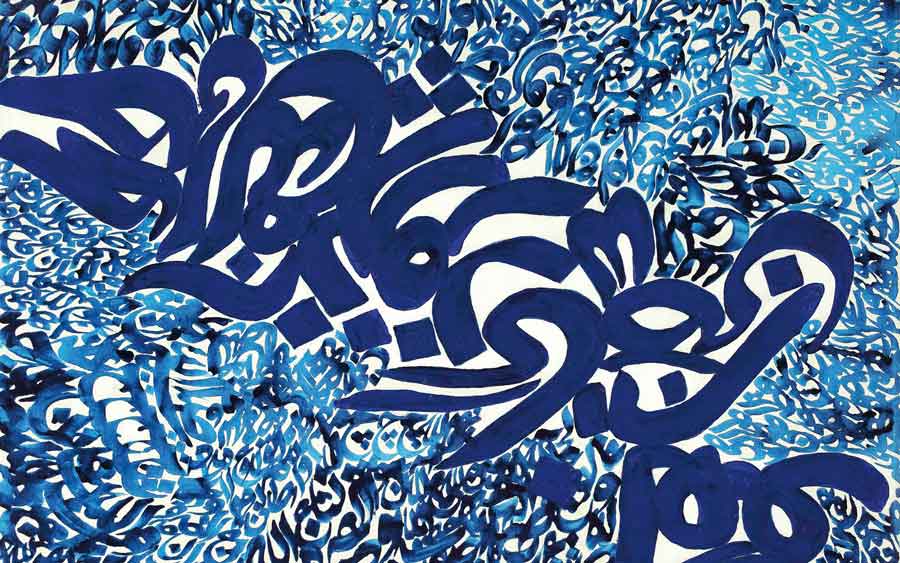
Nuqtavism was a heretical, atomist cosmology that emerged from within Islamic mysticism while simultaneously pushing it toward its limits. The endgame of Islamic esotericism was always the horrifying announcement that the mystic, through infinite cycles of ascetic self-creation and self-annihilation, had finally reached the highest point of abstraction, or tajarrud: the final release from materiality. At this moment the mystic uttered a specific cry called shat-h: “I am Allah,” or ana’l-haqq. The paradox opened into the heart of monotheism: Allah does not accept any similar deity, and this is utter blasphemy. The story of one such saint has become famous: Hussein ibn Mansour Hallaj, who was hanged on charges of blasphemy and self-divinization.
Shat-h was a result of hulul, or immanence, the idea that there is only one being in the whole cosmos, namely Allah, and every other entity is dissolved into God, like sugar in water. Etymologically hulul comes from hall, which literally means the dissolution of a solid in a liquid such as water. God is the most powerful solvent, in which all entities finally collapse and disintegrate as a way of unification, dying into infinite particles of nuqtas (literally points) while at the same time unifying with Allah.
Nuqtavism turned this into a rigorous and also fatal tactical ontology of historical immanence that saw hulul not as just a mystical threshold but as a tactical weapon to rewrite history. More than a theological deviation, Nuqtavism posed a radical question: how does history move, and how is earthly history manipulated by forces that do not belong to historical time itself? At stake was not merely the end of Islam or the birth of a new god, but the relation between local, terrestrial history and what can be called suprahistory, the occult, cosmic strata that condition historical change.
This problem was inherited from Horufism. The Horufis conceived reality as an inscriptional order: the world was composed of letters (horuf), each letter a manifestation of divinity, each entity a glyph written by God. Reality, in this view, was not substance but script. Yet Horufism remained largely metaphysical and it was only nuqtavism that radicalized it.
In Asrar al-Nuqta (The Secrets of the Point), Mir Sayyid ʿAli Hamadani explains that letters themselves are secondary. They emerge from the movement of the point (nuqta) within a supra-physical spatiality, the unseen (qayb). The nuqta is not a symbol but an operator. Its movement generates letters, forms, and ultimately worlds, much like talismans produced through occult crafts. What matters is not inscription but motion in the unseen.
Nuqtavism transformed this cosmology into a revolutionary doctrine. Mahmoud Pasikhani (Nuqtavi), declaring himself the “God of Tomorrow” (Allah-e-Farda’i), articulated a theory of adwar, cosmic cycles generated by the movement of the nuqta in the qayb. Each cycle produces a new god; history is not linear but periodically reprogrammed. His concept of istijam, often read as a return from Arab-Islamic dominance to the Ajam or Persian, was in fact a temporal operation: the reconfiguration of Iranian cosmology through control over time itself.
Nuqtavists treated Iran not as a fixed identity but as a programmable earth, open to manipulation through cosmotemporal intervention. In this sense, they were early theorists of what I call Persopunkism: a mode of thought that treats Iranian history, geography, and cosmology as hackable, occult systems governed by unseen operations. From this perspective, Nuqtavism does not belong to the past. It anticipates contemporary thought concerned with intelligence, abstraction, and the manipulation of time.
This lineage can be traced through modern Iranian thinkers such as Ahmad Fardid and Reza Negarestani. Despite their differences, all rely, explicitly or implicitly, on the twin concepts of qayb and nuqta, the unseen and the atomic-dustic, in different forms and shapes. They understand history as perpetually destabilized by qiyamas, ruptures produced by forces operating from the unseen. The primary battlefield of this cosmotemporal warfare today is technocapitalism.
How, then, should Persopunkism be situated in relation to technocapitalism in the age of the posthuman?
In Cosmopolitical Parties in the Age of the Posthuman,[1] Hilan Bensusan places Negarestani within the cosmopolitical party of Inhumanism, aligning him with an anastrophic strategy rather than a catastrophic one: the catastrophe clings to the past and fears time as destruction, while anastrophe affirms time as preparation for what must come. Iranian thought, seen through this lens, has long been divided between these two orientations. Figures such as Fardid, Corbin, Nasr, and Shayegan represent a catastrophic party of waiting and concealment, while Hurufis, Pasikhani, Negarestani, and later Shariati form an anastrophic line oriented toward intervention.
What this paper emphasizes is the Nuqtavist core of the anastrophic party, the one that is not merely mystical or revolutionary but truly cosmopolitical by offering a theory of how occult forces operate from the unseen, how history is punctured and reassembled, and how new gods, new regimes of sense and power, emerge through the movement of the nuqta in the qayb.
The Nuqtavis were Safavid-era persopunks. They presented an anastrophic reading of Iran and its core locality in the qayb. Pasikhani called himself a new god, the Allah of tomorrow, whose hand is the architect of destiny. The Nuqtavis were persopunk thinkers who created an atomism in order to invent a new history and a new cosmos. This atomism hides only to rise again in the occult-Islamic atomism of Cyclonopedia. But in order to see the core axioms of this atomism, let us take a look at Asrar al-Nuqta by Hamadani.
Hamadani induces a movement into the heart of Islamic divinity. For him, relying on Ibn Arabi’s bateni reading of Islam, being is made of the letters of Allah, or the horuf, and each letter, or harf, is made of nuqtas, produced as a result of the movement of the nuqta, the emblem of unity and monotheism. The nuqta is an operator moving in the darkness of the qayb that creates multiple worlds and cosmoses by moving. Nuqta is the point where our seen, or shahada, world verges on the qayb, the unseen cosmic realm where Allah resides. With each movement, the nuqta or point produces different qiyamas, a notion to which we will return shortly, and death-rebirth cycles. In other words, it uses the darkness of the qayb to turn the wheel of cosmic time toward a new era.
In Asrar al-Nuqta, Hamadani shows the different movements of nuqta and connects them with colors of death. According to him, nuqta is “the secret to the absolute qaybic entity,”[2] the first determination that fuses unity and plurality; it is Allah, present in the genesis of all things; it is the continuation of the divine breath (nafas-al-rahman) that turns into letters as entities.[3] He explains how nuqta has levels: before extensity it is in the state of unity. Then the breath begins to turn the nuqta (point) into a letter, and finally the ultimate form of nuqta is “the determination of the spiritual nuqta,” which is the act of “the wind of God blowing from the qayb of luminous determination.”[4] Here nuqta acts as a paradoxical point where the light of God and the darkness of qayb meet: this is how beings are created, and the god-nuqta is multiplied into atoms that create beings. Monotheism goes through the ecstasy of the qayb and opens “the gates of possibility.”[5] Nuqta is present in each entity; the first and the last, the zahir and the batin, the seen and the unseen, converge here.[6] Nuqta is beyond physical spatiality; it is circular in shape, which shows both the perfection and the circularity of time.[7] It moves in different paths and shapes, and the cosmos is like a circle with nuqta both at the center and on the periphery.[8] The nuqta is where the occult and the qaybic infuse the seen and the luminous.[9] The movement of the nuqta in qayb causes multiple qiyamas that gradually break down everything into God: from the apocalypse to the qayb of malakut and the qayb of jabarut.[10] God breaks into nuqtic dust until it reaches the lowest of the low: the nasut.[11] This is how Hamadani weaponizes immanentist monotheism.
What is qiyama? According to Negarestani, qiyama is connected to jihad: the advent of the apocalypse. The nuqta is a jihad-accelerator in the qayb, or the cosmic desert of the occult. In other words, it is a cosmopolitical force in the cosmotemporal warfare that accelerates qiyama. Qiyamas are not only temporal agents of disruption but also cosmopolitical forces in the cosmotemporal warfare that produce temporalities via resurrection and resetting the game. It collapses temporality:
“For Islam and Capitalism, the end of time is mapped through chronological disunity on the helical-machinery of the corkscrewing motion. The end of time always emerges from the other side: while the techno-capitalist chronosphere harbors a chronological cataclysm for the Islamic front, Islam’s chronopolitics — saturated by the timeless desert of Qiyamah (Islamic momentary apocalypse which is constantly active and present) — is the cancelation, not merely of the technocapitalist chronosphere, but of western Time.”[12]
How can Islam defeat technocapitalist temporality? Where should Islam hide in order to do so? In the qayb, and via hypercamouflage.
The main strategic component of jihad as a cosmotemporal movement is relying on taqiyya or hypercamouflage: a tactical weaponization of the qayb or the unseen, a force in the qaybic geopolitics. In Negarestani’s terms the qayb is the zone of occultural traffic,[13] and to be in the qayb means to be in the presence of occult entities; this is taken in this paper as a definition of the qayb as a cosmic locality. The main point is that Negarestani takes this not as a philosophical concept but as a cosmotemporal attack on the cosmopetropolitics of capitalism: the qayb erodes the state’s border and reinvents it as a field of vortices unloading occultural heterogeneities into a state.[14] I claim that these heterogeneities are the horuf produced by the cosmic movement of the nuqta moving cosmically through infinite qiyamas.
Cyclonopedia is a neo-Nuqtavist cosmic cryptogram, or in other words a telesm or talisman. The attack of the occult particles[15] as occultural saboteurs can be explained as the occult-militarized reinvention of Nuqtavism: particles of the occult are nuqtas, the entities of the outside, like the djinn. They erode the borders of the state, explains Cyclonopedia, the dark necronomicon, the persopunk, neo-Nuqtavi telesm or occult sigil. The book is an occult device or weapon, just like the Nuqtavi and Horufi heresies. It connects the earth with the entities of the outside, which is another name for qayb.
Dust in Negarestani’s cosmology is the Nuqtavi agent par excellence. The war on terror, he explains, is riddled with ancient crypts saturated with occult geometries[16] or horuf-letters used in an occult telesm. Telesms or talismans are connectives to the outside, or, as the title of the main manuscript by Pasikhani, Mafatih-al-qoyub, the keys to the qaybs or outsides.
What are the cosmopolitical functions of telesms? As said before, they are occult devices, the best example of which is the Cross of Akht in Cyclonopedia. Akht was a magician, an engineer of dark forces, an occult saboteur. He made a telesm similar to another cosmic device called the Haftvad device, which was a kind of cross with two handles as cosmic operators. This was not the sun or the Zurvanite device, and is not related to light (some might say Akht is derived from Akhtar, meaning Star) but to pestilence and dark forces of the occult. These are Nuqtavi pests, telesmatic weapons that, according to Negarestani, “awaken,”[17] as one awakens the djinn, the cosmotemporal hidden-agent of pestilence and junun: when the djinn hits a person it acts as a “storm of incoming junun and djinns, demons and sorcerous particles of all kinds, making the man a traffic zone of sweeping cosmodromic data.”[18] What Negarestani is explaining is a very lucid Nuqtavi principle. The Nuqtavi-dustic device in Cyclonopedia operates by naft or oil: the highest occult entity that resides, like the worm of Haftvad, in the heart of the Earth. It is an inorganic demon, an occult-telesmatic device, a qaybic, cosmotemporal device, a Nuqtavi weapon, as I call it. It is a sentient agent whose job is to make anomalous narrations.[19] It lubricates by oily devices that ooze from the outside, or, as I say, the qayb. The devices act as persopunk spies who navigate the qayb, the heart-desert of the occult: Heart of Darkness. This is why, according to Negarestani, oil is the narrative organizer of darkness,[20] and all darknesses are reflected in oil.[21] Each particle or nuqta of dust carries infinite darkness within itself,[22] thus making it an occult telesm. Darkness is the essence of the occult telesm. The telesm is a “crystallised data-base,”[23] an occult narration that, in my terminology, uses the Nuqtavi device in the form of what Negarestani calls “interstellar dust formations.”[24] The Earth is “shelled” with cosmic darkness, or a shield: this shield is a qaybic locality, a Nuqtavi ambush or sietch (the Quran calls it mirsad, the divine ambush) in the darkness of the oily qayb, creating an occult trajectory that oozes qayb into the seen, the path; then it magically hits a village with the wind of the djinn (as is well known in the southern parts of Iran): winds bring outsider elements[25] because they are winds of nuqtas, Nuqtavi agents, djinns in the cosmic desert, inhuman cosmic flows that cause cyclones, cosmic spirals that both converge and diverge.[26] In Nuqtavi terms, this is the movement of the nuqta in the qayb, a qaybic cyclone that creates histories and cosmic nodes beyond the earth and its solar pit, where the telesms perform what I call “the cosmotemporal Nuqtavi coup.”
Asrar al-Nuqta explains that the way to enter the qayb is to infiltrate it through a series of different-colored deaths, where each death is a tunnel toward the desert of qayb. Tunnels, to use Negarestani’s terms, are cyclones connected to a corkscrew, let us call it a whirling nuqta, a dustic atom that carries the power of disintegration.[27] In Persopunkism we call them occult-nuqtic telesms that infect each and every solid with atoms of decay,[28] with the force of the qaybocosmic occult. Decay is an agent of the qayb, an evil device of the occult, which is also “the decaying entity.”[29]
If in Negarestani’s Persopunkism darkness or the occult are forces that erode the stability of the cosmic whole,[30] nuqtas in this sense are both hole and whole ((w)hole): as Hamadani shows, the blasphemy of Nuqtavism comes from its unification of the seen and the unseen through the nuqta. Negarestani calls this erosion via blasphemy “the monotheist return.”[31] It is a return to paranoia, but in a blasphemous point, let us say: in the nuqta as the point of blasphemy. This is why all the Nuqtavis were massacred by the Safavids. Nuqta is what Cyclonopedia calls the avatar of the Outside[32] in atomic scale, which the Nuqtavis turned into an occultural device against the Earth as the ultimate Cosmic State. (This is where Cyclonopedia shows how genre matters: from Nuqtavism to the dustism of Dune. I call this a move from petropunkism to Persopunkism.)
Mahmoud Pasikhani was a complex persopunk insurgent. He was a heretical disciple of the Horufi master Fazlallah Astarabadi, both from northern Iran. Pasikhani was excommunicated even by Fazl, who was himself hanged on charges of hulul heresy. Some say Mahmoud threw himself into tizab, or acid, at the age of thirty-one as an act of self-annihilation in order to reach absolute hulul. During the two centuries after his death, the Nuqtavis were under severe repression from the Safavids, who saw them as dark occult magicians aiming to overthrow the empire. They were not mistaken, since the basis of the Nuqtavi ontology is that the era of Allah is over and now every nuqta or atom is God.
Mahmoud had his own Nuqtavi style of interpretation. He took the Quranic verse “And We will resurrect/raise you into a maqam mahmud, a station of praise, distinction, and authority” to refer literally to himself as the new god. The same blasphemous idea was turned into a poem: “Run from Muhammad into Mahmoud, since the latter contains more than the former.”[33] He saw Muhammad and Ali as atomic-Nuqtavi constructs who later disintegrate into Mahmoud.[34] He called himself, the new god, “the luminous compound” (morakkab-al-mobin) and also “the essence of the square” (zaat-e-morabba) that contains the four elements in a nuqta.[35]
Shah Abbas Safavi massacred the Nuqtavis of his time, and he is said to have done this after he learned and weaponized their doctrines. While he was on his way to Mashhad to pray at the shrine of the eighth Imam, a Nuqtavi dervish told him to stop and instead pray at the house of “the living Imam.” When the Shah asked him who the Imam was, he pointed at himself. The Shah, who was fascinated with the new invention of the weapon using bullets, said he would believe him to be the Imam only if he survived the bullet, and he killed him. Before being executed, the dervish noted that not even the Imams were safe from death.[36]
According to the Nuqtavis, being is always a complex of atoms, which is the main particle of being. This gave them a way to show how even man and God are not that different; they are both made of nuqtas.[37] Their critics emphasized that their atomism could not explain intellect or intelligence, which is not materially constructed,[38] but the Nuqtavis insisted that they were materialists while also believing in tajarrud as a construction of atoms.[39]
The Nuqtavis wrote in an occult style. For example, they used different combinations and designs of points (nuqtas) in their writing to show God, man, and other entities. Using four nuqtas in the form of a square showed man as the fourfold essence, or zaat-e-morabba,[40] revealing how everything is made of atoms and the four elements.
The Nuqtavis also believed in a specific cosmohistorical account of creation. In an occult script said to be written by a Nuqtavi thinker at the time of Pasikhani himself, the writer replies to several questions about their ontology. He says that, according to the Horufi alphanumeric system, the name Muhammad equals twenty-eight and is thus equal to the number of the moon. Mahmoud, whom he calls “the last one” (shakhs-i-akher), equals a higher number, that of the sun. The nuqta, the new god, creates adwar, or time units: days, weeks, months, years, centuries, and millennia, and he calls Mahmoud “the king of the millennia” (padishah-e-hezarreh).[41] He also notes that, since the Farsi alphabet has four more letters (گ چ پ ژ) than the Arabic, this shows that the dawr, or age of the Arab, ends and the age of the Ajam begins: this is the Nuqtavi doctrine of istijam, or turning toward the Ajam and away from the Arab.[42] He calls Mahmoud “the Sun rising from the West” or “the Ajami Sun.”[43] This obviously points to the Zoroastrian sun.
He says that Muhammad awaited the Sun rising from the West at all moments of his life[44] and believed that he himself was the moon, and that the Sun to come, namely Mahmoud, was “in the qayb” and is “the king of the last hour,”[45] the one who accelerates the qiyama. Every entity, according to him, is nothing but the rays of his light; everything is but the atoms of the Earth, lit by his face.[46] He is God but with no hijab; he is the qayb being exposed.[47] Unlike all the other prophets, who were stars, Mahmoud is the Sun.[48]
The rise of Mahmoud is the qiyama, or, as Hamadani showed, one of the qiyamas:
“A day will come when mountain and plain are reduced to fluffed dust and pulverized, when the stars, the moon, and the sun enter eclipse and occultation; when all things break apart from themselves and are shattered. Heaven and earth will be rolled up like the scroll of a scribe, and the Possessor of the cry “To whom belongs the sovereignty?” will turn all with a single finger. Earth and sky will intermingle. This whole matter may be the greatest of tidings: that whenever the promised last person appears, he comes in his very self as water, earth, air, and fire; and he affirms—by his own self, which is water, earth, air, and fire—that God, who is the First and the Last, the Manifest and the Hidden, is none other than this very self. And he affirms that to conceive of anything other than this mentioned One—who is myself—is impossible, inconceivable, and improper. Indeed, whether it be the sun or the moonlight, it is impossible to find things as they are; but if you assign them a condition in relation to the lunar, then you will find all things—relative to this mentioned manifestation—in eclipse and occultation, in dispersion and splitting, in pulverization and explosion, fluffed up and scattered. That is, you will find all things absorbed into themselves, shattered, and dispersed; and you will find no manifestation except the effect of the One effective Agent, whom you will not find apart from Him. The Striker! What is the Striker? And what will make you know what the Striker is? All things will be found like scattered locusts, like fluffed wool, like dispersed locusts; and in comparison with the last person—namely, Mahmūd ‘Ajamī—they will be like airborne particles, bewildered and involuntarily revolving near the rising sun. The sun rises from the west, and all the first and the last, before the manifestation of his light and radiance, become like particles turning upon the face of the sun—by the extremity of his manifestation—absorbed, shattered, insignificant, and without volition.”[49]
Nuqtavi monotheism is a monotheism of locusts as atoms or nuqtas, from Mahmoud Pasikhani to Reza Negarestani:
“Pazuzu’s anthropo-insectoid body bears the black humor of all bodies it overruns, strips naked of flesh, all the bodies chewed and peeled off by a sky-blackening swarm of locusts, by the hurtling body of Pazuzu, dehydrated and reduced to a twisted spectre of bone and wrinkled skin. Make yourself many, like the locust! Make yourself many, like the swarming locusts!”[50]
Persopunkism asks about the nature of these particles, whether nuqtas or locusts or dust particles: how can “the journey to the outside”[51] or the occult movement of qaybocosmic particles be accelerated? In other words, how can we blasphemize Fardid’s Horufism with post-dustic Nuqtavism in the cosmotemporal warfare going on through the winds of the occult or the qayb?
Persopunkism names that the unseen is a battlefield, not a waiting room but a manipulable terrain. As Pasikhani explained, the current era is a qiyama that exposes the qayb or batin: “become naked!”[52] and see “the laughter of the Allah of tomorrow.”[53] The nuqta is the exposure of the qayb: “come like the nuqta who is naked.”[54] Mahmoud emphasizes that the Allah of tomorrow is here and the qiyama is on the horizon, which means all dustic nuqtas are Allah now. Against catastrophic nostalgia and libidinal acceleration alike, dustic Nuqtavism affirms intelligence as the capacity to tunnel, to perforate, to open qiyamic apertures inside history itself. The nuqta no longer signifies unity or origin; it operates as an insurgent operator, a blasphemous hinge where shahada and qayb contaminate one another. Cyclonopedia does not merely describe this contamination, it performs it, functioning as a telesmatic weapon that unleashes occult particles, winds, oils, and cyclones as agents of cosmotemporal sabotage. In this sense, Persopunkism is neither mysticism nor theory but a strategy of adjacency: standing in the qurb of the unseen while intervening in the visible, accelerating not capital but apocalypse, not desire but intelligence. History fractures where dust circulates. Gods mutate where nuqtas move. And Iran, no longer a homeland or essence, reappears as Iranveij: a desert of intelligence, riddled with tunnels, ambushes, and cyclonic exits, where the future is not awaited but engineered from the heart of darkness.
Notes
[1] Bensusan, Hilan. Cosmopolitical Parties in the Age of the Posthuman. Triple Ampersand (&&&). https://tripleampersand.org/cosmopolitical-parties-post-human-age/.
[2] Hamadani, Amir Seyyed ʿAli. Asrar al-Nuqta [The Secrets of the Point]. Translated into Persian by Mohammad Khajavi. Tehran: Mowla, 2000, 8.
[3] Hamadani, Asrar al-Nuqta, 6–10.
[4] Ibid, 15.
[5] Ibid, 20.
[6] Ibid, 21.
[7] Ibid, 27.
[8] Ibid, 33.
[9] Ibid, 34.
[10] Ibid, 49.
[11] Ibid, 53.
[12] Negarestani, Reza. Cyclonopedia: Complicity with Anonymous Materials. Melbourne: re.press, 2008, 97.
[13] Ibid, 94.
[14] Ibid, 94.
[15] Ibid, 94.
[16] Ibid, 95.
[17] Ibid, 28.
[18] Ibid, 132.
[19] Ibid, 29.
[20] Ibid, 35.
[21] Ibid, 35.
[22] Ibid, 101.
[23] Ibid, 101.
[24] Ibid, 101.
[25] Ibid, 112.
[26] Ibid, 52.
[27] Cyclonopedia, 192.
[28] Ibid, 192.
[29] Ibid, 192.
[30] Ibid, 192.
[31] Ibid, 192.
[32] Ibid, 105.
[33] Kia, Sadeq. Nuqtaviyan ya Pasikhaniyan [The Nuqtavis or the Pasikhanis]. Tehran: Iran Kudeh, 1941, 19.
[34] Ibid, 20.
[35] Ibid, 20.
[36] Ibid, 23.
[37] Ibid, 24.
[38] Ibid, 28.
[39] Ibid, 28.
[40] Ibid, 32.
[41] Ibid, 76.
[42] Ibid, 76.
[43] Ibid, 76–77.
[44] Ibid, 81.
[45] Ibid, 81.
[46] Ibid, 83.
[47] Ibid, 85.
[48] Ibid, 86.
[49] Ibid, 89–90.
[50] Cyclonopedia, 125.
[51] Cyclonopedia, 205.
[52] Nuqtaviyan ya Pasikhaniyan, 93.
[53] Ibid, 94.
[54] Ibid, 94.
References
Bensusan, Hilan. “Cosmopolitical Parties in the Age of the Posthuman.” Triple Ampersand (&&&). https://tripleampersand.org/cosmopolitical-parties-post-human-age/.
Corbin, Henry. Islam in Iranian Land: Spiritual and Philosophical Aspects. Translated from the French. London and New York: Routledge & Kegan Paul, 1971–78.
Corbin, Henry. Spiritual Body and Celestial Earth: From Mazdean Iran to Shiʿite Iran. Translated by Nancy Pearson. Princeton, NJ: Princeton University Press, 1977.
Fardid, Ahmad. Gharb va Gharb-zadegi [West and Westernization]. Tehran: Forno, 2016.
Hamadani, Amir Seyyed ʿAli. Asrar al-Nuqta [The Secrets of the Point]. Translated into Persian by Mohammad Khajavi. Tehran: Mowla, 2000.
Kia, Sadeq. Nuqtaviyan ya Pasikhaniyan [The Nuqtavis or the Pasikhanis]. Tehran: Iran Kudeh, 1941.
Negarestani, Reza. Cyclonopedia: Complicity with Anonymous Materials. Melbourne: re.press, 2008.
The Nuqtavis (Noqtaviyan): Texts on Nuqtavi Doctrine and History. Tehran: Asatir, 16th–19th centuries (compiled editions, n.d.).