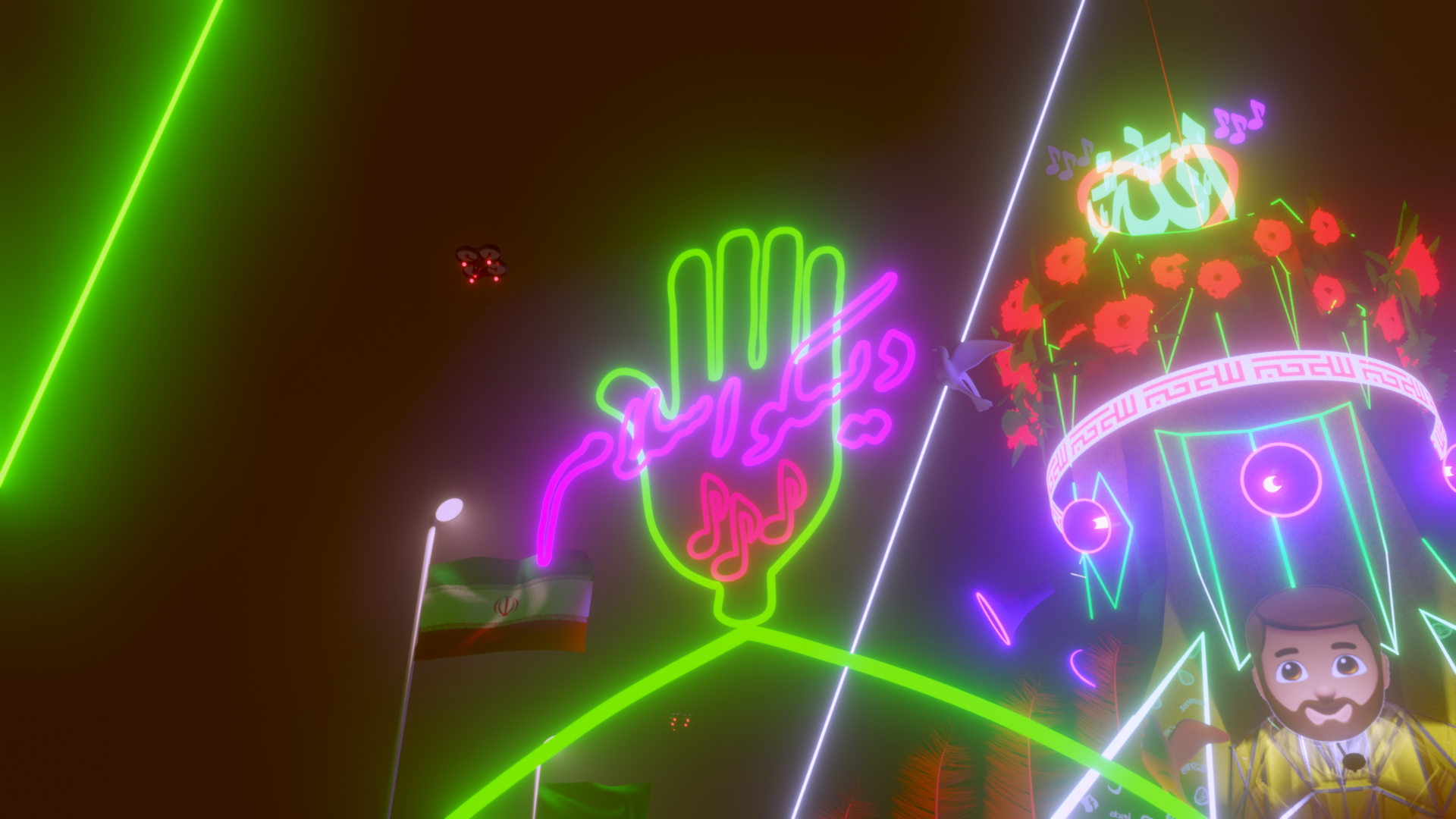
When I left Iran more than a decade ago to end up as a refugee in the UK, I never imagined I’d be navigating the boundaries of my artistic freedom amidst a censorship war between the hard-left and the far-right. I came to the UK in 2011 and after spending 27 years of my life in one of the most repressive countries in the world – a nation governed by Islamic law that seeps into every aspect of daily life. A country that imprisons artists and journalists, beats and jails women for not wearing the hijab, shoots protesters in the head, coerces gender reassignment on homosexuals, stages public hangings, promotes superstition and pseudoscience on state television, and ranks among the world’s worst violators of human rights. A regime that, in January 2026, launched its most brutal and deadly crackdown yet to maintain an uncompromising grip on power, massacring tens of thousands of protesters in just two days and enforcing the third‑longest nationwide shutdown on record at the time to conceal the death toll.
I left Iran during another bleak – though less vicious – period following the collapse of the Green Movement, when resistance to the regime’s brutality felt impossible and any hope for change seemed completely extinguished. In the UK, through my art and my engagement with diaspora media, I continued to fight for freedom and transformation (the very reasons for which I also cannot return to Iran). And yet, I must admit that on numerous occasions, I’ve found myself reflecting on how the treatment I’ve received from the art world – its silencing, its evasions – echoes, in essence, the same censorship I experienced back in Iran. And in case you’re wondering, let me tell you why.
In October 2022, I received an email from a member of the New York-based art collective DIS, whose work I have long followed and deeply admire. DIS uses the aesthetics of advertising, fashion, and pop culture to reveal contemporary art’s complicity with the financial mechanisms of late-stage capitalism. The email I received was in response to a request to have a film of mine considered for their platform, DIS.ART. Their reply read: “Thank you for your interest and appreciation, and thank you for sharing your work. I don’t know if it’s exactly right, or right for now, with the current environment, but I really enjoyed it.” The film in question is a work of mine from 2020 titled Disco Islam. I describe it as a sci-fi “corporate video” promoting a hyper-neoliberal fictional nightclub from a future Iran. Disco Islam appropriates the visual and rhetorical language of corporate promotional media – much like the strategy employed by DIS – in order to examine a dominant political discourse in Iran during the 2010s.
To better understand that period, I need to give you some context from the previous decade, the 2000s. It was a pivotal time when over twenty years of totalitarian cultural control following the 1979 Revolution began to erode, largely due to the rise of satellite television and, even more importantly, the internet. As blogging boomed in Iran, artists like myself began using digital platforms to access global culture and express ourselves beyond state censorship. This was the spirit which created the conditions for the Green Movement, and the Arab Spring across the region, and cycles of socio-political unrest since (including the Woman, Life, Freedom movement in 2022).
In the 2010s and while I was in the UK, Iran sought through the nuclear deal (JCPOA) to lift sanctions tied to its nuclear program and human rights record, hoping to reopen the country to the global capitalist economy. Western countries embraced the deal as access to a long-closed market, guided by the neoliberal belief that market liberalization would foster democratic and human rights reforms. This approach extended into the cultural sector as well, where a cautious reopening of previously banned or restricted forms – art, music, cinema, fashion, theatre, literature – was underway. Even Tehran’s gallery scene became more active, with the art market beginning to attract growing international attention. This limited cultural thaw was less a sign of liberalization and more a calculated gesture to support the image of a reformist, business-ready Iran. During those years, I observed from afar as individuals from the private sector with ties to the government suddenly rushed into the arts, eager to exploit its (mostly) financial potential. The impact of this shift was not only the gentrification of resistance spaces and the neutralization of artistic dissent, but even serious allegations of money laundering, as galleries emerged overnight backed by vast sums from unclear sources. I watched as many artists gradually gave in – some under financial pressure, others perhaps with genuine hopes for change, and some simply riding the wave.
The point is that these contradictions – between resistance and cooption, autonomy and complicity – and, more broadly, the impact of neoliberalism in Iran and the Middle East, have been central to all of my work since around 2017. In my 2020 film Disco Islam, I explored neoliberal dynamics in Iran through a futuristic setting where the nightclub – once a symbol of freedom – becomes an empty spectacle stripped of its subversive potential. By blending corporate aesthetics with Islamic kitsch and portraying indigenous culture as a commodity, my aim with Disco Islam was to reflect upon the political discourse in my country during the 2010s.
When I asked DIS to clarify their response – specifically, what “current environment” made my film not “exactly right” – I never received a reply. To be honest, I wasn’t surprised. Since completing Disco Islam, I had received many rejections from festivals and events that claimed to champion similar themes and amplify voices from the Global South. In fact, I had started investigating why the film was proving difficult. I experimented by editing out segments that might provoke anxiety for decision-makers which worked at a few instances. I reached out to a friend in Germany who was on the judging panel for one of the festivals to figure out that the panel had avoided selecting Disco Islam out of fear that engaging with it might jeopardize future opportunities in Iran. By fragmenting the film, I was able to present it as an installation, mostly at artist-run project spaces and venues outside the flagship spotlight. When I was eventually selected by Eastside Projects (an artist-run space in Birmingham) to develop a show based on the film – thanks in part to the support of a curator-artist from an ethnically proximate background – we had to hold a special security meeting, anticipating the possibility that my live performance, which was a deconstruction and commentary on the film, might trigger an unexpected reaction from the audience.
Later on and in 2024, I was generously invited by one of the Jameel Prize curators to submit my work for the seventh edition, which focused on moving image works from the Middle East. I later learned that my submission made it to the final stages of the shortlisting process – only to be deemed “divisive.” A person closely involved with the prize, told me candidly later on that the core dilemma was this: how does one engage with a work that raises sensitive critiques without risking the reinforcement of Islamophobic tropes? And so it seemed, the safest option was to erase the difficult question instead of confronting it.
I understand and appreciate that the Western world – especially the UK and the US – is currently going through a phase where it must confront the traumas of its imperial and colonial past. I fully recognize that this near-perfect utopia (as it appears to us in the Global South) was built hand-in-hand with the savagery, violence, and exploitation that capitalism – and its bastard child, racism – have inflicted. I’m also keenly aware of the fragile foundations on which the legacies of the Enlightenment rest, and of the many valid critiques they face today. And I understand that speaking about human rights, secularism, and democracy is considered unfashionable – perhaps even naïve – in many contemporary art and academic circles. But as someone who comes from a place where we’ve spent our lives fighting for precisely those values, giving in to the trends and pressures of the Western art world would feel like the easiest – and laziest – thing I could possibly do. Especially now, as we witness how a toxic mix of neoliberal careerism and what the Iranian philosopher Reza Negarestani calls “Kitsch Marxism” has led to a widespread erosion of political trust, extreme polarization, and a growing disillusionment with the very idea of meaningful change.
I’ve observed how artists at various stages of their careers engage with these themes and topics, much like investors in the stock market – strategically positioning their work where cultural capital yields the highest returns. I’ve seen individuals who, from a Global South perspective, are thoroughly embedded in Western privilege, carefully curating their identities to present themselves as anything between the ultimate victims of the world, to visionary messiahs from the margins. I’ve seen individuals present a distorted, detached portrayal of a marginal culture in ways that strikingly mirror the tactics of classical orientalism, echoing the very tropes they claim to resist. I’ve watched people whose day-to-day lives are shaped by cutthroat competitiveness or inherited wealth – often cloaked in the language of decoloniality and identity politics – sell themselves as moral authorities and ethical gatekeepers. And I’ve also seen rich artists from the Global South – often more privileged than most working-class or many middle-class Westerners – celebrated by curators simply for referencing their identity or brandishing grand decolonial claims. I’ve spoken to someone who didn’t know the meaning of the word “altruism” while working – loudly and self-congratulatorily – for one of the most successful altruistic art collectives of our time. I’ve sat with people who showed little to no empathy in their personal lives, yet ruthlessly built academic careers on “challenging colonial power structures.” I’ve seen artists brazenly present themselves as radical “disruptors” while being paid by the very institutions they claim to be disrupting – to stage exhibitions about decoloniality within those institutions. I’ve watched the phrase “compulsory hijab” in the context of Iran get softened into “involuntary hijab,” as if to make its violence more palatable to academic and art-world sensibilities. I’ve seen nearly everyone I know from Iran reshape their practice – consciously or not – around the vocabulary of decoloniality, simply to keep their institutional patrons happy. And I’ve watched those institutions – big and small – welcome them with open arms, propelling careers to dazzling heights, handing out status and stipends in a defunded, hyper-competitive industry desperate to look good. I’ve seen the favouritism, the red carpets rolled out, the entire charade. I’ve seen it all. Haven’t you perhaps too?
Because at the same time, I’ve seen – again and again – how truly marginalized voices from the Global South rarely get the chance to even catch a glimpse of the art world from the inside. How the current money-based border regime ensures that access is reserved for those with wealthy parents, or for the select few invited to serve powerful institutions – usually under neat, strategic banners like “decoloniality.” And I’ve experienced firsthand how topics that diverge from decoloniality, pose a critique of it, or sit outside its normative frameworks only become palatable to the Western art world when kept at the safe distance of “network talk” and studio visits – pleasant, conceptual, unthreatening. And how this ongoing lack of recognition and representation seeps into your work and life, both materially and spiritually – especially in these zombie neoliberal times, when public infrastructure for the arts has been gutted by austerity, defunding, and relentless market logic.
Unlike many diasporic artists, I didn’t leave Iran to pursue a career in the arts. Raised by a family of communists and deeply influenced by my poet father, art emerged to me not as a profession but as a natural extension of a desire for freedom – freedom from thought control, religious repression, superstitious irrationality, gender bias, injustice, inequality, discrimination, and beyond. I still remember telling my parents, in my early years in the UK, about the sweet, almost intoxicating sense of what freedom and democracy could truly feel like. But now, more than a decade later, the structures of the art world have offered something quite different: not liberation, but a new set of constraints. I received the DIS email just over a month after the Woman, Life, Freedom movement erupted in Iran – a feminist uprising sparked by the death of a 22-year-old woman who died in the custody of Tehran’s “morality police” for allegedly wearing her hijab improperly. A movement that united Iranian society more strongly than ever – from women and youth to minorities, artists, and workers, all joined in a shared demand for freedom and dignity. And I understand that a protestation of hijab may sit uneasily within the Western constructed discourse of Islamophobia, but shouldn’t at least we, the so called “Muslims,” be able to speak about our own lived-experiences and realities, freely and openly? Secularism in the West has such a long history that most people take it for granted, but imagine if discussions of abortion or same sex marriage were censored or banned simply because they might discomfort Christian communities. And that’s not to mention the fact that the Church holds no power over the state.
The project of decoloniality explicitly (and quite rightly) sets out to challenge Western-centrism and amplify marginalized perspectives. But in practice, it often appears more concerned with doing so on its own terms – selectively and narcissistically. In other words, it seems more interested in elevating those voices from the margins that conveniently reinforce the authority and legitimacy of its own institutional frameworks, while strategically disregarding or shutting down any criticism that might challenge or jeopardize the dominance, integrity, and prominence of the theory itself. I often wish the Western art world were less decolonial in rhetoric and more decolonial in practice – making space for urgent, complex conversations from the Global South to enter public discourse, even when they are uncomfortable or difficult. Instead, these voices are too often brushed aside, evidently leaving a vacuum swiftly filled by far-right forces, deepening cultural divides and accelerating the catastrophic collapse of democracy, freedoms, and basic human rights worldwide.