Before I went to Venice I thought I’d try a travel diary, but that’s not how I like to write and it’s what everyone does, i.e. deferring the responsibility of coming to any conclusion about the Biennale as a whole by giving a first-person account of how utterly chaotic preview week was. I wasn’t at the previews, thankfully, but I’m sure it was; writers who get thrown into the fray and have to produce something out of it on an obscenely short deadline have my sympathy. The masochistic ritual of frenetic drinking, schmoozing, getting intercepted by an acquaintance that drags you to a crowded opening for an artist whose name you didn’t catch, vaporettos, too much walking, jet lag, etc. etc., serves to turn Venice into the art world’s luxury version of summer camp or a high school reunion, which works quite well for manufacturing a sense of significance by means of endurance irrespective of the actual art being exhibited. The Olympics has its opening ceremony and Venice, “the Olympics of art,” has preview week. But where big choreographed dances (and athletics in general) are at least inherently impressive feats of skill, art, to say nothing of art world people drinking Aperol and posting Instagram stories, has no guaranteed appeal to anyone, participants included.
If there’s been anything noteworthy about Venice this year it’s only been the inability of the system to keep up its veneer of decorum and significance. There’s the ongoing controversies about the participation of Russia and Israel, the jury resignations, the artists protesting and withdrawing from the “Visitor Lion” that’s supposed to replace the jury’s Golden Lion, the general unease at Alma Allen representing the Trump admin for the U.S. Pavilion, the Russian Pavilion willfully bungling their entry by just doing some live music and vodka shots open only for preview week, Gabrielle Goliath being pulled from representing South Africa because her work referenced Gaza, and I’m sure I’m forgetting more. Oh yeah, someone took a shit in the pee-only porta-potty in Florentina Holzinger’s Austrian Pavilion installation that pumps the urine into a tank with scuba diving performers.
All this messiness is bad enough, if unsurprising considering the state of the world, and what’s worse is that the reception of the Biennale in general has been palpably negative. I can’t say that I’ve scoured the reviews, but that a usual punch-puller like Artforum mostly couldn’t summon anything nice to say in its coverage seems to me like enough of a sign that even the most fundamental edifices of contemporary art can’t keep up the charade anymore. It seems pretty obvious that Artforum‘s new co-editors are trying to shake the wooly old thing out of its senescence, what with the open negativity and them letting Theo Belci write about the art young people actually care about. I’m not holding my breath on a real comeback, if only because I don’t see magazines coming back in general. It’s still refreshing to see them try; Rachel Wetzler’s article made a couple of salient points, which is more than I’ve come to expect from the magazine. Her first point is that the Biennale’s curator, Koyo Kouoh, had only prepared an early draft of the show before her sudden passing, and it still needed a lot of work, but the remaining curatorial team’s reverence for her memory precluded any tampering and thus doomed the show. Second, the failure in general looks like a sign of the structural collapse of the entire logic of biennale internationalism. That’s no revelation, but it does feel notable that it’s being said in Artforum by one of its heads.
Both of her observations work as a micro (norms of curating and making art) / macro (art’s relationship to society) frame for the message underlying the 2026 Venice Biennale: contemporary art is dead. By that I mean contemporary art as a specific artistic periodization that followed the dyad of modernism and postmodernism, not art itself in the present. It would be cheesy and blithely superstitious to equate this death with Kouoh’s, but, on the other hand, that would be entirely in line with the type of “intuitive, poetic, spiritual, embodied, non-rational” logic that overtly drove the main exhibition, “In Minor Keys.” The self-defeating piety of consecrating the deceased curator1 functionally mirrors the exhibition’s attitude towards art, which is essentially a Global South iteration of New Age mysticism. To list a few invocations from the exhibition’s introduction: deep breaths, karma, the moon, the minor2, the soul, free jazz3, groundedness, mythology, the ritual attentiveness that comes from eating a mango from a tree. The text also quotes a passage from Kouoh’s earlier writing:
In all beginnings there are words. Words are bridges to the other. Words are a revelation to oneself. Words hang in the air, move from tongues to ears au gré des vents, words penetrate the soil as clandestine fertiliser, their sounds, rhythms and melodies perfuming the air.
–Koyo Kouoh, “A Poetical Journey to Timbuktu”, Gallery: The art magazine from Gallery Delta, September 2000, No. 25, 17–25.
In other “words,” anything spiritual, “being in the moment,” language and poetics as an armature for the presumed reconciliation of the interpersonal, the human with the natural, any and all signifiers of profoundly experiential, and therefore intangible, significance, with a vaguely political shrug towards indigeneity as authenticity against empire and capital, and thus implicitly (but not explicitly) Eurocentrism, whiteness, etc.
Taken in the abstract, there’s nothing inherently wrong with these sentiments. I mean, I’m from California, I like meditating. Or rather, if I tend to be suspicious of squishy mysticism, I’m not biased enough to reject the perspective out of hand without first considering the results. The problem is that the results have been found hopelessly wanting. More pointedly, such rhetoric coming from the curator of the art world’s largest display of international soft power is a herculean task of bad faith culture laundering, as if the Venice Biennale is not fundamentally a spectacle for stroking the egos of the rich white people in whose interests it is to flatter globalist liberalism. In this context the underlying crude binary, “West=Capitalism=Bad” versus “Global South=Tradition=Good,” isn’t even worth criticizing for being reactionary, it’s merely a non sequitur for being so divorced from the actual power dynamics at play. Like a Palantir employee that thinks their mindfulness practice redeems their livelihood, the real issue at hand is being papered over by yoga teacher spirituality and left unaddressed. Again, although this might not be an ideal perspective for curating a major biennial, if the exhibition happened to be good this would all be easy enough to ignore or forgive. That it most definitely isn’t good begs the question of what all this rhetoric is trying, and failing, to conceal.
The promise of the reality of content, which makes that content true, Adorno argues, is tied up with its sensuousness. The socially determined, declining aesthetic significance of mimesis, however, appears as a proscription against sensuousness. This is the real crisis of art: “Art will not survive if it forgets sensuousness, just as it will not survive if it gives itself over to an external sensuousness that is divorced from its real structure.” (T. W. Adorno, Aesthetic Theory, tr. C. Lenhardt, p. 389)
–Peter Osborne, “Adorno and the Metaphysics of Modernism: the Problem of a ‘Postmodern’ Art”.
If this particular biennale attempts to give itself over to the external sensuousness of Kouoh’s lite-spiritualism, that gesture is forced into existence as an attempt to overcome contemporary art’s forgetting of sensuousness in general. I won’t endeavor to do justice to Osborne (let alone Adorno) here, but the palpably broad dissatisfaction with Venice already makes the general point clear. See, for instance, the framework for “In Minor Keys” laid out in the introduction by Koyo’s team, an intricate narrative framework of shrines, the carnivalesque, schools, settlements, geology, creole gardens, invitations to rest, poetics, the cosmic, the urban, oases, etc. Not one element of this jumbled conceptual architecture does anything to improve or even inform the experience of the main exhibition, which is just an overcrowded mess of rhetorically bloated and shitty art. The art provides no significance on its own terms (a sense that prevails in spite of the occasional presence of good artists like Beverly Buchanan and, more than a little inexplicably, Duchamp), and the curatorial editorializing cannot provide any compensation because, ultimately, it can’t and shouldn’t have to. Art is supposed to have its own resources to rely on, but this presentation so thoroughly proscribes any immediacy that the artworks themselves have apparently ceased to be even a consideration in the planning of the exhibition. That is, if one distinguishes between the allegorical narratives imposed upon the works from the experience one has in front of them.
Still, this isn’t so much an individual curatorial failure as the collapse of contemporary art’s ability to project even a semblance of meaning. I have more than my fair share of bones to pick with Benjamin Buchloh, but his review of Venice from 2005 is interesting, in part because it’s barbed and entertaining, but mostly because of the feeling that he was responding to a moment in contemporary art. The distinction is that, at the time, art still had a sense of being a moment one could respond to, which is to say that art could still work within and respond to its context in a way that deserved attention. Much of my issue with Buchloh’s perspective is that his insistence on criticality in art, as opposed to the sensuousness that he dismisses as ideological (in spite of his reverence for Adorno), seems to me to have always been doomed to ending up at this impasse. The critical/allegorical language of the contemporary that he was responding to at the time has curdled, and his enthusiasm in the article for Ed Ruscha’s warehouse paintings provides no clear suggestion of how art could possibly prevail now that “the contemporary” has lost its sense of value as a locus of meaning. For instance, Buchloh, excitedly beating the long-dead Greenbergian horse, claims that, “More subtly than ever, Ruscha insinuates in these paintings the demise of any aspiration that had equated abstract pictorial or spatial orders with a teleology of progressive thought.” His critical reading may have prevailed in becoming a norm of biennale strategy, but with no remaining modernist pictorial tradition to reject the critique loses its object, leaving the discursive armature around art open to interpretations of any kind. Thus, Buchloh’s beloved negativity actually laid the ground for the current Biennale’s spiritualist positivism.
We’ll come back to what all of this means later, but for now let’s go over the shows. My notes are mostly scant, and I didn’t particularly love anything in the Biennale itself. What’s more is that I found myself reorienting my sense of standards as I went through, which is something I’ve never experienced before; the median was so far from what I’d consider satisfactory that some shows that I didn’t like initially (and still don’t think were good) gained in my estimation by having any qualities that could be considered redeeming, like basic aesthetic polish or a sense of humor. Since a lot of things were too meager for specific reviews, I’m going to group them into thematic categories. I stopped taking notes in the back end of the Arsenale, and didn’t bother writing anything about some others earlier, so I vaguely remember seeing Ireland, China, Luxembourg, Italy, India, etc. I was in a fugue state by that point, so it’s not a complete overview.
Post-European Melancholia/Cultural Nostalgia:
Lawrence Abu Hamdan, Massimo D’Anolfi and Martina Parenti, Roman Khimei and Yarema Malashchuk, Janis Rafa, P. Staff, Wang Tuo, Yuyan Wang, Maya Watanabe – Canicula – Complesso dell’Ospedaletto
This was the first thing I saw, about an hour after I’d arrived in Venice. I thought it mostly kind of sucked, and I still do, but as I saw the rest of the Biennale it kept improving in my mind, or at least shifting. The exhibition design was definitely the most elaborate of anything I saw, with top-of-the-line video projection hardware and situated inside a labyrinth in a former-church-turned-former-hospital, which was impressive if overwrought. The content of the works (all video) immediately struck me as desperately grasping for a sense of meaning, which they are, but I had no idea they were accurately setting the stage with all the major representative themes for the entire Venice Biennale. Janis Rafa’s video, displayed in a chapel, takes place in a meat refrigeration facility with images of shirtless raving guys, milk cascading down stairs, a boiling heart, a truck in the parking lot on fire. The imagery clearly aspires to imbue the work with mythological resonances and symbolic content, but, as the first of many instances of “art about trying to have a spiritual experience at Berghain,” it displays, in near-literal terms, the strained failure of the attempt to find a place of meaning in a meaningless, hellish reality. However, depicting life as a hopeless void only reifies that impotence. Yuyan Wang collected found footage of machines, as a “commentary on technology”; Massimo D’Anolfi and Martina Parenti’s film is feature-length and seems varied, but when I was there it was something about hospitals as sites of care, human contact at the minimum layer of preserving life as a force of elemental connectedness, sort of the inverse of (and therefore equivalent to) Rafa’s transcendence in a concrete bunker; P. Staff’s strobing video was abstract and abrasive enough that I thought it was kind of cool; Lawrence Abu Hamdan assembled footage of protests in Serbia on a complex array of video screens, which reminds me of Harun Farocki and Andrei Ujică’s Videograms of a Revolution except that that assemblage of home media from 1992 is a consideration of how video mediated reality in a way that was new at the time in a very specific geopolitical context, whereas Abu Hamdan’s now-conventionalized video art as “research” only occludes the content of its ostensible subject matter inasmuch that, being a video installation, it has to be arty instead of providing any real information on the event described in the information pamphlet; Wang Tuo’s video depicts a radical left-wing collective in China as an image of togetherness and fragility, kind of like a hospital; Maya Watanabe’s video is more sewer/bunker/underground stuff; and Roman Khimei and Yarema Malashchuk’s series of videos document a fictional future where maimed Russian soldiers reflect on the pointlessness of their war with Ukraine. The design of their future hospital equipment looks good, the cinematography is informed by paintings like Holbein the Younger’s The Body of the Dead Christ in the Tomb, and even the minimal installation in the actual setting of hospital rooms is well-executed and spatially sensitive, all of which helps to make their “war is hell” sentiment feel like less of an affectation. Instead of mere stylistic decisions, the orchestration of all these elements makes the heaviness of the subject matter palpable and even actively disturbing. It’s hard to remember in what follows, but that’s the point of art; any “statement” an artwork can make is necessarily banal, like “community,” “alienation,” “destruction,” “belief,” etc. It’s only when the art manages to articulate itself with eloquence, an eloquence intrinsic to the work that isn’t imposed by language, that it avoids being trite. Even then, such content generally doesn’t matter that much. It’s perfectly possible, for instance, to be moved by a Veronese without having any interest in the work’s literal content of glorifying God or the Republic of Venice.
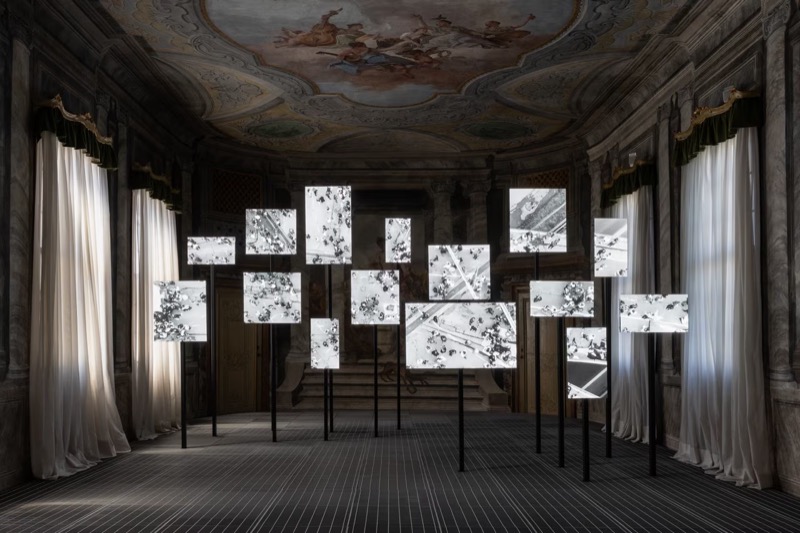
Lawrence Abu Hamdan et al., Canicula, Complesso dell’Ospedaletto
Henrike Naumann, Sung Tieu – Ruin – German Pavilion
This was probably the best pavilion in the Biennale that I saw; if not for Tieu’s indoor work, utterly dumb faux-minimal bars based on measurements of her mother’s body and an infestation of chocolate ladybugs, it would be a good show. Naumann’s physical history of East German interior design works in the manner of a well-made research catalogue; it develops a sensibility through the rigor of its presentation, turning a collection of mostly nondescript chairs and knick-knacks into a whole that rewards attention by suggesting the historical reality it’s drawing from. Tieu’s mosaic imitation of a housing complex applied to the exterior of the Nazi-era pavilion building has, evidently like the rest of her work, a navel-gazing personal narrative, but as a Venice-tier site-specific intervention it’s entertaining and relatively clever. Naumann, and Tieu’s exterior, unlike almost everything else at Venice, managed to do something with their work while incorporating the requisite level of sanctimonious narrative baggage about history, identity, cultural shame, etc. That seems to be a lucky accident on Tieu’s part, and I’m a little wary that all of Naumann’s work was about DDR interiors, but it seems like she knew what she was doing, which makes her own untimely death all the more tragic.
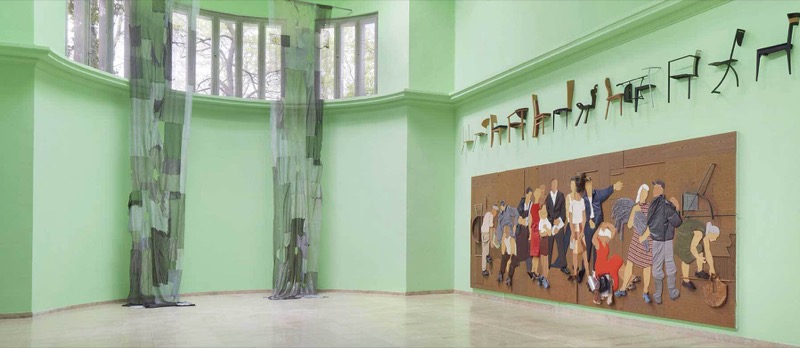
Henrike Naumann & Sung Tieu, Ruin, German Pavilion
Lubaina Himid – Predicting History: Testing Translation – British Pavilion
I wasn’t sure if this should go in the “Nostalgia” or “Care” section but since the theme is “care by means of idealizing British culture,” of all things, I went with the former. Crude, ugly (in a manner separate from the crudity), and utterly sycophantic paintings.
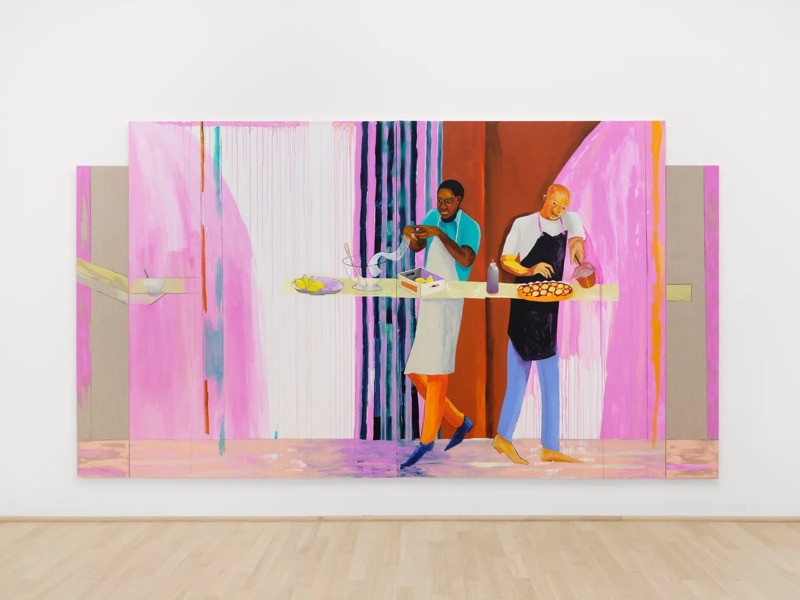
Lubaina Himid, Predicting History: Testing Translation, British Pavilion
Jakub Jansa, Selmeci Kocka Jusko – The Silence of the Mole – Czech and Slovak Pavilion
The video is something like Paul McCarthy’s Painter if it wasn’t funny, which is to say if it sucked. It’s also another instance of the sewer-as-our-contemporary-dystopia-but-we’re-still-seeking-the-light stylistic theme, but I got the feeling it was merely dramatizing Jansa’s own failure to justify anything he’s doing. The sculptures reminded me of another stylistic through line of the biennial: the aestheticized void-as-corporate-space of Severance and Backrooms.
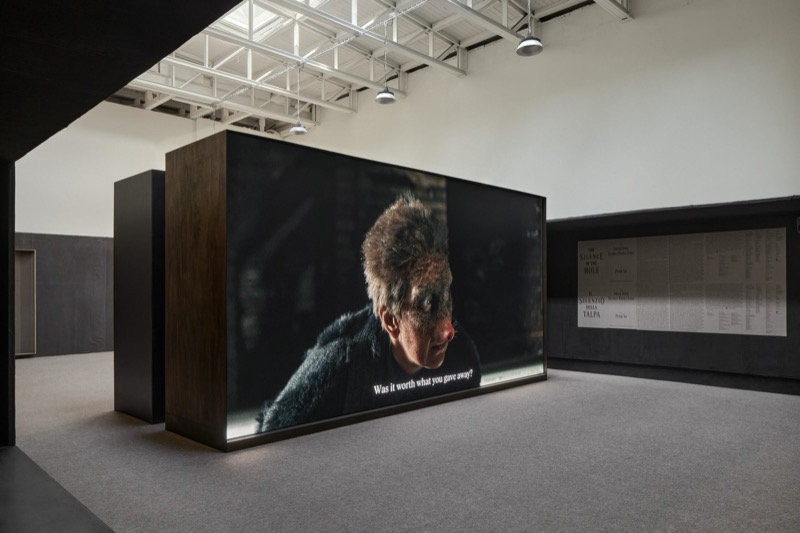
Jakub Jansa, The Silence of the Mole, Czech and Slovak Pavilion
Oriol Vilanova – Los restos – Spanish Pavilion
The show consists entirely of the artist’s huge postcard collection, organized thematically and covering the entirety of the walls in the manner of a Hanne Darboven installation. It’s a cheap trick and the nature of collecting old postcards is automatically a quotidian nostalgia, but by that same token it’s fun to just browse through the images. Similar to Henrike Naumann, the archival function takes over and makes the work interesting by letting the things be in a setting that encourages looking. It stands out in Venice, but we’re not exactly dealing with Broodthaers here either. An excerpt from the description: “This expanding personal collection brings in marginal economies and everyday practices that destabilise the regimes of governance underpinning the institutional aura of the museum.” Does it? What institutional aura? And for that matter, what museum?
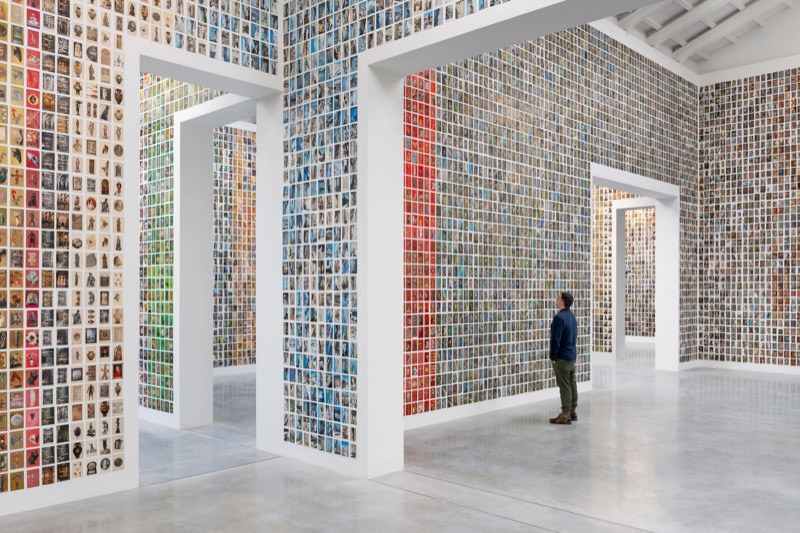
Oriol Vilanova, Los restos, Spanish Pavilion
Endre Koronczi – pneuma cosmic – Hungarian Pavilion
This pavilion, being Hungarian, felt the most like an attempt to square the circle of contemporary art ideology (global liberalism) with the rise of the nationalist right and, predictably, the results are even more feeble and confused. The artist’s theme, since he couldn’t do anything “woke,” is some attempt to romanticize breath. This leads to what could be the corniest line in the entire Biennale: “In the course of exploring pneuma cosmic, Koronczi walked for a year in order to find and capture the most important sigh.” This is intended to be contemplative and slow, but the show also features piles of decommissioned ventilation shafts, which makes the prevailing atmosphere into one of ruin and decay, mourning the “end of Europe.” If anything that becomes a convincing message, only because it doesn’t seem to have been the intended one.
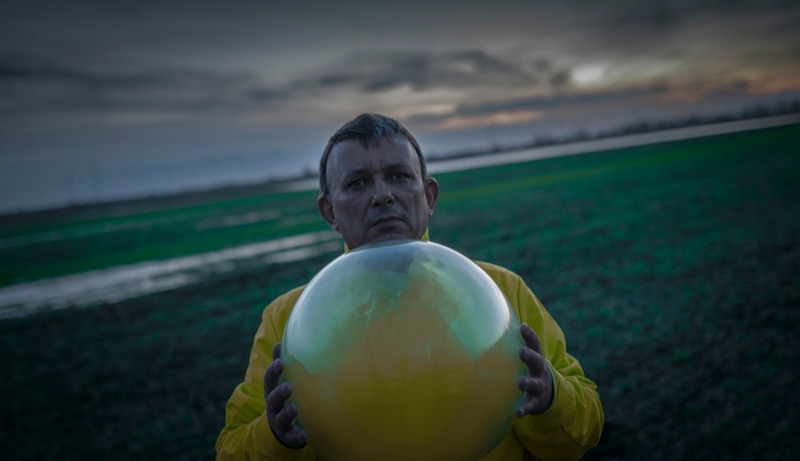
Endre Koronczi, pneuma cosmic, Hungarian Pavilion
Andreas Angelidakis – Escape Room – Greek Pavilion
Another basement rave, but at least this one is silly and playful, throwing together Plato and MAGA hats in a kitschy neon rave situation, beanbag Ionic columns, giant soft zines, but also a t-shirt boutique, etc. It’s dumb as hell, but on purpose, which gives it some joie de vivre. Whereas most of the other rave art in Venice feels like toeing the unappealing line between transcendence and an overdose, this is keyed to memories of being gay and partying in Greece in the ’90s, which must have been fun.
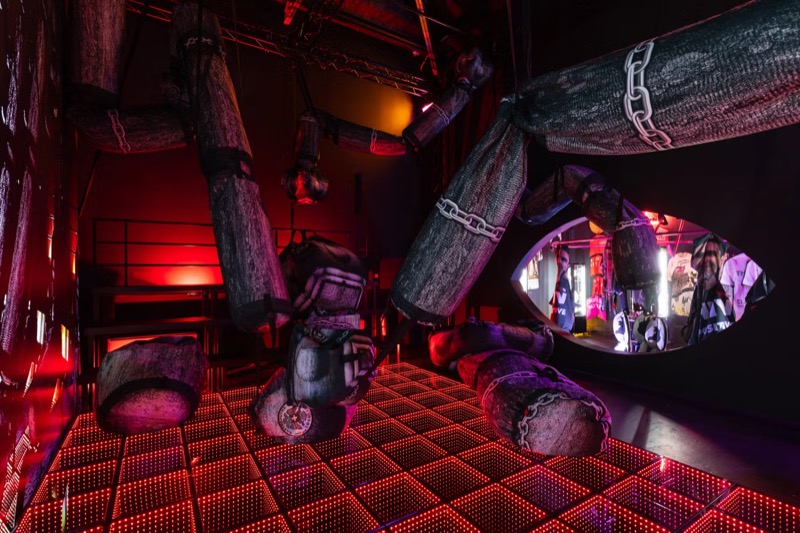
Andreas Angelidakis, Escape Room, Greek Pavilion
Anca Benera, Arnold Estefán – Black Seas – Scores for the Sonic Eye – Romanian Pavilion
The Black Sea, the climate, the ecology, a half-assed sound piece trying to do the heavy lifting. It looks like shit.
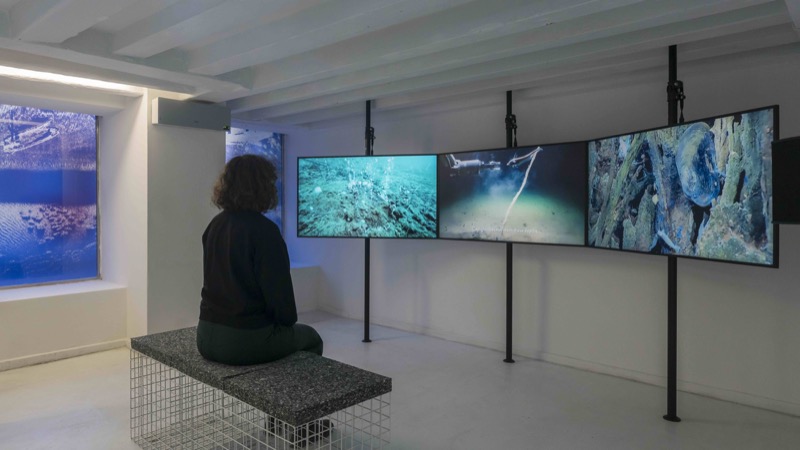
Anca Benera & Arnold Estefán, Black Seas, Romanian Pavilion
Bogna Burska, Daniel Kotowski – Liquid Tongues – Polish Pavilion
Almost the same as Romania, only the water is in a pool and there are deaf people. In terms of cinematography I got a Peter Greenaway vibe.
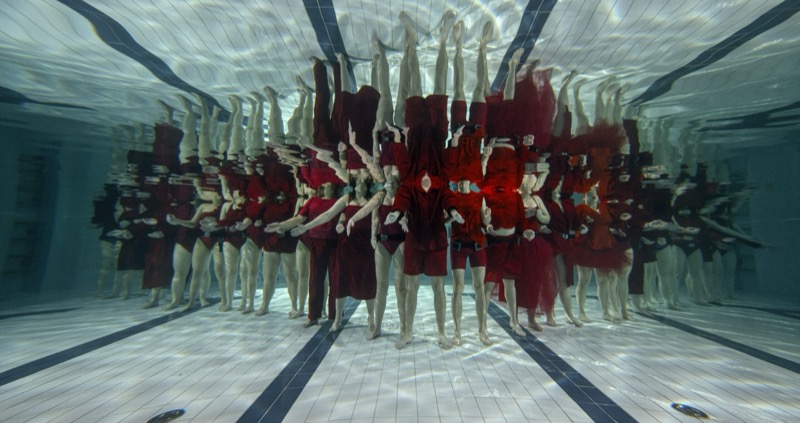
Bogna Burska & Daniel Kotowski, Liquid Tongues, Polish Pavilion
Predrag Djaković – Through Golgotha to Resurrection – Serbian Pavilion
Keeping on with the repetitions, this is almost the same as Spain’s postcards except that it lays on a thick layer of national nostalgia. It’s trying harder to do contemporary art and straining for more of an effect, but that only makes it less rigorous and less effective. Still, appropriating photographs that have some visual appeal on their own terms counts for a lot in this company.
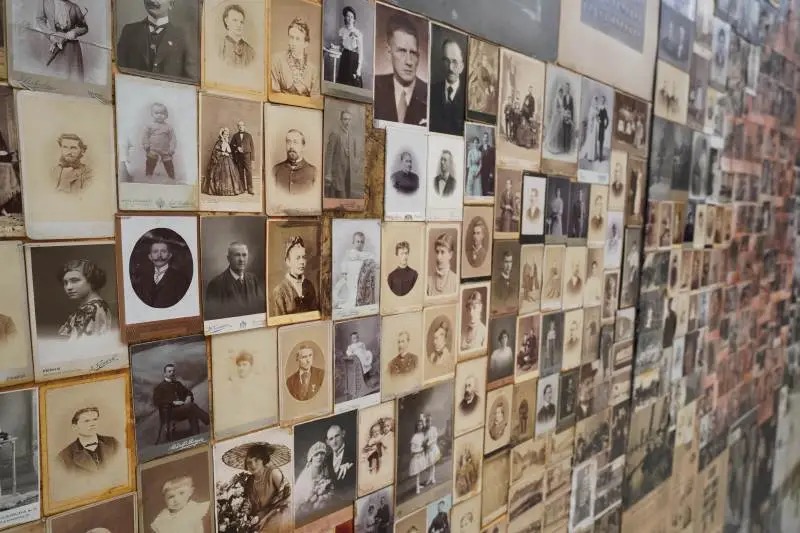
Predrag Djaković, Through Golgotha to Resurrection, Serbian Pavilion
Florentina Holzinger – Seaworld Venice – Austrian Pavilion
As everyone knows, the show consists of a bell where a naked woman periodically climbs in to act as the clapper, naked women in a tank next to a port-a-potty the audience is invited to piss in, pumping it into the tank, and a naked woman on a jet ski in the flooded pavilion. It’s about how global warming is going to submerge Venice. I happened to walk by as the bell thing happened, which is outside the pavilion, but I wasn’t about to wait in a huge line in the rain to see the rest. In terms of spectacle and public attention this is far and away this year’s Golden Lion in absentia, but it’s moronic. A friend told me the line to get in during the previews was four hours long, which only proves, yet again, that society has declined to the point that the only criterion of value people are acquainted with is wasting time in a line to psychologically trick yourself into believing what you’re waiting for is a big deal. What’s even more miserable and upsetting to me is that people were claiming this was new or exciting when it’s self-evidently a 1+1=2 of “Viennese Actionism” and “Anne Imhof” who, no matter how worthless her work is (hats off to Buchloh), at least did have a claim to some sense of newness in 2017. That newness, though, was a sort of trend-cycling weak form of novelty, which is now functionally impossible and didn’t count for all that much back then. The pathetic thing is that the art world doesn’t know how to do anything else at this point, so they cling to the attention this farce gets as if it’ll be their salvation.

Florentina Holzinger, Seaworld Venice, Austrian Pavilion
Dana Awartani – May your tears never dry, you who weep over stones – Saudi Arabian Pavilion
Similar to Germany/Spain/Serbia, this stone flooring is nice because it’s appropriating historical mosaics that are nice; you could just as easily appreciate it outside of an arts context. The artist’s appropriating gesture is itself so absent from the material that it doesn’t even register, so by the terms of contemporary art it’s very nearly not an artistic gesture at all. That that makes this relatively good here only suggests how decrepit and rotted-out the prevailing logic of contemporary art is. It’s nothing more than a pretext that no longer actively spurs artists on to produce anything worth doing, and if you stumble across something “good” (or basically kind of enjoyable) it comes off as an accident or an oversight.
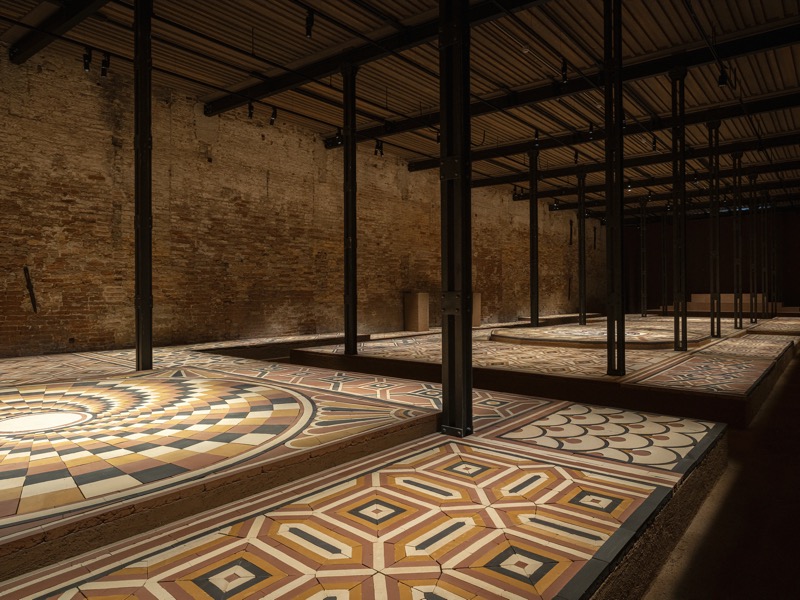
Dana Awartani, May your tears never dry, you who weep over stones, Saudi Arabian Pavilion
Care/Community/Love:
Alexander Kluge, Benedictine Nuns of the Abbey of St. Hildegard Eibingen, Bhanu Kapil, Brian Eno, Carminho, Caterina Barbieri, Devonté Hynes, FKA Twigs, Holly Herndon & Mat Dryhurst, Ilda David’, Jim Jarmusch, Kali Malone, Kazu Makino, Laraaji, Meredith Monk, Moor Mother, Otobong Nkanga, Patti Smith, Precious Okoyomon, Raúl Zurita, Soundwalk Collective, Suzanne Ciani, Tatiana Bilbao Estudio, MAIO Architects & Dogma, Terry Riley – The Ear is the Eye of the Soul – Holy See
You’re given wireless headphones in a garden, and as you walk through audio plays from the various contributors in different quadrants. The general reception seems to have found this to be a moving moment of calm in a quiet corner of Venice, but I found it totally non-immersive and borderline grating. Maybe I’ve just listened to too much ambient music so I’m hard to please, but both the awkward experience of walking through a “spatial mixtape” and the pervasively generic spiritual tones clashed with my appreciation of the garden more than it sucked me in. I came away with the feeling that the only thing the curators paid any attention to was getting the equipment to function smoothly. The conceit that combining a pretty garden with pretty music is automatically elevating to both components is suggestive of the foundational problem of the Biennale: the rationales of contemporary art are so musty and overgrown that the practicalities of production have entirely crowded out any consideration of whether the work is actually accomplishing what it sets out to do. This has to do, I think, with the pervasive virtualizing of experience, but Hans Ulrich Obrist, Mat Dryhurst, and Holly Herndon’s other exhibit, “Strange Rules,” reviewed below, is even more symptomatic of that.
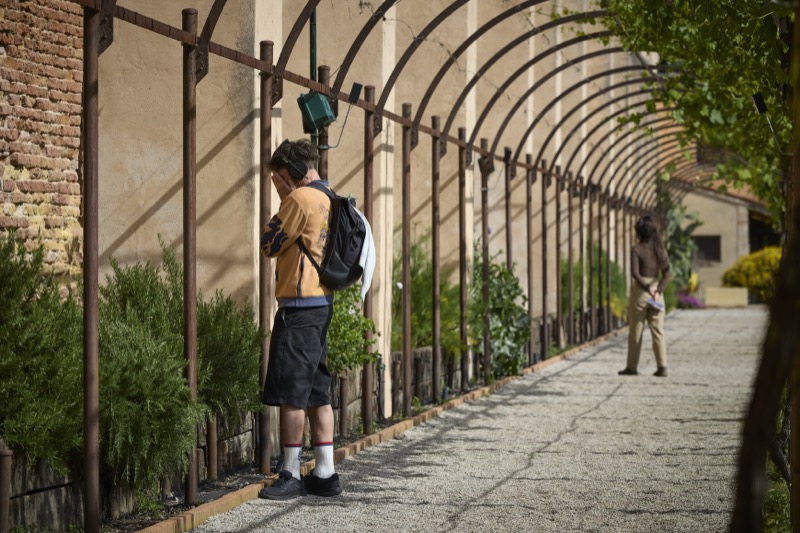
The Ear is the Eye of the Soul, Holy See
Ei Arakawa-Nash – Grass Babies, Moon Babies – Japanese Pavilion
You’re supposed to carry around baby dolls that are as heavy as real babies as you walk around the space looking at other baby dolls climbing ropes and scaffolding and stuff and wearing sunglasses. It’s not the wittiest thing I’ve ever seen, but it works out alright because it’s so maximally insistent on a simple pretext without developing itself into an assertion of profundity or diverting into aestheticism.
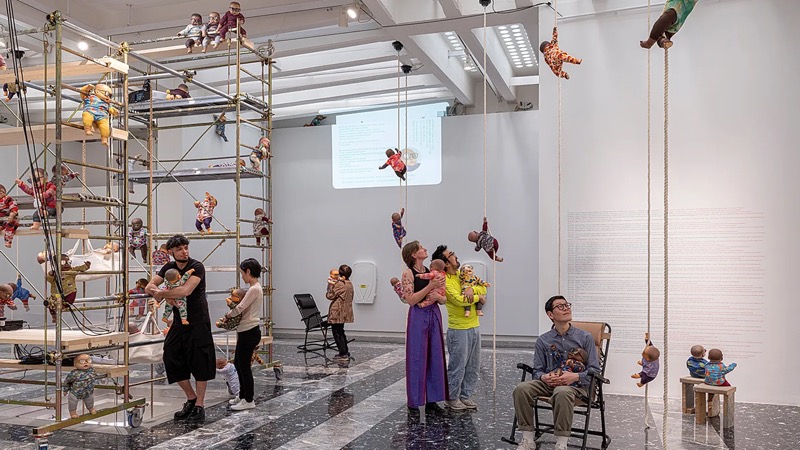
Ei Arakawa-Nash, Grass Babies, Moon Babies, Japanese Pavilion
Maja Malou Lyse – Things to Come – Danish Pavilion
This one’s “about” dropping sperm counts and some research paper that showed that men who watch porn are more fertile. What it “is” is a video of porn stars goofing off in the role of lab scientists at a sperm bank on a snazzy 360° screen, and another room with cryogenic tanks used for transporting sperm donations and a video on a small screen of a “sperm racing” tournament. What it “amounts to” is that DIS codirected it, so they’re trying to pitch internet hyperreality again. It’s boring, but the aesthetic language is a lot less out of touch than most everything else so, like Canicula, I’ll give it some credit for that. It’s not exactly in touch either, the DIS fixation on extreme aesthetic surface over a complete existential void didn’t appeal to me when it was relevant in 2014, and now it’s stale. I was a bit surprised at how tame it was, I don’t think I saw any nudity and I vaguely remember seeing something somewhere that implied the original title was supposed to be “Things to Cum.” I don’t think throwing something more graphic in there would have helped, it just feels stupid to do a show that’s based around porn if you have to be restrained because it’s Venice and all the politicians are going to see it. Weren’t project space artists in Melbourne just straight up doing porn and showing it as art a while back?4 That’s what’s particularly annoying; Lyse’s “conceptual Playboy bunny” act is marketing itself as transgressive, but the emphasis is entirely on the professionalized aesthetic marketing of transgressiveness that would never actually dare to do anything other than present a tired simulacrum of already-commodified sexuality. Not that porn aesthetics in a gallery is an interesting idea in the first place.
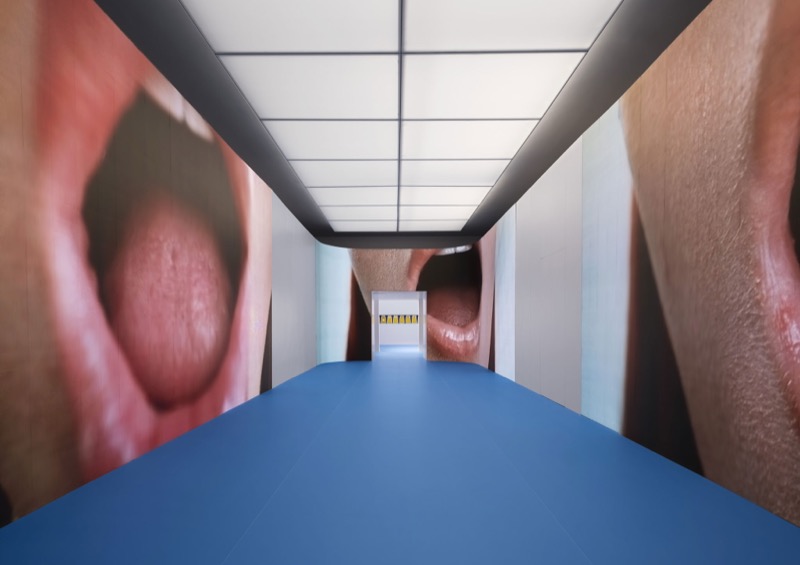
Maja Malou Lyse, Things to Come, Danish Pavilion
Miriam Laura Leonardi, Lithic Alliance, Yul Tomatala, Nina Wakeford – The Unfinished Business of Living Together – Swiss Pavilion
I really don’t remember, there was more of the rave thing plus some DIY gay mutual aid content. I gather the subject is that there was a debate on Swiss TV about the “problem of homosexuality” in 1978, but I’m not sure getting nostalgic for when gay people were more oppressed 50 years ago is as progressive as the artists think. That reminds me, I listened to a good podcast recently about the late, reactionary Horkheimer’s relationship to Christianity, and one of the funniest parts was that Horkheimer argued in favor of Humanae Vitae, the encyclical where the Catholic Church officially opposed birth control, because the essence of young love is in its illicitness, so it’s a good thing that people shouldn’t be allowed to use birth control. I had the thought that that’s like someone seriously arguing that homophobia should be encouraged because there were more great gay artists when society was more openly homophobic. Anyway, research-based art practices should always ask themselves why their research is being done as art, but it seems like that’s the one thing they never ask.
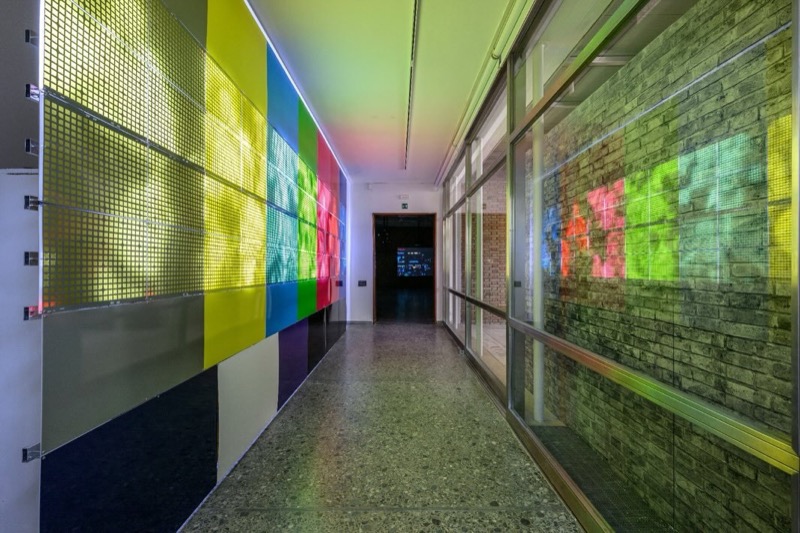
The Unfinished Business of Living Together, Swiss Pavilion
Khaled Sabsabi – conference of one’s self – Australian Pavilion
Bad AbEx tries to get around being bad AbEx with a superimposed video of morphing paintings, meditative music, and black on black text. Seeing someone attempt to foist a New Agey spiritual enlightenment on painting in this day and age is, well, sad.
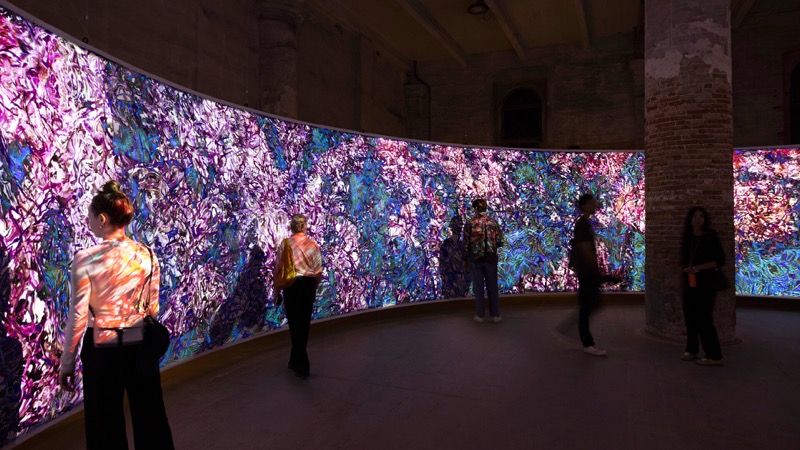
Khaled Sabsabi, conference of one’s self, Australian Pavilion
Amar Kanwar – Co-Travellers- Palazzo Grassi
The exhibition is ostensibly about paying tribute to political gestures and drawing attention to atrocities, etc., but it’s all about the video hardware. Take out the sleek screens and you have a bunch of fluff, images of South Asia that might be pleasant enough but essentially amount to pastiche.
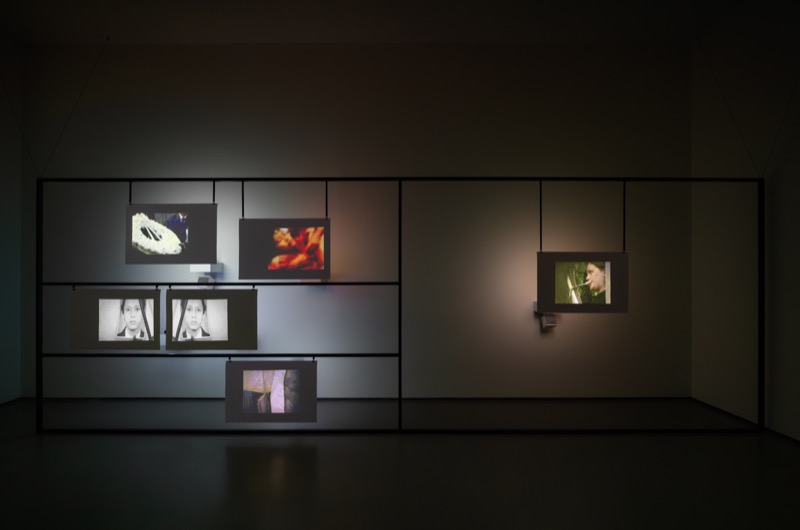
Amar Kanwar, Co-Travellers, Palazzo Grassi
Lorna Simpson – Third Person – Punta della Dogana
I don’t remember this at all except that I really hated it. I’ll just let my notes stand, typos and all: “arthur jada, christopher wool, awful stupid paintings with the dullest symbolism about jaguars and black women. singing bowls! jesus christ. the sub kruger collages are just mentally catatonic”
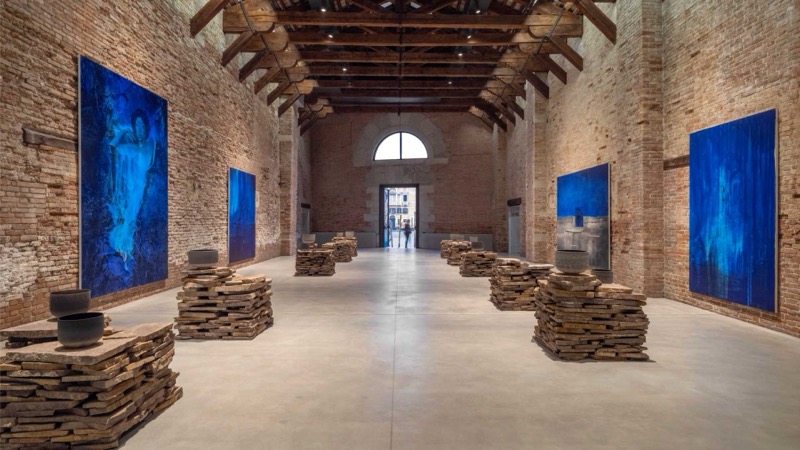
Lorna Simpson, Third Person, Punta della Dogana
Paulo Nazareth – Algebra – Punta della Dogana
Again: “i don’t even know. blee blee blah blah blu blu blu. the self-importance of putting some salt on the ground, as if this is a meaningful force of social change”
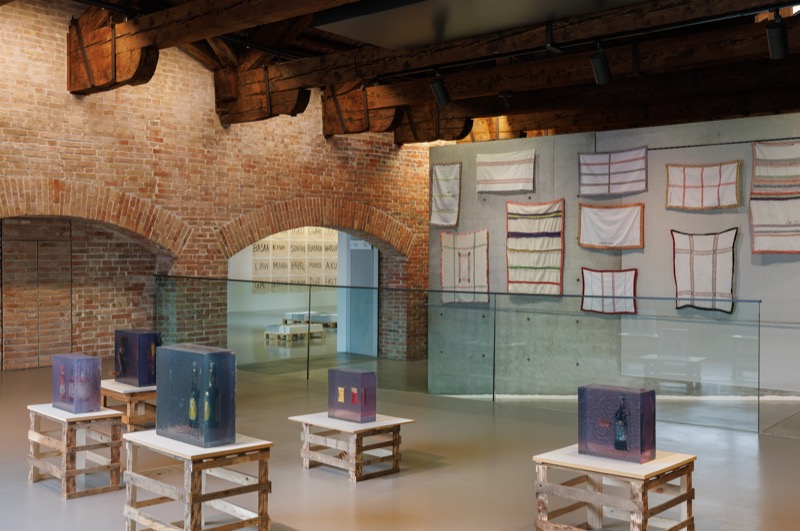
Paulo Nazareth, Algebra, Punta della Dogana
Lydia Orahumane – 5 Works – Nicoletta Fiorucci Foundation
Orahumane is a conceptual artist; you can tell because the show is called “5 Works” but there’s seven works. They are: an old light that used to illuminate a Bellini at San Giovanni Grisostomo, which turns on for three minutes if you put in a one euro coin; a docking pier made by a local pier maker installed in the space that’s going to be moved to Poveglia, an abandoned island with a reputation for being haunted; a collection of old bed linen from hotels in Venice in cages; a beaded curtain made by female prisoners (the bedroom window of the room Orahumane stayed in while making the show looked out on the Venice women’s prison); a collection of old plaster casts from a foundry in Naples; a boiling pot of soup; contact sheets and negatives of photos she took in Venice. So what’s the concept? It’s sort of research-based if you consider googling “most haunted places in Venice” or learning how hotels wash their linens a form of research, and I guess the whole “working with local businesses” thing is a riff on Christo & Jeanne-Claude, except that their large-scale installations on public land necessarily required dealing with governmental organizations to realize their projects and Orahumane is doing it just because. All the things here are brought together only by a vibey, poetry-adjacent arbitrariness, and, in spite of the informational posturing about where she got everything from, they’re purely aesthetic objects. The interview in the exhibition pamphlet only really establishes that she likes old, discarded things, talking around “use”, “smell,” “sight,” “haunting,” “voids,” etc. as necessary, which doesn’t add up to anything, conceptually speaking. They work better in a purely visual manner, where her appropriative grammar adds up to a refined sense for preciousness and patina that “looks good,” and, if you’re susceptible, flatters the intellect of visitors who find themselves to be so cultivated that they’re enjoying conceptual art. The problem is that it isn’t conceptual art, it’s aestheticized object curation that’s pre-validated by a surface association with the heritage of conceptuality. My gripe is that unlike, say, Rosemarie Trockel, Lucy Skaer, or Park McArthur, there’s no apparent methodology or focus of inquiry to anchor any of these objects formally or thematically as part of a credibly intellectuallized practice. These works rely only on visual appeal and the vague mysticism of her interests, which in itself is a surface-level aestheticization of the artist’s romanticized capacity for embodied, meaningful experience, as in, “her time spent in Venice was more profound than ours because she did all this esoteric stuff like thinking about ghosts and interacting with the working class.” I’ve been trying to think of the word for what this aestheticized denigration of conceptuality is, and I just remembered: it’s kitsch.
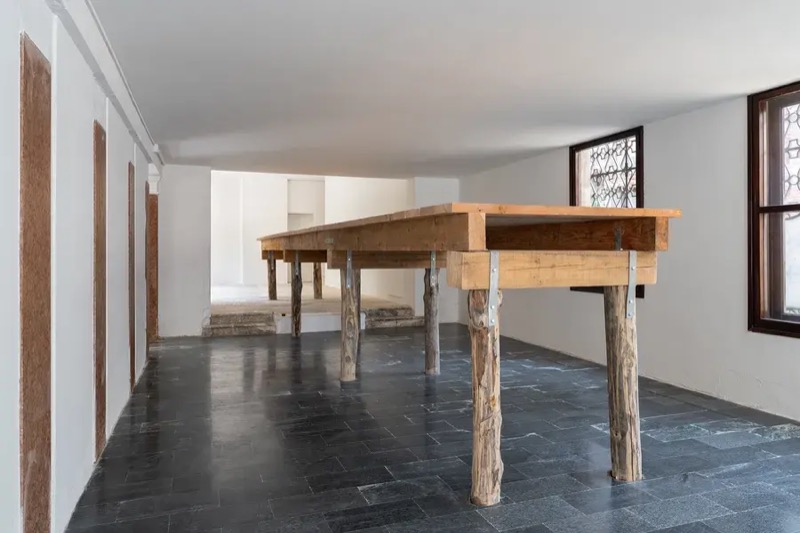
Lydia Ourahmane, 5 Works, Nicoletta Fiorucci Foundation
Modernity Redux:
Alma Allen – Call Me the Breeze – American Pavilion
Yes, of course, it’s terrible. As others have observed, it really is sculpture for the lobby of a crass expensive hotel. The work is “abstract” and the artist “doesn’t want to dictate meanings” in spite of most things being near-figurative, a mushroom cloud here, Gumby in the fetal position there. It feels more like seeing an animal in a cloud than some kind of reactionary modernism, it’s easy and laughably unambiguous. Still, it’s annoying that people act like this is a black mark on Venice because it’s “Trumpian.” People are just encouraged to scold it, unlike everything else, but I also saw some reviews acting like the work is deficient because it doesn’t have a tacked-on meaning, which is scary. Allen falls solidly in the middle of the pack for Venice overall, so he’s squarely deep in the shit, I’m just indignant that there’s so little acknowledgement of how much everything else sucks. And don’t get me started on people trying to claim that the Jafa/Prince show is the “real American Pavilion.” Oh, a dual retrospective of the two highest-profile artists showing in Venice is better than this random decorative sculptor? No shit!
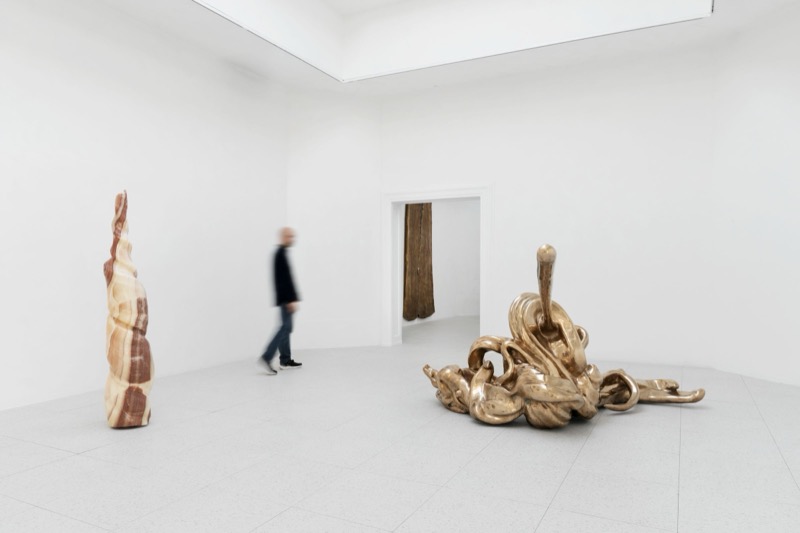
Alma Allen, Call Me the Breeze, American Pavilion
Yto Barrada – Comme Saturne – French Pavilion
This had the worst imitation of concrete poetry I’ve ever seen, and boy I tell you what, I’ve seen some real bad concrete poetry in my day. Jean-Francois Bory’s Once Again is stiff competition but I think Barrada wins out. There’s also some quasi-Anni Albers fabrics that were kind of fine but visibly straining to find a way to complicate themselves. Everyone gravitated to watching the TV playing Looney Tunes because they know how to do that.
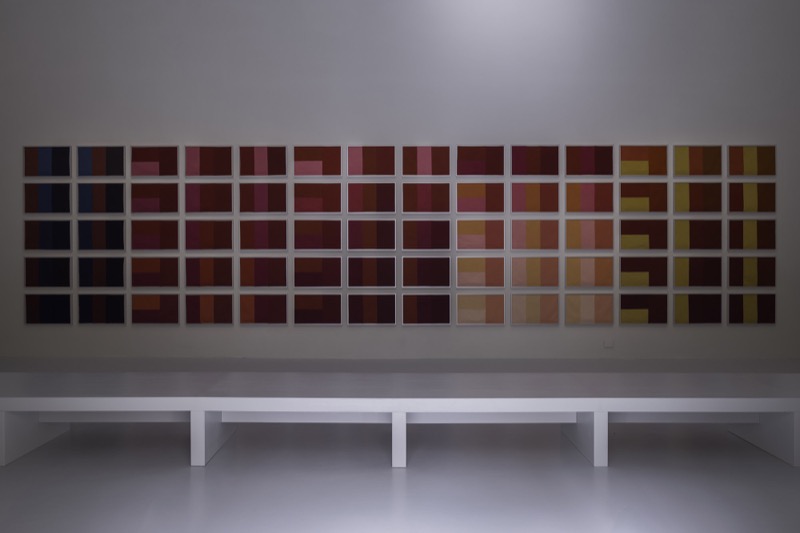
Yto Barrada, Comme Saturne, French Pavilion
Miet Warlop – IT NEVER SSST – Belgian Pavilion
I only walked by because there was a crowd blocking the entrance, but the show is just a durational performance of a song, a lot of yelling as an aimless reiteration of punk, yet again de/recontextualized into the dedifferentiated space of contemporary art.
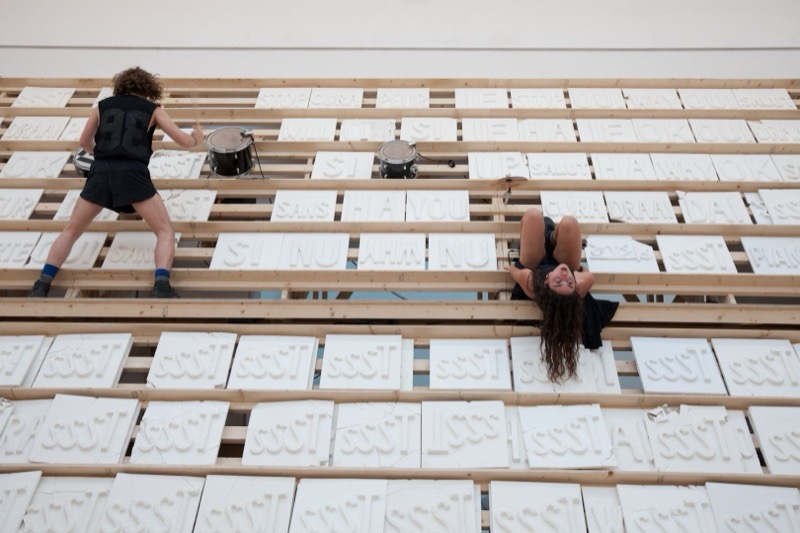
Miet Warlop, IT NEVER SSST, Belgian Pavilion
Armen Agop – Silence Pavilion: Between the Tangible and the Intangible – Egyptian Pavilion
An oblong disc made out of dark stone in a dark room. This one hurt, you can really tell when the country hasn’t been clued-in to the script of anything that’s happened in art in the last fifty years.
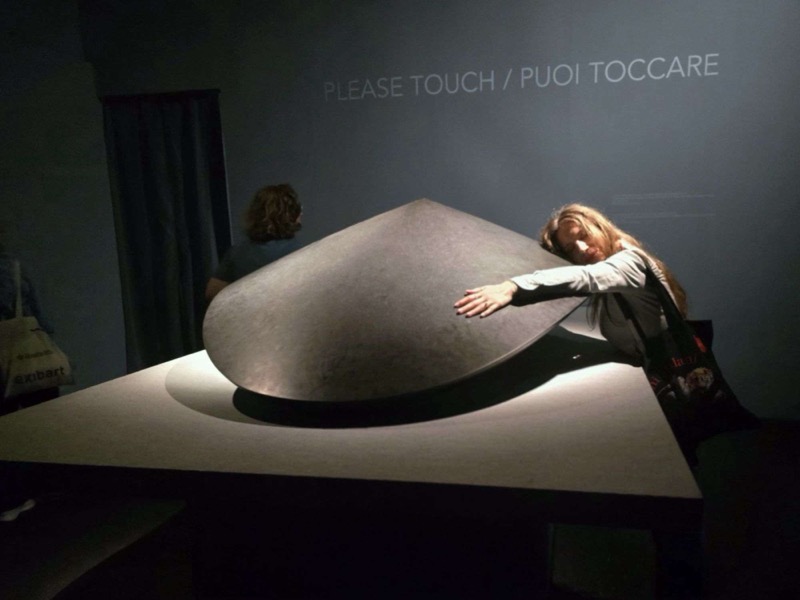
Armen Agop, Silence Pavilion: Between the Tangible and the Intangible, Egyptian Pavilion
Belu-Simion Fainaru – Rose of Nothingness – Israeli Pavilion
A pool underneath tubes in the ceiling that drop water into the pool in a grid pattern. An entirely trite recapitulation of Sol LeWitt as a water feature, but it’s basically pleasant and meditative. Sort of like a water feature…
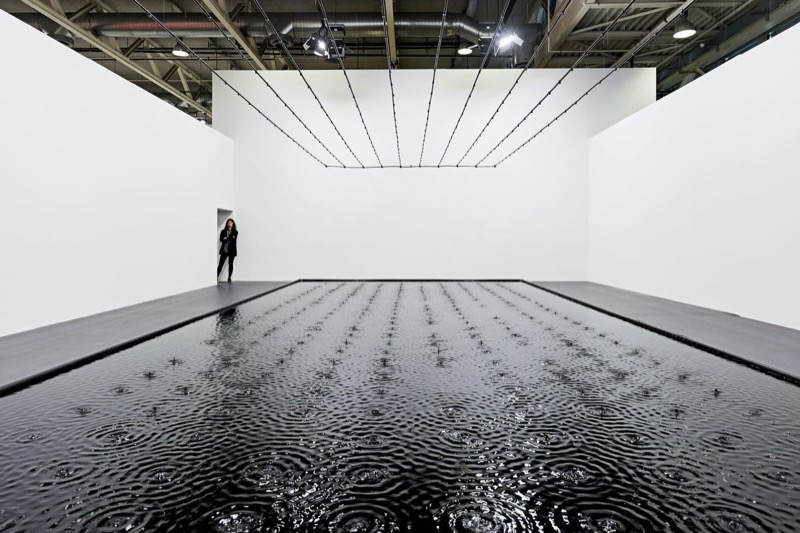
Belu-Simion Fainaru, Rose of Nothingness, Israeli Pavilion
Joshua Citarella, Harold Cohen, Primavera De Filippi, Simon Denny with Venkatesh Rao, Stephanie Dinkins, Fabien Giraud, He Zike, Holly Herndon & Mat Dryhurst, Lynn Hershman Leeson, Ho Tzu Nyen, New Models, Ayoung Kim, Agnieszka Kurant, Michael Levin, Trevor Paglen, Philippe Parreno, Lorenzo Senni, Avery Singer, Ken Stanley, sub, terra0 – Strange Rules – Palazzo Diedo
I’ve thought about Mat Dryhurst, Holly Herndon, and Trevor Paglen more than anyone else I saw in Venice since I was there, but that’s largely just because of the relentless PR frenzy forcing them down our throats. They also make the only relatively coherent claim to artistic newness via their engagement with AI, which they’re trying to label “Protocol Art.” Roughly, this refers to their interest in the creation of technological protocols that generate or interact with media as the new exciting frontier of art. I don’t agree with them, for reasons that will soon be made obvious, but their claim that they are following in the tradition of conceptual art is at least accurate. The shift of focus away from artworks themselves to the systems of their production recalls the classically postmodern rhetoric one can find in essays like “From Work to Frame” by Craig Owens.5 But, where Smithson, Kruger, Sherman, and the rest were engaging with the “frame” of the art system as an intrinsic condition for their artmaking, being into tech doesn’t presuppose any direct relevance to art, unless, I guess, you’re an artist who’s more into tech than art. Even then the connection is tenuous because none of them seem to have a more than coincidental interest in art. My favorite line from the puff pieces linked above has to be Paglen asserting that “Caravaggio would have murdered someone for a copy of Photoshop. Leonardo would have done far worse for a Claude Code subscription. Those are facts. Artists use whatever it takes.” That’s about as meaningless as saying “if Jesus was alive today he would have worn Nikes,” but it does point to the deeper issue at hand; namely, the total occlusion of the role or even the basic nature of the artist in relation to all these protocols. What on earth does he mean? Whatever it takes to do what? Caravaggio was born 455 years ago and painted with oils. He would not “be Caravaggio” in any real sense if he was a middle-aged artist using Photoshop today or, in the alternate hypothetical where a time traveler brings him a laptop, he wouldn’t, uh, know how to use it, or care. How would he charge it? My head hurts. Clearly Paglen doesn’t literally mean what he’s saying, it’s just a rhetorical trick for legitimating his own tech-forward practice by mentioning some Old Masters, in the same way that they all throw around the word “beautiful” in those interviews. They don’t care about works of art, art is just a space for legitimating the tech stuff they like as a proof of concept. To get to the show itself: it’s a trainwreck. Citarella and New Models put together a room full of physical objects to mirror the essence of slightly-alt online discourse. If you know what Fanged Noumena is there’s no surprises here, which is maybe the point. The aim seems to be to broadly survey the surfaces of online subcultural norms, but I can’t see it as anything other than reducing culture to media trends, precluding the possibility of articulating anything other than a regurgitation of the trend, i.e. the midwit “slightly above average but never quite insightful” discourse tier of Doomscroll. Herndon and Dryhurst set up some benches in a room and your speech is collected and processed by AI, or something. They had an event in there, but it was dull and literally vacant during regular hours. Kevin Stanley’s shiny AI images are sort of nice to look at, but everything else goes from phoned-in to outrageously stupid and incompetent. terra0’s “work” is literally a few stools in the courtyard and a wall text promoting the Autonomous Forest, an NFT project, Primavera De Filippi has some robotic flowers with iPads in front of them that you can use to… buy NFTs with crypto. Simon Denny and Avery Singer suck as usual, videos like Ho Tzu Nyen’s are fully downstream of brainrot Instagram Reels, Paglen contributes a 25-minute hypnosis meditation room thing guided by AI-generated text, which I was not about to do, but the gallery attendant, who I spoke to, also didn’t try to get me to do it. What might be the most lasting impression is that the installation was just poorly done; none of it felt considered or more than slapdash. The video rooms were too dark, one of the iPads in front of De Filippi’s work had too short of a cord and was precariously hanging off of its plinth, the map was unreadable, there was an unfinished balcony in the room with Philippe Parreno’s boring light installation. My takeaway is that all of this obsession with technology just divorces one from being in touch with reality, which is generally the sense one gets from tech scenes. But where Silicon Valley is actually producing these “protocols” at scale and can ignore reality as long as their stocks go up, this is an art show. The works are real, in front of your face, and they are embarrassing.
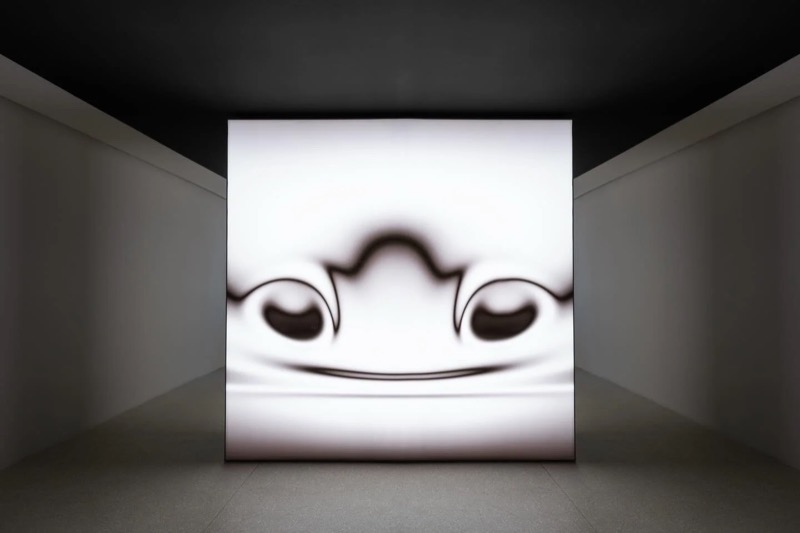
Strange Rules, Palazzo Diedo
Sanya Kantarovsky – Basic Failure – Palazzo Loredan
I’ve written about Sanya’s paintings before and, although I think he tried extra hard for Venice, he doesn’t get out of his usual cul-de-sac of slightly forced Belle Époque fantasies. If anything, that conspicuous effort could be the obstacle that keeps his painting at a cagey distance; the skill is there, the subject matter and technical range is cleverly varied, but there’s no spark of spontaneity or forthrightness to break the self-aware framework of his painterly mannerism. The classic problem with studious contemporary painters is that they can’t quite figure out how to engender actual risk-taking; any evidently challenging behavior (like hiding a Jesus painting behind a wall here) never goes so far as to actually disrupt the ingrained tastefulness of the whole. The melancholic disposition in the press release seems to actually dramatize the depressive inability to get out of that trap, but I still come away feeling like the one thing his painting is missing is the one thing that matters.
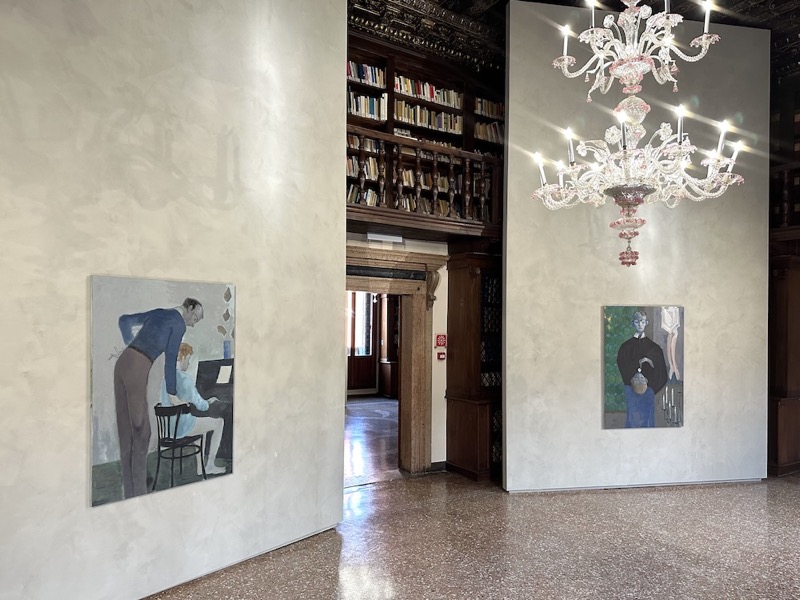
Sanya Kantarovsky, Basic Failure, Palazzo Loredan
Straight Trash:
Benjamin Orlow, Klara Kristalova, Tori Wrånes – How Many Angels Can Dance on the Head of a Pin? – Nordic Pavilion
This was so overwhelmingly bad that I couldn’t come up with anything to say except that it made Alma Allen look good. There were some logs with woodland creatures on top of them and scaffolding? It’s a very nice building, but I would have appreciated it more if it was empty.
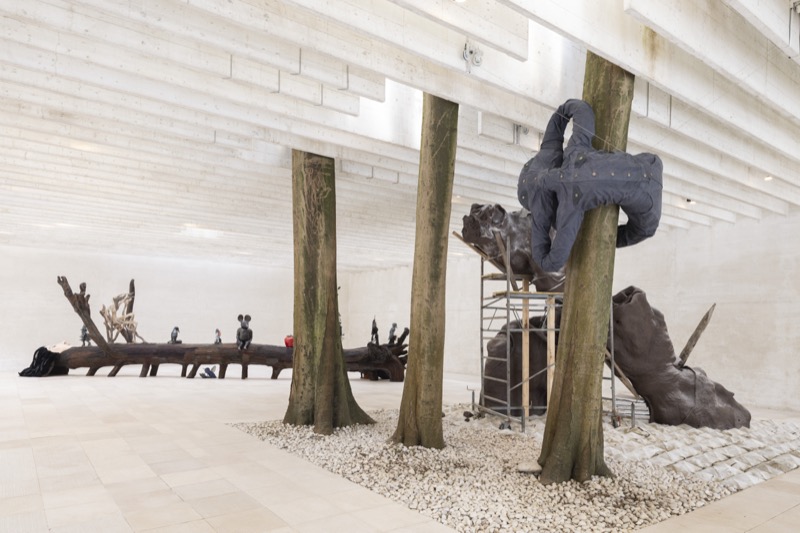
How Many Angels Can Dance on the Head of a Pin?, Nordic Pavilion
Abbas Akhavan – Entre chien et loup – Canadian Pavilion
The building has been repurposed as grow pond for water lilies. One problem is that only a couple had emerged while I was there, another problem is that it’s a stupid, shallow short-term imitation of a botanical garden. What is this doing that a literal garden doesn’t do far, far better?
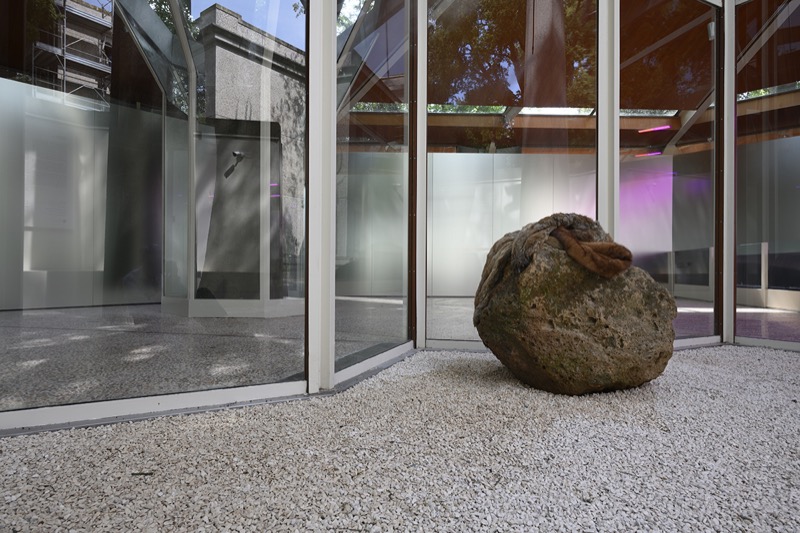
Abbas Akhavan, Entre chien et loup, Canadian Pavilion
Goen Choi, Hyeree Ro – Liberation Space: Fortress/Nest – Korean Pavilion
I didn’t take any notes, there were some copper tubes and room dividers, and a bunch of trinkets arranged cleanly. I remember I said this about something I saw in Vienna last year, but I think Asian postminimal art, maybe particularly Korean, is some of the worst out there. It seems to be because their traditional sensibility is compatible with minimality, but that aesthetic proximity makes them all the more ignorant of what any of these gestures should be accomplishing.
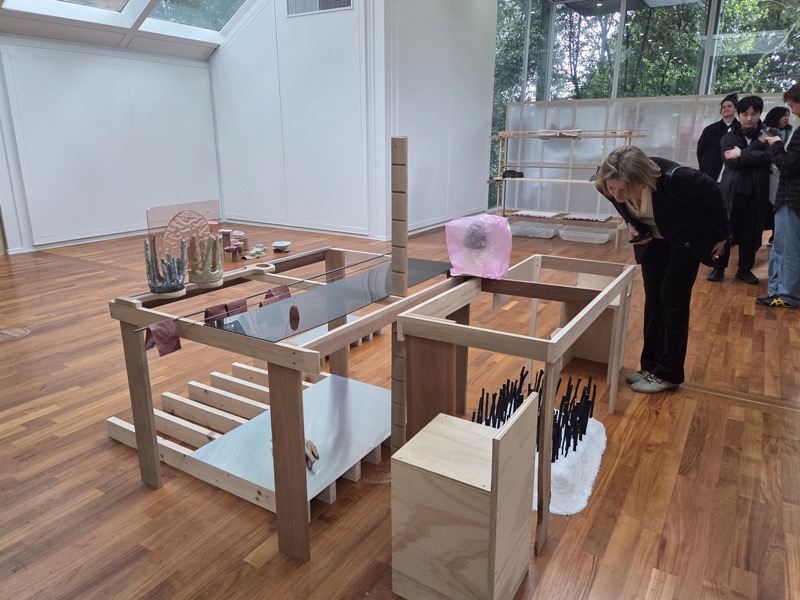
Goen Choi & Hyeree Ro, Liberation Space: Fortress/Nest, Korean Pavilion
The curation is immediately and inexorably pulled into reflexively pushing and pulling back and forth between the authentic “minor” identity of folk culture, traditional crafts, etc. on the one hand and the monumentality of late-contemporary biennale art on the other, and the latter completely sabotages the affective goals of the former. Industry, but also flowers, but also the elemental, earth mother, colonialism, materiality-as-meaning, anything that can shoehorn in sentiments about nature. Terribly installed; it’s oppressively crowded and the blue walls are smothering. Arsenale in particular felt like being dragged through the Bluebeard’s castle of contemporary art, only worse; instead of being murdered at the end, you have to walk back through it again to leave.
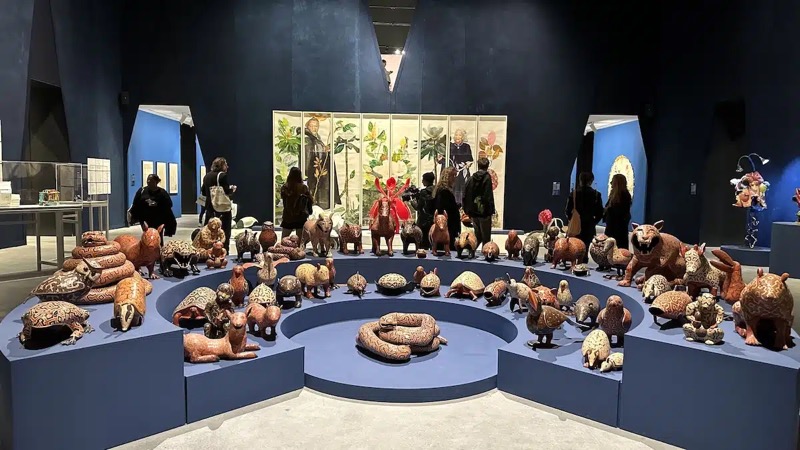
In Minor Keys, main exhibition
Institutional Flexing:
Arthur Jafa, Richard Prince – Helter Skelter – Fondazione Prada
I’ve seen people say that this was a surprising pairing, but I thought they went together almost too naturally, to the point that the similarities of their practices emphasized their shared limitations. I’m not much of a fan of either of them, though. In brief, I think Prince is a successful provocateur, but the nature of his provocation is so overtly cynical that I can’t quite bring myself to love his work, even if I do think he’s accomplished something by sticking to his particular attitude so unflinchingly. There’s a depth of contempt for everyone and everything in the work that gives it its certain surly flavor, but I can only appreciate that as a dynamic in relation to the art world. The prankish rebelliousness (if not criticality) in his work insistently prods at art’s sense of dignity, but taken on its own terms I can’t get past the underlying nihilism. Jafa, on the other hand, bugs me because he traffics so thoroughly in the signifiers of edginess without a corresponding friction in the structure of the work. His art is obviously grounded in reiterating the language of radical art from the past with a modifying focus on race, and my main issue with that strategy is that both reference/reiteration and racial content are wholly validated by the institution, which is only an intrinsic problem if the work aims to position itself as at odds with the establishment. I just don’t see any critical tension in his work because he’s too enthusiastically embraced by the art world to position himself antagonistically; he’s giving the people exactly what they want, which prevents the possibility of autonomy. I don’t really have any idea if he thinks of his own work in these terms, but that was the difference that stood out to me between him and Prince. To put it another way, he appropriates like a Tumblr user, which is to say like a fan collecting the pop culture and art imagery that he likes. Prince does this too to some degree, which is part of their shared limitation, except that Prince revels in the limitedness of appropriation as a consciously tasteless, defiant refusal to give people what they want. Jafa admires that quality, I’m sure, but he likes his source material too much and his decisions are too stylish to be so withholding. The root of this is probably just that, with his background as a cinematographer and collaborations with Kanye and all that, he has too much of an earnest pop cultural sensibility to not be attracted to the aesthetic surface first and foremost. That’s why Love is the message, the message is Death is such a beloved work, it’s an art video but it also works in the manner of a conventional music video, which is something people like much more than video art. I didn’t see it when it was new, but I remember 2017 as a time when the divisions between art, pop culture, and life were excitingly porous and I can see how Love succeeded in capturing that feeling, like The Life of Pablo did. The problem is that that feeling didn’t last, at least not for me, so I see Jafa’s general engagement with cultural icons and music as something easy and shallow, but I can imagine someone who’s more sentimental having a much stronger experience. The more I think about it, Jafa feels more and more like a secretly post-internet artist, in the sense that my misgivings about his work are grounded in an indulgent attitude towards pop media I used to have a decade ago that I’m now disillusioned with. I didn’t take any notes that went over anything in the show specifically but, notwithstanding this entire review, it is definitely the best presentation of either artist’s work that I’ve seen and, on the whole, one of the better shows I saw in Venice.
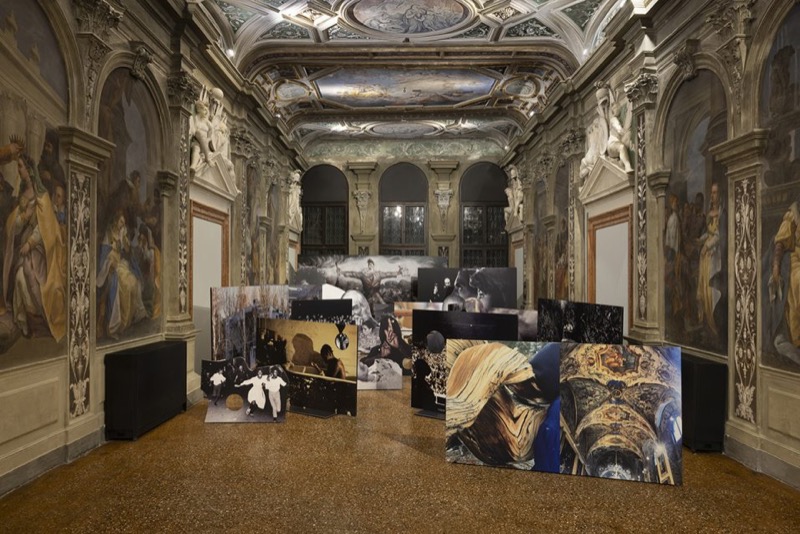
Arthur Jafa & Richard Prince, Helter Skelter, Fondazione Prada
Michael Armitage – The Promise of Change – Palazzo Grassi
These are actually very good, I think he must be the closest I’ve ever seen someone come to pulling off a contemporary Impressionism, maybe a sort of 21st century Bonnard. The photorealistic moments of his portraiture tend to get too literal and upset the formal concerns that are at the forefront of the rest of his paintings, but they’re the exception. His usual strategy is to keep his figures in the distance as indistinct, huddled masses incorporated into the larger scene, or treating them as apparitions emerging invasively onto the “real space” of the background. Maybe more than anything he manages to mediate the technique of painting with the visionary space of a dreamtime hallucination, which I’d call an obvious solution to the problems of contemporary painting if anyone else could manage it as well as he does. The room of sketches and studies suggests his pictorial imagination springs from being a prodigious student of the natural world, like a proper Impressionist, and that capacity to simply be engrossed in the act of depicting reality seems to be his ace in the hole. His earlier works are sometimes weighed down by the knee-jerk urge to react to current events, but on the whole I’m extremely impressed. He’s a great painter, which is an epithet I would apply to very few living painters under the age of 70.
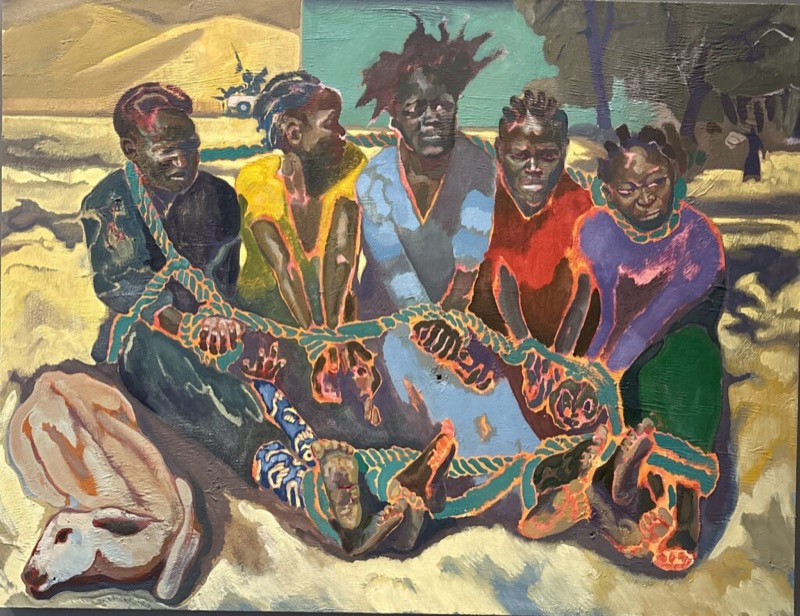
Michael Armitage, The Promise of Change, Palazzo Grassi
David Salle – Painting in the Present Tense – Palazzo Cini
I literally ran through this, it’s not exactly a full flex but it doesn’t fit anywhere else. The palazzo has a Botticelli and a Piero della Francesca downstairs, so I guess that makes it close enough. I had time to get the impression that they’re better than his last series of AI paintings, but I’m still not sold on the whole idea. They’re certainly good relative to the Biennale.
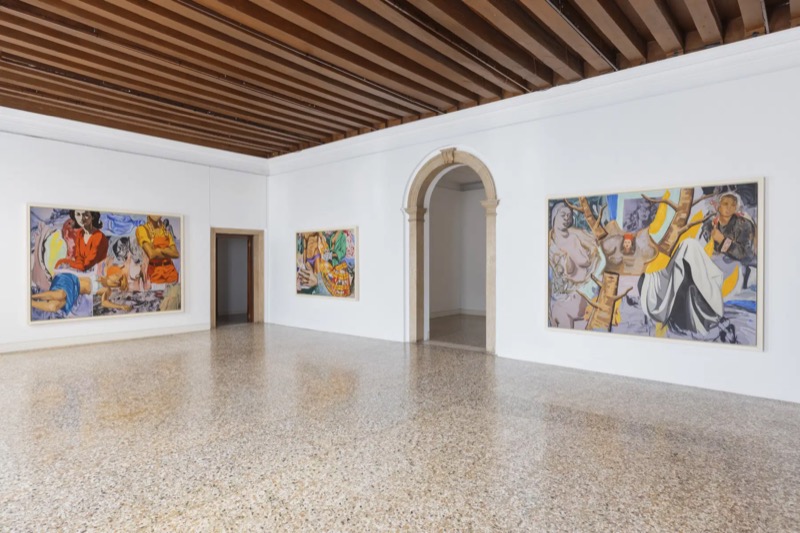
David Salle, Painting in the Present Tense, Palazzo Cini
Well. Having laid all that out, the contrasting foil closest at hand is Venice itself. I arrived with the goal of spending as little time with the Biennial as possible and as much as I could with the Renaissance, and that mostly worked out. (My priority was to see the Giottos in Padua, but a rail strike messed that up.) Aside from the predictably memorable experiences I had with a lot of amazing paintings, I also found myself facing up to the real historical context of that art in a way that was disarmingly new to me. In the Doge’s Palace one finds Tintoretto’s Paradise and many other colossal paintings that have been in situ for over 400 years, originally serving as decor to flatter the council’s self-regard as a glorious economic and military power, now kept up for tourism revenue.6 This is true of the rest of the city as well; it’s Europe’s version of Disneyland in the form of a once improbably powerful manmade island, now a playground of undead history preserved in amber. I’d be the last to suggest that any of this means Venice isn’t an incredible place that’s worth preserving, but still, it’s a surreally disjunctive and borderline artificial experience to go to the Scuola di San Giorgio degli Schiavoni, a small confraternity building for Dalmatian immigrants, to see Carpaccio’s St. Augustine in his Study that’s been there since 1507.
None of this has any bearing on the art, which is my point. Venetian painting endures in spite of representing a world that is antiquated and foreign to us,7 just as Venice is lovely whether or not it’s a floating museum. Contemporary art’s insistence on itself as a progressive, quasi-utopian social force, on the other hand, puts the cart before the horse by conflating its value with its meaning, which has become an existential conundrum. It could convince itself of its social value as long as the “end of history” illusion of liberal consensus prevailed, but now, up against a crumbling global order, it’s faced with its own practical impotence. The logic of contemporary art relied on the persistence of contemporaneity, a posthistorical emphasis on presentness-as-significance, which is finally, ironically, apolitical and complacent by suspending continuity for an eternal “now.” Politics implies collectivity and prolonged coordination in the building of projects, and this is precisely what contemporary art cannot abide. With the emergence of a multipolar world order, or whatever it will turn out to be, the end of history is ending, and contemporary art along with it.
I won’t hazard any guesses about what is going come after the contemporary, but Venetian art can offer some suggestions at least for what it is that contemporary art lacks, or has come to lack. The comparison is fraught with obstacles: there’s the obvious but doomed desire for a return to old painterly traditions (mimesis and sensuousness cannot simply be rewedded after the 20th century), the corresponding inherited post-’60s aversion to tradition, the remoteness of historical artworks that turn a Titian into a legendary, unknowable figure, the canon that presupposes Renaissance art’s value whether it’s actually appreciated or not, etc. But, on a simple level, a great painting of the Annunciation is a great painting in the tradition of paintings of the Annunciation. The scene has relatively little to do with its greatness, aside from being a pretext for paintings with certain iconographic conventions. What European painting offers is an incredible number of paintings on similar subjects to develop a sense of what distinguishes a great artwork from a lesser one, and that process implies the cultivation of one’s own relationship and capacity for an engagement with art.
At this point some would complain that this is upholding a normative Eurocentric aristocratic tradition, but I don’t think that’s true. Rich people today seem to me to be as tasteless as everyone else, for one thing, and I don’t think a knowledge of art history implies any reactionary traditionalist fantasies. Conservative Eurofetishist trads on Twitter are, famously, also as tasteless as everyone else. If anything, the mystical atavism of “In Minor Keys” seems to me to be more substantively traditionalist in a reactionary sense, a fundamentalism that gets a pass for romanticizing cultures that aren’t European. I have no interest in romanticizing any particular culture as superior to others, I just happen to like Venetian painting and I’ve found the study of it to be personally and substantially enriching to my relationship with art.
But let’s use another example anyway, like the jazz standard. An unexceptional song written for a forgotten Broadway musical can live on for decades as something that’s been reinterpreted endlessly; musicians like to play it because they know it and can use it as a form, listeners like to hear it because they know it. The conventions of American music in the first half of the 20th century encouraged that kind of sentimental relation to specific songs, which made them live on much longer than the contemporary “Brat Summer” model that demands constant and increasingly hollow cycles of novelty. It’s possible to build a relationship with the form of a song as you first heard it by Billie Holiday, and then by Art Tatum, then Lee Konitz, whatever, and that relationship can then deepen over time between each recording, which isn’t to even scratch the surface of how complex a broad interest in jazz can become. This is true of folk songs, or more annoyingly, Christmas songs; they’re the byproducts of traditions that one need not ascribe to or affiliate with, but that take on the categorical form of a continuity by the means of familiarity and comparability. Those qualities can only occur within the stability of a system that’s broader than the narrowly individualistic urge to create, yet again, something singularly new in the present moment.
Contemporary art is built against this: I randomly came across this show recently, and the similarity to Lydia Orahumane’s pot of boiling soup is striking. I highly doubt she stole the idea, but it’s still embarrassing because the coincidence suggests the real formal limits of contemporary art’s ostensible limitlessness. Art may be concerned with a sense of the boundless, but that has to be earned by the specificity of a work in context. The “innovation” of putting a boiling pot in a gallery depends on that gesture’s unexpectedness, but such surprises are a paradigmatic norm of contemporary art, making it mannered and obvious even before the accidental repetition. On top of that, this demand for formal uniqueness turns similarity into failure, inverting the iterative dynamic of a traditional form that uses shared qualities as a productive basis. The logic of contemporary art confuses formal novelty for artistic content and semantic meaning for experiential substance, and thereby obfuscates the actuality of art. In doing so it’s given up the means for even approaching the question of what art is or does, what the stakes of a painting or a piece of music or a conceptual artwork actually are, what a good artist as opposed to a bad artist is, and therefore contemporary art has lost the capability of encouraging and producing good artists who can make art that people will care about in a decade or a century. That’s not a dire statement though; one can do otherwise simply by seriously considering what art is and does. Venice is a good place for doing just that, if not at the Biennale.
Footnotes
- This isn’t, of course, to trivialize her early death, or the practical nightmare of losing the linchpin of a huge enterprise like this partway through. The point is that the curators’ attempts at respectful decorum was an obstacle to showing her real respect by creating a successful show. ↩
- The minor key in music really only conventionally connotes sadness, but the curators let it bleed into “the minor” as the marginal, in the manner of Deleuze and Guattari’s minor literature, as well as the sotto voce, low frequencies, smallness, and whatever other free associations. ↩
- Free of key, and therefore unrelated to the minor. ↩
- That’s also pretty dumb, but I know the Melbourne art scene is such a tight-knit clique that I imagine there was some undeniable edge to seeing a video of your friends having sex. Kind of like how, in 2014, people in LA used to do poetry readings at McDonald’s and the poems were all just cut-ups of YouTube comments or whatever but then someone would read a breakup text from their ex-girlfriend who was in the room and there was a bunch of drama. Definitely edgy, but also definitely irredeemable. ↩
- I won’t go into my thoughts on Owens except to say that his arguments aren’t illegitimate regarding the specific artists he champions, but his claims regarding art in general that follow are significantly less defensible. For instance, in his essay “Representation, Appropriation, and Power” he bluntly claims that we “must” identify Philip IV as the “author” of Las Meninas, not Velázquez. He is (or claims to be) following Foucault, of course, who uses the painting to address his own epistemological concerns outside of the purview of art. To make that statement as an art critic, though, is to flatten the entirety of art history to questions of patronage. If Philip “authored” every painting he commissioned, then Owens dismisses the interest one might take in differentiating any of those paintings from one another. I might be oversimplifying his argument, but that essay itself is an oversimplifying dismissal of both Michael Fried and Svetlana Alpers, both of whom I take more seriously than I do Owens. ↩
- I felt similarly about the Prado when I was in Madrid the following week. Notwithstanding the footnote above, I was surprised by my own awareness that the museum is a royal collection largely assembled by Velázquez for Philip IV. The reality of European art’s proximity to unimaginable monarchial wealth is an abstract concept when you’re at the Met, but walking through the treasure room at the Prado with Philip’s collection of outlandishly ornate goblets made me realize with a strange forcefulness that I wouldn’t want to actually own anything in the museum if it was offered to me, not even the View of the Garden of the Villa Medici. It’s hard to put the exact significance of that thought into words, but I guess it was a moment of bridging the usual “distanced and aesthetic” experience of an artwork in a museum with the historical reality of it as a luxury object that, when I think about it, makes me a little queasy. ↩
- I mean that I take it for granted that most lovers of Renaissance art these days aren’t devoted Christians looking for spiritual experiences, or history buffs that care about the identity of the nobleman in a portrait. ↩
Originally published on The Manhattan Art Review.