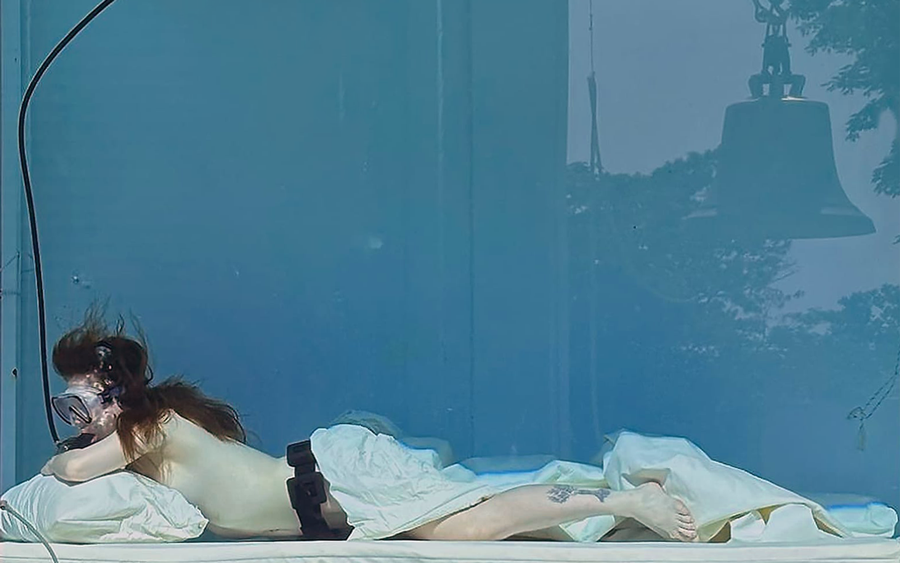
“In SEAWORLD VENICE, the promise of progress unfolds as a ‘Frankensteinesque’ dystopia: robot dogs wade through the rising water behind glass, acting as mechanical Cerberuses guarding a central sacrificial altar. Here, a performer lives within a tank sustained by body fluids contributed by the audience.” -Austrian Pavilion, Nora-Swantje Almes’s curatorship
After the online introduction to the Austrian Pavilion at Biennale Arte 2026, the 61st International Art Exhibition of La Biennale di Venezia, featuring Florentina Holzinger’s SEAWORLD VENICE, May 9 to November 22, 2026, curated by Nora-Swantje Almes.
The Austrian pavilion is one of the most talked-about exhibits at this year’s Venice Biennale, described everywhere as highly provocative. People are lining up to see it, and one possible reason (as Jörg Heiser put it on Facebook, Berlin, May 14, 2026) is perhaps something as trivial as the performers’ full-frontal nudity. Heiser also points out that the work criticizes water pollution caused by turbo-tourism right in the Mecca of turbo-tourism, and thus contributes to it directly in its own way.
Matthias Dusini (in his Radical Chic: Braune Lagune (“Brown Lagoon”), Falter, Vienna, May 8, 2026) calls the work a “Cirque du Soleil of Body Art,” something that panders to a less experienced audience, but also to institutional authorities in the art world (including very prominent ones) who, for one reason or another, extol populism. In his What does a woman swimming in urine tell us about the state of the world? Lots! (Guardian, London, May 8, 2026), Eddy Frankel even wrote, “It’s brilliantly obscene and vile.” “Brilliantly obscene and vile.” My f*****g goodness!
Dusini borrowed his title from Tom Wolfe’s satirical essay Radical Chic: That Party at Lenny’s (New York magazine, June 8, 1970), which describes a gathering at which Leonard Bernstein brought together mainstream politicians and Black Panther representatives, where glamour and white guilt mingled with the possibilities of enlightenment as a new catharsis and a new fashion of upper-class “performative activism.” Blackness+ was (and still is) a sexy cosmetic of capitalism there. A Radical Chic conference was later organized by Ute Meta Bauer at Künstlerhaus Stuttgart in 1993.
Holzinger’s project includes portable restrooms connected to a system that filters, disinfects, and pumps liquid waste into a large aquarium tank, where nude performers spend hours breathing through diving masks. Visitors are invited to urinate into these toilets, thereby contributing, quite literally, to the water level in the tank. The appealing aspect of participation is thus also fulfilled. Signs in the restroom warn: “PLEASE SIT DOWN,” “NO SHITTING,” “NO PAPER IN THE TOILET.” Urination was part of the art; solid waste was not the intention of this specific, filtered closed loop… However, according to some reports, on May 13, 2026, one visitor broke the rule and allegedly disabled the entire system, and thus the artwork, for more than a day. Whatever the verifiability of the event, Emma Stern speculated on it too, in her Who Took a Sh*t in the Austrian Pavilion?: Notes on System Failures, published on her Substack on May 25, 2026.
b)
Is SEAWORLD VENICE transgressive, hypocritical, or just simple-minded? Is this radical chic a form of decadence that plays with banality? Holzinger probably wouldn’t agree. “NO SHITTING” is like “bite me softly.” Sh*t sounds like Chic.
And what if the rumor of the sabotage was itself self-generated, a piece of fake news released from within the pavilion to add further transgression and thrill, if not also the valorization of system failure, that favorite idea of the art world, to the work? Hypothetically, it would be the most consistent gesture of the entire project: a transgression against the work manufactured by the work, provocation closing into its own marketing loop. The scandal would then be not the sh*t but the script.
Anyhow, Holzinger’s work belongs to a long tradition of explicit engagement with the body in the arts. Nudity is not provocative. It has been part of art for as long as art itself, with many explicit manifestations culminating in the performance art of the 1960s and 1970s, most extremely in her home country. Yes, nudity is a tradition, and as such it is conservative. If anything, it is open to criticism for its superficiality and for the potential objectification and self-exploitation of certain groups (even within their own circles), though it is also often perceived as a mere nuisance. And yes, there is a vast trajectory of scatological reference in art. Among many: Piero Manzoni’s notorious Merda d’artista (1961), Artist’s Piss (2021) by Gavin Turk, Oxidation Paintings (1978) by Andy Warhol, the photographic works of Andres Serrano, like Piss Christ (1987) or the Shit (2008) series, Piss Flowers (1991) by Helen Chadwick, Chris Ofili’s The Holy Virgin Mary (1996), Cloaca (2000) by Wim Delvoye, America (2016) by Maurizio Cattelan, Terence Koh’s Gold-Plated Poop (2007), Complex Shit (2008) by Paul McCarthy (among many of his other works), and let’s not forget the Luxembourg Pavilion at this year’s Biennale and Aline Bouvy’s La Merde (“an anthropomorphic excrement”), accompanied by a publication featuring a brief (and delicate) historical overview of the relation between art and fecality.
Activism (in art) cannot merely be pretended or performed in order to qualify as activism.
If it remains an aesthetic gesture, a spectacle, an adrenaline-fueled festivity (circus) that satisfies only its loyal community (keeping any community together is significant, but not enough), it is not activism. It is (also in the words of some historical Austrian artists) Actionism: something that is only mimetically played. We are not only homo ludens but also homo sapiens and homo faber. Activism, when it operates with artistic pretensions, is a form of applied art (as Artur Żmijewski also described it in his Stosowane Sztuki Społeczne / “Applied Social Arts,” Krytyka Polityczna, Warsaw, 2007), whereas the free art of Actionism can remain within the framework of an autonomous personal statement, ignorantly neglecting to work on comprehensibility, impact, and consequences, neglecting to work on the effectiveness of the event or movement, neglecting to work for others.
In the logic of radical chic, art is expected to be provocative. Even establishments ignorant of art history expect it. History repeats itself, but only as farce. Can provocation still be provocation if it fulfills such expectations? Provocation thus becomes a convention, an easily marketable commodity, a genre, just as the commodified outputs of Institutional Critique once instantly entered the collections of the very institutions they criticized (the case of all the emblematic pieces of Andrea Fraser, among many), and just as Marcel Duchamp observed in The Afternoon Interviews with Calvin Tomkins, 1964. Yet almost nothing is more contrary to the essence of free art than a cheap convention tailored to fit comfortably, for large sums of money. Conventional means mummified: rendered a dysfunctional, aestheticized museum item. Such a contract inevitably turns free art into applied or even decorative art. If something engages the convention intelligently, that is a different matter. But that does not apply to the pavilion in question.
I do not consider Holzinger’s work the worst (not at all); it merely embodies a symptom of art different from the (presumably) intended awareness of an (environmental) problem, and this I consider an emblem of the entire 2026 Biennale. It provokes us to speak about one of the (in my view) acute threats to art that it reveals, namely (despite the lessons we might have learned from the hypocrisy of Institutional Critique) the commodification of suffering as a sought-after commodity of the cultural-political industry: what Luis Ospina and Carlos Mayolo of the Grupo de Cali called pornomiseria in their 1978 manifesto.
Curatorship, and art as an institution altogether (as Daniel Baumann also argued in his article What Happened to the Curator? for Spike, 2024), is under threat of being reduced to filling out spreadsheets with statistically correct categories of political “goodness.” The reduction comes not only from the founding bodies of institutions (which believe that art is a service, thus an applied discipline, of cultural policy), but also from within activist movements. It is a call for comprehensibility and a renunciation of artistic depth in the name of some powerful imperative of today’s higher goals. If art (and philosophical thought) relinquishes its depth, if it accepts that there are higher goals to which it must yield (Inter arma silent Musae, just as Malevich tragically had to succumb to the Soviets…), then it has lost, and we all lose with it, for it will have negated its very essence: the essence of radicalism, the transgression of all thresholds, the unexpected provocation that arises from delving into the unknown, something realpolitik refuses to do. If we do not resist the demand for simplification, we not only lose all Black Squares but will never reach the radix of the problem, and thus will have no chance of solving it. What would have happened if the scientists had reacted that way?
Today, a significant share of activism has become the radical chic, the velvet methamphetamine microdosing, of semi-literate establishments and/or mainstreams: a defining art-washing detergent of the next generation of conservatism. This is precisely because of a poor understanding (logos) of the political craft (nomos and tekhne), of the practicality and effectiveness of activism’s actions, wherever the thirst for a good party prevails. And there are plenty of career-driven curators and artists who cannot wait to pragmatically fill out those “goodness” radical chic checklists, meeting the exhaustive quotas set by their superiors, all in order to climb the (circus) ladder higher.
I am not a moralist. I understand the rules of career mountaineering based on consensual bipartisan cannibalization (yes, I have Brazilian Antropofagia in mind), which keeps this diagrammatic machine of art working. I only want to point out that this does not support free art, but rather applied art, or, in fact, merely mimetic decorative craftsmanship, a kind of political catering. They/we are taking ourselves back to before the 19th century. Yes, we ignore the cosmos and only apply another layer of boring cosmetics (produced by political abstraction) to hide the problem. But hiding the problem does not solve it. It will continue to brew trouble, sowing discord in vitro, and we can expect it to erupt somewhere, sometime, by itself anyhow, too late. Boredom is a craniopagus sister of depression.
c)
The Venice Biennale is a process of selection with its own rules. The Venice Biennale is a competition of genres: monological fragments that complement one another. This Excel of genres addresses several imperatives: national representation and, above all, the urgent issues of today. Among the urgent issues (which belong to the agenda of political correctness, manifested here as radical chic in its entirety) are ecology (so many pavilions related to water and the ocean, reflecting a certain “hydro-fashion”), gender and identity politics, including decolonial discourse, indigeneity, equality, and advocacy for the disadvantaged and marginalized; then there is the intensive buzz in our communities around Russia/Ukraine and Israel/Palestine/Iran/US, along with transhumanity (that “Frankensteinesque” arabesque in Holzinger’s/Almes’ introduction), AI, and participation… As can be seen, the Austrian pavilion embodies many of these messianic Excel attributes, and we can therefore view it as representative of a broader range of current trends.
These serious phenomena become clichés in art, and consequently not just in art. In other words, the overuse of phenomena intended to raise sensitization leads to desensitization. Synaesthesia morphs into anaesthesia. The Venice Biennale is a competition of clichés. And if transgression is a cliché too, and surely it is here, as we can experience, then it must itself be transgressed. Someone (decades after Manzoni, and others) simply has to sh*t in it again, at the very least.
The convergent birth of the avant-gardes (art as the fastest of all disciplines) was immediately (somewhat instinctively) followed by divergent personal death-drives, which, by the end of the 1980s, had ground all the -isms into dust, then scattered into nothingness by mass-media white noise. Parallel to this evolution, the 19th-century new human, the individual, has today been dividualized into quecto fragments. I feel that capitalism has undergone a similar development: it is no longer a cohesive whole, but merely an endless multitude of compatible or incompatible atoms of a distributed economy, against which it is no longer possible to fight as such. Capitalism has transgressed and subverted itself epidemically.
In Contro Venezia passatista (1910), Filippo Tommaso Marinetti’s gang proposed the bulldozing and industrial transformation of Venice.
Venice, however, has transformed itself into a hyper-industry without being demolished. So if we are to be effective in performing the aforementioned genres (which are inescapable), we must follow the avant-garde experience of ad hoc divergence in order to grind that system to smithereens ad absurdum, without any physical destruction. Material destruction is too costly in time, money, and other resources, and in our case unnecessary, because it took place long ago in immaterial form. We only need to include the virus bugs when filling out that Excel, to connect the main spreadsheet to peripheral documents through enigmatic links. This processing is a kind of statactivist hacking and programmatic coding in the neuroaesthetic social sphere, its unconscious of desire. If capitalism is a matrix of many atoms (wirelessly interconnected), then we need not try to change the rules, because we can slip through the gaps and/or create our ad hoc molecules of sympathy (perhaps even a sort of ephemeral femmages) out of it. Gaps, emptinesses, are crucial. Empty is a synonym of free, and free is a synonym of empty.