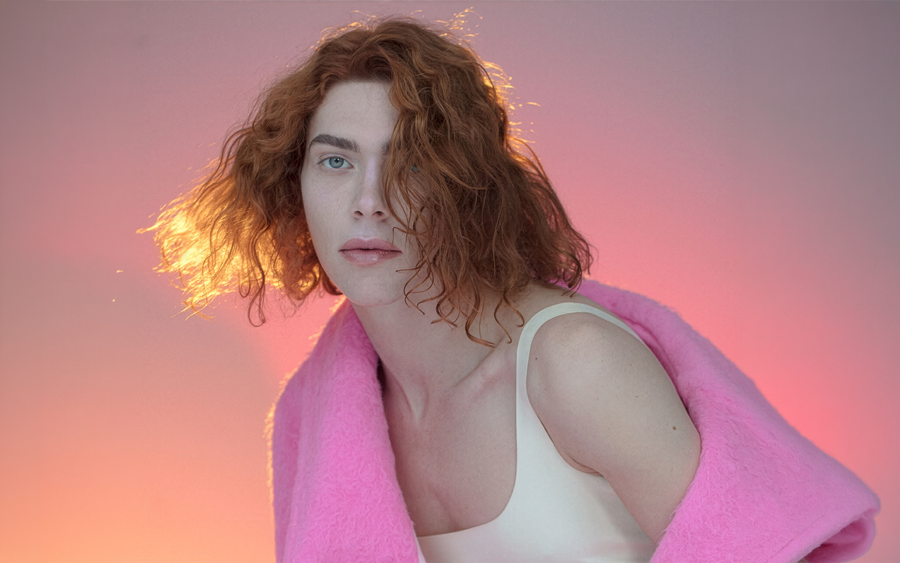
Sophie Xeon, the most inventive and imitated music producer of the last decade, has been invoked, more than ever since her death in 2021, as a symbol for new music, new freedom, and new identities. She took the cold artifice that has permeated electric and electronic music since the beginning, making it sound natural. In doing so she realised a 20th century dream, and cured the weaknesses of early, machinic pop.
In Stanley Kubrick’s A Clockwork Orange, ultraviolent bazoomny Alex hums along to Beethoven between beatings. First he loves the orchestral “Ode to Joy”, but when it returns on synthesizers, it becomes the soundtrack to his psychiatric torture and rehabilitation. Finally, the technologists who broke Alex decide to make him natural again, and when the Ode sounds natural and he smiles from his hospital bed, we know he’s been cured.
The film is a clockwork winding the past, present, and future of music into one song, from Modernism to Pop to the new organic sounds now emerging in Arca’s mutant anatomies and Caroline Polachek’s bionic arias.
Today, it seems as if Andy Warhol’s Postmodernism has won the aesthetic debate, and the Synthetic of yesterday will be the organic sounds of tomorrow. This is why whenever Sophie’s name is invoked, we need to remember what she declared from the beginning:
“It’s dance pop music, that’s the only kind of music that exists. And anyone that says anything else is a liar.”1
Nothing that happened since her debut has changed this. Sophie comes out and casts off the Warholian aesthetic because expressionism and gender are vulnerable to technological remoulding, in a way they never were in either the heyday of Pop Art or the epoch of Judith Butler. The reproduction of images and the reiteration of gender has been surpassed by a new, digital synthesis that inhabits audiences and artists alike. The sterility (her words) of a song like “Bipp” doesn’t bother us as it would our ancestors because the coldness in the song is internalized by everyone now. Pop is not a genre anymore, but an inescapable medium of life and art. Like Warhol always wanted:
“I think everybody should be a machine. I think everybody should be like everybody.” Is that what Pop is? “Yes, it’s liking things.”2
Warhol’s uniqueness isn’t creation, but consciousness and unwavering evangelism. Those who understood their fate as objects to be exchanged, eaten up and discarded had an advantage over the rest in pop. They always will. Marilyn Monroe might have been dead within months of her Warhol diptych, but she’d been copying herself for years, in a way Warhol admired and emulated. He was a Marilyn, and he modelled his deaths after hers. From his Factory he canonized the predecessors and recruited the next generation: Madonna was Warhol dressed as Monroe when she made the song that defined and replaced her, “Material Girl”.
What Walter Benjamin struggled to discover, Warhol breathed in and out like air. His Pop Art rescued the concepts within “The Work of Art in the Age of Mechanical Reproduction” from their sad academic confinement (Adorno), installed them in his New York Factory, and turned them back towards the original, messianic ambition that Benjamin called Dialectical Image: the printing of existence into nonexistence. The cinema, photography and consumer products emanating out of Belle Epoque Paris had been Benjamin’s omens. Every copy was eroding the unique space-time coordinate, or the aura, of its original. If mechanical reproduction continued to grow exponentially, originals might cease to exist, and with them gone, any stable concepts would drown in the sea of copies. Warhol’s endless prints of soup cans and superstars accelerated the destruction of aura, as he admitted when he switched to printing car crashes and electric chairs.
When did you start with the ‘Death’ series?
“…I was also painting the Marilyns. I realized that everything I was doing must have been Death”3
Death was something the popstar and philosopher could agree on. Replication should become so omnipresent, and authenticity so insubstantial, that concept and object merge, mimesis overcomes itself and copying transforms into a genuine absorption and (co)extension of the copied. In this moment of pure creation, when everybody likes everybody, an inexhaustible newness replaces our old concepts of time. History is a gruesome picture, and as Warhol puts it, “when you see a gruesome picture over and over again it doesn’t really have any effect.”4 A lesser artist might have been satisfied when Fredric Jameson saw in his paintings “a random collection of dead objects… as shorn of their earlier lifeworld as the pile of shoes left over from Auschwitz,”5 but not Warhol. He’d only settle for a total, global alienation, where everyone liked everyone, and Jameson and Warhol were as friendly as one dead object is to another.
As capital enclosed space, the key cultural battlefields shifted into time. Pop didn’t conquer the world with visual art but with the eerie classical facsimiles of Wendy Carlos. Carlos co-invented the Moog synthesizer, demonstrated its power with Switched-On Bach, then found her ideal accompaniment in a novel Warhol had already adapted: A Clockwork Orange. If Kubrick’s film had included half the music she scored, the director would have been completely overshadowed. What he left in, “A Funeral For Queen Mary”, a short fragment of “Timesteps” and her terrifying “Ode to Joy”, was enough to spread synthetic pop worldwide. Kraftwerk and Ryuichi Sakamoto walked out of cinemas to turn synthesizers and vocoders against their own Imperial cultures and Volkish nostalgias. When both artists were spliced into Afrika Bambaataa’s “Planet Rock”, pop began reconquering America as Hip-hop.
Analog printing and copying have inbuilt representational weaknesses. The end of history Benjamin prophesied and Warhol clawed at came in the 1990s, when digital computing took over, not the 30s or the 60s. What delayed it was the lossiness and crude translations inherent to techniques like vinyl, film, silkscreen prints, and the whole apparatus of midcentury mechanical reproduction holding art together. Since representation is easier in visual media, Benjamin, the film and camera lover, could ignore these problems. His close friend, Adorno, could not. Adorno was a trained composer and his reflections on music and the limits of representation are the most sustained theoretical assault pop has ever faced. Until Wendy Carlos proved the power of digital synthesis, they were irrefutable.
The essence of the critique of instrumental reason is that every conceptual system has gaps and blindspots. The moment Benjamin is waiting for, when replication becomes a co-extension of concepts and matter, can never arrive in a society anything like our own. If the moment seems near, all that indicates is delusion and collapse. Adorno makes this concretely relevant to Pop Art in the essay “Schoenberg and Progress”, tracing repetition in music from Bach to the dead-end of the 1940s. In Beethoven’s wake, repetition had become the heart of Expressionism. For an Expressionist each motif was an individual, and through iteration it evolved into a unique aesthetic life-form. But then, amidst the crises of the early 20th century, artists were forced to confront the reality that these life-forms were corrupted at the roots. The motifs were derived from the culture they wanted to be free of, and so all their growth belonged to that unchosen language. To save itself, Expressionism flipped into a disciplined Formalism. No more unchosen motifs, the whole artwork would be deliberate. Repetition hardened into a strict set of rules that could seal art away from culture’s law.6
This is where Warhol would be. His Pop Art is a machinic project, cut off from the temptations of false inspiration and societal influence. For all his seeming compatibility with commercialism, Warhol fled commercial art; wanted something more commercial, more perfect than advertising could offer him. Adorno’s example is the incredibly strict 12-tone serialism of his favourite composer, Schoenberg, and after a long, well-meaning look at the most complex and rational art system he can find, all he sees in it is another failure. Serialism is still hopelessly flawed, the supposed ‘equality’ of its chromatic scale is imperfect and unfixable. Schoenberg struggles endlessly against his own system while lesser composers fall into dogmatism:
“Emancipated music would like to restore, through organization, a lost wholeness, the lost power and necessity of Beethoven. This is only successful at the price of its own freedom, and thus it fails.”7
The incompleteness of music, and of art more generally, would be more tragic were it not so consoling. The failure of representation doesn’t just disallow coherent and free expression under capital, it also demonstrates the inability of 20th century capital to cohere. Like an industrialist or dictator, an artist can try to dominate nature, to build a perfect little rational world for themselves, but in time nature reveals your blindness and it all comes crashing down. The failure of art shows both the scars left on us as we try to escape society, and the incompleteness by which capital is haunted.8
Most of the haunting in art today is not real. The structural problems Adorno identified have been solved. The samples, the vinyl hiss and the VHS fuzz in new media are mostly digital simulations of analog, and the line from techniques like tape-splicing, collage and cut-up to the strangeness of 21st century Hip-hop and liminal space is a crude one. Hauntology is the ritualised performance of Adornian critique’s surface details, in the hopes of reviving inner mechanisms that have been entirely hollowed out by digital computing. The artworks that Mark Fisher9, Žižek10 and The Caretaker all lean on in the 2000s as evidence of something missing are explained away at the source, by their composer, as the product of technical inadequacy:
“There are possibly half a dozen basic sounds you can get out of an analog machine…They’re like little islands that sound good floating in an ocean of possibility.”11
Kubrick’s The Shining is probably the core of hauntology, but the woman who scored it and then surpassed it is never credited. Wendy Carlos is the spectre haunting hauntology.
The same serialism that drove Adorno to tears drove Carlos to computers.12 She saw the same weaknesses in it that Adorno saw, but rediagnosed them as technological problems and cultural blindness. The flaw wasn’t reason itself, it was analog. The equal temperament tuning that had dominated Western music since Bach was a compromise, an imbalanced and impure scale forced by the limitations of musical instruments.13 The advantage was coordination, in equal temperament tuning a whole orchestra can play in any key without retuning. The disadvantages were the same as any analog system or machine, whether the Moog or the silkscreen printing press.
“We don’t need the compromise anymore. We can begin to work in areas that up to now have been forbidden because we only had the equal-tempered scale. Where these steps may lead is anyone’s guess.”14
Adorno failed to imagine reason and representation beyond European modernity, and this same deafness that locked jazz away from him locked his entire critique into the age of mechanical reproduction. There are brilliant moments in Philosophy of the New Music where he tries to imagine representation pushed further, where it almost sounds like he’s predicting Industrial and Techno, but in the end Adorno loved Bach too much. While the young Bach practiced his scales at the court of Celle, next door Leibniz had already sketched out the binary refutation.
After her Tron soundtrack, Carlos began the work by recreating choir voices and classical instruments through digital synthesis. Instead of a limited set of possibilities to copy and collage, she had an infinite mesh of sound to melt down and sculpt back. First came a proof of concept, the orchestral Digital Moonscapes. The follow-up, Beauty in the Beast, is her greatest achievement, definitive proof that art would never be the same. It takes the tunings and instrument timbres of a dozen cultures, invents a few new ones, combines them, swaps them, deliberately does everything a real instrument ensemble can’t. The result isn’t a mishmash, it’s seamless. Carlos maintains a detailed website, and in her maddened descriptions of each track15 and her accompanying interviews, you get a sense of how Sophie Xeon might have had to describe her art if Wendy’s precision hadn’t made it all intuitive.
The dark side of all this (and it gets darker with Sophie) is that the synthesis which makes a dialectical image possible opens the door on totalitarianism as well. Beauty in the Beast is neocolonial world music. It doesn’t give the scales and timbres of Bali or Bulgaria a chance to speak, and it doesn’t sell cheap facsimiles of them either; it melts them down and builds them back up, proving anyone and anything can be subsumed gaplessly into the culture industry. Adorno’s consolation is gone. The failure of representation once demonstrated capital’s own incompleteness; a synthesis without gaps demonstrates nothing except its own power. With the digital arrives a previously unimaginable coextension of thought and matter, making domination sustainable as a political project and a cultural logic. In a world without instruments, the critique of instrumental reason cannot save us.
We’re at the end of the movie, strapped to our sick-bed. “Ode to Joy” rings out again. Beethoven was among the last images Warhol printed and now the lost power and necessity of his music is recovered through digital art. The technological basis of our cure was already being forgotten when Carlos called it tuning in the natural way, and since then the folding of nature into technology and capital has accelerated rapidly. Raw, real, natural art is a joke in the age of digital streaming. Naturalism belongs to groups like Autechre, whose music since Confield has been one long simulated evolution. Nowadays, their work is designing algorithms that design the music16: every track becomes a long, jazz-like pulsation of molten complexity. Past the digital biophilia of an artist like Björk, the true inhospitality of inorganic life is made apparent in a song like “feed1”, or an AMA answer like this:
Q: “What do you think of the whole all of our communications are being surveilled by the US government under the guise of anti-terrorism thing?” A: “A necessary stage in human evolution.”17
Sophie Xeon was born in the same year Beauty in the Beast was released. What Carlos struggled to discover, she breathed in and out. Hardware and software that Autechre had to wait for, she picked up early and mastered, internalising the liberating and nihilistic topology of digital life:
“You can create amazing things now just purely synthetically…there is absolutely no noise generated when you’re working purely in the box…you can compose something that is completely sterile…”18
“It’s just waveforms that can be pushed into shapes and materials and sequenced…”19
Sophie combines the Naturalism of Autechre with the critique of musical and capitalist semiotics that PC Music have inherited from Wendy and Warhol. Her insistence on a “monophonic, elastic, full frequency range morphing composition”20 doesn’t end when a song does, but extends to the whole world. Her every move towards singular authenticity is a move towards contingent fakeness too. She revolutionises sound design, but packages the results in a blank compilation called Product. She comes out for Oil of Every Pearl’s Un-Insides but the word NOTHINGNESS is written on her arm. Her famed “Immaterial” is an inversion of Madonna’s “Material Girl”: where Madonna priced the body, Sophie prices everything, and now limitless freedom converges with unrestricted exchange. And in “Whole New World/Pretend World” (her best song), it’s the New World that sounds false, held together by flat synths from yesterday’s future, until the Pretend World swallows them all up for good.
No more collage. When concept and matter are entangled enough to create art like this, everything collapses into one morphing composition. If you can take a bassline made out of elastic and try it in metal,21 if a percussion becomes a melody becomes a vocal, for how much longer does a static, predefined body satisfy you? In the world of “Faceshopping”, where the face is storefront and product at once, is satisfaction even possible? The idea that coming out could have resolved these problems, that something called transition can end the anxieties of unanchored change, is as ridiculous as thinking you’ve escaped colonial digitality by playing rock music. The simulation will brook no compromise, demanding an answer more and more desperately until, by the end of Oil of Every Pearl’s Un-Insides, it’s either absolute freedom or total annihilation. The solution that begins to take shape on her Non-Stop Remix will be strange, discomfiting, and heartbreaking.
We’ve been cured, and what might initially have felt like a return to the comfort of modernity or authenticity will be much more dangerous and beautiful. In “Nothing More to Say”, Rinse FM, Product, Oil of Every Pearl’s Un-Insides, Non-Stop Remix, Heav3n Suspended and Sophie I hope to find new approaches to life, and new histories for her predecessors. Warhol was the consciousness of his age; Sophie is the consciousness of ours. The Ode sounds natural again. From the sick-bed, we smile.
Notes
- Sophie Xeon, “History of Bass Double Bill with Annie Mac and Sophie,” BBC Radio 1, accessed August 14, 2026, https://www.bbc.co.uk/programmes/p01gq9kv. ↩
- G.R. Swenson, essay, in Warhol Warhol: Interview with G.R. Swenson (London: Thames and Hudson, 1969), 116–19, 116. ↩
- Ibid 2. ↩
- Ibid 2. ↩
- Fredric Jameson, Postmodernism, or, the Cultural Logic of Late Capitalism (Durham: Duke University Press, 2013), 18. ↩
- Theodor W. Adorno, Adorno: Philosophy of New Music (Minnesota: University of Minnesota Press, 2006) 41-43 ↩
- Ibid 6. 56 ↩
- Martin Jay, “Taking on the Stigma of Inauthenticity: Adorno’s Critique of Genuineness” (Fordham University Press eBooks, 2009), 17–29. https://doi.org/10.5422/fso/9780823231263.003.0003. ↩
- Mark Fisher, “The Metaphysics of Crackle: Afrofuturism and Hauntology,” Dancecult 5, no. 2 (2013): 42–55, https://doi.org/10.12801/1947-5403.2013.05.02.03. ↩
- Slavoj Žižek, In Defense of Lost Causes (Verso, 2009). ↩
- Connor Cochran, “Tuning in to Wendy Carlos,” Carlos interview by “Freff,” 1999, https://www.wendycarlos.com/cochran.html ↩
- Wendy Carlos, “An Open Letter to the Music and Arts Editor of the New York Times,” 1997, https://www.wendycarlos.com/resources/2ed-nyt.html. ↩
- Ibid 12. ↩
- Ibid 11. ↩
- Wendy Carlos, “Beauty in the Beast Notes,” 2000, https://www.wendycarlos.com/+bitb.html#1notes. ↩
- “Mark Hurrell – Autechre and Responsible Algorithms,” n.d. https://markhurrell.com/prospects/autechre-and-responsible-algorithms/. ↩
- Sean Booth and Rob Brown, “Ask Autechre Anything (02-07/11/2013),” Google Sheets, 2013. ↩
- John Roberts, “With Clothes? Sophie Interview,” Archive.today, 2013, https://archive.li/WkIBF. ↩
- Da Sterner, “Elektronauts: Sophie Interview,” Elektronauts, 2014, http://web.archive.org/web/20141107185217/https://www.elektronauts.com/talk/view/62. ↩
- Ibid 19. ↩
- Ibid 19. ↩