October 23, 2026
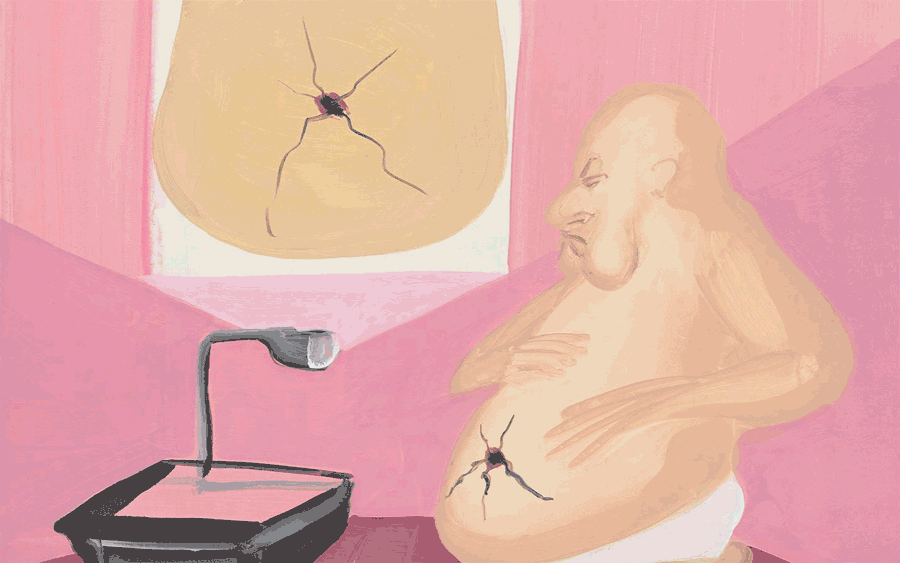
Original Image: Tala Madani, Projector, 2011.

Is There an Iran for Curators to Discover? On To Share a Stomach at The Brick

To Share a Stomach ran from August 8 to September 19, 2026, at The Brick, the Los Angeles non-profit art space formerly known as LAXART.

Aram Moshayedi curated the exhibit around proposals, instructions and letters sent by 25 artists living in Iran and carried out in Los Angeles by 24 American artists acting as their proxies. The press release dates the project to March 2026, when, in its words, the country was under daily bombardment and living through the longest internet shutdown ever recorded, and it describes the Iranian artists as people held back by “circumstances not of their making.”

Moshayedi does not hide the complications of the arrangement, acknowledging the unequal conditions under which the works were produced and asking what happens when one artist proposes a work and another executes it. These are the questions the exhibition permits itself to ask, but they are not the questions that matter the most after what has happened in Iran since January.

The internet shutdown Moshayedi’s press release attributed to the war was in fact imposed by the Islamic Republic much earlier than the beginning of combat. On January 8, 2026, the twelfth day of nationwide protests, the state cut the country off from the global internet; human rights organizations have described the blackout as an attempt to hide the mass killings that followed.

Never having fully subsided, the shutdown went into high gear again on February 28, the day American and Israeli strikes hit Iranian territory. The passive voice in the press release politely sidesteps these facts. In reality “circumstances not of the artists’ making” were very much of someone else’s. The exhibition’s founding sentence credits the war with the blackout, and everything else that is wrong with To Share a Stomach follows from this substitution.

The war did not begin the ongoing Iran crisis, but the widespread Lion and Sun Rebellion, as it is called inside Iran, attributed to monarchists did. On December 28, 2025, protests began across Iran as the currency collapsed and living conditions deteriorated; within days they had become a nationwide movement demanding the end of the Islamic Republic and restoration of the monarchy. On January 8 the authorities finally cut the internet while security forces carried out mass killings of protesters and bystanders.

Amnesty International describes January 8 and 9 as an unprecedented period of mass unlawful killings and calls it the deadliest period of repression in decades of its research; Human Rights Watch reports that thousands of protesters and bystanders are believed to have been killed. The counting is still going on. The Human Rights Activists News Agency had verified 7,007 deaths by late February, with more than 11,000 further cases under investigation; Iran Human Rights had identified 4,219 of the dead by name by September, 281 of them children. These figures are floors. The UN Special Rapporteur on Iran, Mai Sato, said in January that at least 5,000 people had been killed and that her medical sources put the number as high as 20,000; a network of doctors inside the country, cited by the Sunday Times and the Guardian, counted more than 25,000; TIME, citing senior officials in the Ministry of Health, reported that January 8 and 9 alone may have killed 30,000. Khamenei himself conceded “thousands” in a speech on January 17, and the state later settled on an official figure of 3,038. The precise number remains unknown because the shutdown and the repression that followed it were designed to keep it unknown. Amnesty, Human Rights Watch and the UN Fact-Finding Mission documented the involvement of the IRGC, the Basij, the police and other security forces, and in September the UN mission found that the killings took place in all 31 provinces and amount to crimes against humanity. The genocidal violence came from the state, which aimed it at its own population.

Those weeks opened a valley of blood filled with corpses between “Iran” and “the Islamic Republic.” To Share a Stomach does not account for tens of thousands of dead bodies murdered by the regime. It takes the March bombardment as the condition of its understanding of Iran; the resulting country is one under attack, cut off from the world, exposed to censorship and war, and represented by the testimony of artists who remained inside.

This is a more sympathetic picture than the old exotic, irrational country trapped between religion and geopolitics; but this does not make this new picture less misleading. Once the January massacre is left out of the frame of reference, Iranian suffering appears as something inflicted on Iran exclusively from outside by the US and Israel. For the exhibition and its selected artists, the Iranian population is the victim of bombardment and blackout, while the state that rules it, and had already been massacring its youth, recedes into the background.

When are we going to learn that Iran and the Islamic Republic are not interchangeable terms? The distinction is one of the central political facts of Iranian life. The Islamic Republic is a state with institutions, armed forces, ideological commitments, economic interests and an oversized apparatus of repression; the IRGC is one of its principal centers of military, political and economic power. This is why Iran or the Iranian society cannot be reduced to those institutions. The people killed in January had not been caught between their country and foreign powers. Many of them were demanding the removal of the system that claimed to speak in their name, which is why Amnesty describes the January protests as a popular uprising for dignity, freedom and an end to the Islamic Republic.

The Iranian population inside and outside the country belongs to several diametrically opposed political formations such as secularists vs Islamists, monarchists vs republicans, nationalists vs internationalists, reformists vs revolutionaries. There are people who want the Islamic Republic preserved and people who want it abolished, people opposed to Western military intervention and people who support it, people for whom Palestine is the central political question and others for whom the overthrow of the regime takes precedence. But to understand the scale of these contradictions, we can look at findings by GAMAAN, the Netherlands-based Group for Analyzing and Measuring Attitudes in Iran.

In June 2026, three months after the war, GAMAAN surveyed 31,450 people inside the country. About a quarter of the literate population over 15, roughly 14 million people, said they had taken part in the January protests, and 71 percent of them named rejection of the Islamic Republic as their reason. Eighty percent of all respondents judged the regime’s handling of the protests wrong, 75 percent of all respondents completely wrong; the 14 percent who approved were concentrated among pro-regime respondents.

Asked about their political orientation, 47 percent wanted regime change as the precondition for any improvement, 23 percent wanted a structural transition out of the Islamic Republic, 10 percent wanted gradual reform within it, and 9 percent identified with the principles of the revolution and the Supreme Leader.

Asked what should replace the system, 34 percent chose some form of monarchy, 28 percent a republic, 13 percent the Islamic Republic as it is, and a quarter either did not care or did not feel they knew enough to choose.

The war divides the same population down the middle: 42 percent called the American and Israeli strikes military aggression against Iran and nearly as many refused that description; 38 percent had supported foreign military intervention both before and after the war, 27 percent had opposed it both before and after; 60 percent felt satisfaction at the weakening of the Islamic Republic, and 52 percent said the killing of the Supreme Leader did not sadden them. Views of Donald Trump split evenly at 44 percent each way; Benjamin Netanyahu drew more positive views than negative; 62 percent rejected the slogan “Death to Israel.”

Getting back to the exhibition, among its own constituency, there are artists who remain in Iran because they cannot leave, artists who remain because they choose to, artists who have left, and artists whose positions align with the regime because the alignment simply enhances their careers. Some occupy several of these positions at once; some refuse all.

This disagreement is the Iranian political reality with no “real” Iranian experience lying beneath it. An exhibition that uses “Iran” without confronting the disagreement turns the word into a container in which not only can incompatible positions be stored without the institution having to tell them apart, but one particular opinion can also be suggested to stand for the rest. The question of who disappears when the country becomes a single subject is masked in the name of its unmasking.

The proxy structure of the exhibition involving artists in Iran and Los Angeles makes the problem of recognizing Iran worse. An artist in Tehran sends a proposal; an artist in Los Angeles executes it; the work circulates despite restrictions on movement and communication. But the American audience never meets the Iranian artist. It meets a chain of mediation: the proposal, the proxy’s interpretation, the curatorial framework, the institution, and finally its own expectations. Each link translates and each translation removes something. The accompanying booklet, which reproduces the artists’ first emails and texts to Moshayedi, sets their proposals beside their accounts of life during wartime, so that the war arrives as the context in which every proposal is to be read. The question that matters is which Iran is left visible when the whole chain of work has been executed, and what had to disappear for the exhibition’s Iran to remain comfortable.

The exhibition asks its audience to listen to Iranian artists instead of Western media, while its Iranian artists are nonetheless assembled into a legible image of Iran by a mediating American institution. Moshayedi subverts their contradictory pluralities into his own preferred coherence so that an Iran of his making can be recognized. Thus, the Western gaze survives any new translation by gathering more evidence for its new version of Iran.

There is a further difficulty specific to the American liberal art discourse. The language of anti-imperialism is indispensable when it describes actual imperial violence. The United States has intervened in Iran repeatedly; Israel’s military actions belong to a history of occupation, displacement, military power and Western geopolitical interest that cannot be set aside. None of this disappears because the Islamic Republic has mass murdered its own people. But anti-imperialism turns dangerous when it becomes a sorting mechanism in which opposition to the United States or Israel produces political legitimacy by itself for whomever wherever. A state can oppose American power while repressing its own population; the Islamic Republic can condemn Israeli violence while imprisoning and mass killing Iranians.

The Islamic Republic’s hostility to the West also has its own intellectual history, older than any reaction to American foreign policy. Ahmad Fardid’s concept of gharbzadegi, later popularized by Jalal Al-e Ahmad, usually translated as Westoxification, treats all of Western modernity as a civilizational disease rather than a cultural or geopolitical opposite. After 1979 the concept entered the ideological vocabulary of the state. While Fardid cannot be blamed for everything the Islamic Republic became, that vocabulary cannot be translated into the language of contemporary American decolonial politics without omissions or falsifications. Yet this is the translation that an exhibit framed by bombardment and internet blackout invites. The show never has to say any of this. It only has to leave the state out of the picture; the audience, trained in that vocabulary, will likely supply the rest.

For this reason the exhibition title deserves to be taken seriously. Moshayedi has written that To Share a Stomach is his own mistranslation of hamdeli, the Persian word for empathy, which properly means to share a heart; del, the heart, is also the gut. The metaphor proposes intimacy across distance. The curator’s admission that the title mistranslates is more honest than the exhibition around it.

Whose stomach are we sharing? The American audience is offered an Iranian experience already selected, translated, arranged and institutionally sanctioned. The proxies in California producing the art serve as bridges, the curator as the translator, the organizers as a big gate, the institution as the frame, and the audience? They will come to the exhibit and receive “Iran.”

The exhibition wants to move Iran out of the Western center of the art world, as Copernicus moved the Earth out of the center of the cosmos. But Copernicus put the Sun in the Earth’s place and left the structure intact: a universe still organized around a privileged point. It took later cosmology to draw the full conclusion of the Copernican principle, which holds that no observer occupies a privileged position anywhere in the cosmos.

This is why To Share a Stomach is heliocentric. It rejects the old Western image of Iran and installs the Iranian artist as the new Sun from which the country can be known, inside an epistemology that has barely changed. Finding a more authentic center solves nothing because no authentic center is waiting to be discovered; there are only asymmetrically popular and competing political subjects and incompatible memories.

An exhibition cannot turn that disagreement into one Iranian voice without falsifying it.

The exhibition fails utterly by producing an Iran that only fits the needs of a Western art audience: vulnerable enough to generate sympathy, repressed enough to generate moral clarity, anti-imperialist enough to fit the politics of the room, disconnected enough to justify the proxy producers, war-torn enough to generate urgency, and coherent enough to remain legibly exhibitable.

Nobody at The Brick needs to support the Islamic Republic for this exhibition to serve the regime since its logic reproduces one of the state’s most useful assumptions: that “Iran” is a single political subject whose conflicts are best narrated through its confrontation with foreign powers.

The January massacres made that assumption no longer possible. The pro-monarchy protesters shattered the fantasy that the Iranian people and the Iranian state form one political body while thousands of them paid the price of this lesson by being murdered for it. Sorry, but their deaths drew a line that cannot be erased by placing “Iran” on one side of a geopolitical conflict. An exhibition that dates its Iran to March 2026 erases that line, whatever its intentions.

The task of representing Iran after January lies in refusing the demand for a single image rather than in finding a more sympathetic one, if not interrogating the illusory unity of the image that liberals and leftists in the art world, those either from Iran or from elsewhere in the art ecosystem, have hegemonized in the name of progressive politics.

That refusal or interrogation would be Copernican in the full sense: no artist, curator, institution, diaspora, state or audience occupies the point from which every Iranian experience becomes intelligible. Rather than telling an American audience what Iran is or represents, the exhibition would have had to put that audience in front of people who disagree violently over what Iran should become.

That is a harder exhibition to organize for career curators who often build their path through presenting the safe bets they make as counterhegemonic, perhaps why his exhibition offered no clean moral position and no reassuring sense of having met the “real Iran”; it leaves the contradiction of “sharing a stomach” with people with whom you may not agree.

The question, finally, is less whether an American audience can share the experience of Iran than whether the exhibition is willing to give up the pleasure of believing that it already knows what that experience is.

Moshayedi ought to stand in front of a mirror and ask himself whose stomach he was sharing: the people, the state, the proxy, the institution, or the image the American art world is prepared to recognize? Until he answers that question, replacing the Western image of Iran with a more sympathetic one only moves the Sun to the center and leaves the old white sky in place.

More Articles from &&&

Is There an Iran for Curators to Discover? On To Share a Stomach at The Brick

To Share a Stomach ran from August 8 to September 19, 2026, at The Brick, the Los Angeles non-profit art space formerly known as LAXART.

Aram Moshayedi curated the exhibit around proposals, instructions and letters sent by 25 artists living in Iran and carried out in Los Angeles by 24 American artists acting as their proxies. The press release dates the project to March 2026, when, in its words, the country was under daily bombardment and living through the longest internet shutdown ever recorded, and it describes the Iranian artists as people held back by “circumstances not of their making.”

Moshayedi does not hide the complications of the arrangement, acknowledging the unequal conditions under which the works were produced and asking what happens when one artist proposes a work and another executes it. These are the questions the exhibition permits itself to ask, but they are not the questions that matter the most after what has happened in Iran since January.

The internet shutdown Moshayedi’s press release attributed to the war was in fact imposed by the Islamic Republic much earlier than the beginning of combat. On January 8, 2026, the twelfth day of nationwide protests, the state cut the country off from the global internet; human rights organizations have described the blackout as an attempt to hide the mass killings that followed.

Never having fully subsided, the shutdown went into high gear again on February 28, the day American and Israeli strikes hit Iranian territory. The passive voice in the press release politely sidesteps these facts. In reality “circumstances not of the artists’ making” were very much of someone else’s. The exhibition’s founding sentence credits the war with the blackout, and everything else that is wrong with To Share a Stomach follows from this substitution.

A Darkness unto Itself: A Response to “The Superdark Factory”

The question shared by my paper Deep Objects, Broken Metabolism and The Superdark Factory pertains to the fate of agency once cognition is distributed across organizations whose tempo and differentiation outstrip individual apprehension.

In the deep-object argument, its stronger locus is geistic and historical rather than zoological propriety. Intelligence exercises agency insofar as it can reconstruct enough of its conditions to discriminate contingent inheritance from structural constraint, then alter the former without impairing the functions it sustains. Freedom, on this account, takes architectural form through the capacity to treat the conditions of its realization as objects of reconstruction and redesign rather than as inherited jurisdiction. As the metabolism reproducing those capacities is exhausted, formal discretion can survive after substantive agency has been hollowed out.

This also elucidates the relation to Intelligence and Spirit, whose account centers on rational agency rather than generic causal efficacy or autonomous operation. A system can act and reconfigure itself without entering a normative space in which commitments can be justified, criticized, and revised in light of reasons. That account still holds as a criterion of rational or general (qualitatively understood) artificial agency, although its developmental picture should no longer be construed as the likely trajectory of contemporary AI. Contemporary systems evince another trajectory along which operational agency can intensify without the rational integration associated with sapience.

The Superdark Factory radicalizes this divergence insofar as its architect cedes internal command and admits an organization whose development outruns descriptive mastery. Agency is initially concentrated in the Stackelberg move, which establishes the conditions of self-organization, and later continues at the boundary through the charter.

Speculative Realism & the Invention of Post Kantianism

It is the poststructuralist verbiage that reduces the Kantian subject to the supposed fallacy of an (absolute) sovereignty or autonomy. Kant does not postulate the Subject in such a manner. When the so-called (speculative) realists attack poststructuralism as post-Kantianism, they adopt the poststructuralist framing of Kant: “it’s all in our heads,” reality is but the… Read More »

The Fold, the Grid & the Void

Since the release of the A24 film The Backrooms, directed by Kane Parsons, earlier this year, the obsession with liminality has moved from semi-underground web lore into the mainstream. The lore began in May 2019 with a single image posted to 4chan’s /x/ board, in a thread asking for “disquieting images” that felt “off”: a… Read More »

Why The Dark Forest Theory of the Internet Is as Red as Communist China

Every theory of the internet is almost a theory about online attention and, above all, surveillance and visibility.

Bogna Konior’s The Dark Forest Theory of the Internet says something about the subject that most Western media writing won’t admit, that the lights online were never for seeing but for being seen. The book interprets the internet, and then AI, through Liu Cixin’s Three-Body trilogy, a universe where civilizations hide because getting noticed gets you killed.

In this text, I ask, from where does this picture emerge and where is Konior positioned when she writes about it? The short answer is that the dark forest she borrows from Liu grew straight out of communist one-party states, and that her book makes the most sense once it is read that way.

Liu’s trilogy begins in 1967, at the height of Mao’s Cultural Revolution in Beijing during a “Struggle Session,” where a young astrophysicist watches Red Guards beat her father to death for refusing to take back his scientific claims, killing her faith in humanity. What grows in its place is the certainty that humans can’t be trusted with themselves. That certainty is what makes her respond to the alien signal and invite a hostile civilization to come and wipe Earth out.

This is why Liu’s dark forest rule that shows up in his second volume about staying silent because anything that spots you will assume the worst and shoot first, is just the struggle session blown up to the size of the galaxy.

Lust to See: Rasa & Time-Given Beholding

The first time I stood before Lee Ufan’s From Line (1978) series was at Museum MACAN in Jakarta. The museum framed Ufan’s work as offering an Asian post-war critique of Eurocentrism and as belonging to the Mono-ha movement. The series’ lines and intervals were here cast as refusals of Western painterly gesture, a resistance to fullness or plentitude. Six years later at Tate Modern in London I stood before another work from the same From Line series—the institution having completely recontextualized it. Here Ufan was placed within a Western narrative of painting’s evolution, cited alongside Richter as fitting into or exemplifying a different genealogy of restraint. What had clearly changed was the field of articulations or legibility surrounding this series, and with it the work’s temporal address.

My dear friend Ina replied to the photo of the Tate collection I posted online—I had quietly wondered whether anyone would recognise this same series in Jakarta. She implied that I did not have to go so far to see this particular series for we can see it at home, in Indonesia: “This exists even in Museum MACAN, haha.” She recognised Ufan’s work, and we did not have to name either the series or the artist in the chat. In this instance of intersubjective beholding, recognition is named through the encounter of shared memory—having stood before the same object in the same institution, in the same city, by grace of the same proximity.

Were I to define “institutional,” I would include those who build and inhabit such public spaces: the curators, educators, guards, critics, and the public itself—all of whose habits and styles of looking give those rooms their precise temporality.

Sophie’s Choices: Freedom or Annihilation?

Sophie Xeon, the most inventive and imitated music producer of the last decade, has been invoked, more than ever since her death in 2021, as a symbol for new music, new freedom, and new identities. She took the cold artifice that has permeated electric and electronic music since the beginning, making it sound natural. In… Read More »

A Mother Is Never Enough for Life on Mars: On Post-Planetary Ectogenesis

In her book Hospitality of the Matrix: Philosophy, Biomedicine, and Culture, Irina Aristarkhova discusses how the progress of feminist thought on pregnancy has often been impeded by its struggle against the oppressive hierarchies surrounding it: “Often, in feminist research, pregnancy was represented in the context of an impending struggle between mothers and medical and socio-cultural institutions that treated it as a means to an end: the child.” The task of her study is not to keep pregnancy within this “problematic” context for feminist politics, but to find ways of describing it that would make the process of species reproduction emancipatory for those who participate in it—primarily mothers, but also a multitude of other actors. This task is realized nonlinearly, and it runs through several stages. One needs, first, to see through the philosophical presuppositions of the pregnancy-organizing discourses of embryology and immunology, in order to dismantle the hostility toward mothers embedded in them. Conceptualizing reproductive practices in terms of hospitality rather than competition demands, next, a deep inquiry into how the foundational phenomenological relation of the self toward the other is modeled—for the oppressive realities women face within reproductive institutions build up from an under-conceptualized psychic economy. Art projects such as Virgil Wong and Lee Mingwei’s Male Pregnancy then exemplify reproductive practices modeled on the relation of hospitality. And finally, biotechnological capabilities and their material realities directly inform pregnancy as a discursive practice.

You Died, Subscriptions kept Renewing; You’re an Influencer Now!

The dead keep surfacing on the interface. A social media profile reappears under People You May Know, a birthday reminder fires for someone buried in the spring, a subscription renews against a card nobody thought to cancel, a playlist refreshes itself for no one.

The systems are not being callous, requiring a death already registered and then overruled. Strangely, nothing has yet registered. The addressee was never the one who died. It was the profile, the behavioral outer form, assembled from years of signaling, and the profile is now in perfect health again.

The living are currently addressed in the same form; death simply makes the separation of the thing and time easier to observe. A feed never overlaps perfectly with a whole life lived; it meets the signal, then rewards whatever performance it can classify. Users learn the lesson without needing to understand it. Some versions travel, others stall or disappear. Over time, this creates pressure toward a self that can revise itself at the system’s speed.

That training takes place inside an infrastructure (platforms, models, attention routes, finance, law), and the means of reproduction is owned. No one has to command the trajectory. Platforms set out to maximize engagement and predict conduct, which requires many users who can be addressed at scale. Because some forms of subjectivity are easier to measure and route than others, optimization selects for them effortlessly, almost as a side effect.

Sirat, Exocapital & Europe’s Beautiful Souls

I wish I could write an objective review of this movie, but the first third to half of it was a straight-out portrayal of a continental Western European working class subculture (teknival/French hardtek) that myself and many others grew up intimately familiar with, on a visceral, physical level: the complete illegality of it, the walls… Read More »

NO SHIT: Notes from Venice Biennale 2026

“In SEAWORLD VENICE, the promise of progress unfolds as a ‘Frankensteinesque’ dystopia: robot dogs wade through the rising water behind glass, acting as mechanical Cerberuses guarding a central sacrificial altar. Here, a performer lives within a tank sustained by body fluids contributed by the audience.”  -Austrian Pavilion, Nora-Swantje Almes’s curatorship   After the online introduction… Read More »

On Trump Defeating Communism, Again!

You must love our country. […] as we approach this magnificent anniversary, we see our American identity under a renewed attack, a generation after we fought and won the Cold War against the menace of communism. There is now a resurgence of the communist menace in our land, including from newcomers to our country […]… Read More »

Death in Venice

Before I went to Venice I thought I’d try a travel diary, but that’s not how I like to write and it’s what everyone does, i.e. deferring the responsibility of coming to any conclusion about the Biennale as a whole by giving a first-person account of how utterly chaotic preview week was. I wasn’t at… Read More »

Who Is Western Marxism Really For?

There is this letter Althusser wrote in 1962, to a woman he was seeing, where he just trashes Lenin. He is rereading Lenin on philosophy and he is basically going: god, this is weak. Amazing guy when it came to reading an actual situation, reading what was in front of him, but the second he… Read More »

Occult Perso-Punkism of Cyclonopedia

Nuqtavism was a heretical, atomist cosmology that emerged from within Islamic mysticism while simultaneously pushing it toward its limits. The endgame of Islamic esotericism was always the horrifying announcement that the mystic, through infinite cycles of ascetic self-creation and self-annihilation, had finally reached the highest point of abstraction, or tajarrud: the final release from materiality.… Read More »

Genealogy of Wokeism

Introduction The last thing most progressives think we need is another male writer complaining about “wokeism.” Why not talk about more important things? Wokeism has become somewhat of a floating signifier. Wokeism can mean different things to different people, with many people throwing the term around as a pejorative in highly inconsistent ways. However, many… Read More »

Paratypology: Towards a Scrap Theory of Form

1. To Sort I find myself at a furniture factory, in the seaming department, surrounded by the pneumatic humming of sewing machines. All around me, industrious hands are swift in joining odd parcels of hide, textiles and other soft surfaces according to flat templates. Although the individual steps they carry out are familiar to me,… Read More »

Socialism after Socialism, A Response to Conrad Hamilton

In the spirit of dialogue, I am responding to the observations in Conrad Hamilton’s recent expansive review of my book The Political Theory of Liberal Socialism. I will be concentrating on Hamilton’s three main claims, that there is a gap between the form and content of socvialism, invoking Marxist theories of struggle before coming down… Read More »

Biennialese Blues: Review of Whitney Biennial 2026

ARTISTS: Basel Abbas & Ruanne Abou-Rahme, Kelly Akashi, Kamrooz Aram, Ash Arder, Teresa Baker, Sula Bermudez-Silverman, Zach Blas, Enzo Camacho & Ami Lien, Leo Castañeda, CFGNY, Nanibah Chacon, Maia Chao, Joshua Citarella, Mo Costello, Taína H. Cruz, Carmen de Monteflores, Ali Eyal, Andrea Fraser, Mariah Garnett, Ignacio Gatica, Jonathan González, Emilie Louise Gossiaux, Kainoa Gruspe,… Read More »

No View from Nowhere: On Discourse, Différance & Functorial Semantics of Micro-Communities

This essay argues that natural language semantics admits no global orientation—no ‘view from nowhere’—but only local positions within psychoanalytically and sociologically embedded discourse communities. Drawing on Derrida’s concept of différance, I demonstrate that meaning is constitutively deferred across the differential play of signs, precluding any meta-linguistic standpoint from which all local meanings could be adjudicated.… Read More »

Liberalism Is Dead, Long Live Liberalism!

Matthew McManus’ The Political Theory of Liberal Socialism is a powerful attempt to merge two disparate traditions, parlaying reformist compromise into a coherent political program. It also rests on the assumption that socialism is inherently illiberal, an assumption that deserves to be questioned. While often hailed as the single-minded son of America, perhaps the best… Read More »

Luxury Activism: Art, Fashion & Capital

[This text was previously published by the author in Portuguese on Contemporânea Magazine — Ed.] I don’t want to work with fashion. Beauty must be preserved from capitalism. Fashion favours the escape into personal, private, selected, chosen space, as a form of false self-determination. Fashion reflects the fear of losing’ identity. — Thomas Hirschhorn The purposelessness… Read More »

The Questions Concerning the Ethics of AI

With recent articles in &&& concerning the status of what is or is not Marxism, I took it upon myself to write a piece that I consider firmly placed in that tradition. I am not being paid by the CIA, I promise. Furthermore, despite appearances, my article is not an article in the “ethics of… Read More »

The Best Ever Art Basel Review that Qatar Money Can Buy

During the Art Basel Qatar’s VIP preview of Sweat Variant’s durational performance My Tongue is a Blade on February 4, two special seats up in front of the stage stayed empty for a while.  Empty with intent.  People hovered, looked, and reconsidered occupying them in their head at the last minute like they were about… Read More »

SUPPORT THE IRANIAN REVOLUTION 2026!

SIGN THE STATEMENT HERE The past several weeks have borne witness to a bloodbath in Iran amidst images of systematic massacre and horrific abuses of power by the Iranian government against its own people. As a united front, we stand together to uphold the following convictions: 1- That the Islamic Republic of Iran must come… Read More »