November 7, 2026
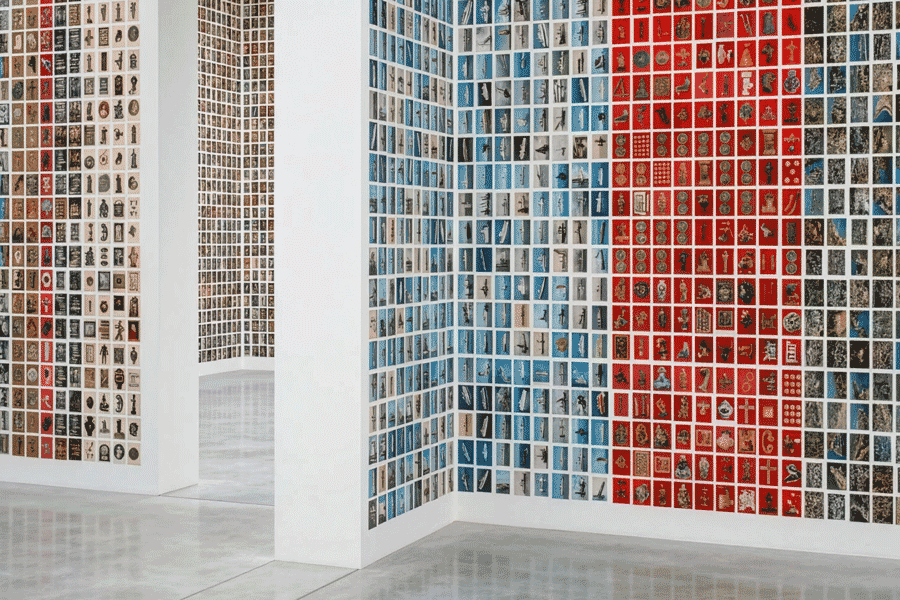
Oriol Vilanova, Spanish Pavilion, Venice Biennale, 2026.

How I Came to Accept the Death of Contemporary Art in Venice

My final words…

Contemporary art died a while ago, and all we have these days is the ongoing display of mostly decaying corpses presented as living bodies, while the exceptional living practices have to hide as corpses amongst the rest. Surely good art survives the contemporary art paradigm, but it stays buried until someone finds a way to liberate it from the chokehold of the morgue attendants we call curators, who have no frame other than contemporaneity with which to talk about art.

This edition of the Venice Biennale can function as the light at the end of this dark tunnel, since the exhibition’s main curator Koyo Kouoh sadly passed away before the show started to congeal. OK, I am not suggesting here that all curators must die for art to be free, or, as Suhail Malik put it a decade and a half ago, to “exit” from the contemporary, but that art and artists cannot wait for curators and institutions to initiate their liberation. All of those who truly love art, and at least respect it as a form of historical objectivity and an objective history of passing time, must do whatever they can to start this process.

Ledger

½* Utterly Insignificant
* bad
*½ Meh
** Not bad
**½ OK
*** Good
***½ Very Good
**** Excellent
Hat tip to my friend and colleague Sean Tatol for inspiring me to have my own star system for this text and also for inventing a straightforward way to talk about art.

+++

Central Pavilion, Giardini (In Minor Keys, conceived by Koyo Kouoh; realized by advisors Gabe Beckhurst Feijoo, Marie Hélène Pereira and Rasha Salti, editor-in-chief Siddhartha Mitter and research assistant Rory Tsapayi): A hodgepodge of ethno-kitsch works from mostly black artists around the world; the closer they were to the West, the more kitsch and less interesting their works. I wasn’t sure whether I was walking through an African luxury craft fair or a curated exhibition. I kept forgotting that the curator passed away and her team put this hot mess together. ½*

Arsenale (In Minor Keys, same team): It started strong with a few great pieces, which only raised the viewer’s expectations, producing nothing but greater disappointment as the exhibition unraveled into MFA works from the Global South. But the award for the worst work has to go to Kader Attia, himself a biennale curator, who is obviously big enough to intimidate a substitute team into rubber-stamping his ideas, but not good enough to understand how to showcase a multidimensional video installation adorned with small collages clearly created for commercial purposes. The insignificant content of the videos, resembling reports on poor countries at NGO summits somewhere in the European Union, was compounded by their projection with huge white margins on the walls., and the robes with mirros were like a cheap one hit wonder. The piece silently screamed EXHIBITION DESIGN SOS!!! Plus, the entrance and exit were so badly designed that I ended up claustrophobically convinced I had been imprisoned in a decolonial hellhole. Sad, because Attia is capable of great work evidenced by his exhibition from two years back at MUAC, Mexicvo City. *½

Turkish Pavilion (Nilbar Güreş; curator Başak Doğa Temür; commissioner İKSV): I was delighted to see Nilbar Güreş’s work one more time, as she represents a fresh new approach to art-making from an overpoliticized region. My only complaint is that there should have been at least one more large work and none of the smaller works on paper and drawings, to focus on the monumentally whimsical nature of the artist’s work. ***

Austrian Pavilion (Florentina Holzinger; curator Nora-Swantje Almes; commissioner Arts and Culture Division, Austrian Federal Ministry for Housing, Arts, Culture, Media and Sport): Abject poverty of thought costing Austria millions of euros. When North European artists and intellectuals have nothing new to say they often resort to supposedly shocking and under the belly trash stuff. Fuck this shit. ½*

Saudi Pavilion (Dana Awartani; curator Antonia Carver; assistant curator Hafsa Alkhudairi; commissioner Visual Arts Commission, Saudi Ministry of Culture): Truly incredible work, eclipsed only by a couple of other presentations: a beautiful and massive piece covering the pavilion’s entire floor with stones carefully cut to compose a mesmerizing pattern, a subtle balance of modern and contemporary versus traditional. Antonia Carver has done it again. I wish this work could be permanently installed somewhere where regular people, and not just art world douchebags, can experience it. ***½

Belgian Pavilion (Miet Warlop; curator Caroline Dumalin; commissioner Caroline Gennez, Flemish Minister for Culture): A bunch of hipsters yelling and moving erratically while shifting slabs of something marked with letters. Calling this shit show the intersection of dance and performance art is an injustice to AI slop. ½*

Greek Pavilion (Andreas Angelidakis; curator George Bekirakis; commissioner Fani Tsatsaia, MOMUS): The best installation of this edition, the funniest version of a 1980s gay club as art, as gay as Frankie Goes to Hollywood. Crazy projections, fed by cameras picking up images from inside the pavilion, were thrown back onto the walls, surrounded by oversized printed T-shirts, all padded like Andreas Angelidakis’s signature works from the past. This is a real homosexual, and not queer, show about gayness and dark, black nightclubs; one could almost smell the poppers! ***½

Japanese Pavilion (Ei Arakawa-Nash; curators Lisa Horikawa and Mizuki Takahashi; commissioner The Japan Foundation): Pointlessness in a work of contemporary art can only be appreciated if we assume it points to the pointlessness of the whole genre. **

Spanish Pavilion (Oriol Vilanova; curator Carles Guerra; commissioners AECID and AC/E): This is what I call real protocol art (see my review of Strange Rules in the collaterals section below), also beautiful, also architecturally perfect, truly the best pavilion of this edition. The idea is as simple as a single line of code: cover every wall with postcards, most of them turned against their original horizontal orientation and hung vertically. It becomes protocol art through the meticulous way Oriol Vilanova carried out this rule in real physical space, where the postcards complemented the beautiful structure of the pavilion, with its many atypically shaped rooms, and unified the whole building into one continuous work. ****

Irish Pavilion (Isabel Nolan; curator Georgina Jackson, Douglas Hyde Gallery; commissioner Culture Ireland): Nice rugs, and a beautiful, large navy blue tote bag I desperately needed for my collection, which they forced me to buy. Still not as incredible as John Gerrard, who should finally represent the country, but every time, the woke art admin people of this once great nation give it to mediocre, adjacent but safe bets. **

Russian Pavilion (group presentation with Alexey Retinsky, Phurpa, Intrada Ensemble and others; commissioner Anastasiia Karneeva; no curator credited): Why ban Russia from the Venice Biennale when allowing it to put up a ridiculous exhibition with nothing in common with art is the best way to embarrass the country’s leaders? However, let’s admit that serving −30 degree vodka at 10 am during the opening days was the greatest way to start the day. *

Canadian Pavilion (Abbas Akhavan; curator Kim Nguyen; commissioner National Gallery of Canada, Jean-François Bélisle): Simply boring, like the building in which it was housed, except for the moss-covered rock outside carrying a hide emanating water. Abbas Akhavan seems happy just to check off “Canadian Pavilion, Venice Biennale” on his CV rather than give us another great exhibition, something he is known for. If this is a change of direction for him, it’s certainly the wrong one. My advice: get back to producing great art like before (hint: your show at the Belkin last year) or get a job as the set designer for the next season of Apple TV’s Severance. **½

Slovenian Pavilion (Nonument Group: Neja Tomšič, Martin Bricelj Baraga, Nika Grabar and Miloš Kosec; curator Nataša Petrešin-Bachelez; commissioner Martina Vovk): Easy peasy stuff. Bring in a bunch of rubble from a construction site, lay it out on the ground, then quietly pretend that this is a response to the “Genocide” in Gaza. ½*

Israeli Pavilion (Belu-Simion Fainaru; curators Avital Bar-Shay and Sorin Heller; commissioner Michael Gov): A clever water-installation version of something Sol LeWitt would have done. Given the conceptual and apolitical nature of this work, I think what triggers the Palestine delusional crowd is that the sprinklers in the exhibit, lined up in a perfect grid showering into a rectangular pool, remind them of Israeli irrigation technologies turning the desert into a forest LOL ***

Dutch Pavilion (Dries Verhoeven; curator Rieke Vos; commissioner Eelco van der Lingen, Mondriaan Fund): A time-slotted performance art piece you were not allowed to leave until the end. No thanks. This insane idea made me think of another insane idea: does the Netherlands have the right to exist? Maybe it should be divided between Belgium and Germany? Zero stars.

Korean Pavilion (Goen Choi and Hyeree Ro; curator Binna Choi; commissioner Arts Council Korea): It looked like a mid-1990s MFA graduation exhibition, with precious little nothing pieces elevated to the level of “conceptual art” (Zzz) just because the artist is finally graduating. The exhibition even included a locked but visible glassed-in area, as if it were the artist’s studio, with a big poster inside saying Zionism is Racism or something like that. ½*

German Pavilion (Henrike Naumann and Sung Tieu; curator Kathleen Reinhardt; commissioner ifa, Institut für Auslandsbeziehungen): A mixed bag of excellent and mundane. The main hall was elegantly filled with the absence of Henrike Naumann, who unfortunately passed away before the opening, and the facade was cleverly transformed to resemble the Plattenbauten of DDR public housing; but the minimalist sculptures by Sung Tieu, the German-Vietnamese artist, did not really add anything to the exhibition. ***

Polish Pavilion (Bogna Burska and Daniel Kotowski; curators Ewa Chomicka and Jolanta Woszczenko; commissioner Agnieszka Pindera, Zachęta National Gallery of Art): When artists decide to jazz up their video installations with non-rectangular projections and strange wall placements, it’s a sign that the return of essay films to history books, and out of galleries, is overdue. *½

Holy See Pavilion (Soundwalk Collective; curators Hans Ulrich Obrist and Ben Vickers; commissioner Cardinal José Tolentino de Mendonça, Dicastery for Culture and Education): A bunch of New Agey sound works in a garden, but instead of placing actual speakers in the space and letting the sounds bleed into each other, a whole system of wireless signals was designed, so you had to experience the audio works by wearing headphones and placing a ridiculous receiver on top of your head. It malfunctioned in the rain, so they were supplying visitors with a cat shower cap to protect the device, and we all looked so ridiculous; and then there was the whispering and moaning of Patti Smith, yuck! The one star assigned here is because the soundscape began with an OK piece by Brian Eno. *

UAE Pavilion (Mays Albaik, Jawad Al Malhi, Farah Al Qasimi, Alaa Edris, Lamya Gargash and Taus Makhacheva; curator Bana Kattan; assistant curator Tala Nassar; commissioner Salama bint Hamdan Al Nahyan Foundation): I was stunned at the level of TED Talkery one can incorporate into an exhibition. The works were so unrelated they felt like sideshow presentations at some corporate event. Really shameful, given how much money this tiny but corrupt country spends on art. ½*

Argentinian Pavilion (Matías Duville; curator Josefina Barcia; commissioner Directorate for Cultural Affairs, Argentine Ministry of Foreign Affairs): A simple idea executed so well that it almost seemed magical: an installation of charcoal and white salt made to look like a snowstorm, with everything depicted by scratching the white surface, the way we make marks with our shoes. The tactility of the installation was also the greatest mask for how the whole room felt like a crazy virtual reality experience. Kudos! ***½

Swiss Pavilion (Miriam Laura Leonardi, Lithic Alliance, Yul Tomatala and Nina Wakeford; curators Gianmaria Andreetta, Luca Beeler and Nina Wakeford; commissioner Pro Helvetia): An expensive, tiresome, but more importantly failed attempt at wokism’s backward compatibility, trying to read the queer activist art of yesteryear to boost wokism in the time of its decline. ½*

Serbian Pavilion (Predrag Djaković; curator Tomáš Koudela; commissioner Ivan Milošević, Belgrade City Museum): Lots of suitcases and vintage sepia-toned photographs, which looked OK together, but there was also a video, which then ruined it all. **

Lebanese Pavilion (Nabil Nahas; commissioner and curator Nada Ghandour): How do you exhibit a big group of large paintings but make sure they are all seen all the time by everyone in a crowded room? Hang them one next to the other with no margins, almost two meters above the floor, on all four walls around the room. ***

British Pavilion (Lubaina Himid; curator Ese Onojeruo; commissioner Emma Dexter): Decolonial woke social realism, paintings of black people elsewhere (not the UK, obviously) being good workers and peasants at their jobs. *

Czech and Slovak Pavilion (Jakub Jansa and Selmeci Kocka Jusko; curator Peter Sit; commissioner Michal Novotný, National Gallery Prague): A work that would have been great in the heyday of post-internet art arrives a decade and a half late, and no amount of exhibition design, nor the newly outdated wide-legged pants and suits on the artists’ and curators’ bodies, could hide the fact that the primary audience for this exhibition is the attention-hungry younger Czech and Slovak artists back home, hoping for a sliver of a career in the almost bankrupt, European Union-funded world of contemporary art. As for the Slovak duo, bad furniture and exhibition design blend in an inseparable way, with horrible colors whose only job was to make Jakub Jansa’s work look slightly better. *½

Danish Pavilion (Maja Malou Lyse; curator Chus Martínez; commissioner The Danish Arts Foundation): The best part of the whole thing, the round corner room with a massive video and minimal sci-fi aesthetics as an update to the post-internet vibe, was actually produced by DIS and not Chus Martínez, so all my stars go to Lauren Boyle and the rest of the DIS people. ***

French Pavilion (Yto Barrada; curator Myriam Ben Salah; commissioner Institut français): Another legacy of modernism by a Global South artist, but in a colonial European pavilion. *½

Nordic Pavilion (Klara Kristalova, Benjamin Orlow and Tori Wrånes; curator Anna Mustonen; commissioners Kiira Miesmaa, Kiasma; Gitte Ørskou, Moderna Museet; Ruben Steinum, OCA): Unbearably ethno-kitsch and incredibly tone-deaf spatially in relation to the high modernist, albeit outdoorsy, structure of the pavilion’s architecture. In other words, it’s so hard to fuck things up in this space, but somehow they managed to do it! (minus) -***

American Pavilion (Alma Allen; curator Jeffrey Uslip; commissioner Jenni Parido): If Trump could be art, this is how it would look. Pure right wing populism for once. I wish the artist would stop being embarrassed for how mediocre the works were and would push it even further in that direction. **

Australian Pavilion (Khaled Sabsabi; curator Michael Dagostino; commissioner Creative Australia): An interesting idea that, instead of avoiding its decorative pitfalls, has decided to dive headfirst into them, not just once but twice, since the artist is also showing a very similar piece in the Arsenale. *½

Collaterals

CANICULA, Fondazione In Between Art Film, Complesso dell’Ospedaletto (curators Alessandro Rabottini and Leonardo Bigazzi; artists Lawrence Abu Hamdan, Massimo D’Anolfi and Martina Parenti, Roman Khimei and Yarema Malashchuk, Janis Rafa, P. Staff, Wang Tuo, Yuyan Wang and Maya Watanabe; exhibition design 2050+): A group show of film and video works drowned in exhibition design to the point of vomit. Was there anything left to see besides design and architecture? Does good and relevant art need this much aesthetic infrastructure to shine? What happens when brightness overshadows the brilliance, either because there is no brilliance or because the whole thing is conceived from the get-go for its Instagram effects? **½

Marina Abramović, Transforming Energy, Gallerie dell’Accademia (curator Shai Baitel): A cross between a Berghain entrance queue (no camera, no pics) and New Age crystalism, including resting stations to lie down and feel the energy! Imagine if Goop customers overdosed on ketamine, then designed an interactive installation in black, white and some greys for their chill time. ½*

Strange Rules, Berggruen Arts & Culture, Palazzo Diedo (curators Mat Dryhurst, Holly Herndon and Hans Ulrich Obrist with Adriana Rispoli): Simply the worst group exhibition about technology. Hans Ulrich Obrist is really running out of ideas, while at the same time trying to cover this lack of originality by teaming up with NFT clowns like Holly Herndon and Mat Dryhurst to coin new artistic paradigms like Protocol Art, then getting an older generation of post-internet artists like Simon Denny and Philippe Parreno to subject their practice to the boring hybrid professionals (legal scholar artist etc) like Primavera De Filippi or terra0 and of a shyster like Joshua Citarella. Zero stars

More Articles from &&&

How I Came to Accept the Death of Contemporary Art in Venice

Contemporary art died a while ago, and all we have these days is the ongoing display of mostly decaying corpses presented as living bodies, while the exceptional living practices have to hide as corpses amongst the rest. Surely good art survives the contemporary art paradigm, but it stays buried until someone finds a way to liberate it from the chokehold of the morgue attendants we call curators, who have no frame other than contemporaneity with which to talk about art. This edition of the Venice Biennale can function as the light at the end of this dark tunnel, since the exhibition’s main curator Koyo Kouoh sadly passed away before the show started to congeal. OK, I am not suggesting here that all curators must die for art to be free, or, as Suhail Malik put it a decade and a half ago, to “exit” from the contemporary, but that art and artists cannot wait for curators and institutions to initiate their liberation. All of those who truly love art, and at least respect it as a form of historical objectivity and an objective history of passing time, must do whatever they can to start this process.

Art Against Object Economy!

Transitive social action, which has a social impact and engages the issues of the present, is part of what makes art contemporary, yet it has become rare in today’s artworks. Much artistic production across many fields is still driven by intuition, experimentation, and aesthetics (rooted more in immediate understanding than in mediated interpretation) and remains enframed within conventional institutional art, where it poses no question to power structures and prompts no change in public attitudes. Categorizing, enframing, and artistic determination are themselves methods of analysis and control. Such works are produced through the repetition and reproduction of forms, technical prowess, or heavy economic investment; they descend from the legacy of modernism without exerting any real influence on authority or the public. The market and the cycle of consumption absorb them, and capitalism profits from them because they never escape its discourse. Practitioners who persist with this approach have stripped art of its relevance to the present and have taught audiences to take art and the artistic process for ornamental, decorative, tradable things, that is, for tangible objects aligned with capitalist methodology, while they hold on to the outdated notion of “high culture” and its ties to modernist ideas.

Is There an Iran for Curators to Discover? On To Share a Stomach at The Brick

To Share a Stomach ran from August 8 to September 19, 2026, at The Brick, the Los Angeles non-profit art space formerly known as LAXART.

Aram Moshayedi curated the exhibit around proposals, instructions and letters sent by 25 artists living in Iran and carried out in Los Angeles by 24 American artists acting as their proxies. The press release dates the project to March 2026, when, in its words, the country was under daily bombardment and living through the longest internet shutdown ever recorded, and it describes the Iranian artists as people held back by “circumstances not of their making.”

Moshayedi does not hide the complications of the arrangement, acknowledging the unequal conditions under which the works were produced and asking what happens when one artist proposes a work and another executes it. These are the questions the exhibition permits itself to ask, but they are not the questions that matter the most after what has happened in Iran since January.

The internet shutdown Moshayedi’s press release attributed to the war was in fact imposed by the Islamic Republic much earlier than the beginning of combat. On January 8, 2026, the twelfth day of nationwide protests, the state cut the country off from the global internet; human rights organizations have described the blackout as an attempt to hide the mass killings that followed.

Never having fully subsided, the shutdown went into high gear again on February 28, the day American and Israeli strikes hit Iranian territory. The passive voice in the press release politely sidesteps these facts. In reality “circumstances not of the artists’ making” were very much of someone else’s. The exhibition’s founding sentence credits the war with the blackout, and everything else that is wrong with To Share a Stomach follows from this substitution.

A Darkness unto Itself: A Response to “The Superdark Factory”

The question shared by my paper Deep Objects, Broken Metabolism and The Superdark Factory pertains to the fate of agency once cognition is distributed across organizations whose tempo and differentiation outstrip individual apprehension.

In the deep-object argument, its stronger locus is geistic and historical rather than zoological propriety. Intelligence exercises agency insofar as it can reconstruct enough of its conditions to discriminate contingent inheritance from structural constraint, then alter the former without impairing the functions it sustains. Freedom, on this account, takes architectural form through the capacity to treat the conditions of its realization as objects of reconstruction and redesign rather than as inherited jurisdiction. As the metabolism reproducing those capacities is exhausted, formal discretion can survive after substantive agency has been hollowed out.

This also elucidates the relation to Intelligence and Spirit, whose account centers on rational agency rather than generic causal efficacy or autonomous operation. A system can act and reconfigure itself without entering a normative space in which commitments can be justified, criticized, and revised in light of reasons. That account still holds as a criterion of rational or general (qualitatively understood) artificial agency, although its developmental picture should no longer be construed as the likely trajectory of contemporary AI. Contemporary systems evince another trajectory along which operational agency can intensify without the rational integration associated with sapience.

The Superdark Factory radicalizes this divergence insofar as its architect cedes internal command and admits an organization whose development outruns descriptive mastery. Agency is initially concentrated in the Stackelberg move, which establishes the conditions of self-organization, and later continues at the boundary through the charter.

Speculative Realism & the Invention of Post Kantianism

It is the poststructuralist verbiage that reduces the Kantian subject to the supposed fallacy of an (absolute) sovereignty or autonomy. Kant does not postulate the Subject in such a manner. When the so-called (speculative) realists attack poststructuralism as post-Kantianism, they adopt the poststructuralist framing of Kant: “it’s all in our heads,” reality is but the… Read More »

The Fold, the Grid & the Void

Since the release of the A24 film The Backrooms, directed by Kane Parsons, earlier this year, the obsession with liminality has moved from semi-underground web lore into the mainstream. The lore began in May 2019 with a single image posted to 4chan’s /x/ board, in a thread asking for “disquieting images” that felt “off”: a… Read More »

Why The Dark Forest Theory of the Internet Is as Red as Communist China

Every theory of the internet is almost a theory about online attention and, above all, surveillance and visibility.

Bogna Konior’s The Dark Forest Theory of the Internet says something about the subject that most Western media writing won’t admit, that the lights online were never for seeing but for being seen. The book interprets the internet, and then AI, through Liu Cixin’s Three-Body trilogy, a universe where civilizations hide because getting noticed gets you killed.

In this text, I ask, from where does this picture emerge and where is Konior positioned when she writes about it? The short answer is that the dark forest she borrows from Liu grew straight out of communist one-party states, and that her book makes the most sense once it is read that way.

Liu’s trilogy begins in 1967, at the height of Mao’s Cultural Revolution in Beijing during a “Struggle Session,” where a young astrophysicist watches Red Guards beat her father to death for refusing to take back his scientific claims, killing her faith in humanity. What grows in its place is the certainty that humans can’t be trusted with themselves. That certainty is what makes her respond to the alien signal and invite a hostile civilization to come and wipe Earth out.

This is why Liu’s dark forest rule that shows up in his second volume about staying silent because anything that spots you will assume the worst and shoot first, is just the struggle session blown up to the size of the galaxy.

Lust to See: Rasa & Time-Given Beholding

The first time I stood before Lee Ufan’s From Line (1978) series was at Museum MACAN in Jakarta. The museum framed Ufan’s work as offering an Asian post-war critique of Eurocentrism and as belonging to the Mono-ha movement. The series’ lines and intervals were here cast as refusals of Western painterly gesture, a resistance to fullness or plentitude. Six years later at Tate Modern in London I stood before another work from the same From Line series—the institution having completely recontextualized it. Here Ufan was placed within a Western narrative of painting’s evolution, cited alongside Richter as fitting into or exemplifying a different genealogy of restraint. What had clearly changed was the field of articulations or legibility surrounding this series, and with it the work’s temporal address.

My dear friend Ina replied to the photo of the Tate collection I posted online—I had quietly wondered whether anyone would recognise this same series in Jakarta. She implied that I did not have to go so far to see this particular series for we can see it at home, in Indonesia: “This exists even in Museum MACAN, haha.” She recognised Ufan’s work, and we did not have to name either the series or the artist in the chat. In this instance of intersubjective beholding, recognition is named through the encounter of shared memory—having stood before the same object in the same institution, in the same city, by grace of the same proximity.

Were I to define “institutional,” I would include those who build and inhabit such public spaces: the curators, educators, guards, critics, and the public itself—all of whose habits and styles of looking give those rooms their precise temporality.

Sophie’s Choices: Freedom or Annihilation?

Sophie Xeon, the most inventive and imitated music producer of the last decade, has been invoked, more than ever since her death in 2021, as a symbol for new music, new freedom, and new identities. She took the cold artifice that has permeated electric and electronic music since the beginning, making it sound natural. In… Read More »

A Mother Is Never Enough for Life on Mars: On Post-Planetary Ectogenesis

In her book Hospitality of the Matrix: Philosophy, Biomedicine, and Culture, Irina Aristarkhova discusses how the progress of feminist thought on pregnancy has often been impeded by its struggle against the oppressive hierarchies surrounding it: “Often, in feminist research, pregnancy was represented in the context of an impending struggle between mothers and medical and socio-cultural institutions that treated it as a means to an end: the child.” The task of her study is not to keep pregnancy within this “problematic” context for feminist politics, but to find ways of describing it that would make the process of species reproduction emancipatory for those who participate in it—primarily mothers, but also a multitude of other actors. This task is realized nonlinearly, and it runs through several stages. One needs, first, to see through the philosophical presuppositions of the pregnancy-organizing discourses of embryology and immunology, in order to dismantle the hostility toward mothers embedded in them. Conceptualizing reproductive practices in terms of hospitality rather than competition demands, next, a deep inquiry into how the foundational phenomenological relation of the self toward the other is modeled—for the oppressive realities women face within reproductive institutions build up from an under-conceptualized psychic economy. Art projects such as Virgil Wong and Lee Mingwei’s Male Pregnancy then exemplify reproductive practices modeled on the relation of hospitality. And finally, biotechnological capabilities and their material realities directly inform pregnancy as a discursive practice.

You Died, Subscriptions kept Renewing; You’re an Influencer Now!

The dead keep surfacing on the interface. A social media profile reappears under People You May Know, a birthday reminder fires for someone buried in the spring, a subscription renews against a card nobody thought to cancel, a playlist refreshes itself for no one.

The systems are not being callous, requiring a death already registered and then overruled. Strangely, nothing has yet registered. The addressee was never the one who died. It was the profile, the behavioral outer form, assembled from years of signaling, and the profile is now in perfect health again.

The living are currently addressed in the same form; death simply makes the separation of the thing and time easier to observe. A feed never overlaps perfectly with a whole life lived; it meets the signal, then rewards whatever performance it can classify. Users learn the lesson without needing to understand it. Some versions travel, others stall or disappear. Over time, this creates pressure toward a self that can revise itself at the system’s speed.

That training takes place inside an infrastructure (platforms, models, attention routes, finance, law), and the means of reproduction is owned. No one has to command the trajectory. Platforms set out to maximize engagement and predict conduct, which requires many users who can be addressed at scale. Because some forms of subjectivity are easier to measure and route than others, optimization selects for them effortlessly, almost as a side effect.

Sirat, Exocapital & Europe’s Beautiful Souls

I wish I could write an objective review of this movie, but the first third to half of it was a straight-out portrayal of a continental Western European working class subculture (teknival/French hardtek) that myself and many others grew up intimately familiar with, on a visceral, physical level: the complete illegality of it, the walls… Read More »

NO SHIT: Notes from Venice Biennale 2026

“In SEAWORLD VENICE, the promise of progress unfolds as a ‘Frankensteinesque’ dystopia: robot dogs wade through the rising water behind glass, acting as mechanical Cerberuses guarding a central sacrificial altar. Here, a performer lives within a tank sustained by body fluids contributed by the audience.”  -Austrian Pavilion, Nora-Swantje Almes’s curatorship   After the online introduction… Read More »

On Trump Defeating Communism, Again!

You must love our country. […] as we approach this magnificent anniversary, we see our American identity under a renewed attack, a generation after we fought and won the Cold War against the menace of communism. There is now a resurgence of the communist menace in our land, including from newcomers to our country […]… Read More »

Death in Venice

Before I went to Venice I thought I’d try a travel diary, but that’s not how I like to write and it’s what everyone does, i.e. deferring the responsibility of coming to any conclusion about the Biennale as a whole by giving a first-person account of how utterly chaotic preview week was. I wasn’t at… Read More »

Who Is Western Marxism Really For?

There is this letter Althusser wrote in 1962, to a woman he was seeing, where he just trashes Lenin. He is rereading Lenin on philosophy and he is basically going: god, this is weak. Amazing guy when it came to reading an actual situation, reading what was in front of him, but the second he… Read More »

Occult Perso-Punkism of Cyclonopedia

Nuqtavism was a heretical, atomist cosmology that emerged from within Islamic mysticism while simultaneously pushing it toward its limits. The endgame of Islamic esotericism was always the horrifying announcement that the mystic, through infinite cycles of ascetic self-creation and self-annihilation, had finally reached the highest point of abstraction, or tajarrud: the final release from materiality.… Read More »

Genealogy of Wokeism

Introduction The last thing most progressives think we need is another male writer complaining about “wokeism.” Why not talk about more important things? Wokeism has become somewhat of a floating signifier. Wokeism can mean different things to different people, with many people throwing the term around as a pejorative in highly inconsistent ways. However, many… Read More »

Paratypology: Towards a Scrap Theory of Form

1. To Sort I find myself at a furniture factory, in the seaming department, surrounded by the pneumatic humming of sewing machines. All around me, industrious hands are swift in joining odd parcels of hide, textiles and other soft surfaces according to flat templates. Although the individual steps they carry out are familiar to me,… Read More »

Socialism after Socialism, A Response to Conrad Hamilton

In the spirit of dialogue, I am responding to the observations in Conrad Hamilton’s recent expansive review of my book The Political Theory of Liberal Socialism. I will be concentrating on Hamilton’s three main claims, that there is a gap between the form and content of socvialism, invoking Marxist theories of struggle before coming down… Read More »

Biennialese Blues: Review of Whitney Biennial 2026

ARTISTS: Basel Abbas & Ruanne Abou-Rahme, Kelly Akashi, Kamrooz Aram, Ash Arder, Teresa Baker, Sula Bermudez-Silverman, Zach Blas, Enzo Camacho & Ami Lien, Leo Castañeda, CFGNY, Nanibah Chacon, Maia Chao, Joshua Citarella, Mo Costello, Taína H. Cruz, Carmen de Monteflores, Ali Eyal, Andrea Fraser, Mariah Garnett, Ignacio Gatica, Jonathan González, Emilie Louise Gossiaux, Kainoa Gruspe,… Read More »

No View from Nowhere: On Discourse, Différance & Functorial Semantics of Micro-Communities

This essay argues that natural language semantics admits no global orientation—no ‘view from nowhere’—but only local positions within psychoanalytically and sociologically embedded discourse communities. Drawing on Derrida’s concept of différance, I demonstrate that meaning is constitutively deferred across the differential play of signs, precluding any meta-linguistic standpoint from which all local meanings could be adjudicated.… Read More »

Liberalism Is Dead, Long Live Liberalism!

Matthew McManus’ The Political Theory of Liberal Socialism is a powerful attempt to merge two disparate traditions, parlaying reformist compromise into a coherent political program. It also rests on the assumption that socialism is inherently illiberal, an assumption that deserves to be questioned. While often hailed as the single-minded son of America, perhaps the best… Read More »

Luxury Activism: Art, Fashion & Capital

[This text was previously published by the author in Portuguese on Contemporânea Magazine — Ed.] I don’t want to work with fashion. Beauty must be preserved from capitalism. Fashion favours the escape into personal, private, selected, chosen space, as a form of false self-determination. Fashion reflects the fear of losing’ identity. — Thomas Hirschhorn The purposelessness… Read More »

The Questions Concerning the Ethics of AI

With recent articles in &&& concerning the status of what is or is not Marxism, I took it upon myself to write a piece that I consider firmly placed in that tradition. I am not being paid by the CIA, I promise. Furthermore, despite appearances, my article is not an article in the “ethics of… Read More »