March 8, 2025
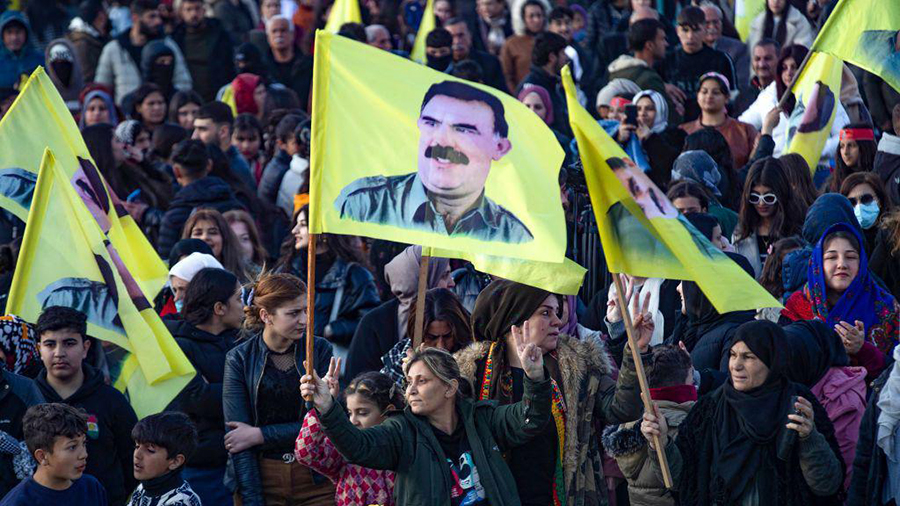
Imprisoned PKK leader Abdullah Ocalan

Abdullah Öcalan’s Letter Demanding Unilateral End to Kurdish Armed Conflict with Turkish State

Abdullah Öcalan, the founding leader of the Kurdistan Workers’ Party (PKK), has been a key figure in the Kurdish struggle for autonomy in Turkey. Captured in 1999, he has been imprisoned, gradually shifting his focus from armed resistance to advocating for “democratic confederalism”—a model promoting grassroots democracy, gender equality, and coexistence. His writings continue to influence Kurdish politics and regional debates on peace and autonomy.

In this letter, Öcalan salutes Newroz, the Kurdish/Persian New Year, as a moment of renewal and unity. He critiques the impact of imperialist capitalism and nationalist conflicts, arguing that ethnic and religious divisions have been exploited to sustain oppression. He calls for an urgent transition to peace, urging the PKK to end its armed struggle and embrace democratic politics within Turkey. He envisions a new era where different identities coexist under a democratic system, overcoming the nation-state model imposed by capitalist powers. Finally, he highlights the role of women and youth in the struggle for equality and salutes the resistance of Kobanê. His letter is both a call for Kurdish-Turkish reconciliation and a broader vision for a democratic Middle East.


To All Our Peoples;

I salute the Newroz of all our peoples and friends who stand for peace, equality, freedom, and democracy.

The crisis caused by the neoliberal policies imposed worldwide by imperialist capitalism and its despotic local collaborators is being experienced in our region and country with devastating effects. In this crisis environment, the ethnic and religious differences of our peoples and their cultures are being consumed by senseless and ruthless identity wars. Neither our historical nor contemporary, neither our conscientious nor political values can remain silent or indifferent to this picture. On the contrary, an urgent intervention is required by our religious beliefs, as well as our political and moral responsibilities.

The struggle we have been waging for democracy, freedom, fraternity, and honorable peace for the peoples of our country stands today at a historic threshold. Our movement, which has endured four decades of suffering, has not been in vain, yet it has also reached a stage where it cannot be sustained in its current form. History and our peoples demand from us a democratic solution and peace that align with the spirit of the time. On this basis, we are faced with the duty of initiating a new process grounded in the ten-point declaration that was officially announced by all of us at the historic Dolmabahçe Palace.

In line with the declaration, and upon reaching an agreement on principles, I see it as both necessary and historic for the PKK to hold a congress to end its armed struggle against the Republic of Turkey, which has lasted for nearly forty years, and to determine the political and social strategies and tactics in accordance with the spirit of the new era. I hope that we will soon reach a principled agreement, go through a truth and reconciliation commission formed by members of parliament and an oversight committee, and successfully realize this congress. With this congress, a new era begins. In this new period, we are entering a phase where, within the Republic of Turkey, we will live together in peace and fraternity as a democratic society with a democratic identity, based on free and equal constitutional citizenship. Thus, we will move beyond the conflict-ridden past of the 90-year history of the Republic and walk toward a future built on true peace and the universal criteria of democracy. What befits the true history of Newroz is to welcome such a stage in your presence. However, what is right for our country and our peoples must also be valid for our sacred region.

The general reality of capitalist imperialism over the last two hundred years, and more specifically in the last hundred years, is this: closing ethnic and religious identities inward in contradiction to their essence, turning them against each other based on nationalist nation-state foundations, and ruthlessly sustaining this existence to this day in line with a divide-and-rule policy!

We must recognize that the latest manifestation of the oppression caused by imperialist powers that refuse to abandon their ambitions over the Middle East has appeared in the form of ISIS. This organization, which defies even the meaning of barbarism, has committed brutal massacres against all the peoples and faiths of the region—primarily Kurds, Turkmens, Arabs, Yazidis, and Assyrian-Syriacs—without sparing women or children.

Now is the time to put an end to this ruthless and destructive history and transition to peace, fraternity, and democracy in accordance with our true past. In line with what I know to be right and with my beliefs, it is a necessity to transcend the nation-states born from conflict-ridden, consumptive, and destructive nationalism through democratic politics and to transition into a common existence based on open democratic identities. To this end, I call on nation-states to realize a new form of democratic co-existence through democratic politics within themselves, and I call on them to build the democratic common home of the Middle East among themselves.

On this occasion, I also call upon the women and youth, who constitute the overwhelming majority of this great assembly and who yearn for freedom, to take the most active role in the struggle for freedom and equality in the economic, social, political, and security spheres in the coming period and to succeed. Additionally, I salute the resistance and victory of Kobanê, which holds great significance for both our region and the international world. On this basis, I welcome the emerging ‘Spirit of E?me’ as a new historical symbol among our peoples.

All of these assessments I have tried to outline above constitute, in a single sentence, a valuable call for the revision, restoration, and reconstruction of our society—both in terms of our history and our present.

Once again, I extend my greetings with the hope that this historic Newroz will bring great blessings to all humanity through your presence.

Long live Newroz,
Long live the fraternity of peoples!

More Articles from &&&

Socialism after Socialism, A Response to Conrad Hamilton

In the spirit of dialogue, I am responding to the observations in Conrad Hamilton’s recent expansive review of my book The Political Theory of Liberal Socialism. I will be concentrating on Hamilton’s three main claims, that there is a gap between the form and content of socvialism, invoking Marxist theories of struggle before coming down… Read More »

Biennialese Blues: Review of Whitney Biennial 2026

ARTISTS: Basel Abbas & Ruanne Abou-Rahme, Kelly Akashi, Kamrooz Aram, Ash Arder, Teresa Baker, Sula Bermudez-Silverman, Zach Blas, Enzo Camacho & Ami Lien, Leo Castañeda, CFGNY, Nanibah Chacon, Maia Chao, Joshua Citarella, Mo Costello, Taína H. Cruz, Carmen de Monteflores, Ali Eyal, Andrea Fraser, Mariah Garnett, Ignacio Gatica, Jonathan González, Emilie Louise Gossiaux, Kainoa Gruspe,… Read More »

No View from Nowhere: On Discourse, Différance & Functorial Semantics of Micro-Communities

This essay argues that natural language semantics admits no global orientation—no ‘view from nowhere’—but only local positions within psychoanalytically and sociologically embedded discourse communities. Drawing on Derrida’s concept of différance, I demonstrate that meaning is constitutively deferred across the differential play of signs, precluding any meta-linguistic standpoint from which all local meanings could be adjudicated.… Read More »

Liberalism Is Dead, Long Live Liberalism!

Matthew McManus’ The Political Theory of Liberal Socialism is a powerful attempt to merge two disparate traditions, parlaying reformist compromise into a coherent political program. It also rests on the assumption that socialism is inherently illiberal, an assumption that deserves to be questioned. While often hailed as the single-minded son of America, perhaps the best… Read More »

Luxury Activism: Art, Fashion & Capital

[This text was previously published by the author in Portuguese on Contemporânea Magazine — Ed.] I don’t want to work with fashion. Beauty must be preserved from capitalism. Fashion favours the escape into personal, private, selected, chosen space, as a form of false self-determination. Fashion reflects the fear of losing’ identity. — Thomas Hirschhorn The purposelessness… Read More »

The Questions Concerning the Ethics of AI

With recent articles in &&& concerning the status of what is or is not Marxism, I took it upon myself to write a piece that I consider firmly placed in that tradition. I am not being paid by the CIA, I promise. Furthermore, despite appearances, my article is not an article in the “ethics of… Read More »

The Best Ever Art Basel Review that Qatar Money Can Buy

During the Art Basel Qatar’s VIP preview of Sweat Variant’s durational performance My Tongue is a Blade on February 4, two special seats up in front of the stage stayed empty for a while.  Empty with intent.  People hovered, looked, and reconsidered occupying them in their head at the last minute like they were about… Read More »

SUPPORT THE IRANIAN REVOLUTION 2026!

SIGN THE STATEMENT HERE The past several weeks have borne witness to a bloodbath in Iran amidst images of systematic massacre and horrific abuses of power by the Iranian government against its own people. As a united front, we stand together to uphold the following convictions: 1- That the Islamic Republic of Iran must come… Read More »

Rhetoric vs Reality: Iranian Regime Is an Imperialist Project Preventing a Free Palestine!

Since its founding, the Islamic Republic of Iran has cultivated legitimacy by embedding itself within global progressive movements—particularly those oriented around anti-imperialism and racial justice. Rhetoric, repeated, obscures reality: the Islamic Republic of Iran (IRI) is an imperialist project that will not enable a free Palestine. The IRI is built on an expansionist doctrine resembling… Read More »

On State Collapse & Democide in Iran

1. Middle Eastern Islamisms and Islamists are reorganizing in a post-jihadi/takfiri Muslim/Arab world within their national boundaries. First of all, the Taliban’s path back to Afghanistan was facilitated by the USA. Afghan Islamists were swift in adopting a more Afghanistan-focused vision and dismantling any public state capacity, especially in social and women’s affairs, built under… Read More »

How Was This Monster Born? Contemplations on the Ontology of the Iranian Islamic Republic

By Asal Mansouri and Borna Dehghani, writing from Tehran How can survival turn into something shameful? How does breathing itself become a burden – one that a person no longer dares to carry, a weight that grows heavier by the moment, with no path of escape left open? What took place across Iran in January… Read More »

The Human Centipede II: Qatar & the Broker’s Cut

If my first The Human Centipede: A View From the Art World (2013) traced the art world as a closed alimentary circuit, this sequel begins where that circuit was sublimated into brokerage as a state-form with unmistakable political aspirations.[1] The same logic is now in the open for everyone to witness, wearing the grimace of… Read More »

الغای زیر ساخت‌های شیعه اسلام در ایران 

ENGLISH VERSION در لحظه‌ای که این سطور نوشته می‌شود، ایران با زخمی باز زنده است. جامعهٔ ایران یکی از تاریک‌ترین مقاطع تاریخ معاصر خود را از سر می‌گذراند. ده‌ها هزار نفر در خیابان‌ها کشتار شده‌اند؛ معترضانِ زخمی توسط نیروهای امنیتی از بیمارستان‌ها ربوده می‌شوند؛ و اعدام‌ها در زندان‌ها به شکلی صنعتی ادامه دارد. خانواده‌ها آیین‌های… Read More »

Abolition of Infrastructural Shia Islam in Iran

FARSI VERSION As I write this, Iran is an open wound. Iranians are living through one of the darkest moments of their country’s contemporary history. Thousands upon thousands upon thousands have been massacred in the streets; wounded protesters are being removed from hospitals by security forces, and executions are taking place on an industrial scale… Read More »

ایران، بزرگترین دردسر: دربارهٔ سکوتِ مزمنِ بخشی از چپِ معاصر

با چیزی آغاز می‌کنم که در نگاه اول شبیه یک حاشیه‌روی است، یک خاطرهٔ قدیمیِ تلویزیونی که زمانی لبخند روی صورتِ ما می‌آورد. اما همین خاطره، مدلِ فشرده‌ای از یک واکنشِ سیاسی است که مدام در ایران تکرار می‌شود. وقتی جوان‌تر بودم، سریالی بود به نام «روزی روزگاری». یک پدیده شد و واقعاً هم عالی… Read More »

Regarding the Erasure of Iranian Uprising

The most recent state crackdown on Iranian protesters stands among the most violent suppressions of public dissent in Iran’s modern history. Protesters have been killed, blinded, and mass-arrested. As the state imposed a sweeping information blackout and advanced claims blaming foreign agents for the violence, this brutality has nonetheless been met with a striking absence… Read More »

Why Critical Theory Isn’t Marxism & Why Western Vs. Eastern Marxism is an Illusory Dichotomy?

I have almost finished Gabriel Rockhill’s “Who Paid the Pipers of Western Marxism?” (Monthly Review Press, 2025) amidst the uproar among the so-called progressive left academia and publishing. Rockhill has said the quiet truth out loud: the so-called critical theory has in fact nothing to do with Marxism. Its path has been paved by former… Read More »

Applied Collapse in Venezuela

The recent decapitation of the Venezuelan regime by the US military is part of a longer history of induced collapse: from Iraq to Afghanistan to Palestine, the techniques of empire have been wielded to destroy societies. But behind the Maduro extradition may be a kind of new American weakness.As you know, Nicolás Maduro and his… Read More »

Hard Habit to Break: On Political Readings of Art & Marxist Citationalism

I want to talk about a habit in contemporary art writing that I keep running into, especially in Marxist-inflected theory, where interpretation is substituted with citation and judgment is treated as an embarrassment. The pattern is familiar: the artwork becomes an occasion to rehearse a framework, the framework becomes a moral sorting machine, and the… Read More »

Computational Contemplation of
Burg of Babel

To watch a one-minute version of the film, please click here. Burg of Babel (2017-2024) is built on a very simple but unusual structure. On the screen, instead of one large moving image, the viewers see a grid made up of twenty-five rectangles, five across and five down, each playing the same 25-minute film, with… Read More »

Organized Callousness: Gaza & the Sociology of War*

Introduction The ongoing war in Gaza has generated extensive polemic among scholars and the general public.1 Some have described this conflict as a novel form of warfare. The deeply asymmetric character of this war and the vast number of Palestinian civilian casualties have prompted some analysts to described Gaza as a “new urban warfare.”2 Others… Read More »

Postcards from Mitteleuropa: Reviews from Sean Tatol’s European Tour*

Chris Sharp, Los Angeles slop-gallerist extraordinare, once scolded me on Instagram for comparing Raoul de Keyser to Peter Shear, evidently because he thinks it’s wrong to see connections between artists if they’re not from the same generation, which is a novel opinion if I’ve ever heard one. When I asked why that would be a… Read More »

Two Futures

In the brief essay that follows, I consider art as an event that de-privatizes the subject by exposing us to the hyperobjects constituted by the circulation of transgenerational trauma, power, and subjective identities. I also examine the role of contingency in this process and argue for art as a tool of indifferent future production. What… Read More »

9/11 & Televisual Intersubjectivity

The six-channel work I presented at Art In The Age Of…Asymmetrical Warfare exhibition reconstructs from video archives of the September 11th attacks the televisual unfolding of the event on CNN, Fox, NBC, CBS, ABC and BBC news networks. The synchronic and uninterrupted footage which is playing on a continuous loop starts with the networks’ mundane… Read More »

Exotopy, Neo-Orientalism and Postcolonial Curation

After visiting the Ordinary Moments exhibition, curated by Mansour Forouzesh and featuring a collective of Iranian independent photographers at the FUGA Gallery in Budapest, I was once again convinced that the consumption of modern Iranian visual culture in the West is essentially orientalistic. Precisely through the contrast this exhibition provides, one can see more clearly… Read More »