The world is about to end. The sole reason it might continue on is that it exists. How feeble a reason, compared to all those that point to the contrary, particularly the following: where, under heaven, is the earth now heading? — For, even supposing that it might continue to exist materially, would this be an existence worthy of the name or in the dictionary definition of the term? I’m not saying that the world will be reduced to the harebrained schemes and farcical chaos of the South American republics — or that we might even lapse back into a state of savagery, searching for fodder, rifle in hand, amid the overgrown ruins of our civilization. No — because this particular fate and these kinds of adventures would still suppose a certain vital energy, an echo of earlier times. Fresh examples and fresh victims of inexorable moral laws, we shall perish by that which we believed had sustained our life. Machinery will have so Americanized us, progress will have so atrophied our spiritual faculties, that none of the bloody, sacrilegious, anti-natural reveries of the Utopians could be compared to its actual effects. I ask any thinking man to show me what remains of life. Useless to speak of religion or to look for its remains: to bother to deny the existence of God is the only scandal still possible in these matters. Property had virtually disappeared with the abolition of the right of primogeniture. But the time shall come when humanity, like some vengeful ogre, even snatches this last morsel from those who believe that the revolutions had legalized their inheritances. Which, it’s true, would not be the worst thing to happen.
The human imagination can conceive of republics or of other communitarian states that would be worthy of some glory — if directed by holy men, by certain aristocrats. But it is not specifically in the political institutions that one will observe the effects of universal ruin, or of universal progress — it hardly matters to me what name it goes by. It will be seen in the degradation of the human heart. Need I mention that whatever remains of politics will have to combat the onslaught of widespread animality and that governments will be forced — just to maintain themselves and to create a phantom of order — to resort to methods that would cause men of today to shudder, callous though they already be? — At that point, the son will flee his family, not at age eighteen but at twelve, emancipated by his precocious greed; he will flee, not to seek out heroic adventures, not to rescue some damsel imprisoned in a tower, not to immortalize his garret with sublime thoughts, but to start a business, to make money, to compete with his vile papa, the founder and shareholder of a newspaper that provides such daily enlightenment as will make Le Siécle of those days seem like a regular hotbed of superstition. — At that point, those who stray from the course, those who have fallen from their station, those who have gone through several lovers, those who are sometimes called Angels in recognition of and in gratitude for the absolute insouciance that flares forth like some haphazard flame from lives as logical as evil—at that point, I say, these creatures will be pitilessly well behaved, having acquired a wisdom that will condemn everything, except money — everything, even errors of the senses!* — At that time, everything that resembles virtue, indeed, everything that does not thirst for riches, will be considered merely ridiculous. Justice, if justice still obtains during these fortunate times, will banish all citizens incapable of amassing wealth. — Your wife, O Bourgeois, your chaste better half, whose lawful weddedness you find so poetic, will henceforth introduce into your legal arrangement a despicable practice beyond reproach. The loving and watchful guardian of your strongbox, she will be the perfect ideal of the kept woman. Your daughter, mature beyond her years, will dream while still in the cradle that she is selling herself for millions. And you yourself, O Bourgeois — even less a poet than you are today — you will find nothing wrong with this, you will regret nothing. For there are things in man that grow stronger and more prosperous as others slacken and go into decline: thanks to the progress of these times, all that will remain of your insides will be your bowels! These times are perhaps quite near; who knows whether they are not already upon us, and whether the coarsening of our nature is not the sole obstacle preventing us from recognizing the atmosphere we breathe.
As for me, who sometimes feel myself laughable as a prophet, I know that in these times I shall never encounter the charity of a doctor. Lost in this wretched world, elbowed by crowds, I am like some weary man whose eyes see, in the deepening years behind him, only bitterness and disappointment, while before him there gathers a storm containing nothing new — no new instruction or pain. In the evening, when this man has snatched a few hours of pleasure from fate, lulled by his digestion, forgetting (as much as possible) the past, content with the present and resigned to the future, intoxicated by his own cool composure and dandyism, proud to be less ignoble than those who pass by, he says to himself, contemplating the smoke of his cigar: What does it matter to me what becomes of these consciences?
I think I may have wandered off into what those in the trade call an hors-d’oeuvre. Still, I’ll let these pages stand — because I want to attach a date to my anger.
sorrow**
— Charles Baudelaire, Late Fragments, trans. Richard Sieburth, pp. 99-102.
* Sieburth’s translation is much better than Christopher Isherwood’s except for this phrase, which is almost nonsensically ambiguous. Isherwood renders it as “crimes of the senses,” which, if not much clearer, suggests more of the libertine image Baudelaire has in mind. [My note.]
** anger/sorrow: Baudelaire initially corrected “anger” by “sorrow” but let both words stand in the end. [Sieburth’s note.]
It’s hard to say what’s most shocking about this screed at the end of Baudelaire’s Flares, admired (and feared) by Proust, Celan, and Nietzsche, when we read it today: that he already had such an infernal vision of the future in the 1860s, or that we find ourselves living in that vision. The world has ended; the culture industry has finally removed all culture from its industry; hell is here, undoubtedly if not absolutely. Twenty years ago an art critic like Jean Fisher could say this without blushing: “There is no doubt that globalization and particularly its commodification of culture — and of thought itself — present a situation in which art history, art, and critical practices risk stagnating and becoming irrelevant to the wider sociopolitical issues that affect us globally.” (ed. James Elkins, The State of Art Criticism, 2008, p. 178) Art is most definitely irrelevant to the wider sociopolitical issues now, it was then, and whether it ever truly has been is at best debatable. The surprise is that it was still possible so recently to believe in a bulwark against this decline. The commodification of culture and thought has been disastrous, naturally, but what could have stopped it? Roundtables on art criticism? Barack Obama? Please. This damned augury from nascent modernity is our reality, so the question now becomes a new one: not how to prevent this fate but what can be done now that it has come to pass.
First, we can brush aside Baudelaire’s bitter grumblings about primogeniture and republics worthy of glory “if managed by holy men, by certain aristocrats.” His visions of societal ruin are limited only by an atavism that was a naive response to the disappointments of the revolutions he lived through and participated in. Unlike today’s conservatives, it’s at least plausible that his belief in enlightened aristocrats was an earnest one, which is just to say that his disillusionment with the future made him cling, however ambivalently, to traditions that still had a veneer of respectability. And yet we can take his meaning: no enlightened society can come to exist if it isn’t orchestrated by people possessed of enlightenment, and his disillusionment with the People made him return to the ancien régime belief in the superiority of the first and second estates over the third. We have no such vain recourse, although Baudelaire certainly did not take his conservatism very seriously. His disillusion with the Left turned him no more into a full-throated Rightist than Belgium turned him into a chauvinist for France; he only had found that the New was even more degenerate than the Old, whose faults he knew intimately. The prophet of modernity may have lost hope, but that is what confirms him as a prophet. He did not turn his back on the future, he saw so deeply into the unbearable weight of the modern that all the scales fell from his eyes.
What it is that he saw, however, is no conventional apocalypse but the death of the human spirit, a descent into universal venality. Capitalism, in other words, the full force of profit-mongering beating all morality into submission, snuffing out every virtuous feeling, the total denigration of the soul, the coarsening of our nature, etc. These sentiments were more freely invoked in the 19th century, but they’re no less true after 160 years of humanity growing accustomed in turn to every new indignity. Culture has declined so precipitously that it’s considered disrespectful or reactionary to dare call attention to how far we’ve fallen, but if Horace Vernet represented the height of obstinate idiocy to Baudelaire then And Just Like That… is such an image of complete societal dementia that it bears no comparison. We can take the show’s glorification of wealth and crass materialism for granted, but the very existence of such an inept, contrived fever dream of a sequel articulates the long-term effects of craven commercialism and social decay so thoroughly that it strains the limits of even our vision of hell. Moreover, at least in comparison to what’s simply depressing and unsatisfying in most television, the vertigo I get from the show’s totalizing stupidity is so intense that I almost actually enjoy it. It might approximate getting too high and having a three-hour white knuckle meltdown only to do it again the next night just because it’s better than feeling nothing, but existential horror is more constructive than numb complacency. That’s a Baudelairean notion, come to think of it.
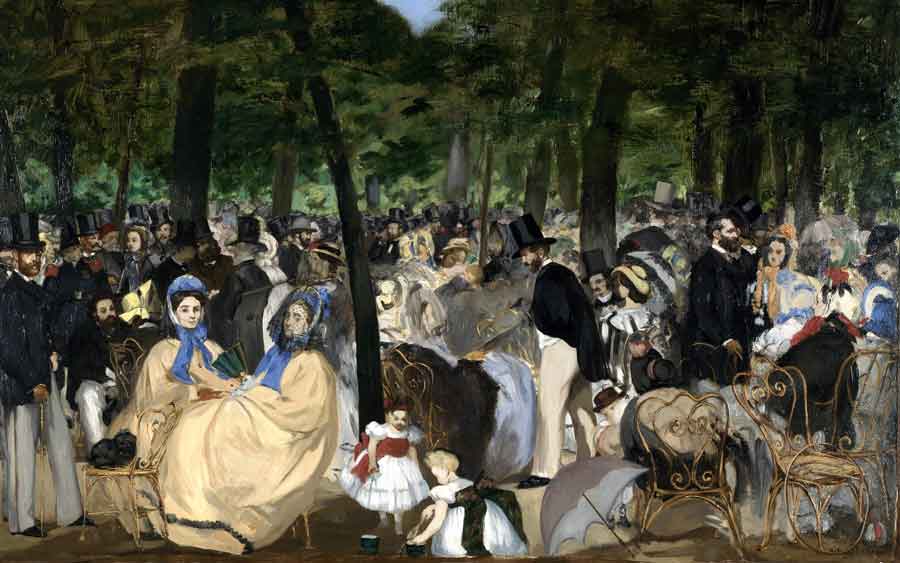
The substantial point beneath a frivolous comparison of worthless TV in 2025 to worthless 19th century military painting is that the content of every cultural edifice has been ground to dust. Salon painting at least had its pretensions and standards, no matter how conservative and tasteless its judges might be. Manet still wanted the Salon’s approval in spite of everything, and that desire for social achievement is a valuable motivator, which is not to suggest we can or should return to that model. The implications are much broader than academic painting; the library or the museum would never be invented today because those institutions are founded on ideas of cultural edification that are now entirely foreign to society at large. The assumptions of the End of History from the 1990s until roughly 2016 led the cultural sphere to assume it would proceed by its own momentum, reinventing itself boundlessly with no need for maintenance. That may have worked for a time, but the internet, social media, the rising cost of living, and so on, has since stripped culture for parts. Social media kills the social, dispersing in-person groups that used to be called countercultures and subcultures, and monetization optimizes the attention economy into a self-regulating system of everyone selling out to the algorithm. As usual, what at first seems liberatory is a crack in culture that more capitalism seeps into. The humanities and education in general, let alone the art world or popular media, are no longer able to maintain standards of development or basic competence, and it seems impossible to recover them from their current state.
But this is pessimism, not fatalistic cynicism. As Adorno has it: “All specifically modern art can be regarded as an attempt to keep the dynamic of history alive through magic, or to increase the horror at the stasis to shock, or to portray the catastrophe in which the ahistorical suddenly begins to look archaic.” (“Spengler After the Decline,” Prisms, p. 58.) We don’t need cultural institutions to keep the dynamic of history alive or portray our catastrophe, and in all likelihood those edifices have been more of a hindrance than an aid for some time. This can be framed as a freeing from institutional indoctrination, but this is a high price to pay and a challenging imposition on the individual. The internet certainly indoctrinates the general public far more crudely and insidiously than institutions, and this is far from optimistic; rather than an excitement at new tools, the collapse of institutionality forces us to find alternatives on our back foot. The internet may have killed culture, but its barrage of information revived the possibility of history by giving us immediate access to vast amounts of media of the past, and this access can, possibly, act as a trapdoor to outmaneuver the end of the world for the few that care to put in the effort.
By the internet I don’t mean its very contemporary experience, of course, that flood of frivolous content optimized to command and envelop our attention. I mean the Internet Archive, Newspapers.com, JSTOR, Libgen, torrents, online catalogue raisonnés, untapped research archives in raw HTML, even Wikipedia rabbit holes, means of accessing vast stores of information far larger than any physical archive that are sitting and waiting to be utilized. Most of these are relics from the ‘90s when people could still see the internet as an unprecedented practical resource, an idea that’s so hard to remember now. Social media effectively harnesses this immensity, which is why it’s so insidious; unlike the straightforward banality of television, TikTok is a kaleidoscope of reality snippets that are too weird and infinitely various to dismiss as mere stupidity. The problem is that the relentlessness of the algorithm makes us stupid. But the outside possibility remains that we can still use the internet for our own benefit, as an infinite library to draw from for our subjective cultivation in the absence of a functioning culture.
If the present is intolerably stupid, we can exhume examples of past intelligence to teach ourselves how life has been and could be. More important, at least for our purposes here, is the example of figures such as Baudelaire as models of intransigence. What we need is indignant despair, disgust at our own abjection, a refusal of stupidity and perpetual distraction. The person who rejects society to preserve their soul gains the dignity that can only come from a self-conscious acceptance of our pervasive wretchedness, and through this can find the drive to become radical, even uncompromisingly political. Lest this be considered a call for solipsistic iconoclasm, the terrible irony of our situation is that the social conformist is a narcissistic individualist and the humanist is the outcast. One of the greatest indignities of contemporary life is the difficulty of real rebellion, as our social structures make it all but impossible to grasp the scope of its indignity from within its boundaries, or to build anything that isn’t either impotent or immediately reincorporated and negated by the logic of commerce. Hence our need for history, for Baudelaire, for every one of the martyrs that was cut down by society for refusing complicity, whose sufferings are redeemed when we draw our strength from them.