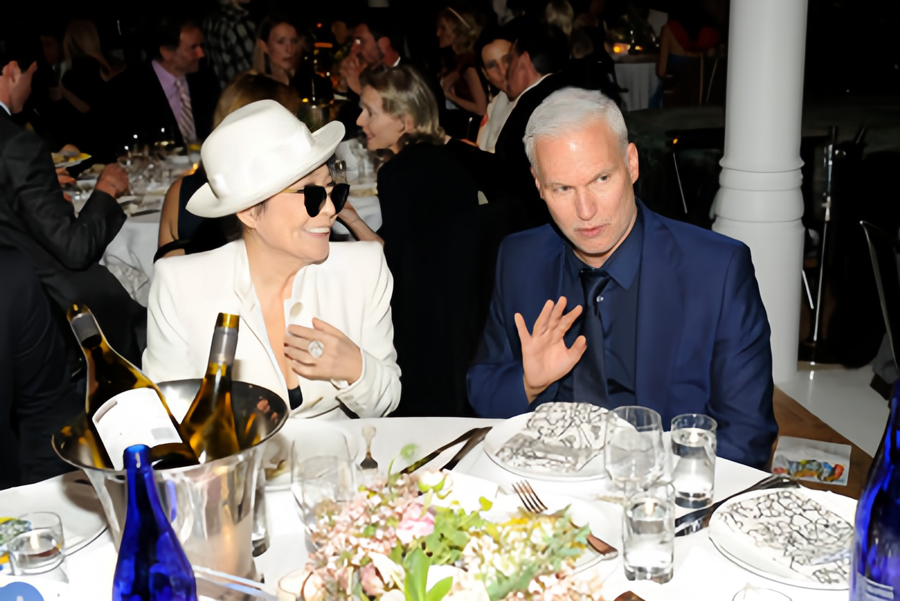
Berlin has a Yoko and Klaus problem these days. You read that right, we’re not talking about the likeable ProSieben presenters, but rather the widow of John Lennon and the director of the Neue Nationalgalerie. The former is more of a symptom, and the latter the trigger of a complex that deserves to be described in more detail: the capital’s largely paralyzed, internationally unsatisfactory museum landscape.
Let’s start with the symptom. Two exhibitions recently opened in Berlin—at the Martin-Gropius-Bau and the Neue Nationalgalerie—are dedicated to the artistic work of Yoko Ono, although it would be an exaggeration to say that one of these exhibitions would have been enough.
Directly in front of the entrance to the National Gallery, on the terrace of the Mies van der Rohe building, once dominated by Barnett Newman’s “Broken Obelisk,” there now stands a wishing tree by the Japanese artist. In the courtyard of the Gropius Building, it’s almost a forest. Visitors to both locations are encouraged to write their wishes for peace on slips of paper and hang them on the branches.
Dripping participation kitsch
“Wishtree” thus programmatically sets the altitude of the exhibitions. There are works like “Handshake Painting,” a white canvas with a hole that hangs from the ceiling in the middle of a room. Here visitors are encouraged to shake hands with other visitors through the hole. The “Bag Piece,” in turn, invites us to crawl into sacks and either hop around in them or play hide-and-seek.
Ono’s conceptual approach is so low-threshold, her participation kitsch so dripping, that one already wonders at this point whether all this is still financed by the federal culture budget or already subsidized by health insurance.
In “Mommy’s Room,” a late work by Ono to which an entire room is dedicated in the Gropius-Bau, visitors are then supposed to write memories of their mothers on slips of paper and leave them on the empty canvases provided in abundance by the artist. So that journalists at the press preview could already get an impression of the emotional impact of the female empowerment sought here, the staff of the Gropius-Bau had already taken the lead. “My mom is everything! Love, courage, caution,” one said. Or simply: “Inge!”
Their boss, Jenny Schlenzka, who has been the new director of the Gropius-Bau since last year, then described Yoko Ono in her opening speech as the “ideal artist” who exemplarily realizes in her works what she, Schlenzka, envisions programmatically for the entire museum – to create a place of inclusion in which “visitors become participants.”
A few minutes’ walk and an hour later, it was then Klaus Biesenbach’s turn to place Yoko Ono’s work in a historical context. Visibly moved by his own curatorial achievement, he explained to the guests in the Neue Nationalgalerie how important it had been to him to place Yoko Ono as a visionary peace activist in the central room of the basement, exactly between Gerhard Richter’s “Birkenau” cycle on one side and Andy Warhol’s hammer-and-sickle paintings and Sylvie Fleury’s flokati-covered rocket on the other.
“I don’t know if you noticed,” said Biesenbach standing on the stairs and overlooking the room and his guests. “But hammer, sickle, rocket, Birkenau: these are all weapons. Although Birkenau is not a weapon in the actual sense, but where it leads to.”
All the more important it was now to place Yoko Ono’s work precisely in between.
Insult to historical consciousness
One then stood somewhat perplexed in front of the corresponding work, the so-called “Cleaning Piece” (1996), three piles of pebbles that are “intended to stimulate self-reflection.” If one felt happy, one was encouraged to take a stone from the first pile and place it on a second “happiness” pile; if one was rather worried, one should place the stone on a third pile representing fears or misfortune. A work that was indeed ahead of its time, as Yoko Ono could not yet have guessed in 1996 that almost thirty years later, travelers at airports around the world would be asked for feedback on their hygiene experience with a similarly simplified survey system after leaving the toilets.
By now, no one expects any kind of historical awareness from Klaus Biesenbach, who for his last exhibition had invited Nan Goldin and her intifada fan-curve into the Nationalgalerie. Nevertheless, in front of the pebble piles, one wondered for whom this work by Yoko Ono, together with the introduction by her curator, represents the greater insult: for thinking visitors in general or for Gerhard Richter and Andy Warhol in particular?
Biesenbach, visibly shaken in his speech, was deeply moved by the brilliant curatorial achievement of his colleagues at the Gropius-Bau, before which, as he said, he could only “go to his knees.” And indeed, one could understand his emotion, since this double opening of two leading institutions was nothing less than a demonstration of his new Berlin power, which has expanded considerably since the appointment of his former New York assistant Jenny Schlenzka as director of the Gropius-Bau.
Schlenzka worked under Biesenbach as associate curator for performance art at the Museum of Modern Art and established the event series “Sunday Sessions” of the MoMA-affiliated art space PS1 in Queens, led by Biesenbach, before becoming director of the so-called Performance Space in the East Village, a non-profit organization of rather local significance.
That she was then called to lead the Gropius-Bau, one of the most important and largest federally funded exhibition venues in Germany, was surprising only at first glance, since Gabriele Horn, the longtime managing director of the Berlin KunstWerke (today KW Institute for Contemporary Art), founded by Klaus Biesenbach, was part of the selection committee whose preparatory work was then approved by Biesenbach’s close friend Claudia Roth. The Federal Government Commissioner for Culture did not miss the opportunity to personally sign Schlenzka’s appointment certificate, although this would – purely in terms of protocol – have actually fallen to the director of the Berliner Festspiele, Matthias Pees.
One would certainly have wished for Schlenzka to quickly step out of the shadow of her long-time sponsor in Berlin and develop an independent profile, instead of introducing herself with a show by one of the closest friends of her former boss, which in large parts looks like the final presentation of an adult education course “Introduction to Conceptual Art” temporarily taught by a mindfulness coach. But the ties seem too strong, especially when it comes to Ono, who in 2012 personally awarded Jenny Schlenzka a “Yoko Ono’s Courage Awards for the Arts,” of all places in a ceremony at the MoMA restaurant, at which Klaus Biesenbach, of course, sat in the front row.
One can accuse Yoko Ono of many things, but she broke up the Beatles. Klaus Biesenbach’s merits cannot be so easily summed up, especially not to explain his ever-growing influence in Berlin. At the KunstWerke (founded in a squatted house on Auguststraße), no important decision has been made since 1990 without Biesenbach. Directly next to the Neue Nationalgalerie, he will also – should his contract be extended – soon direct the new museum built by Herzog & de Meuron and named “berlin modern” by Biesenbach himself (estimated construction costs at least 450 million euros). And now the Gropius-Bau is also proving to be his playground.
Biesenbach’s underperformance in Los Angeles
It is a remarkable turn for a curator whose career in the USA already seemed to be over after he moved to Los Angeles as director of the Museum of Contemporary Art (MoCA) following his time at MoMA, where he was soon demoted from museum director to artistic director due to obvious underperformance. The New York Times, which rarely comments in detail on German museum appointments, seemed surprised that Biesenbach was offered the most important museum job in Germany at just that moment.
In New York, the paper noted, no one could remember art-historically relevant exhibitions by Biesenbach, more likely attention-seeking spectacles with Björk or Marina Abramovic. And from Los Angeles, the New York Times quoted a MoCA trustee saying that one had to work closely with Biesenbach to compensate for his organizational “shortcomings.”
Biesenbach’s most consistently pursued project thus far seems to be his self-staging, which not only appeals to German cultural policymakers: with 302,000 followers, he is internationally one of the most far-reaching curators on Instagram, not least because he shamelessly uses every opportunity to pose for selfies with celebrities.
Since there really doesn’t seem to be any hidden art-historical agenda with him – as of 2025 – he may well be taken at face value for his social media activities: at the time this article was published, Biesenbach had posted 65 selfies with Patti Smith, 53 with Marina Abramovic, and 20 with Yoko Ono.
It would be mean to infer from this that after the first appearances of Patti Smith in the Nationalgalerie and the newly opened double exhibition of Yoko Ono, Marina Abramovic would be next for Berlin. And yet, that seems to be the case: according to WELT information, a major exhibition with her is already being planned – not in the Neue Nationalgalerie, but: in the Gropius-Bau.
What is certain: for a director with so many problems, his current and future sphere of influence can only be described as sprawling. His core museum has such budgetary hardship that major works of Classical Modernism like Christian Schad’s “Sonja” have been sent on an almost two-year, evidently well-paid US tour. Because the fame of the Neue Nationalgalerie is certainly not nourished by stations in Fort Worth, Minneapolis, and Albuquerque – more likely, they involuntarily reflect the sender’s loss of international significance.
For the upcoming contemporary “berlin modern” museum, Biesenbach – who has never really learned to work with collections – so far has neither a coherent concept nor enough top-class works from recent decades to offer, especially after the withdrawal of the Mick Flick collection and the sale of masterpieces from the Erich Marx collection, which had been believed to be in Berlin long-term, two of the reasons for building the museum have now disappeared.
These are adverse circumstances, and Biesenbach’s flight forward can certainly be admired: compensating a lack of substance by expanding the power base is also a strategy.
But for the Berlin art scene, which has in many parts already resigned, there is hope. Biesenbach, who has now been in office for three years, has always been a man of opportunities. It’s no coincidence that he, of all people, who wrote the “frequent flyer” column for the art magazine Monopol for more than ten years, now advocates for more sustainability in the State Museums.
Should the political tailwind from Claudia Roth weaken due to her retirement, this could indeed be reflected in his program. As confidently as Biesenbach may appear: deep down he likely senses that without continued protection, it won’t be enough, as director of the Nationalgalerie, to show three New York positions – Andy Warhol, Nan Goldin, and Yoko Ono – in a row and otherwise give a stage to his most prominent artist friends.
The Yoko problem will be resolved by mid-September. The Klaus problem will be with us for at least another two years. Let’s hope Berlin finds ways to defuse it itself.
* Translated by Mohammad salemy, this text was originally published in German in Die Welt on May 2, 2025.