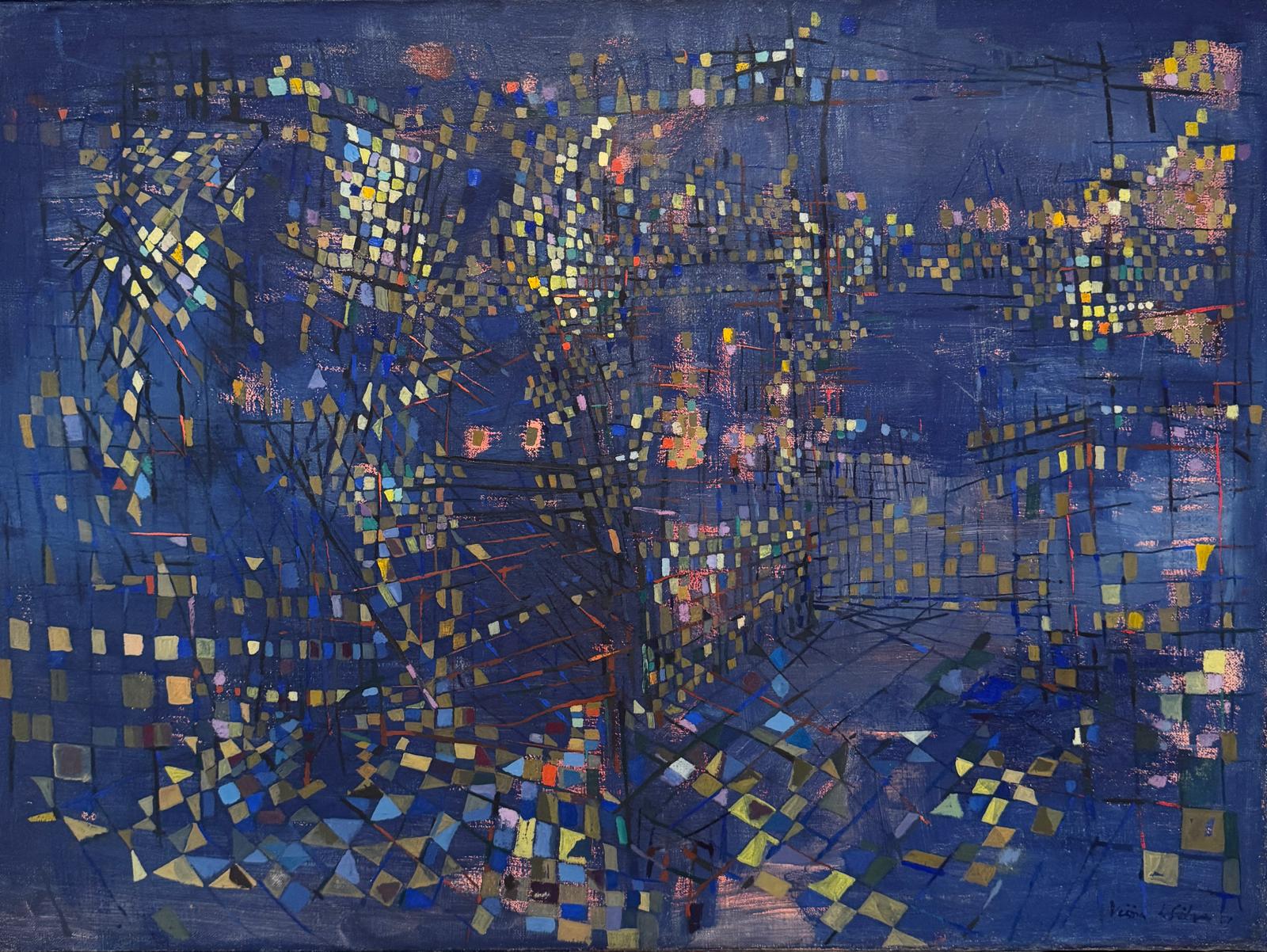
A preview of the paper with related graphics is available here.
Why Identity, Why Category Theory?
We are living through a moment of conceptual fatigue, if not the outright decline of identity politics. Once a disruptive analytic, a lexicon for articulating marginalization and reclaiming visibility, over the last two decades this political strategy settled into ambient institutional noise. Terms that once unsettled power became embedded in it, then were used selectively as instruments of exclusion and cancellation. Race, gender, sexuality, and disability now appear everywhere: in grant applications, museum wall texts, university syllabi, social media bios, corporate advertising. Their ubiquity did nothing to sharpen their political efficacy. Identity calcified instead into procedural optics, a bureaucratic protocol of recognition that displaced the antagonisms it once named and then covered them with a thick coat of paint.
At its core, the dominant discourse on identity rests on a model of classification. It assumes that people can be sorted, that attributes can be layered, and that justice can be algorithmically approximated through representational balance.
The 2016 and 2024 U.S. elections exposed the limits of that assumption as electoral strategy. Hillary Clinton’s campaign leaned on the symbolism of a first female president; 2024 leaned on the historic candidacy of a first African American woman. Identity was treated as a moral achievement rather than as a response to systemic crisis. The approach alienated voters facing economic and institutional disillusionment, and it handed the far right a grievance to weaponize. By choosing representation over transformation, the Democrats helped consolidate the cultural terrain on which right-wing populism grew.
This is the logic that led Joe Biden to select a prosecutor with Kamala Harris’s record as his running mate in the middle of the BLM movement, as a gesture toward Black voters. Even intersectionality, conceived as a critique of one-dimensional analysis, has been operationalized as an additive matrix of social variables. Look at me: a Muslim gay immigrant. My intersectionality might still get me three credit cards, letting me say and do things my white male colleagues would not dare. The framework, for all its sophistication, remains rooted in a metaphysics of being. Who are you? Which boxes apply? How many oppression points have you accumulated?
What I propose instead is a shift toward a politics of transformation. Rather than asking what identity is, or to what group one belongs, we ask what identity does, how it moves, and how it composes and decomposes across social, political, and economic systems. That shift requires a different language, one that privileges transformation over substance, relation over essence, and mapping over membership.
Category theory, developed in the 1940s by Samuel Eilenberg and Saunders Mac Lane, offers such a language.1 Born within algebraic topology, it provides a general theory of mathematical structure grounded in morphisms, the structured relations between objects, rather than in the properties of the objects themselves. It abstracts the notion of function beyond numbers and sets, formalizing how structures relate, translate, and preserve coherence across contexts. Its subject is transformation.
This paper introduces category theory as a conceptual tool for reframing how we think about identity under conditions of institutional capture, technological governance, and global reordering. If identity today is in crisis, it is not simply because it has been overused. It has been misframed, consciously and unconsciously. Category theory offers the possibility of tracing identity as a structure rather than locating it as an essence.
The route from category theory to questions of identity was opened for me by Fernando Zalamea’s Synthetic Philosophy of Contemporary Mathematics.2 Zalamea reads Grothendieck’s mathematics as a philosophical system, showing how category theory supplies not only technical tools but a framework for rethinking relation, difference, and transformation across domains. His emphasis on the dynamic transit between local and global perspectives suggested a model for approaching the contextual nature of identity formation in the present political landscape.
Historical Foundations of Category Theory
Category theory emerged during a pivotal period in the mid-twentieth century, as mathematics was undergoing a foundational transformation. Eilenberg and Mac Lane conceived it in 1945 in their work on algebraic topology, and they conceived it in response to a practical problem: how to translate results across different mathematical domains with structural consistency. What began as a formalism for comparing homology theories matured quickly into a sweeping reformulation of how mathematics could be practiced.
In category theory, an object is defined by its morphisms to other objects rather than by its internal content. Consider two sets:
A = {1, 2, 3} and B = {x, y, z}.
From a category-theoretic perspective, the specific elements are irrelevant. What matters is how the sets relate through functions, such as a morphism f: A → B. If a bijection exists between them, A and B are structurally identical, or isomorphic, whatever their internal elements. Identity is determined relationally, through the network of morphisms.
This displacement of objects by arrows was the revolutionary move. It let mathematicians build unifying frameworks in which sets, spaces, functions, and groups could be described in a common language of composition.
Alexander Grothendieck extended the machinery into a reformulation of algebraic geometry. Born in Berlin in 1928 to anarchist parents, he traveled from statelessness to the Institut des Hautes Études Scientifiques before withdrawing from the mathematical establishment altogether. Through schemes, topoi, and sheaf theory, he described spaces in terms of their relations to other spaces rather than in terms of their points, and imagined a mathematics in which local data is glued into global coherence.
Schemes
A scheme generalizes the algebraic variety by describing a space through the rings of functions defined on its local pieces, glued along their overlaps. There is no privileged set of points underneath. The space is constituted by a compatible system of partial descriptions and the maps between them, so that what can be said locally, under local conditions, determines what the space is globally.
Topoi
A topos is a category structured enough to behave like the category of sets, which means it can support its own internal logic. Each topos carries its own criteria for what counts as an object, what counts as a truth value, and what counts as valid inference. Two topoi can each be internally consistent and still be mutually untranslatable. The concept therefore lets one compare whole regimes of intelligibility rather than statements within a single one.
Sheaf Theory
A sheaf assigns data to the open sets of a space and specifies when local assignments agree on their overlaps and can be glued into a global section. Not every collection of local data glues, and the obstruction to gluing is itself information, measurable by cohomology. Sheaf theory turns the passage from local to global into a mathematical object rather than an assumption.
In Esquisse d’un Programme,3 Grothendieck outlined a vision of mathematics as a landscape of transformations and correspondences, its objects of knowledge dynamic configurations rather than fixed entities, flexible to context and scalable across levels of abstraction. Jean-Pierre Serre summarized the approach: “the objects of a category do not play a large role; it is the morphisms that are essential.”4 The ethos travels well beyond mathematics. It describes an epistemology in which systems are understood through flows, connections, and processes.
Category theory is in this sense a methodological shift with philosophical implications, aligned with a long arc of relational thinking that runs from Spinoza’s modes and Leibniz’s monads through Whitehead’s process philosophy to Deleuze’s difference and repetition. It foregrounds transformation, and that is precisely what makes it useful for rethinking identity.
Set Theory versus Category Theory
The framework underpinning contemporary discussions of identity remains set-theoretic. From bureaucratic databases to academic theories of intersectionality, identity is conceived as membership in predefined sets. A person is Black, queer, disabled. These identities are discrete units that intersect and accumulate. The logic carries the assumptions of classical set theory: objects belong or do not belong, categories are static, operations are performed on well-defined elements.
The limitations are significant. This model flattens identity into combinatorial logic and ignores the contextual transformations that occur as identities move across institutions, borders, and discourses. It presumes a universal coordinate space in which identities can be mapped, compared, and ranked as if the world were an elaborate spreadsheet.
Set-theoretically, Barack Obama is Black, the first African American president, a fixed symbolic category of progress. The framing obscures the relational roles he actually played. He expanded drone warfare and defended neoliberal economics against democratic socialism inside his own party. His administration supported regime change in Ukraine by dispatching Victoria Nuland to back the Maidan uprising, escalating tensions with Russia and expanding NATO’s influence, eventually leading to Russian Aggression against Ukraine. In Libya he pursued an interventionist policy that toppled Gaddafi and left behind a collapsed state and an open-air slave trade, an outcome that stands in flat contradiction to his racial symbolism. Category theory shifts the question from “Who is Obama?” to “What does he enact within multiple systems?” His Black identity operated as a morphism, translating symbolic progress into legitimacy while masking his role as a manager of imperial continuity. Identity here is a relational function across structures of global power.
Intersectionality, when deployed, tends to revert to additive inclusion rather than transformative relation. Kamala Harris’s elevation as the first Black and South Asian woman vice president illustrates how intersectional identity can mask entrenched power. Her rise was framed as progress; her record as California attorney general, prosecuting Black Californians for nonviolent drug offenses and resisting sentencing reform, tells a different story. Internationally she has offered the same support for Israel’s war on Gaza as her Republican and white male counterparts. Identity functioned as a conduit through which empire and capital cloaked themselves in symbolic diversity.
Category theory offers a way out of this impasse by replacing the logic of classification with a logic of translation. Identity becomes a morphism, a structured transformation from one domain to another. The emphasis moves from belonging to behavior, from static coordinates to dynamic mappings. We become less interested in which set a person belongs to and more interested in how their position transforms as they traverse legal, social, medical, and artistic systems. Identity becomes a path.
The shift matches lived experience. Gender is legible in one context and opaque in another. Race operates differently in Europe than in North America. Queerness is entangled with language, geography, and temporality.
Consider a wealthy closeted gay man from Saudi Arabia who keeps a heterosexual family in Jeddah, collects contemporary art, and in whose home an African maid has mysteriously died. At home he is a tyrant with class privileges, and his queerness is both illegible and illegal, suppressed by social norms, legal structures, and familial expectation, while the investigation into the maid’s death is quietly closed. A few times a year, in liberal cities in the U.S. and Europe, he navigates a different topos, one where his sexuality is legible, celebrated, and capitalized upon. In those art-world spaces his identity is reassembled: he becomes a benevolent queer patron whose philanthropy accrues cultural and symbolic capital. Queerness here is a sheaf-like identity, gathered locally, performed selectively, stitched into global circuits of prestige. Category theory reads this as relational coherence rather than contradiction, a structure that shifts meaningfully according to the social, geographic, and legal morphisms connecting one context to another.
Where set theory reifies difference as fixed opposition, category theory models difference as structured relation. It asks how difference connects, and how it persists, mutates, or disappears across mappings. Under the pressures of algorithmic governance, biometric surveillance, and mass migration, this is a practical necessity. Identity has to be rethought as a diagram of transformation rather than a taxonomy of attributes.
Functors and the Politics of Translation
If morphisms describe how individual identities shift across contexts, functors describe how entire systems relate to one another. A functor maps between categories in a way that preserves the structure of relationships, translating objects along with the morphisms between them, so that coherence survives the passage from one domain to another.
The concept becomes powerful when applied to the political, cultural, and institutional infrastructures through which identities are shaped. A single subject, say a refugee, is translated across legal, humanitarian, media, and biometric systems. Each constitutes a distinct category with its own internal logic, yet the individual’s identity must persist across all of them, however distorted. The functorial relation is what allows us to track that movement, and to distinguish the mappings that preserve identity from those that deform it.
Functors model structured variation. They show how identities mutate as they pass from one interpretive regime to another. A trans person may be celebrated within an activist community or in the European Union, remain illegible in an immigration hearing, and face criminalization in parts of the United States. A racialized body can be hyper-visible in policing databases and invisible in political representation. These are translations rather than breakdowns: imperfect, noisy, frequently asymmetrical.
Functoriality thus makes the politics of translation visible. Who gets to define coherence? Which transformations are permitted? Where is rupture deemed illegible? These questions open onto a diagrammatic politics in which the act of crossing categories, whether social, geographic, or epistemic, becomes the terrain of struggle. As the Stanford Encyclopedia of Philosophy puts it, “a category is characterized by its morphisms, and not by its objects.”5 Transposed into politics, this is a call to attend to process over position. Rather than fixating on who someone is, we ask through which systems they must pass, and how each one rewrites them.
In aesthetic terms, functoriality appears in works that layer systems without seeking final synthesis: diagrammatic art, procedural texts, networked performance. Politically, it appears in solidarities built on the mutual recognition of structural traversal and shared interests rather than on shared identity. The functor does not unify. It commutes.
To engage functorially is to ask what transformations must be preserved for an identity to remain politically operative across difference, and what distortions may be necessary to survive translation at all.
Natural Transformations and Differential Identity
Functors map identities across categorical regimes, but they do not account for the tensions, slippages, and negotiations that occur when these mappings collide. Natural transformations operate at a higher order. They are mappings between functors, and they let us model how two systems of translation relate through structured deviation rather than perfect symmetry.
Take a category of Global South states: Nigeria, Peru, Indonesia. The United States and China each exert influence through structured programs, the U.S. through IMF loans, trade deals, and military aid, China through Belt and Road projects, trade agreements, and security pacts. Each country maps onto one of these strategic repertoires, and each mapping is a functor. Both preserve structural relationships internally, aligning economic leverage with infrastructure investment and military aid with security agreements.
The two mappings are not identical, and the gap between them is where natural transformations do their work. Nigeria might receive an IMF loan through the U.S. functor while signing a Belt and Road agreement through the Chinese one. The natural transformation is the structured relation between these pathways, formalizing how they conflict, overlap, or convert into one another. What it models is systemic friction.
In the realm of identity, natural transformations name the interface between systems that translate differently. Medical, legal, and familial systems each construct trans identity in ways that are structurally consistent within themselves and mutually incompatible across the boundary. A natural transformation formalizes that incompatibility rather than resolving it, showing how translation proceeds even when structural logics diverge.
To speak of differential identity is to foreground these variational processes. Identity is the difference that emerges between systems, not simply what moves through them. It renders incommensurability legible as structure rather than as error. Differential identity is what survives and what deforms across all mappings at once. It is the internal logic of the misfit.
The concern is not abstract. A Palestinian citizen of Israel, an undocumented trans person in the U.S., a Uyghur activist in exile, a Ukrainian living under Russian occupation in the east: each must navigate legal systems that rewrite their identity with every crossing. The lived experience of contradiction is a diagram of pressure, survival, and transformation, a political geometry.
Reza Negarestani’s inhumanism,6 Fred Moten’s fugitivity,7 and Édouard Glissant’s right to opacity8 all gesture toward this terrain. They describe modalities of movement, diagonal traversals across frames that never fully align. Natural transformations explain how such movements remain structurally legible even when they refuse the stabilizing pull of identity as sameness.
This opens the possibility of a solidarity built on the recognition of structurally shared misalignment rather than on identification. To see someone else’s differential identity is to acknowledge that both of you are being translated, warped, and suspended by systems neither of you controls.
Functional Aesthetics and Diagrammatic Resistance
Functors reveal how identities move between systems; natural transformations reveal how those systems relate through structured distortion. Functional aesthetics names the domain where these processes are felt, performed, and made perceptible. In a world saturated by images, data, and coded gestures, aesthetics becomes a domain of operational abstraction rather than of decoration. It is where identity is diagrammed and made to function as a system.
A functional aesthetic privileges behavior over resemblance and procedure over picture. It maps how identities circulate, mutate, and stabilize through infrastructures. Thomas Bayrle’s repetitive units and Trevor Paglen’s training datasets do not illustrate identity; they instantiate the logic of pattern recognition, surveillance, and propagation. Their force comes from infrastructural participation. They are about how identity is processed.
This diagrammatic logic has a long history. Geometric abstraction from Iran and the Arab world, West African textile systems, and Indigenous cartographic traditions have all encoded knowledge in non-representational form. Identity in these traditions is woven, repeated, performed, structured through rhythm and recursion. A Kente cloth or a Mixtec codex tells you how something relates, moves, inherits, and transforms.
Diagrammatic resistance arises when these modes are turned against capture. It refuses flattening into data while continuing to engage the systems that demand legibility, deploying opacity, modulation, recursion, and abstraction as intervention rather than retreat. Tactical illegibility. Glissant’s right to opacity becomes here a politics of interface: translated depth in place of transparency.
Among contemporary artists, designers, and coders, this resistance surfaces in generative algorithms, feedback loops, speculative diagrams, and encrypted social gestures. The diagram works as a weapon because it reorganizes perception, redistributing what counts as intelligible. It stretches coherence just far enough to preserve relation while denying extraction.
Functional aesthetics and diagrammatic resistance enact politics on another register. They make the infrastructure of identity visible while refusing to be reduced to it. They are acts of form that rewire function.
Toward a Diagrammatic Politics
If identity today is marked by exhaustion, capture, and operational overexposure, diagrammatic politics offers a path beyond both essentialism and post-political relativism. The diagram, borrowed from category theory and extended into aesthetic, cultural, and political life, is an architecture for composing new modes of relation rather than a tool for mapping what already exists.
A diagrammatic politics rejects the fantasy of pure visibility and stable classification. It proceeds by tracking movements, coordinating transformations, and organizing transversal solidarities. It does not anchor the subject; it facilitates the subject’s freedom and movement. The diagram is a performative infrastructure through which change becomes legible and actionable.
Such a politics rests on three interwoven strategies: a refusal of reduction, in which identity is irreducible to any single frame; a fidelity to structure, understood as a space of constraint and experimentation rather than as rigid form; and a commitment to transformation, in which identity emerges through contingent, partial, situated mappings.
This is not a call to abandon identity politics but to reformat it. We need better diagrams: maps that chart the vectors of our becoming instead of fixing us in place. A diagrammatic politics lets us think across systems without collapsing their differences, move without erasure, and articulate solidarity through shared misalignment rather than through sameness.
The political subject of the diagram is the relational composite, a morphism among morphisms, a structure among structures. Identity becomes a field of operations: unstable, situated, recursive, potent.
To diagram is to resist both static identity and the nihilistic void. It is to trace structure in flux, and to hold form and transformation together as a condition rather than a contradiction.
Notes
- Samuel Eilenberg and Saunders Mac Lane, “General Theory of Natural Equivalences,” Transactions of the American Mathematical Society 58, no. 2 (1945): 231–294. This foundational paper introduced the concepts of categories, functors, and natural transformations. ↩
- Fernando Zalamea, Synthetic Philosophy of Contemporary Mathematics, trans. Zachary Luke Fraser (London: Urbanomic/Sequence Press, 2012). Originally published in Spanish in 2009, the work provides a comprehensive philosophical analysis of contemporary mathematics, with extensive discussion of Grothendieck’s innovations in category theory. ↩
- Alexander Grothendieck, “Esquisse d’un Programme” (Sketch of a Programme), written in 1984 as a research proposal for CNRS, published in Geometric Galois Actions: Volume 1, Around Grothendieck’s Esquisse d’un Programme, eds. Leila Schneps and Pierre Lochak, London Mathematical Society Lecture Note Series 242 (Cambridge: Cambridge University Press, 1997), 5–48. ↩
- Jean-Pierre Serre, “Motifs,” in Journées arithmétiques de Luminy 1989, ed. G. Lachaud, Astérisque 198–200 (1991): 335. In the French: “comme Grothendieck nous l’a appris, les objets d’une catégorie ne jouent pas un grand rôle, ce sont les morphismes qui sont essentiels.” ↩
- Jean-Pierre Marquis, “Category Theory,” Stanford Encyclopedia of Philosophy, first published December 6, 1996, substantively revised September 18, 2019, https://plato.stanford.edu/entries/category-theory/. ↩
- Reza Negarestani develops the concept of inhumanism across several works, most notably “The Labor of the Inhuman, Part I: Human,” e-flux journal #52 (February 2014), https://www.e-flux.com/journal/52/59920/the-labor-of-the-inhuman-part-i-human/, and “The Labor of the Inhuman, Part II: The Inhuman,” e-flux journal #53 (March 2014). His rationalist inhumanism is elaborated further in Intelligence and Spirit (London: Urbanomic and Sequence Press, 2018). Negarestani describes inhumanism as “the extended practical elaboration of humanism; it is born out of a diligent commitment to the project of enlightened humanism. A universal wave that erases the self-portrait of man drawn in sand, inhumanism is a vector of revision.” ↩
- Fred Moten and Stefano Harney, The Undercommons: Fugitive Planning and Black Study (New York: Minor Compositions/Autonomedia, 2013). Moten develops fugitivity as a mode of existence that refuses capture and operates outside institutional control, exploring “fugitive planning” and “Black study” as modes of resistance rooted in the Black radical tradition. ↩
- Édouard Glissant, Poetics of Relation, trans. Betsy Wing (Ann Arbor: University of Michigan Press, 1997), 189–194. Originally published as Poétique de la Relation (Paris: Gallimard, 1990). Glissant writes: “We clamor for the right to opacity for everyone” (“Nous réclamons pour tous le droit à l’opacité”). The concept refers to the right of individuals and cultures to remain irreducible to complete understanding, resisting colonial demands for total legibility. Glissant first articulated the demand in Caribbean Discourse (1981) and continued developing it in his later work. ↩
* This paper was presented on May 24, 2025, at the Identity Crisis Network Conference in Zagreb.