May 10, 2018
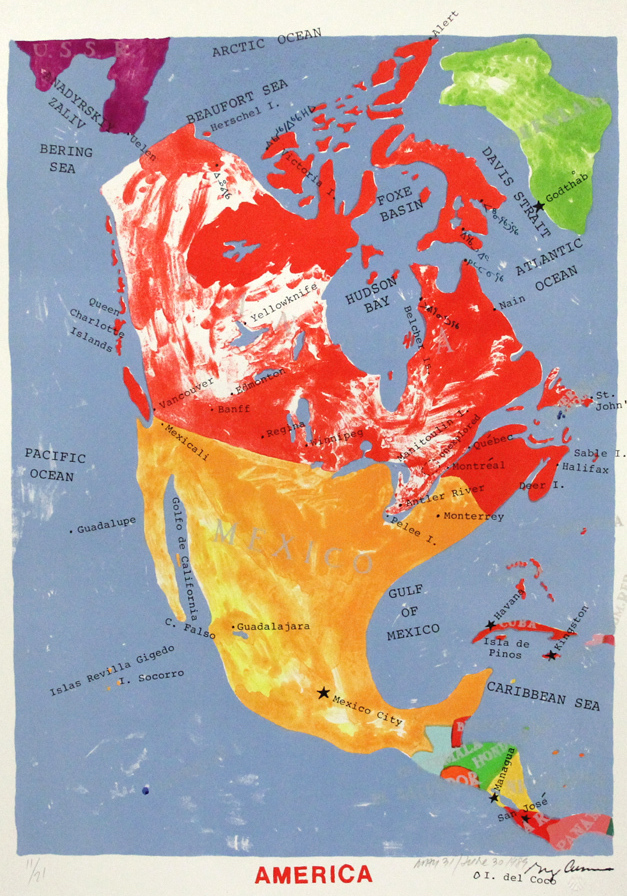
Greg Curnoe, America, 1989, Lithograph

Iranian Nuclear Agreement and a Non-American Vision of the World*

Should we be afraid of the unilateral departure of the United States from the international nuclear agreement with Iran and passively wait for the horrendous results of this warmongering decision, or should we take advantage of this opportunity with the help of other countries party to the agreement? Is this a curse or an excuse to circumvent the US Government’s hegemony? Can we imagine a world which no longer allows the interests of the US Government to be the decisive parameter in international relations, in which relations between neighboring countries with a long history of peaceful coexistence is not subject to the calculations of American arms and energy dealers?

The US exit from the nuclear deal is the decision of a selfishly autonomous political system to abandon a historic agreement. Inside Iran, except for a minority of hardliners and extremist secular nationalists in the diaspora, the agreement was unequivocally supported by a diverse spectrum of political leanings, from the liberal and left positions and oppositions to the families of the Iran-Iraq War martyrs. Even political prisoners from within their confinement supported the agreement. In a dangerous political moment, Iranians, despite their disagreements and while fighting for democracy at home, agreed on helping the nuclear deal, because they viewed the lifting of international sanctions from the outside as a way of rationally resolving the political dead-ends inside. Such a consensus was the outcome of Iranians’ long experience of participating in political struggles.

This densely historical experience is not limited to the last four decades after the revolution and the people’s tumultuous relationship with their government. The history of parallel struggles against tyranny and colonialism is chiseled in the most in-depth memories of every Iranian, not through official narratives and school history books, but with poetry, images, and stories moving from mouth to mouth and house to house.

Iranian’s loyalty and pride towards the nuclear agreement is not merely praise for Iran’s popular foreign minister but is for a history of negotiations and peacemaking by politicians who struggle to open the road of dialogue to improve and secure people’s lives. These sages were able to find a way to negotiate with Mongol rule in the ninth century, turning vicious armies into dignified citizens of the country. Average Iranians have memorialized and repurposed these legacies in their everyday struggles with the authorities.

In addition to damaging Iran’s economy, the US exit from the nuclear agreement also has the potential to damage Iranian’s self-confidence. Iranians and those upholding the deal should patiently protect our self-esteem and peaceful policies and not fear the path ahead of us. The real division in the world is not between Iran and the west but between warmongers and those who seek peace.

Let’s not forget that Iran’s unique geographical borders were not drawn by colonizers. The unique diversity of its people and its independence itself is an exceptional example of cohabitation of people together. This cohabitation is the result of a long-lived faith in diplomacy. Elections in Iran have taken place even under the most profound internal rifts and with a security state overshadowing citizens’ rights.

The post-Revolution experience of life in Iran wasn’t necessarily that of isolation from the rest of the world, but of living in a country whose name for years was on the headlines of world news which never provided an accurate picture of its millions of inhabitants. Instead, the picture of Iran was a vague but fixed image resonating with the old texts of post-Cold War politics: an abstract country whose imaginary dictatorship would remind us of our free world. This unfamiliar picture was broadcast every day to millions around the world. Those trying to undermine this image themselves created upside-down reflections of the country that would be appealing to a western audience, helping them recognize the unknown opposition in Iran. Some Iranian artists unconsciously reacted to this exaggeration through an accentuation of the ordinary in representations of Iran.

Nonetheless, Iran is an exception in the current world order for it undermines the good-evil dichotomy of the post-Cold War years. Iran was a country which was included in George Bush’s Axis of Evil and designated as the focus of constant threats by American politicians. However, over the last 12 years, Iran has emerged as the first country in the history of the United Nations that was able to lift international sanctions through negotiations and didn’t end up in a war.

The preservation of a contested democracy in Iran is the result of a political maturity forged under many years of external threats; a maturity passed down from generation to generation. Today, this politics, more than ever, desires dialogue with the world it faces and has shown itself willing to shape a new internationality driven by the imagination of peaceful political forces in different geographies. This is why the most important catastrophe is not the US exit from the international nuclear agreement with Iran but the loud and willful rejection of this imagination by the official voice of American politics. To protect this imagination, we must get closer to each other more than ever to make possible one more time a vision void of the absolute reign of American hegemony.

*Translated by Mohammad Salemy & Sam Samiee

More Articles from &&&

Socialism after Socialism, A Response to Conrad Hamilton

In the spirit of dialogue, I am responding to the observations in Conrad Hamilton’s recent expansive review of my book The Political Theory of Liberal Socialism. I will be concentrating on Hamilton’s three main claims, that there is a gap between the form and content of socvialism, invoking Marxist theories of struggle before coming down… Read More »

Biennialese Blues: Review of Whitney Biennial 2026

ARTISTS: Basel Abbas & Ruanne Abou-Rahme, Kelly Akashi, Kamrooz Aram, Ash Arder, Teresa Baker, Sula Bermudez-Silverman, Zach Blas, Enzo Camacho & Ami Lien, Leo Castañeda, CFGNY, Nanibah Chacon, Maia Chao, Joshua Citarella, Mo Costello, Taína H. Cruz, Carmen de Monteflores, Ali Eyal, Andrea Fraser, Mariah Garnett, Ignacio Gatica, Jonathan González, Emilie Louise Gossiaux, Kainoa Gruspe,… Read More »

No View from Nowhere: On Discourse, Différance & Functorial Semantics of Micro-Communities

This essay argues that natural language semantics admits no global orientation—no ‘view from nowhere’—but only local positions within psychoanalytically and sociologically embedded discourse communities. Drawing on Derrida’s concept of différance, I demonstrate that meaning is constitutively deferred across the differential play of signs, precluding any meta-linguistic standpoint from which all local meanings could be adjudicated.… Read More »

Liberalism Is Dead, Long Live Liberalism!

Matthew McManus’ The Political Theory of Liberal Socialism is a powerful attempt to merge two disparate traditions, parlaying reformist compromise into a coherent political program. It also rests on the assumption that socialism is inherently illiberal, an assumption that deserves to be questioned. While often hailed as the single-minded son of America, perhaps the best… Read More »

Luxury Activism: Art, Fashion & Capital

[This text was previously published by the author in Portuguese on Contemporânea Magazine — Ed.] I don’t want to work with fashion. Beauty must be preserved from capitalism. Fashion favours the escape into personal, private, selected, chosen space, as a form of false self-determination. Fashion reflects the fear of losing’ identity. — Thomas Hirschhorn The purposelessness… Read More »

The Questions Concerning the Ethics of AI

With recent articles in &&& concerning the status of what is or is not Marxism, I took it upon myself to write a piece that I consider firmly placed in that tradition. I am not being paid by the CIA, I promise. Furthermore, despite appearances, my article is not an article in the “ethics of… Read More »

The Best Ever Art Basel Review that Qatar Money Can Buy

During the Art Basel Qatar’s VIP preview of Sweat Variant’s durational performance My Tongue is a Blade on February 4, two special seats up in front of the stage stayed empty for a while.  Empty with intent.  People hovered, looked, and reconsidered occupying them in their head at the last minute like they were about… Read More »

SUPPORT THE IRANIAN REVOLUTION 2026!

SIGN THE STATEMENT HERE The past several weeks have borne witness to a bloodbath in Iran amidst images of systematic massacre and horrific abuses of power by the Iranian government against its own people. As a united front, we stand together to uphold the following convictions: 1- That the Islamic Republic of Iran must come… Read More »

Rhetoric vs Reality: Iranian Regime Is an Imperialist Project Preventing a Free Palestine!

Since its founding, the Islamic Republic of Iran has cultivated legitimacy by embedding itself within global progressive movements—particularly those oriented around anti-imperialism and racial justice. Rhetoric, repeated, obscures reality: the Islamic Republic of Iran (IRI) is an imperialist project that will not enable a free Palestine. The IRI is built on an expansionist doctrine resembling… Read More »

On State Collapse & Democide in Iran

1. Middle Eastern Islamisms and Islamists are reorganizing in a post-jihadi/takfiri Muslim/Arab world within their national boundaries. First of all, the Taliban’s path back to Afghanistan was facilitated by the USA. Afghan Islamists were swift in adopting a more Afghanistan-focused vision and dismantling any public state capacity, especially in social and women’s affairs, built under… Read More »

How Was This Monster Born? Contemplations on the Ontology of the Iranian Islamic Republic

By Asal Mansouri and Borna Dehghani, writing from Tehran How can survival turn into something shameful? How does breathing itself become a burden – one that a person no longer dares to carry, a weight that grows heavier by the moment, with no path of escape left open? What took place across Iran in January… Read More »

The Human Centipede II: Qatar & the Broker’s Cut

If my first The Human Centipede: A View From the Art World (2013) traced the art world as a closed alimentary circuit, this sequel begins where that circuit was sublimated into brokerage as a state-form with unmistakable political aspirations.[1] The same logic is now in the open for everyone to witness, wearing the grimace of… Read More »

الغای زیر ساخت‌های شیعه اسلام در ایران 

ENGLISH VERSION در لحظه‌ای که این سطور نوشته می‌شود، ایران با زخمی باز زنده است. جامعهٔ ایران یکی از تاریک‌ترین مقاطع تاریخ معاصر خود را از سر می‌گذراند. ده‌ها هزار نفر در خیابان‌ها کشتار شده‌اند؛ معترضانِ زخمی توسط نیروهای امنیتی از بیمارستان‌ها ربوده می‌شوند؛ و اعدام‌ها در زندان‌ها به شکلی صنعتی ادامه دارد. خانواده‌ها آیین‌های… Read More »

Abolition of Infrastructural Shia Islam in Iran

FARSI VERSION As I write this, Iran is an open wound. Iranians are living through one of the darkest moments of their country’s contemporary history. Thousands upon thousands upon thousands have been massacred in the streets; wounded protesters are being removed from hospitals by security forces, and executions are taking place on an industrial scale… Read More »

ایران، بزرگترین دردسر: دربارهٔ سکوتِ مزمنِ بخشی از چپِ معاصر

با چیزی آغاز می‌کنم که در نگاه اول شبیه یک حاشیه‌روی است، یک خاطرهٔ قدیمیِ تلویزیونی که زمانی لبخند روی صورتِ ما می‌آورد. اما همین خاطره، مدلِ فشرده‌ای از یک واکنشِ سیاسی است که مدام در ایران تکرار می‌شود. وقتی جوان‌تر بودم، سریالی بود به نام «روزی روزگاری». یک پدیده شد و واقعاً هم عالی… Read More »

Regarding the Erasure of Iranian Uprising

The most recent state crackdown on Iranian protesters stands among the most violent suppressions of public dissent in Iran’s modern history. Protesters have been killed, blinded, and mass-arrested. As the state imposed a sweeping information blackout and advanced claims blaming foreign agents for the violence, this brutality has nonetheless been met with a striking absence… Read More »

Why Critical Theory Isn’t Marxism & Why Western Vs. Eastern Marxism is an Illusory Dichotomy?

I have almost finished Gabriel Rockhill’s “Who Paid the Pipers of Western Marxism?” (Monthly Review Press, 2025) amidst the uproar among the so-called progressive left academia and publishing. Rockhill has said the quiet truth out loud: the so-called critical theory has in fact nothing to do with Marxism. Its path has been paved by former… Read More »

Applied Collapse in Venezuela

The recent decapitation of the Venezuelan regime by the US military is part of a longer history of induced collapse: from Iraq to Afghanistan to Palestine, the techniques of empire have been wielded to destroy societies. But behind the Maduro extradition may be a kind of new American weakness.As you know, Nicolás Maduro and his… Read More »

Hard Habit to Break: On Political Readings of Art & Marxist Citationalism

I want to talk about a habit in contemporary art writing that I keep running into, especially in Marxist-inflected theory, where interpretation is substituted with citation and judgment is treated as an embarrassment. The pattern is familiar: the artwork becomes an occasion to rehearse a framework, the framework becomes a moral sorting machine, and the… Read More »

Computational Contemplation of
Burg of Babel

To watch a one-minute version of the film, please click here. Burg of Babel (2017-2024) is built on a very simple but unusual structure. On the screen, instead of one large moving image, the viewers see a grid made up of twenty-five rectangles, five across and five down, each playing the same 25-minute film, with… Read More »

Organized Callousness: Gaza & the Sociology of War*

Introduction The ongoing war in Gaza has generated extensive polemic among scholars and the general public.1 Some have described this conflict as a novel form of warfare. The deeply asymmetric character of this war and the vast number of Palestinian civilian casualties have prompted some analysts to described Gaza as a “new urban warfare.”2 Others… Read More »

Postcards from Mitteleuropa: Reviews from Sean Tatol’s European Tour*

Chris Sharp, Los Angeles slop-gallerist extraordinare, once scolded me on Instagram for comparing Raoul de Keyser to Peter Shear, evidently because he thinks it’s wrong to see connections between artists if they’re not from the same generation, which is a novel opinion if I’ve ever heard one. When I asked why that would be a… Read More »

Two Futures

In the brief essay that follows, I consider art as an event that de-privatizes the subject by exposing us to the hyperobjects constituted by the circulation of transgenerational trauma, power, and subjective identities. I also examine the role of contingency in this process and argue for art as a tool of indifferent future production. What… Read More »

9/11 & Televisual Intersubjectivity

The six-channel work I presented at Art In The Age Of…Asymmetrical Warfare exhibition reconstructs from video archives of the September 11th attacks the televisual unfolding of the event on CNN, Fox, NBC, CBS, ABC and BBC news networks. The synchronic and uninterrupted footage which is playing on a continuous loop starts with the networks’ mundane… Read More »

Exotopy, Neo-Orientalism and Postcolonial Curation

After visiting the Ordinary Moments exhibition, curated by Mansour Forouzesh and featuring a collective of Iranian independent photographers at the FUGA Gallery in Budapest, I was once again convinced that the consumption of modern Iranian visual culture in the West is essentially orientalistic. Precisely through the contrast this exhibition provides, one can see more clearly… Read More »