Introduction & Translation by Alan Diaz*
Fernando Zalamea is one of the most prominent philosophers of mathematics to have appeared in Latin America in the last couple of decades. His most recent English-translated book, Synthetic Philosophy of Contemporary Mathematics (2014, Urbanomic), testifies to the impressive breadth of his knowledge in the field of modern mathematics, as well as to his conviction that mathematics can present philosophy with invaluable insights, over and beyond the merely formal and logical tools that resulted from its engagement with 20th century analytic philosophy.
On the other hand, Zalamea is also well-known for being a multifaceted thinker: he seems to move effortlessly, with an encyclopedic (or rather, synthetical) ambition, from mathematics to the social sciences, cultural theory and criticism. Besides being a highly regarded philosopher of mathematics, he has also written several essays on topics such as art, globalization, the current state of knowledge and contemporary cultural disorientation; a parallel essayistic vocation which has earned him the place of a public intellectual of sorts in his native Colombia.
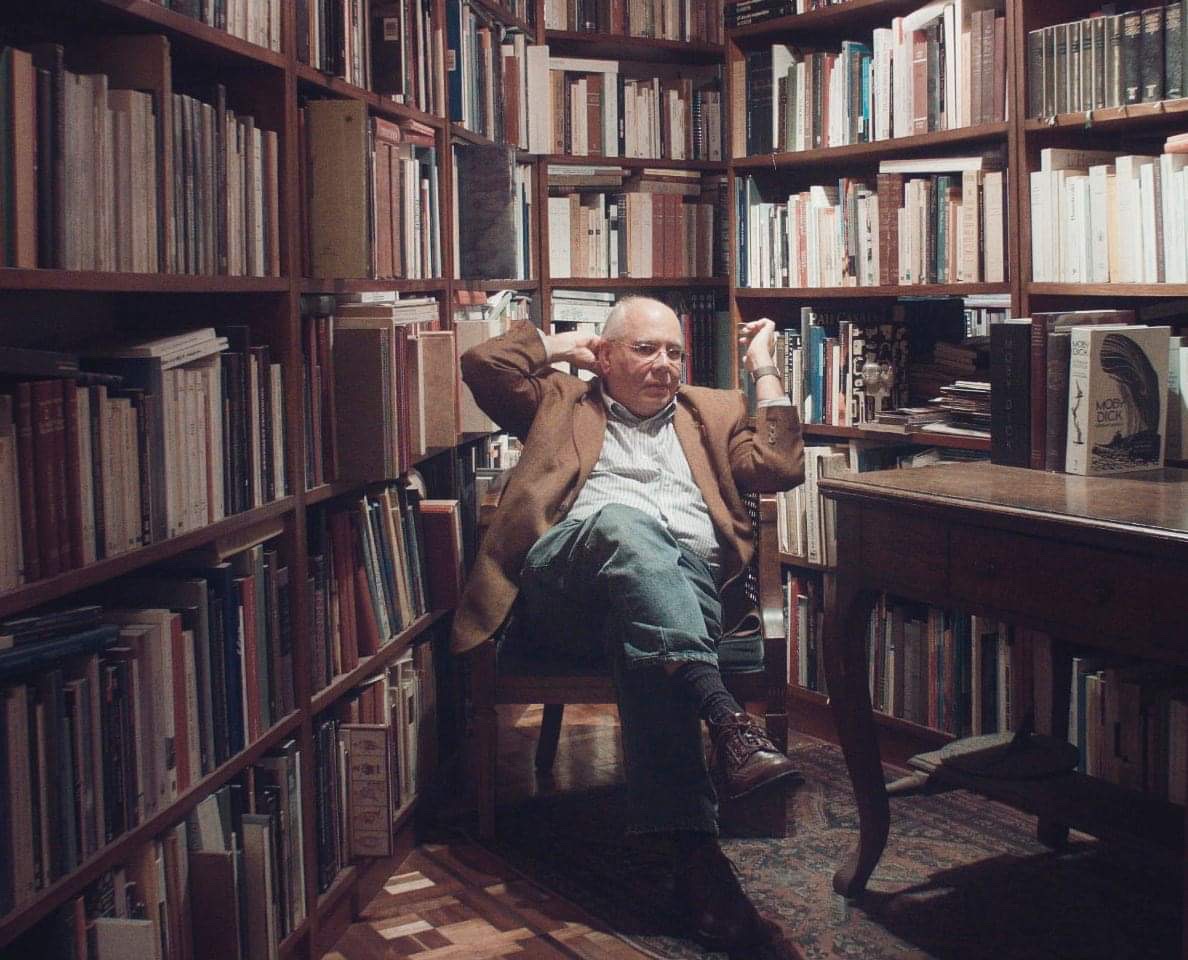
In this interview conducted in Bogotá by Manuel Correa (former New Centre Certificate student) as part of his latest film The Shape of Now, the 72-minute documentary about memory and forced disappearance in Colombia had its world premiere during DOK Leipzig International Documentary Film Festival. Zalamea explains his views on several aspects of mathematics: its historical evolution and ontology as well as the epistemological status of mathematical truth. Additionally, he also presents a passionate argument against the contemporary ‘post-truth condition’ and in favor of correcting this by using the tools of contemporary mathematics that have been so far neglected by the humanities and social sciences.
Could you tell me a little bit about your work and especially about your work as a philosopher of mathematics?
I have been working in two different fields of thought for around 30 years now. From a technical point of view I am a mathematical logician, but on the other hand, I have also approached cultural theory in general. I have tried, more or less systematically, to write about the culture from an essayistic perspective, using the mathematical tools that come from my previous training. I did my degree and my doctorate in mathematics but I was fortunate to grow in an important humanist family. I was able to immerse myself in their humanism and I have tried to use the tools of my technical training to understand something of the contemporary world.
The notion of truth in science has evolved constantly up to the point where it is considered provisional. For a philosopher of mathematics, the notion of truth has fundamental value. How did this transformation come about?
The problem of truth is without a doubt one of the most important historical problems of philosophy and mathematics. Truth, from a formal and rigorous point of view, began to be organized by the mid-nineteenth century with Boole’s works on logic, where he invents what we now call classic logic, which basically amounts to defining the world through two truth values: the true and the false. At a certain point, certain mathematical tools emerged which helped build a coherentist theory of truth in which, between a set of facts and a representation of those facts, there is a coming and going of information which at the start corresponds with a complete equation (truthful things) or to an incomplete equation (false things). This is no longer so in the contemporary world. Over time, perspectives have changed and, throughout the 20th century, multiple alternatives to this binarist logic, in which things are either true or false, have emerged. What now matters the most is what happens in the middle, with the logic of intermediate values that are much more appropriate to our culture, to our ways of living.
What does it mean, or imply, that a certain thesis is considered a scientific truth?
Scientific truths correspond to what I just mentioned: an adequation between a set of facts and a theory that tries to represent those facts. In science, classical logic works quite well, that is, things are either true or false when it comes to the representation of facts. For example, at this moment Einstein’s theory is true because it is adequate to the facts that we know of the universe, but it is very likely that, with the development of civilization, Einstein’s theory will have to be improved so as to be adequate with the facts that we will know in the future. This is something that has constantly happened throughout the history of science: science discovers facts and goes on to invent theories that attempt to explain those facts. Scientific truth corresponds to the correct adequation between facts and the representation of those facts, and this corresponds to the development of classical scientific truth, let’s say, from the Greeks up until today. But truths also depend on the logic used to represent this coming and going between images and realities. If logic changes, so do truths. I believe that in the domain of thought, in general, one of the essential tensions is the struggle between the ideal and the real. The “real” is basically constituted by collections of data, and the “ideal” by the way in which we interpret these collections of data. It is there that our imagination comes into play, through our theories, through the strength of the development of civilization, something that has changed over time. Now, there are multiple logics, there is no longer only classical binarist logic. There is a proliferation of intermediate logics. Thus, scientific truth is nowadays much richer than it was two thousand years ago, for example.
Historiography began as a positivist science, and in the last fifty years, there have been radical changes in this field. Micro-historians and New Cultural History try to find multiple ways of narrating history. These strands of historiography not only do not try to build armored or unique narratives of events, but they also show the mechanisms and devices that are used to construct history and the blind spots these present. Do you think it is important for the truth to be flexible?
Yes, I completely agree. This is an excellent observation. In fact, we can retrace it a little further to one of the great masters of contemporary thought: Charles Sanders Peirce. We have worked a lot on Peirce here in Colombia and we have formed one the largest communities of Peirce scholars internationally. Peirce invented contemporary semiotics, in which, to understand a sign, what you do is introduce a representamen with respect to the sign. The emergent triadic relation between sign, representamen, and interpretant is essential. From Peirce onwards, 1880, 1890, interpretation turns out to be essential for knowledge. This happens to be the same in the particular case of history: if, on the one hand, historiography expected to accumulate data in an aseptic, rigid and strict way, and that these data would confirm the truth, with the 20th century comes the awareness that this is not so and that the interpretation of history is essential. Beyond data, the way we see the data, the way we read the data, the way in which data has been obtained through all kinds of archives and constructions throughout civilization have changed the data itself. This is very important, and the dynamics of knowledge is built upon this. Knowledge is not fixed, it is not determined, but rather knowledge is evolutionary, according to different interpretations, of different entities, throughout civilization. A very interesting panorama is thus obtained in which humankind inserts himself. In the last thirty years—beyond the founders of postmodernism, like Deleuze, fantastic philosophers and great connoisseurs of science, literature and the arts—the deformations of postmodernism have been toying ideas such as the death of history, or the death of art, or the death of mathematics or science, deforming intelligence up until the point where anything goes. No! This is a lie and we must be very careful. The fact that different perspectives are opened and the fact that interpretations allow us to detect multiple differences in the world does not mean that any interpretation is equivalent to any other. This is a very dangerous game which degenerates values (Broch), something which we are suffering in contemporary politics with Trump-style “post-truth.” The idea of opening interpretations does not mean that anything is valid, but that, among interpretations, there are interpretations which are denser than others, with better coherence and greater weight in the mediation of opposites.
Could you describe the process through which scientific thesis is corrected?
Yes. The process is similar to what you just mentioned. Classical sciences, let’s say, physics, biology, chemistry, natural sciences, geography, etc., are sciences which are based on direct and practical knowledge of the world that surrounds us. Mathematics is very different, mathematics does not live in the world that surrounds us. It lives in other worlds. It’s practically imaginary and often mathematics runs ahead of its concrete applications by a margin of several centuries. Just as the 20th century was the century of mathematical physics, it is not hard to predict that this 21st century will be—using mathematics from the 19th century—the century of mathematical biology. Science is based on particular facts and it invents theories that explain those particular facts, and, as long as explanations of facts agree with theories, science continues to develop. Inevitably, a moment of obstruction follows in which new facts, which are not yet explained by the theory, appear. This is something that has always happened and will necessarily continue to happen because all scientific theory is essentially falsifiable (Peirce, Popper). This was demonstrated a long time ago, and it was demonstrated mathematically by Gödel in the 1930s with his limitation theorems, where it is proved that mathematical theories when they reach a certain level of complexity (Peano’s arithmetic), will always have things that escape them, things that theory cannot prove. This also happens constantly in practice. There are basic facts that theories do not prove and that cause the modification of theories, their plastification, their widening so as to cover previous theories so that we can manage to cover these facts. There is a permanent coming and going, what I call a back-and-forth, the pendulum between the real and the ideal. Both movements are essential, we cannot remain solely in the ideal domain or in the real domain. Science is a permanent struggle between both sides until we progressively understand the world better. These understandings of the worlds are fully historical, they depend on the moment we are in. For example, today we have a much more extensive knowledge than we did thirty, fifty or a hundred years ago. It is striking that, quantitatively, mathematics has produced more in the last thirty years than in its previous two thousand years of history! The development of science is impressive, and it is far from any “death” announced by those pseudo-prophets who lack sound judgment. Science is very active, the story that science is decaying is absolutely false. We are in a moment of spectacular explosion, and so it will continue to happen throughout history, it will never stop, until there is an eventual hecatomb, with a nuclear war or something of that sort. But from the point of view of theory, there is no reason why science or art would not continue to advance.
I am very interested in that back and forth which you speak of, and which you mention in your book Synthetic Philosophy of Contemporary Mathematics. This is a speculation of mine, and I am also very interested in this pendulum between the real and the ideal. How could we apply this transit between the real and ideal to the social sciences or to fields such as historiography?
One way, for example, that catches my attention and that I think is important, is to use the mathematical tools from the last century. Social sciences have, in the sense of the techniques they use for their development, fallen extremely behind with respect to mathematics or the development of mathematics. Mathematics has advanced a lot from the point of view of methodology and logic. On the contrary, sociology and history are still very much binary. They have not been able to use intermediate logics to study the different transformations of historical and social events. The use of alternative logics can be very important and profound. It has not been done. It has to be done. This is long overdue, particularly referring to the most important mathematician of the 20th century, who is little known outside mathematics. I am talking about Alexander Grothendieck (1928-2014), who in the ‘60s invented Grothendieck’s topos, where he conjugated something that seemed to be impossible until that moment, that is, to understand in a universal, superior, and unitary way both the notion of numbers as well as the notion of space. Numbers (arithmetics) and space (geometry) were apparently very far apart. Their union in the concept of space-number is even more sophisticated than Einstein’s unifying of space and time. What Grothendieck proposes—to unite space and number as projections of a superior beam—corresponds to the thinking of a notion of a variable set in the universe, of which some technical applications have already been made, although its full implementation in the “real” will be seen in the future. An interesting fact is that the intrinsic logic of the topos, of these new spaces of thought, are non-classical logics. In fact, it can be proved that they are intuitionistic logic, plastic logic, linked to the deformations of topology. Our natural limitations as human beings are thus overcome, and there are very interesting things which at some point should be applied to history and sociology. It is a matter of time. Mathematics tends to be too adventurous and are sometimes centuries ahead. It is possible that topos start to be used in mathematical biology by the mid 21st century.
It is hard to know what immediate applications a science like topology could have since it would seem that many of its cutting edge studies are hard to implement.
Mathematics must, first of all, create an opening and invent abstract worlds and concepts, which at some point will return to reality. One example is the invention of the complex variable, which was carried out in the 15th century. Its first important implementation was not done until the end of the 19th century when Maxwell invented electromagnetic theory using complex numbers (even worse: quaternions). That is, more than 400 years passed before it was used. With topology, things have been a bit faster because, actually, topology, science and mathematics are advancing at a vertiginous rate. It is amazing, everything that is nowadays going on with science. In art and philosophy as well! There are many fascinating areas where great changes have happened. Topology deeply influenced Einstein’s theory, which was formalized thanks to Riemannian geometry (which come from Riemann, a mathematician of the mid 18th century who invented non-euclidean geometries and introduced brilliant topological techniques to the complex variable).
In political discourse, the tendency is to steer the electorate towards the acceptance of particular points of view as indisputable truths. The notion of indisputable truth indicates that the nuances that develop in the middle are ignored.
Indeed, steering reality or steering the truth towards a particular point of view is extremely dangerous. One of the teachings of mathematics is that one particular perception can never be correct, can never capture reality faithfully. By definition, in mathematics (and especially in the mathematical theory of categories), multiple different perspectives are needed in order to understand an object, and it is thanks to these perspectives that a faithful representation of the object is obtained. A single perspective will never present the possibility of correction. Multiple perspectives are needed. With this, a differentiation of the object is obtained. You take the object, you differentiate it from different points of view and, once you have the differentiated object, you look for points in common and you reintegrate it. Mathematics is a double process of differentiation and integration, and it is only halfway in this process that you obtain something relatively correct.
What is the value searching the truth when advancing scientific theories?
The 20th century has managed to adequate this “search for the truth” and transform it into a “search for truths.” Multiplicity becomes fundamental from Gödel onwards. There is no longer a single truth, there are multiple truths, although this does not mean that everything is true. I repeat this, it is another essential point. Expanding truth and multiplying it does not mean that everything can be right. We multiply the truth and this is essential for the development of science since we have greater wealth, more objectives and searches, better techniques. The search for truths, in the plural, greatly expands scientific knowledge and, moreover, extends human imagination. When this is achieved, the human being is more in tune with the cosmos and deep reasons arise which make us think about having an adequate place in the development of the cosmos.
Since it is important to understand from the beginning that there is no single truth and that, in a certain way, truth exists as something one must advance to or reach in practice: could we then say that that truth, instead of constituting itself as an irrefutable proof of something, is rather constituted as a goal to be reached?
Yes! Perfect, perfect! The network of truths, the network of multiple truths, each one with its non-arbitrary raison d’etre, orients the scientist, orients the writer, orients mankind in general towards developments which are coherent and consequent with its worldview. In that sense, the notion of multiple truth as a guide to constitute our plenitude as human beings is very important.
What is the difference between the concept of truth in mathematics and in empirical science respectively?
Related to what we were talking about, mathematics inhabit an essentially imaginative domain, and what is required is a certain coherence within the imagination. This is the only thing it needs. In mathematics, anything is possible, any world is possible. Its truth lies in the consistency of the possible. Mathematics really inhabits ideal worlds, whereas empirical sciences have to be anchored in the real world, in the construction of a specific and testable cosmos. While mathematics has to think in multiple universes, the cosmos is concentrated in the earth, in the solar system, in the galaxies. Truth in the empirical sciences lies in its contrast with the actual. Therefore, there is a very large difference between the restrictions that empirical sciences require and the freedom of mathematics.
*Alan Diaz is a Mexico city-based Architect, currently finishing his master in Critical Theory in 17 Institute for Critical Studies. He is also a Certificate student at The New Centre for Research & Practice.