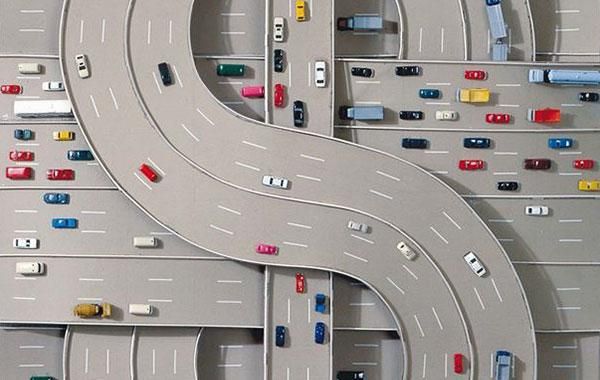
In his book, The Rise of the Network Society, Manuel Castells makes a distinction between the “space of places” and the “space of flows.” The space of flows is the spatial logic of autonomous circuits—the expression and arrangement of flows (flows of information, social operations, social bodies, etc.) distributed across space, independent of territorial sites (the space of places). The spatial site is node, or a “special economic zone,” within the distributed topography of accelerated flows. Appadurai’s concept of financial scape saw these lines of flight within the market as interlocking global networks, abstracted from geography. Globalization corrects the issue of non-simultaneity by speeding up material development. Disjunctive flows absorb and rearrange political forms according to the rhizomatic dynamics of global supply chains. Creolization is a consequence of disjunctive flows as connectivity undermines national borders and cultural hybridization emerges out of the accelerative thrust.
If the internet is an example of global connectivity beyond state then urbanization is its material sibling. According to Castell, “the city isn’t a place, but a process.” That is, urbanization is the accelerative process materializing in real time.
Louis Wirth’s “Urbanism as a Way of Life” attempts to answer the difficult and broad question of what qualities constitute urban life, and essentially, what makes a city a city. Wirth observes that “Just as the beginning of Western civilization is marked by the permanent settlement of formerly nomadic peoples in the Mediterranean basin, so the beginning of what is distinctively modern in our civilization is best signalized by the growth of great cities.” Though it may seem like an obvious distinction, rural areas are more inexplicably linked to nature-based ways of living, while urban areas are more removed from these conditions. Wirth’s essay is an in-depth analysis of these two forms of living as they, “may be regarded as two poles in reference to one or the other of which all human settlements tend to arrange themselves.”
The internet has undeniably revolutionized the ways in which we live, communicate, and consume information. Obviously, at the time of Wirth’s essay, technological development was at a different point entirely, but let’s compare and contrast ideas about the internet with Wirth’s notions of urbanization. At its core, the internet is an interconnected set of networks of all size and scope, and for all kinds of entities, from personal to academic, governmental to commercial. There are an endless array of services that one can find on the internet and boundless amounts of information. Moreover, the internet collapses private and public use together on one large network, though if I were to conceptualize the internet as a “real” space, I would prefer separate “rooms” to different types of websites, each with a distinct purpose. For instance, Wikipedia is an informational site where experts contribute to and edit various topics, while Facebook is a site that is meant to cultivate a sense of online culture among “friends” you add, and though you can get information from Facebook by way of “sharing” articles or links, the site is there more so to cultivate a social environment.
The most obvious difference between the internet and cities is that the former is not physical. However, Wirth notes quite astutely that, in the city, “our physical contacts are close but our social contacts are distant.” What’s more, “The urban world puts a premium on visual recognition. We see the uniform which denotes the role of the functionaries and are oblivious to the personal eccentricities that are hidden behind the uniform. We tend to acquire and develop a sensitivity to the world of artifacts and become progressively farther removed from the world of nature.” Though the city is physical and the internet is purely digital, Wirth infers that the city is a physical space far from what humans deem “natural” and if we take this point a step further, we can conceive of the internet as a space that adds an unnatural layer to all physical spaces, including rural ones. Thus the question we’re willing to posit is, if the city is a geographical hub of modernization, then what can be said of new forms of technology that link almost anyone irrespective of physical locale?
Wirth makes many observations about how populations organize themselves in urban environments and notes that while more “dependent upon people for the satisfaction of their life needs” as opposed to rural counterparts, urban inhabitants “are less dependent upon particular persons, and their dependence upon others is confined to a highly fractionalized aspect of the other’s round of activity.” He also goes on to say that people in cities are able to fragment themselves and “different interests arising out of different aspects of social life” and that they assume positions “in widely divergent groups, each of which functions only with reference to a single segment of his personality.” Here, Wirth points to a greater philosophical point about the nature of identity by suggesting that there are many components and facets that constitute our selfhood. Similarly to the ways the urban inhabitant functions as a social creature, we are able to select which aspects of ourselves we’d like to reveal on the internet, and we can find groups that speak to different parts of our personality. In this way, anyone who likes quilting and wants to connect with individuals who share that interest can visit a chat room or join a group on Facebook devoted specifically to that hobby.
While both the city and the Internet are linked in terms of creating hubs that are far removed from nature, being able to physically walk through the city does create some distinctions between the two. Within the city, “Density, land values, rentals, accessibility, healthfulness, prestige, aesthetic consideration, the absence of nuisances such as noise, smoke, and dirt determine the desirability of various areas of the city as places of settlement for different sections of the population.” Moreover, not only is this desirability determined by these factors, but people are often shuttled into undesirable areas by the flows of capitalism. Here, the internet provides a bit of an advantage over cities as people can connect, organize, and find support regardless of social standing as (at least in developed nations) almost everyone can access it. While urban areas highlight “glaring contrasts between splendor and squalor, between riches and poverty, intelligence and ignorance, order and chaos” the internet collapses all space and time together on one plane and this makes it inherently more democratic, at least in theory.
The defining concept of the 19th and 20th centuries—of the modern political revolutions—is the “mass”. The mass is not merely an idea for use in political justifications but is a real collective subjectivity which arises from the interactions of our daily lives and feeds back into our cognitive schematics by which we extrapolate the possibilities of present and future possibility. The structure of things creates a space for individuals to fill, such that their characteristics fulfill inherent possibilities of that structure. We are far along enough in a pessimism of politics to understand that “humanity” is politically predefined.
The Making of a Subject
If readers feel comfortable with the phrase ‘political-subjectivity’ as it is used by thinkers such as Michel Foucault and Maurizio Lazzarato then they can skip for the sake of attention to the concluding remarks and the next section.
The dynamics of the mass are generalized as such: an individual enters into a space in which they experience simultaneous and identical stimulations with others. A mass is (the idea of) a group of people who are experiencing the same thing. The mass as a subject is the end result of a three-part synthetical process of political modes in which the individual encounters an external situation, participates in the situation, and projects the situation onto any other individual who might enter the space. This third movement is the mode-subjectivity as it is an empty shell beyond particular individuals which might fill it. It is a generalization in terms of who the individual will be and the categories which they will fulfill. The mode-subjectivity is a complex of categories which we ask about the individual, the total of which forms the idea of the ‘subject’. Each of these categories is a way of seeing for an institution and a hook by which it can manipulate individuals.
| External | > Entering into space |
| Internalization | > Knowing that others know |
| Projection | > Imagining possible others |
When we talk about a ‘citizen’ we talk about a subject mode. An individual enters into the external space of a nation-state and is internalized by it through a capturing of the individual’s details in information about the person and body—race, height, name, etc.—which is shared throughout the body of the state so that wherever a citizen may travel within it (across space or across institutions such as schools, credit agencies, and DMVs) the information regarding who they are is coextensive. This process of digesting the external entity so that it can be internalized by the institution leaves, after the individual has received his necessary papers, a process which can be repeated on any entity which is encountered. In Kantian terms, the political subject is fashioned from meaningless noumena into a sensible object by the a priori categories of what we want him to be. Before any person steps up to become a subject, there are the categories with which we will stamp him—race, height, name. These a priori categories are what we mean by a subject and the sorts of questions which we are asking is the subject-mode.
The fashioning of an individual into a subject is a task of sense-making that is creative and generative. It is not a task of ‘finding out’ what already exists. We can imagine without any stretch of the imagination that the state encounters an individual who does not have a name, has many names, has a nom de plume or has only one name such that it is incompatible with the question being asked by the state – that there must be at least two names, a first name and a surname, and preferably a middle name. In order for an individual to become a citizen they must answer the question whose answers will give them existence within the epistemological community – the knowing that others know. The act of naming is a basic form of subject-making which projects upon the radically unknown individual a form of knowledge. The structure of a name predicts the way in which the name will be used. This is the point of it all: so that the entity may have existence within the mythopoesis of society and governance. Discoveries into the logic of institutions such as these are what brings political sciences towards the serious consideration of magic, so far as “magic” is defined as the manipulation of the real world by use of belief in symbols. The only thing more powerfully “magical” than the state is capitalism.
It is easier to imagine all this talk in terms of actual speech-acts. An individual can communicate, identify, and empathize with a group of others when she knows that these others have had the same experiences as her so that the language which is used for expression is common. Without a common language, one cannot effectively communicate. Even subtle differences in concepts may produce dissonant conversations and the breakdown of sensemaking. Using the same words, one may not be talking about ‘the same thing’. For any proof of this, read an article made by your political opposites.
Port this logic over to the functioning of institutions which must communicate in order to function, who must have a way of making sense, and a common language. Every complex interaction of human beings mediated by any sort institution invariably produces for itself a subject out of the radical nothingness of the individual.
Emergence of Mass Modes
In the transition from monarchical-subject-modes to citizen-modes, the use of media to deliberately form a nation was not lost on modern political revolutions. The first iteration of the nation-state coming after the creation of the printing press allowed humans to communicate and identify with others, and to expect that their compatriots have consumed the same canon of knowledge. Hence why the earliest novels were enshrined within the nationalist ethos: national epics like Goethe’s Faust, Cervantes’ Don Quixote or Manzoni’s The Betrothed. The nation-states created in the period of literature formed the ‘bourgeois revolutions’ because the collective identification of the nation could only be held by a literate elite.
The developments in the mode of political revolutions occurred in parallel with evolutions in the modes of communication: the newsprint, the radio and the cinema. No longer was literacy a requirement for political participation, and mass politics could be realized. Though fascism and communism are on opposite sides of an ideological spectrum, their animosity can be seen as emerging from a competition for the soul of the newly fashioned masses. The circuit of media-politics feeds back into itself and while media forms create the possibility of political modes, emerging political actors then appropriate media for their ends. Soviet Cinema. Triumph of The Will. El Instituto Cubano del Arte e Industria Cinematográficos. No coincidence, either, that the McCarthy witch-hunt for communists in America during the Second Red Scare leveled its aim at Hollywood Cinema. Conscious of the ability of cinema to influence national character, the allegiance and purity of those who wielded the means of media production was questioned. Today the conspiracy theory that Jews, Globalists, or other enemies of the American nation control the media is a persistent paranoia which recognizes the power of media over the political community.
The mass as a political concept is a description of the physical-informational reach of the radio: one must merely share a space with others, and be able to understand the aural transmissions – shared territory and language. The radio created a new informational space, and subsequently populated it with individuals who formed a super-individual subject—‘the mass’. If we understand human politics to be revolutionized by the emergence of super-human entities such as mass then are these entities like demons, gods, angels, etc. which operate through humans-as-parts in a social machine delivering supernatural teleologies?
Revolutionary Sciences
By discussing the political concepts of institutional change we approach a science of revolution. Marx got everything at the base of media theory correct because he understood that material forms generated political superstructures in complex mechanisms of feedback. Using media theory to understand these material forms, commodities, as communications develops the holy grail of Marxism: the science of social change, or revolutionary sciences.
Political upheavals of the revolutionary character respond to new forms of expression and consciousness. New subjectivities seep or burst through. In any case, it is impossible to completely resist new forms of organization and subjectivity. It is at least disadvantageous for a state to do so. A media form represents power. That radio could create a mass meant, in turn, that the radio could wield the mass as an object. The old forms of hereditary government could not. It is disadvantageous not to adopt new forms of media because a state, insofar as it is a bureaucracy (or a computer), operates conceptually. That is, it pre-establishes entities with which it will interact. If the state could not accommodate the demands of the mass subjectivity, then the mass subjectivity would overthrow the regime in order to rework the mechanics of government such that the mass is present in the calculation of order. This is evident from the subjective (or cultural) character of both communist and fascist movements in the 20th century: the preponderance of justifications to ‘the people’.
The atrocities of mass governments occurred in the same conceptual spaces. It was difficult to suss out the individual subject, so he was not talked about. Only with the development of social psychology and surveillance could we fashion the concept of the ‘super-predator’ as an issue of governance. Rather, the operational concepts of mass government were masses and the excising of undesirable elements took the form of holocausts and mental asylums. Government action operates on the level of its information. There is a fineness or coarseness to this—exactly as having more pixels (more points of information) gives us a clearer image.
Networks: A New Schema
The media landscape is changing again through the use of networked modes of communication. Mass spaces are being averted and the circuitry of behaviors are reconfigured into individual pathways. If we are to take the effects of the printing press, radio and cinema seriously, then we ought to understand that the networked mode of communication could represent a catalyst for social change. This mystique is the ‘wokeness’ to alt-woke: that media forms lead us on, and we can only hope to exert our wills in the world through first adapting to new situations. The more society resists, the more likely the change will be sudden and catastrophic.
| Radio | > Music Library or Podcast |
| Cinema | > Availability of anything at any time |
| Television | > Netflix |
| Mass transit | > Uber |
| Supermarket | > Amazon |
| Public Square | > Social media |
| Classic Warfare | > Asymmetrical Warfare |
| Library | > Amazon |
| School | > Modular Education |
| Factory | > Platform Labor Sourcing |
| Segregation | > Gentrification |
| Commercials | > Targeted advertising |
The list might continue. The transition from column A to column B is of physics. In mass physics, the individual approaches a situation in which it joins a group that receives a single transmission. In column B, the individual remains individual, and the transmission which it receives is unique. What a radio transmits for everyone, it is the same, and at the same time. But a music library, though the same library, can be accessed in different portions at different times, such that I cannot reliably imagine other users of the library to have heard the same music as I, and it is highly unlikely that they have listened to the same music at the same time, in the same situations, in the same order or with the same frequency. The disjointing of our media practices from scheduled to non-scheduled also disjoints our sense of the understandability of the other. We can also analyze behaviors which are not purely consumptive such as the use of mass transit. Mass transit fulfills our qualifications for ‘mass’ neatly: it is scheduled and homogenous. When I take the New York City subway system and another person takes the New York City subway system I might say to her, “you know what that’s like,” and can reliably infer a number of experiences which she must be familiar with. This is the process of compatriot-making. A public square is the same square for all. But a social media feed is different for each individual. Even if two users subscribe to the same list of content-providers, the presence of reactive algorithms which alter the sequence of that content will individualize the feed.
Why the ascendance of network over mass? The simplified reason that network modes are preferable to mass modes is that they are more efficient. When a government has complete surveillance over its citizens it no longer has to conduct pogroms of whole communities to find its undesirable elements. This saves a host of externalities and keeps the body count low. Labor and capital platforms such as Uber, Postmates, or Taskrabbit reduce misallocations and allow resources in the productive process. If Amazon were to replace every store in the world, we would lose less money to rents and construction. The mass space is permanent and sufficiently large for an expected maximum of participants at a given time. The network space is only as large as it needs to be based on orders. Its extension into space and time – its capital – is more efficient by expanding and contracting to order.
If we have a healthy respect for the influence of media forms on our politics, and understand the radical transition from the mass form to the network form, then we’re already halfway to our doomsday prepping. The only next question to ask is how hot the conflagration will burn—how much of our present forms of governance will not make it out of the revolutionary transition from mass-mode to network-mode?
How can a network-mode apply itself to governance? In what way is a network of actors more efficient than a nation-state? The first obvious example is in asymmetrical warfare, where terrorist networks constantly thwart the lumbering nation-states who spend billions of dollars on anti-insurgency campaigns while terror groups shift the burdens of organization and training onto its participants like franchisees. But warfare is not the only form of governance. It is only one of its main directions. This clues us in: that a government provides many functions, and extrapolating each of these functions across the mass-mode to network-mode rift is the project of contemporary revolutionary sciences.
Another obvious function of government is the role of taxation or the transference of payments. The government justifies taxation by providing services that it imagines a free market would not be able to provide. Why? Because the government acts as an aggregator – it centralizes a decision because if many more actors were to make the decision it would result in a suboptimal outcome. If very many actors built their own infrastructure out of self-interest then there would be network compatibility issues which reduce the network’s throughput. The state aggregates the interests of its individual constituents and assumes itself as an individual who might want to use any section of the infrastructure. This sort of super-individual is key to understanding of the modern state. In terms of decision-making dynamics, the state acts as ‘the mass’ personified – or agentified—i.e. fashioned into an entity which can act as an agent.
Network modes do not accrue individual agents into super-individual agents except where physics demands it. Taxation and infrastructure to the territorialized mass-state can be described similarly, as we have done above. When porting these concepts to network modes we encounter a problem with infrastructure. Its physicality prevents the network mode from being a more efficient form of governance. This exception proves the rule: that at the point in which technology decouples information from the territory, networks are preferable to masses. The more physical a system, the less effective is its evaporation.
What would a networked mode of taxation look like? Are there any that already exist? Is there, in our daily lives, some sort of organization which we regularly pay money to in exchange for a ‘public good’?
| Citizen | > User |
| Rights | > Subscriptions & Services |
Questions for the conclusion:
- Can capital be effectively and inclusively networked for a socialist outcome? Is this a UBI? Is a UBI the conceptual reduction of a nation-state, as far as membership within it is a reciprocation of labor for a bundle of goods and services?
- If networks are like states, and there already exist powerful states, can users act as citizens and democratically organize within their ecosystems to achieve just outcomes?