Introduction
The formation of a given city is predicated on access to its productive peripheries. Cities were first created as intentionally unproductive centres in which the goods from surrounding hinterlands could be stored and distributed. The success and growth of early cities was entirely dependent on the expansion of their footprint – the area from which they drew their wealth. And as the distance between urban centre and productive periphery increased, so too did the importance of the connection between the two. Eventually, the footprints of certain territories extended into and across oceans. By the 16th century, while the seat of power remained within the city, the expansion of power was entirely reliant on maritime trade and navigation. Those European empires responsible for colonising large swathes of distant land conceived of the sea as a means for unimpeded expansion and unprecedented connectivity. These principles, borne of the sea, came to define the space of the city itself. By the 19th century, industrialisation led masses of rural inhabitants to flood into a few great urban centres, which meant an even greater reliance on distant sources of supply[1]. In the new metropolis, the same initial rules applied; if a city could control distant sources of food and raw material, that city could continue to grow. Today, while the distinction between city and productive territory has all but dissolved, the importance of the supply chain and the distribution of goods has only increased.
Capital is generated as much in the distribution of goods as in their production. This distribution relies on urban sites as processing centres – the city is a space defined by logistics where logistics is the ‘science of value added through circulatory systems’[2]. Things get moved from one city to another and by virtue of this movement, their value increases. In this formulation, distance is essential to the generation of value. Defining the urban by the joint concepts of circulation and flow means understanding the scale of urbanisation as truly planetary. This scale is such that the most seemingly isolated spaces – those most distant from city centres or suburban peripheries – have become fundamental components of the urban fabric[3]. The web that makes up the urban has now spread across the entire planet; even the oceans have become urbanised. To best understand this new form of urbanisation therefore requires investigating those distant spaces far beyond the city centre: the free-trade zones, the 24/7 ports, even the sea itself. This article presents an investigation into the urban impact of DP World, a Dubai-based company that operates 77 terminals across the globe. By describing the passage of a container ship between Dubai’s first free-trade zone, Jebel Ali, and DP World Antwerp, this article works to explicate the role of maritime infrastructure in the shaping of cities and economies worldwide.
Infrastructural Sea
Seen through the pervasive lens of capital flow, the sea is as much a piece of infrastructure as is a road or railway line. Standing at the port of Jebel Ali Freezone in Dubai, the water of the Persian Gulf can be glimpsed through a canopy of towering yellow gantry cranes. Here, sublimity is not conjured by the tamed waters but by the mechanical dance of pure logistical efficiency. Jebel Ali is the largest marine terminal in the Middle East and it is DP World’s flagship facility. Like any other port, Jebel Ali is the stage upon which a choreography of interlacing machines plays out continuously. Containers are lifted off the ships by the huge cranes before being placed aside on the tarmac. A horde of smaller straddle-carriers and reach-stackers then cart these containers off into neat piles between lines painted on the ground. Beyond this hypnotising array, the sea appears as a background, an empty surface drained of any depth or ecological richness. This vacant stretch of water between container terminals two and three beckons vessels to dock. If logistical power can be understood as the ability to mobilise the natural world for political effect or economic gain; here we see the space of the ocean reduced to a surface upon which goods are transferred[4]. The sea is by no means empty though, even when seen as an infrastructural space. It is a technologically mediated space, thick with radar and acoustic sensors, with marine traffic constantly monitored using satellites. At sea, as on land, there exist defined lines of travel: north-bound traffic to the right and south-bound to the left. Such marine traffic is also monitored using satellites. The traffic lane that delivers ships to Jebel Ali terminates at a patch of ocean is designated as a waiting area. Beyond each busy port, huge swathes of ocean such as this are repurposed as ship-sized parking lots called anchorages. In the anchorage beyond Jebel Ali, one particular ship named the Africa Two waits its turn before slowly navigating into its allocated position at the dock. A sparse array of dock workers assist cranes to empty the ship of its contents, before new goods are loaded on. Sometimes this process can take a few short hours, but today the Africa Two is full of containers and takes half the day to unload and reload. During this time the ship receives new parts, new food supplies, and it receives an oil change. By the time each of these processes have been completed, the ship detaches from the port and continues on it’s unending journey transporting goods across the globe.
Looking back to Jebel Ali from the Africa Two, countless other free zones can be seen dotting the shore, each with their own tailored array of incentives. These zones are the terrestrial corollary to the constantly circulating ship. They are enclaves in which the standard taxes and regulations of a given state are suspended in order to attract foreign investment. With names including Dubai Maritime City, Dubai Production City, Dubai Media City, and Dubai Internet City, these zones are distinctly urban in their scale and ambition. Inside their air-conditioned towers masses of Indian, Pakistani and Bangladeshi workers perform maintenance work for the benefit of other foreigners. In these cities, the importance of geographical factors that have generally defined the emergence of past cities has been overridden by foreign investment and foreign labour. This is not the deregulation of the Mediterranean city-state but something new, supplemented by a suite of modern technologies such as the shipping container. The zone mediates between two distinct modes of governance; one that is rooted and of the land – that understands territory in contained terms and another that is nomadic and smooth, and thus more conducive to capital flows[5]. It is a quarantined territory that propagates a dream of ‘optimized frictionless passage’[6]. All factors that distinguish one locality from another are obliterated. In the zone, space is flattened to facilitate the ceaseless circulation of money, commodities and bodies. These zones retain an almost identical appearance regardless of where they land, and in their utter indifference to things like cultural variance, they are the perfect conduit for supply-chain capitalism.
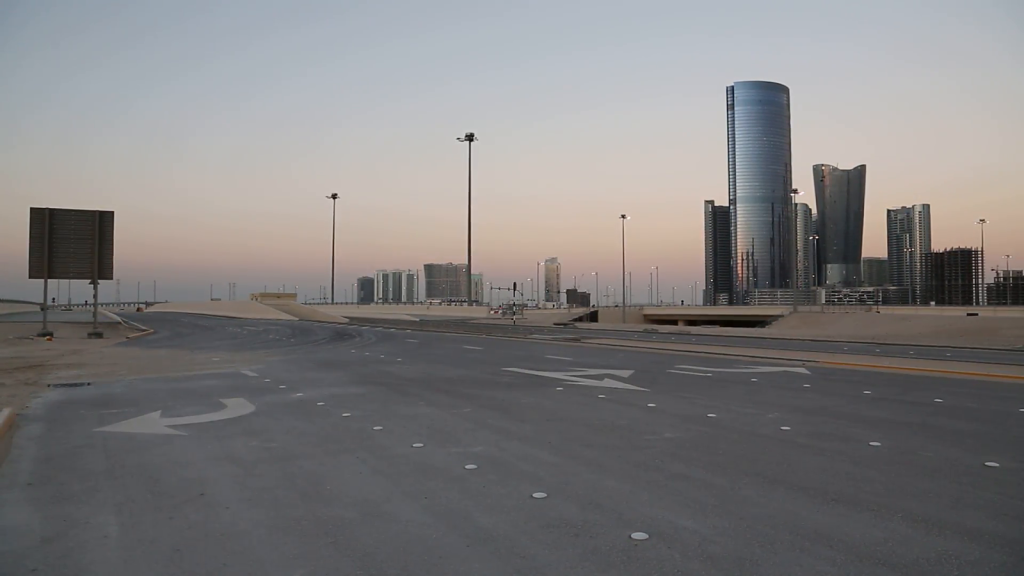
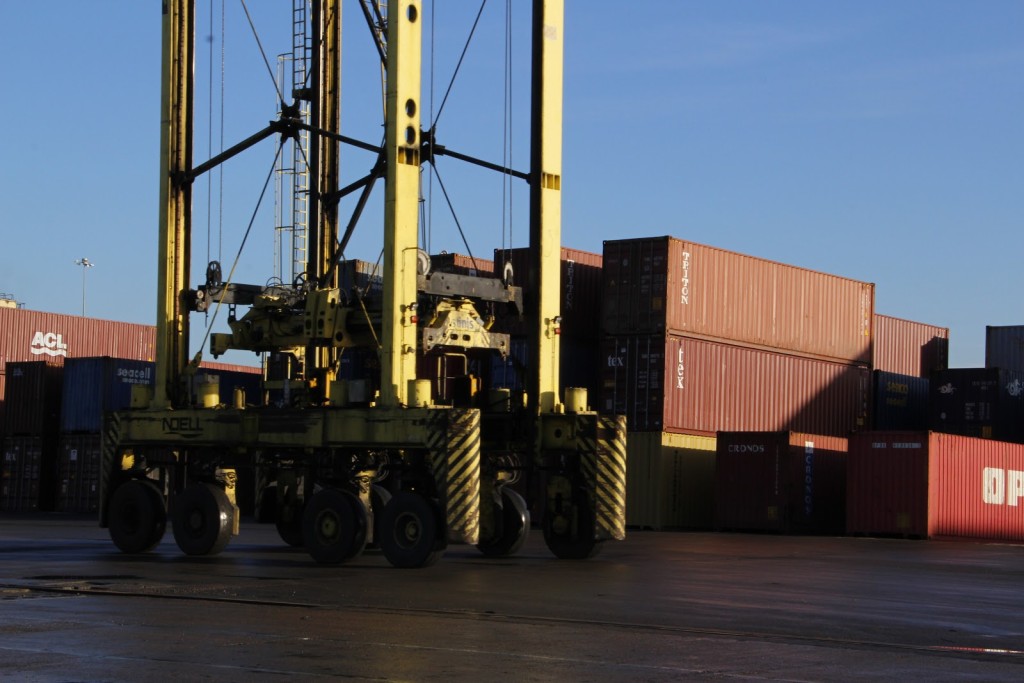
Image by HDVMaster via www.videoblocks.com & by author
The Global Vessel
Contained within the merchant vessel is a globalised world in miniature. As the container ship Africa Two leaves the port of Jebel Ali, it presents a perfect image of efficiency; it’s hulking, 230-metre long hull plies slowly and unendingly through warm waves. Inside the ship, machinery, crew members, and cargo from the furthest reaches of the planet are heaped together. The space of the ship is a synecdoche of the capitalised world at large. The Africa Two embodies the dissolution of geographical distinctions. This Japanese built container ship is operated by a French company, registered to the Bahamas, and manned by Filipino and Ukrainian crew. The 280 meter-long ship can carry up to 62,000 tonnes of cargo. Toward the stern of the ship, rising up from between rows of containers stacked 4 high stands the gleaming white superstructure. This white mass, punctuated by a few small windows, houses the bridge as well as the quarters of the captain and other high-ranking members of the ship. In the middle of the superstructure is the crew’s accommodation and a small gym, while down below is the main office, the engine room, and the two mess halls. Having two mess halls is indeed the rule rather than the exception when it comes to the sea: one for officers, one for crew. However, these rooms would be better described as the Ukrainian and Filipino mess rooms, respectively. While categories of race and class divide the ship almost equally, the few Filipinos who have made it to the position of officer, and those young Ukrainians who hold crew member positions, will choose to eat in the same room as their countrymen. Rather than being a rule to which the ship’s crew are forcefully subjected, this is simply considered “the way things are”.
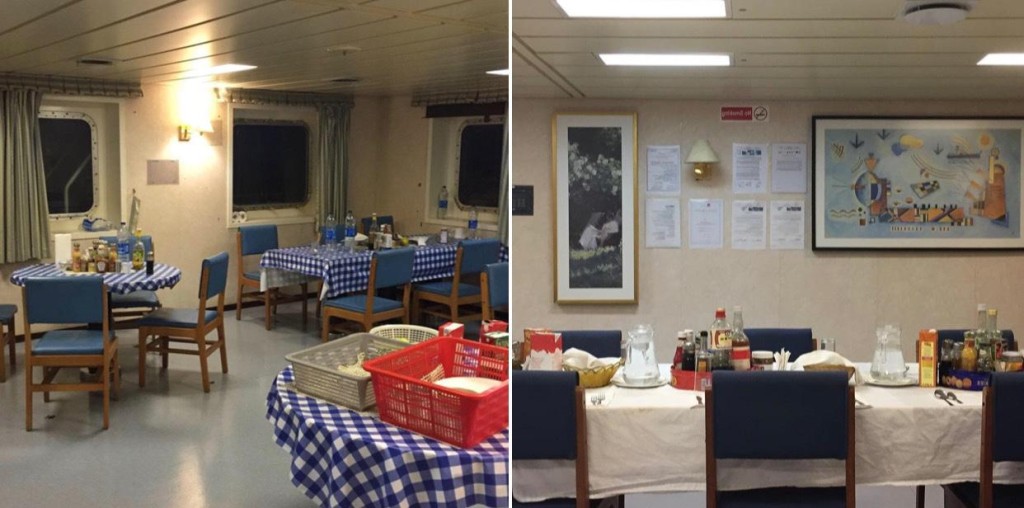
Images by Author (left: crew mess, right: officers mess)
Within the logistics industry there is a tension between generating homogeneity in time and space, and in producing difference in terms of labour. Profits are maximised through both uniformity in space, and through diversity in worker identity. While 40% of all seafarers worldwide hail from the Philippines, an extremely small minority of these seafarers will ever become officers. Indeed because Filipino seafarers speak good English and accept half the European wage, the Philippines was the world’s main supplier of seamen between 1987 and 2015. Since then, this role has been held by China, illustrating the ease with which maritime labour pools can be geographically relocated. Global economic imbalances guarantee that there will always be somewhere new where ever-cheaper labour pools can be drawn from; in this way the relocation of labour is a ‘spatial fix[] for crises of profitability’[7]. Generating new maritime labour pools requires no heavy investment in immobile infrastructure; it relies, instead, on maritime schools which can be placed and replaced at relatively small costs. Now, international institutes and training centres in Sri Lanka and Shanghai churn out scores of seafarers willing to work for half the price of the Filipinos. Yet this cannot be explained in geopolitical terms alone; this difference is something that the workers perform. For logistics workers, factors such as race, ethnicity, religion, citizenship status and age are all things that can be exploited[8]. The social production of all these seemingly non-economic factors is thus central to the structure of supply chain capitalism. Those Filipinos aboard the Africa Two are well aware that their Chinese counterparts receive a mere pittance in comparison to their own salary, and this inspires them to regard the Chinese with a mixture of defensiveness and empathy. Filipino seafarers can earn three times what they would get for a government job at home by working on a container ship[9]. While much of the crew want to leave the industry within a few years, primarily in order to spend time with their families, the prospect of job insecurity naturally causes great concern. Ultimately these workers, who are already working for much less than their European counterparts, know full well that there will always be someone else willing to work for less.
On a container ship like Africa Two, the conditions of the crew are compounded by the alienating nature of logistics work. This sense of alienation, shared amongst those who help to circulate goods throughout the supply chain, is best epitomised in the container itself. Developed to allow goods to be easily transferred from one mode of transport to another, the ISO shipping container completely standardises the movement of goods. These containers are 8 ft wide, 8.5 ft high, and come in two lengths: 20 ft and 40ft. Additionally, these standard containers do not require opening and their handling is done entirely by cranes and forklift trucks. This means that the workers, themselves, never handle any goods directly. In fact the goods which they help to transport remain entirely unknown and invisible to them – they have no idea what these boxes contain. If Marx spoke of the factory as dispossessing workers from the means of production, aboard the container ship workers are even further alienated in that they no longer have any relation to production at all[10]. At sea, these seafarers inhabit a space of pure circulation. Their identity is thereby partly determined in relation to a space that moves. Developing a sense of belonging and stability in this moving context is made all the more challenging by the elemental flux outside the ship. Indeed because the outside is so uncontrollable, the Africa Two’s crew members wrestle agency by taming and sanitising the ship’s interior. In order to be liveable, life on the ship is ‘zoned, monitored and routinised’[11]; food is eaten at 0700, 1200 and 1800 each day. The content of these routines is of little importance: it simply matters that in routine(s), reflection is suppressed. It is this suppression that gives routines their ‘security-generating power’[12]. Through the formation and adherence to routines, the existential threat of being at sea can be managed.
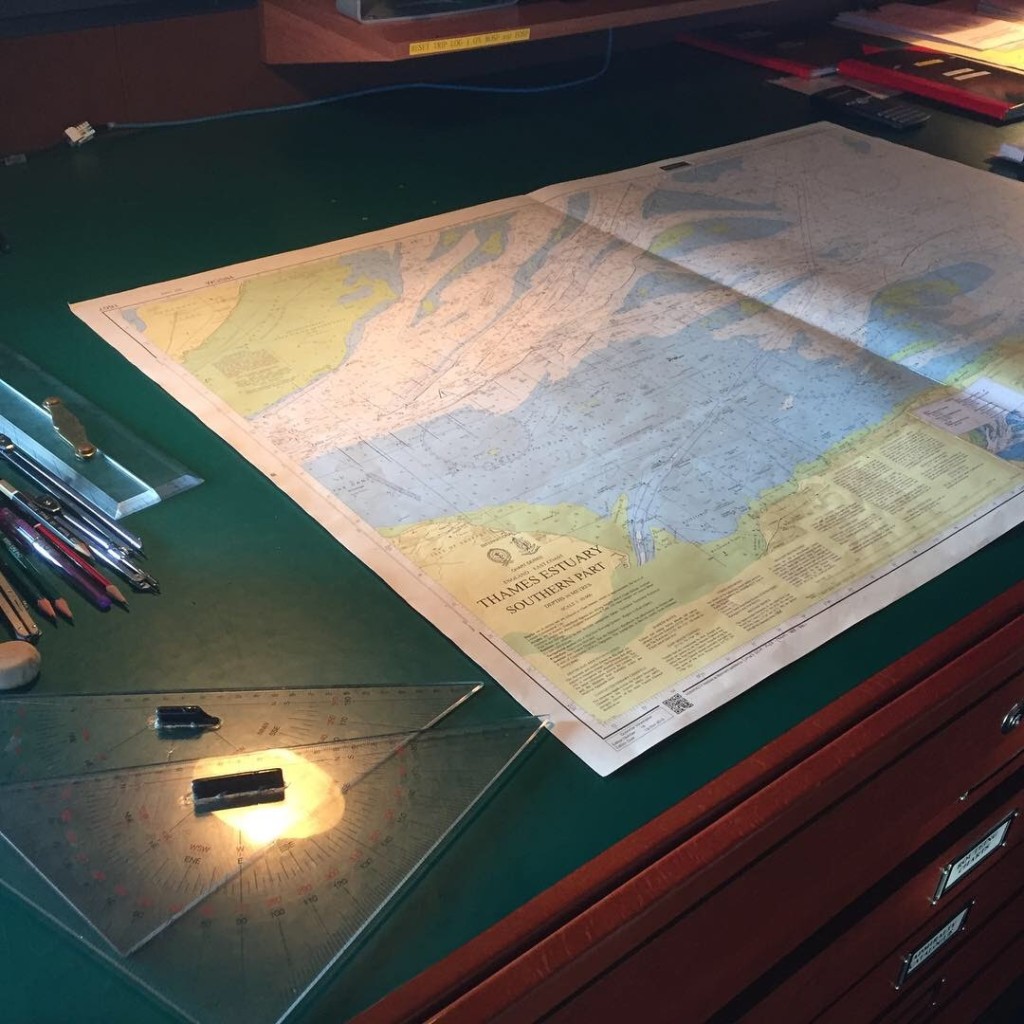
Image by Author
This sense of comfort and security is found not only in routine but also in the tactile and human qualities of the ship. Navigation, for example, despite the plethora of digital interfaces, still relies on plotting a course with pencil and paper. On the Africa Two, this task is done by Second Officer Antonio Acedo, who receives a new nautical chart from each port the ship visits. These paper charts, generally A1 sized, use colours and lines to indicate water depth and land height, as well as geographical and man-made features. Yellow indicates land and green is used for seabeds that dry with the tide; shallow water is shown in blue and deep water in white. These charts also include multiple compass roses, which show the difference between magnetic north and true north specific to the area shown on the chart. In order to steer the cargo ship out of the Persian Gulf, Second Officer Acedo positions his parallel ruler on the chart and uses his pencil to draw a straight line. He then extends half the ruler out in parallel until it meets the centre of the nearest compass rose. Transferring the direction of the course line onto the compass rose then allows the Second Officer to read the line as a course to steer. Having calculated the direction in which to travel, the Second Officer uses sonar and GPS displays to understand the position of other ships relative to the Africa Two. Combining this information with readings on tides and weather, Acedo is able to steer the ship onwards. Just as the various machines in the depths of engine room require workers for troubleshooting, on the bridge the navigator plays an essential role in the functioning of the ship. This human engagement with the materiality of the ship helps to alleviate a pervasive sense of alienation. The crumbs from the eraser, the graphite dust from the pencil sharpener, the grease-covered gloves used in the workshop – these are persistent and tangible remnants of human labour that help to humanise the space of abstracted finance that is the ship.
Black box sites
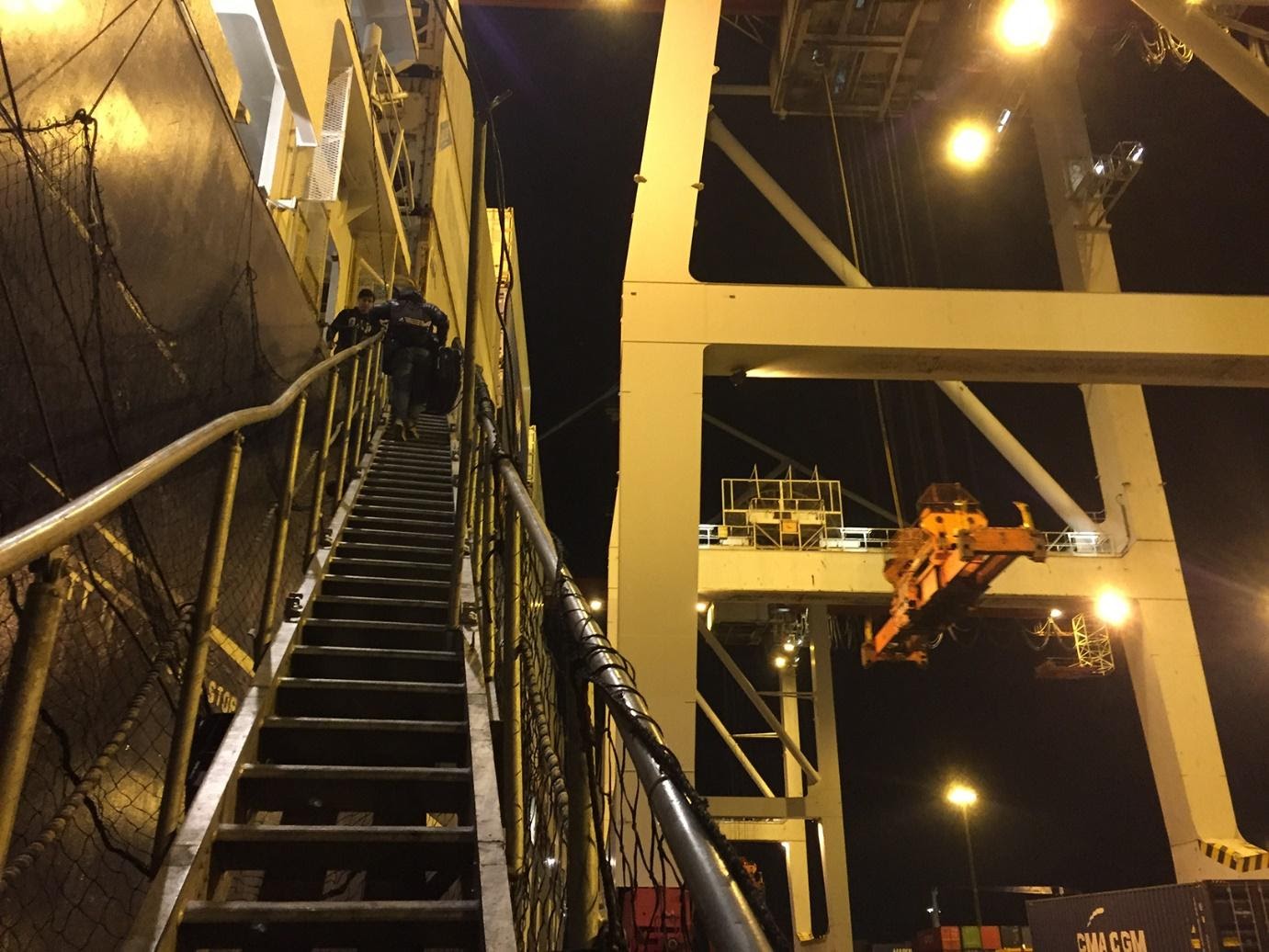
As the Africa Two nears DP World Antwerp, the city of Antwerp still remains far from view. Beyond the space of the ship, the complete standardisation of the container has also impacted the relationship between ports and cities. By obscuring cargo, the standardised container has made the port less visible as well. The city turns its back upon the port, which becomes a space devoid of significant human presence. Like the Africa Two, DP World’s Antwerp port is an exemplary ‘non-place’: a space of transport which is also inhabited, ‘a world thus surrendered to solitary individuality, to the fleeting, the temporary and the ephemeral’[13]. The operations of the port, and of the supply chains that flow through it, are organised according to these very qualities. They use the Just-In-Time method of production, which seeks to cut costs by reducing the amount of goods and materials held in stock. This means that cargo is delivered much more frequently than previously, with much less space required for the storage of goods. The port is thus a space of flux: a space where trucks and ships are constantly entering and exiting, where containers are endlessly navigated around, never stopping for too long. Once the Africa Two is positioned alongside the dock, crew members hurl the heavy mooring lines toward the dockers ashore. In this moment of collaboration between the dockworkers and the seafarers, the ship is at its least insular.
Once the dockers have attached the lines to the human-sized bollards, they glance up at the stern of the ship, they read the word ‘NASSAU’ painted in white letters below the ship’s name. The Africa Two has never been to the capital of the Bahamas however, this is simply the port to which the ship is registered. Just as the standardisation of the container both obscured and liberated the global movement of goods, so too did a system known as ‘flag of convenience’. This system, invented by American shipping magnates in the 1940s, allows shipowners to buy nominal sovereignty from nations such as Panama and Liberia. By flying the flag of the Bahamas, the Africa Two’s French owner can avoid tax as well as pesky labour regulations. The flag is a way for corporate power to disguise its own dealings and to ‘increase forms of inequality by absenting itself from … the spotlight of legal and financial scrutiny’[14]. The Africa Two’s flag thus turns the ship into a space of Bahamian sovereignty, a space in which there is no restriction upon the nationality of the crew members. Indeed, thanks to the camouflage provided by the container as well as the flag, both the port and the ship operate as black boxes. These are spaces that can only be understood in terms of inputs and outputs, hardly ever conceived of in terms of their complex inner workings. At DP World Antwerp, the infrastructure is almost indistinguishable from that of DP World Jebel Ali. The very name, Dubai Ports Antwerp, clearly demonstrates the decoupling of ownership and location that has now become commonplace. The port, as with all non-places, gestures toward a destination somewhere else. Like the contemporary city, the port must speak simultaneously of itself and of places far away from it. And though the port has developed in response to distant supply chains, it is also positioned to take advantage of geographic proximity: here the port is located a one-hour drive from both Brussels and Rotterdam. As the containers that arrived at port now flow outwards into Belgium and beyond, each one filled with goods of every kind imaginable, the Africa Two also makes its way onwards. For the crew it makes little difference which port they’re at. Even when the ship is stopped for a day or two, most of its crew will be too busy to take leave of the ship; some of them haven’t stepped foot off the ship since last year. However, the one thing that does make a difference is the condition of the water around them. Above the English Channel, calm waters make for easy passage; yet when the ship passes the coast of Spain, the open waters of the Atlantic Ocean cause the ship to rock. As men on the docks take the mooring lines off the bollards, and men on deck help machines to wind them back in, the rest of the crew prepare themselves for the duties of the day, and for the next leg of their seemingly perpetual journey.
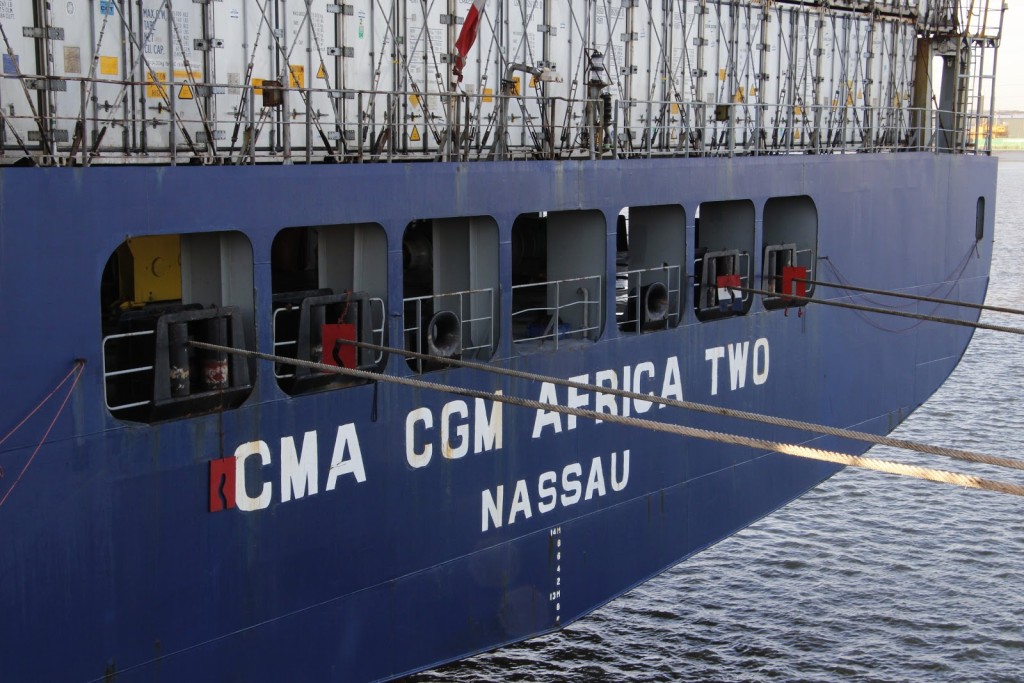
Image by Author
Conclusion
With over 90% of the world’s trade carried by sea, the impact of the shipping industry cannot be overemphasized. The development of the modern shipping industry has played an instrumental role in the emergence of new technologies (i.e., the shipping container), new forms of labour (i.e., globalised labour markets), and new forms of urbanism (i.e., Special Economic Zones). However these advances are also accompanied by side effects, which, although they cannot be attributed to shipping alone, are exacerbated by it. These include the homogenisation of space and the generation of the precarious transport worker. The modern cargo ship and its associated infrastructures can only be understood in paradoxical terms, constantly oscillating between closure and reciprocity. It is a world defined by the circulation of capital, where the entire globe becomes liquid and navigable. According to this logic the world is not divided into land and sea but into areas of concentrated and extended urbanisation. In tracing a small leg of the Africa Two’s unending journey, I have side-stepped the economic purview to focus on how this industry turns the globe into a singular, routinised urban sphere.
Notes
[1] Lewis Mumford, The City in History (Harcourt, Brace & World: San Diego, 1961)
[2] Deborah Cowen, The Deadly Life of Logistics: Mapping Violence in Global Trade (Minneapolis:
[3] Neil Brenner and Christian Schmid, “Planetary Urbanization”, in Matthew Gandy ed., Urban Constellations (Berlin: Jovis, 2012), 12.
[4] Chandra Mukerji, ‘The Territorial State as a Figured World of Power: Strategics, Logistics, and Impersonal Rule’, 2010
[5] Barry Ryan, ‘Security Spheres: A Phenomenology of Maritime Spatial Practices’, Security Dialogue 46, no.6 (December 2015)
[6] Keller Easterling, Enduring Innocence: Global Architecture and its Political Masquerades (Cambridge: MIT Press, 2005), 118.
[7] Charmaine Chua, ‘In Non-Places, No One Can Hear You Cry’, thedisorderofthings.com, https://thedisorderofthings.com/2015/01/31/in-non-places-no-one-can-hear-you-cry/ (accessed January 21, 2019)
[8] Anna Tsing, ‘Supply Chains and the Human Condition, Rethinking Marxism’, 21:2, 148-176, DOI: 10.1080/08935690902743088
[9] Rose George, Ninety Percent of Everything (London: Macmillan Press, 2013)
[10] Charmaine Chua, ‘Landlessness and the Life of Seamen’, thedisorderofthings.com, https://thedisorderofthings.com/2015/01/27/landlessness-and-the-life-of-seamen/ (accessed January 21, 2019)
[11] Ryan, Security Spheres, 12.
[12] Jennifer Mitzen, ‘Ontological Security in World Politics: State Identity and the Security Dilemma’, 2006; 346.
[13] Marc Auge, Non-Places: An Introduction to Supermodernity (New York: Verso, 2008)
[14] T.J. Demos, The Migrant Image: The Art and Politics of Documentary During Global Crisis (Durham: Duke University Press, 2013), 161.