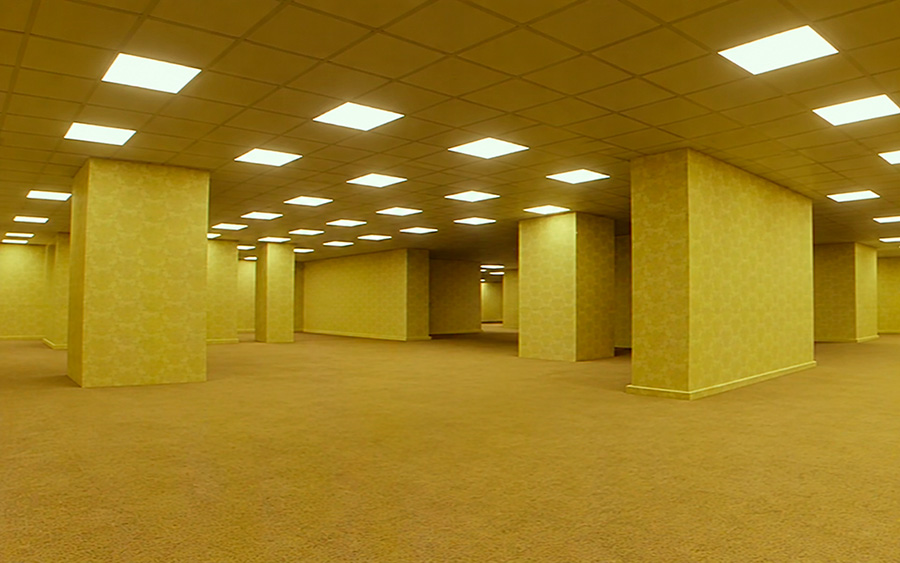
Since the release of the A24 film The Backrooms, directed by Kane Parsons, earlier this year, the obsession with liminality has moved from semi-underground web lore into the mainstream. The lore began in May 2019 with a single image posted to 4chan’s /x/ board, in a thread asking for “disquieting images” that felt “off”: a room with mono-yellow wallpaper, damp carpet, and fluorescent lights. A reply supplied the story: “If you’re not careful and you noclip out of reality in the wrong areas, you’ll end up in the Backrooms…” In Mark Fisher’s sense, the image was eerie.1 Fisher ties the eerie to a failure of presence, when there is nothing where there should be something, or to a failure of absence, when there is something where there should be nothing. The image is a clear case of the first: human-built architecture stripped of human life.
Apparently this emptiness was not uncanny enough, so the liminal space was graced with “entities” lurking in foggy corridors, a desperate move to translate an unsettling failure of presence into a far more conventional, consumable failure of absence. People then acted the lore out, a practice folklorists call ostension (Andrew Peck documented it in his 2015 study of the Slender Man legend cycle),2 searching for abandoned malls, empty transit stations, and basements in which to simulate the experience. They found no entities, mind you, though their dopamine skyrocketed. Beneath the folklore lies what Anthony Vidler calls the architectural uncanny,3 an extension of Freud’s unheimlich (the familiar made unfamiliar)4 into modern built environments. The Backrooms take the most banal spaces of late capitalism, such as the corporate office, the hotel corridor, and the transit hub, and strip them of their function. That architecture, however, is only the surface of the experience. What first drew me to these in-between spaces was what happens to the mind inside a space that frees you from the accumulated weight of context.
Five years ago, while spending hours each day commuting, I noticed something about my thinking. The subterranean transit system, an environment built explicitly for efficiency and deeply anti-human in its concrete design, crowded with exhausted commuters, turned out to be my most fertile creative territory; the entire concept for my first exhibition was born there. Somewhere between stations, underground, I was living inside a moving creation chamber. The realization came with a frustration, since the second I stepped off the train and re-emerged onto the street, the creative energy collapsed. I was dropped right back into the default simulation of my daily life.
Why do transitional spaces produce this sudden surge of creative agency? The anthropologist Marc Augé called these corridors non-places,5 zones where local history and personal identity drop away and leave you anonymous; he read this as a form of modern alienation. What Augé treated as a tragic loss of identity, I read as a liberation. In these spaces no one knows which category you belong to, so you can move without being fully legible and abandon a pre-fixed state. In the language of Deleuze and Guattari, that state belongs to striated space, the rigid grid of mandated roles and schedules into which modern life is organized. Transit cuts through it and opens a temporary pocket of what they call smooth space (A Thousand Plateaus, 1987).6 For a certain amount of time, between point A and point B, you are “off the grid.”
A subway corridor or an airport boarding gate is designed in every detail for humans, yet it treats the individual as an abstract unit of flow, a body to be routed from A to B as efficiently as possible. This systemic indifference is what liberates us; being reduced to an anonymous mass brings an unexpected, even radical, relief. Still, the architecture is only a trigger. To understand the mechanism of liminality, we have to look at what this state does to identity.
When we try to imagine how transitional spaces operate, intuition drags us toward the linear. You enter at point A and leave your fixed social role, travel through a corridor, and exit at point B as a subtly altered person, with a new status and identity. Classic anthropology (most influentially Victor Turner)7 treated the phenomenon as a structured bridge of this kind, which reduces the liminal to an instrument for carrying you from one fixed state to another.
The anxiety surrounding the in-between comes from treating it as a problem, a discomfort to be escaped on the way to the next stable position. Yet arriving at a stable position is also an enclosure; to settle into one state is to foreclose the others. In our post-postmodern existence, liminality refuses to remain temporary and becomes a permanent condition. Bjørn Thomassen sees this mainly as a danger. Permanence sets in when the transition meant to return you to a known structure stops and never completes, and this “frozen” space is, in his words, “the most fertile terrain possible for tricksters to play their act.”8 Drawing on Agnes Horvath, he warns against the trickster, the uncommitted outsider who thrives in ambiguity because he is “at home in liminality itself.”9 He is right about the danger, though he also seems to be longing for enclosure. I propose instead to embrace the condition and to become someone who no longer needs the enclosure.
Embracing it means giving up the kinetic bias of the liminal, the assumption that motion itself produces the clarity. Nietzsche declared that “only thoughts reached by walking have value,”10 and a subway car feels like a contemporary version of that idea. Understanding liminality as a mechanism, though, means abandoning the line entirely.
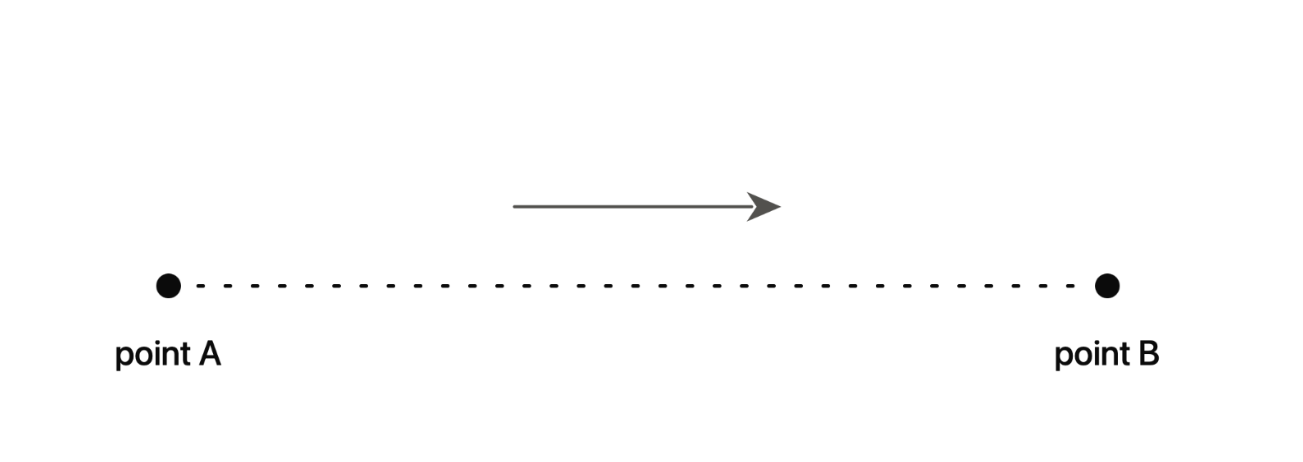
linear mechanism
Instead of a straight vector from A to B, imagine the fold.11 Here A and B become two faces of one folded surface, pressed almost together across a narrow gap. Let A and B stand for identities: the self at A, and whatever self you take yourself to be at B. You start at A and move along the edges of the void until you arrive at B, which turns out to be the other side of A.
 Mechanism of the fold
Identity is the reason the mechanism has to take this shape. On the straight line, B functions as a destination; you leave the old self behind and arrive as another. Yet you never meet your identity in the future tense. You cannot see who you are becoming while you become it, only once it has formed, so you can read it retroactively, after you have exited the fold. While you move along the fold, B does not yet exist; there is only the void around which the surface bends.
But what if liminality has nothing to do with movement at all? If it requires motion, it remains dependent on physical infrastructure. The Faraday cage, a metal enclosure that blocks incoming electromagnetic signals, offers a model of liminality in stillness, an artificial zero-point. It suggests that the core mechanism of the liminal is signal loss, or disconnection: an interruption that cuts off the continuous feed of the external environment and forces the liminal state. It is dangerously easy, though, to turn the cage into another static architectural object, and every time I try to pin liminality to a spatial coordinate, I end up objectifying it. Bergson diagnosed this habit in Time and Free Will, where he argues that we spatialize time in order to understand it, which is exactly what I kept doing.12
What the smooth space, the fold, and the cage share is a place where time bends. Backrooms wikis and Reddit threads return to it under the name of achronism, the sense that moving through the liminal relocates you in space and also collapses clock time. The external map may timestamp an event while the traveler lives it otherwise; Bergson’s homogeneous clock time gives way to lived duration, and the feeling of bending time lies in that gap.
Digital folklore turned the liminal into horror because late-capitalist culture cannot tolerate space without function or time without production. Faced with the void, internet lore invented entities to fill the space with fear. Stripping away context, however, frees us from forced legibility. Whether modeled as a smooth space, a fold, or a Faraday cage, liminality offers shelter from the pre-fixed grid we live in. Thomassen was right that remaining in the in-between breaks the fixed narrative of a life, but wrong to make it a catastrophe. To choose permanent liminality is to live an unscripted existence and to find catharsis where he saw a crisis on the way to enclosure. What the internet staged as horror might be a radical creative state.
NOTES 1. Fisher, Mark. The Weird and the Eerie. London: Repeater Books, 2016. 2. Peck, Andrew. “Tall, Dark, and Loathsome: The Emergence of a Legend Cycle in the Digital Age.” Journal of American Folklore 128, no. 509 (2015): 333–354. 3. Vidler, Anthony. The Architectural Uncanny: Essays in the Modern Unhomely. Cambridge, MA: MIT Press, 1992. 4. Freud, Sigmund. “The Uncanny.” In The Uncanny, translated by David McLintock, 121–162. London: Penguin Books, 2003. Originally published 1919. 5. Augé, Marc. Non-Places: Introduction to an Anthropology of Supermodernity. Translated by John Howe. London: Verso, 1995. 6. Deleuze, Gilles, and Félix Guattari. A Thousand Plateaus: Capitalism and Schizophrenia. Translated by Brian Massumi. Minneapolis: University of Minnesota Press, 1987. 7. Turner, Victor. The Ritual Process: Structure and Anti-Structure. Chicago: Aldine, 1969. 8. Thomassen, Bjørn. Liminality and the Modern: Living Through the In-Between. London: Routledge, 2014. 9. Horvath, Agnes. Modernism and Charisma. London: Palgrave Macmillan, 2013. Cited via Thomassen 2014. 10. Nietzsche, Friedrich. Twilight of the Idols. Translated by Richard Polt. Indianapolis: Hackett, 1997. Originally published 1889. 11. Deleuze, Gilles. The Fold: Leibniz and the Baroque. Translated by Tom Conley. Minneapolis: University of Minnesota Press, 1993. 12. Bergson, Henri. Time and Free Will: An Essay on the Immediate Data of Consciousness. Translated by F. L. Pogson. London: Swan Sonnenschein, 1910.