October 9, 2026
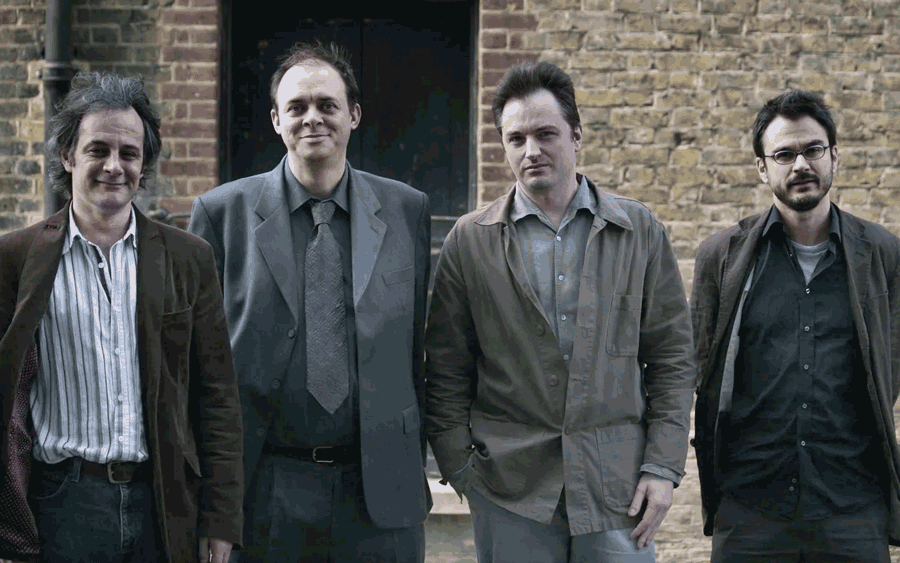
Iain Hamilton Grant, Graham Harman, Quentin Meillassoux, and Ray Brassier at Goldsmiths for the inaugural Speculative Realism, April 27, 2007

Speculative Realism & the Invention of Post Kantianism

It is the poststructuralist verbiage that reduces the Kantian subject to the supposed fallacy of an (absolute) sovereignty or autonomy. Kant does not postulate the Subject in such a manner. When the so-called (speculative) realists attack poststructuralism as post-Kantianism, they adopt the poststructuralist framing of Kant: “it’s all in our heads,” reality is but the linguistic mirage we collectively participate in – as “atomised” individuals.

Yet again, Kant never said the outside reality could not be grasped even though “the noumenon” as the thing-in-itself remains ultimately foreclosed. As François Laruelle insists, we do “correlate” with the real, Thought seeks to speak of it, mediate it; however it does so while submitting to the Real’s foreclosure of the last instance. Lacan’s treatment of the concept of the Real is very similar, notwithstanding the poststructuralist misappropriation of everything Lacanian. Laruelle’s solution to the aporia “the real escapes thought, therefore all is just an illusion” is to argue that there is, in fact, nothing aporetic about it at all; aporia exists due to the expectations of philosophy to either grasp the “thing-in-itself,” and its universal (in Marx’s sense) of “the Real,” or declare complete retreat from any pretension to produce an account of the “out there,” or of reality. Instead, similarly to the ascientific posture of thought, Laruelle proposes that the (non-)philosophical approach is to accept that a certain “syntax” of the real could be transcendentally construed. In other words, traces of the noumenon (my phrasing, revisiting Derrida’s “trace”), could be grasped, interpreted, turned into a model of explanation, while submitting to the axiom of the Real’s foreclosure of the last instance.

The fact that “the Real” (or “the-in-itself”) escapes thought has never deterred science, and we are reminded of this by Laruelle and Marx. Similarly, Kant argues against the “nonscientific” (contrary to formal logic) statement that “I think” is a statement at all, and applies Wolff’s logic according to which “is,” or being for that matter, is not even a necessary category in a statement that makes sense (let alone “I think” … therefore I am). In doing so we exit the entrapment of philosophies and the antinomies that plague it. We are closer to the scientific posture of thought and are free from the ambition to penetrate, grasp, and mirror the noumenon. This is a stance easily comparable to a modern Bayesian network, insofar as the copula, in the sense of post-scholastic logic (Wolff, Meier, Kant drew on), corresponds to what contemporary graph theory formalizes as the “directed edge” (the conditional probability link) between nodes;[1] any rationalist insistence on the “simple identity” (purely analytical, to use Kant’s terminology) would commit the category error Gilbert Ryle wrote about in The Concept of Mind (1949).

Here is Kant in his own words:

In all judgements I am the determining subject of that relation which constitutes a judgement. But that the I which thinks, must be considered as in thought always a subject, and as a thing which cannot be a predicate to thought, is an apodeictic and identical proposition. But this proposition does not signify that I, as an object, am, for myself, a self-subsistent being or substance. This latter statement—an ambitious one—requires to be supported by data which are not to be discovered in thought; and are perhaps (in so far as I consider the thinking self merely as such) not to be discovered in the thinking self at all. (Kant, Critique of Pure Reason, B407)

Kant continues to explain that the concept of singe substance (a certain oneness) of the Subject is a viable analytic category. Nonetheless, Kant asserts, “I think” is a synthetic reality, and the certainty or the immediacy of this oneness is compromised, i.e., the foundation of Cartesian rationalism does not hold. In other words, Kant argues both that Subject is not part of “the outside reality,” that it is an analytic postulate but also that the thinking self is necessarily both conditioned and directed toward the “real-out-there,” i.e. it is synthetic. To insist on one’s rationalist realism in contrast to this thesis is to surreptitiously reintroduce the idealist phantasm of thought “becoming one” with the real. The primitive metaphysics of the Parmenidean dream of real and thought becoming One persists in Descartes, Hegel, Badiou and “the speculative realists” (or just Meillassoux). Therefore, to smuggle in the Badiouian fascination with idealism (Hegel) in dismissing the poststructuralists and “the postmodernists” as “post-Kantian” is simply a flawed statement and a retrograde one too.

Below is a lengthier quote from Kant, and it does not strike me as either linguistic and socio-constructivist (“there is no real except the one inhabiting the Subject”) nor as realist in the sense of the naïve Cartesian rationalist metaphysics.

2. That the I or Ego of apperception, and consequently in all thought, is singular or simple, and cannot be resolved into a plurality of subjects, and therefore indicates a logically simple subject—this is self-evident from the very conception of an Ego, and is consequently an analytical proposition. But this is not tantamount to declaring that the thinking Ego is a simple substance—for this would be a synthetical proposition. The conception of substance always relates to intuitions, which with me cannot be other than sensuous, and which consequently lie completely out of the sphere of the understanding and its thought: but to this sphere belongs the affirmation that the Ego is simple in thought. It would indeed be surprising, if the conception of “substance,” which in other cases requires so much labour to distinguish from the other elements presented by intuition—so much trouble, too, to discover whether it can be simple (as in the case of the parts of matter)—should be presented immediately to me, as if by revelation, in the poorest mental representation of all.

3. The proposition of the identity of my Self amidst all the manifold representations of which I am conscious, is likewise a proposition lying in the conceptions themselves, and is consequently analytical. But this identity of the subject, of which I am conscious in all its representations, does not relate to or concern the intuition of the subject, by which it is given as an object. This proposition cannot therefore enounce the identity of the person, by which is understood the consciousness of the identity of its own substance as a thinking being in all change and variation of circumstances. To prove this, we should require not a mere analysis of the proposition, but synthetical judgements based upon a given intuition. (Kant, Critique of Pure Reason, B407–B408K)

Since the premise is flawed, “the speculative turn” never really broke away from poststructuralism but rather remained compatible with it. No serious disruption to the “post-Kantians” has been caused because they have never been Kantian in any way. Both Alain Badiou and Judith Butler are Hegelian – closer to one another than one would imagine – and so is Meillassoux. And all this is supposed to be linked with the techno-utopia and its ontology of singularity? I think these two concepts are better aligned with Kant than with any form of Hegelianism.

Notes

[1] Concha Bielza and Pedro Larrañaga, “Bayesian Networks in Neuroscience: A Survey,” Frontiers in Computational Neuroscience 8, no. 131 (2014): 3–5, doi.org.

More Articles from &&&

Speculative Realism & the Invention of Post Kantianism

It is the poststructuralist verbiage that reduces the Kantian subject to the supposed fallacy of an (absolute) sovereignty or autonomy. Kant does not postulate the Subject in such a manner. When the so-called (speculative) realists attack poststructuralism as post-Kantianism, they adopt the poststructuralist framing of Kant: “it’s all in our heads,” reality is but the… Read More »

The Fold, the Grid & the Void

Since the release of the A24 film The Backrooms, directed by Kane Parsons, earlier this year, the obsession with liminality has moved from semi-underground web lore into the mainstream. The lore began in May 2019 with a single image posted to 4chan’s /x/ board, in a thread asking for “disquieting images” that felt “off”: a… Read More »

Why The Dark Forest Theory of the Internet Is as Red as Communist China

Every theory of the internet is almost a theory about online attention and, above all, surveillance and visibility.

Bogna Konior’s The Dark Forest Theory of the Internet says something about the subject that most Western media writing won’t admit, that the lights online were never for seeing but for being seen. The book interprets the internet, and then AI, through Liu Cixin’s Three-Body trilogy, a universe where civilizations hide because getting noticed gets you killed.

In this text, I ask, from where does this picture emerge and where is Konior positioned when she writes about it? The short answer is that the dark forest she borrows from Liu grew straight out of communist one-party states, and that her book makes the most sense once it is read that way.

Liu’s trilogy begins in 1967, at the height of Mao’s Cultural Revolution in Beijing during a “Struggle Session,” where a young astrophysicist watches Red Guards beat her father to death for refusing to take back his scientific claims, killing her faith in humanity. What grows in its place is the certainty that humans can’t be trusted with themselves. That certainty is what makes her respond to the alien signal and invite a hostile civilization to come and wipe Earth out.

This is why Liu’s dark forest rule that shows up in his second volume about staying silent because anything that spots you will assume the worst and shoot first, is just the struggle session blown up to the size of the galaxy.

Lust to See: Rasa & Time-Given Beholding

The first time I stood before Lee Ufan’s From Line (1978) series was at Museum MACAN in Jakarta. The museum framed Ufan’s work as offering an Asian post-war critique of Eurocentrism and as belonging to the Mono-ha movement. The series’ lines and intervals were here cast as refusals of Western painterly gesture, a resistance to fullness or plentitude. Six years later at Tate Modern in London I stood before another work from the same From Line series—the institution having completely recontextualized it. Here Ufan was placed within a Western narrative of painting’s evolution, cited alongside Richter as fitting into or exemplifying a different genealogy of restraint. What had clearly changed was the field of articulations or legibility surrounding this series, and with it the work’s temporal address.

My dear friend Ina replied to the photo of the Tate collection I posted online—I had quietly wondered whether anyone would recognise this same series in Jakarta. She implied that I did not have to go so far to see this particular series for we can see it at home, in Indonesia: “This exists even in Museum MACAN, haha.” She recognised Ufan’s work, and we did not have to name either the series or the artist in the chat. In this instance of intersubjective beholding, recognition is named through the encounter of shared memory—having stood before the same object in the same institution, in the same city, by grace of the same proximity.

Were I to define “institutional,” I would include those who build and inhabit such public spaces: the curators, educators, guards, critics, and the public itself—all of whose habits and styles of looking give those rooms their precise temporality.

Sophie’s Choices: Freedom or Annihilation?

Sophie Xeon, the most inventive and imitated music producer of the last decade, has been invoked, more than ever since her death in 2021, as a symbol for new music, new freedom, and new identities. She took the cold artifice that has permeated electric and electronic music since the beginning, making it sound natural. In… Read More »

A Mother Is Never Enough for Life on Mars: On Post-Planetary Ectogenesis

In her book Hospitality of the Matrix: Philosophy, Biomedicine, and Culture, Irina Aristarkhova discusses how the progress of feminist thought on pregnancy has often been impeded by its struggle against the oppressive hierarchies surrounding it: “Often, in feminist research, pregnancy was represented in the context of an impending struggle between mothers and medical and socio-cultural institutions that treated it as a means to an end: the child.” The task of her study is not to keep pregnancy within this “problematic” context for feminist politics, but to find ways of describing it that would make the process of species reproduction emancipatory for those who participate in it—primarily mothers, but also a multitude of other actors. This task is realized nonlinearly, and it runs through several stages. One needs, first, to see through the philosophical presuppositions of the pregnancy-organizing discourses of embryology and immunology, in order to dismantle the hostility toward mothers embedded in them. Conceptualizing reproductive practices in terms of hospitality rather than competition demands, next, a deep inquiry into how the foundational phenomenological relation of the self toward the other is modeled—for the oppressive realities women face within reproductive institutions build up from an under-conceptualized psychic economy. Art projects such as Virgil Wong and Lee Mingwei’s Male Pregnancy then exemplify reproductive practices modeled on the relation of hospitality. And finally, biotechnological capabilities and their material realities directly inform pregnancy as a discursive practice.

You Died, Subscriptions kept Renewing; You’re an Influencer Now!

The dead keep surfacing on the interface. A social media profile reappears under People You May Know, a birthday reminder fires for someone buried in the spring, a subscription renews against a card nobody thought to cancel, a playlist refreshes itself for no one.

The systems are not being callous, requiring a death already registered and then overruled. Strangely, nothing has yet registered. The addressee was never the one who died. It was the profile, the behavioral outer form, assembled from years of signaling, and the profile is now in perfect health again.

The living are currently addressed in the same form; death simply makes the separation of the thing and time easier to observe. A feed never overlaps perfectly with a whole life lived; it meets the signal, then rewards whatever performance it can classify. Users learn the lesson without needing to understand it. Some versions travel, others stall or disappear. Over time, this creates pressure toward a self that can revise itself at the system’s speed.

That training takes place inside an infrastructure (platforms, models, attention routes, finance, law), and the means of reproduction is owned. No one has to command the trajectory. Platforms set out to maximize engagement and predict conduct, which requires many users who can be addressed at scale. Because some forms of subjectivity are easier to measure and route than others, optimization selects for them effortlessly, almost as a side effect.

Sirat, Exocapital & Europe’s Beautiful Souls

I wish I could write an objective review of this movie, but the first third to half of it was a straight-out portrayal of a continental Western European working class subculture (teknival/French hardtek) that myself and many others grew up intimately familiar with, on a visceral, physical level: the complete illegality of it, the walls… Read More »

NO SHIT: Notes from Venice Biennale 2026

“In SEAWORLD VENICE, the promise of progress unfolds as a ‘Frankensteinesque’ dystopia: robot dogs wade through the rising water behind glass, acting as mechanical Cerberuses guarding a central sacrificial altar. Here, a performer lives within a tank sustained by body fluids contributed by the audience.”  -Austrian Pavilion, Nora-Swantje Almes’s curatorship   After the online introduction… Read More »

On Trump Defeating Communism, Again!

You must love our country. […] as we approach this magnificent anniversary, we see our American identity under a renewed attack, a generation after we fought and won the Cold War against the menace of communism. There is now a resurgence of the communist menace in our land, including from newcomers to our country […]… Read More »

Death in Venice

Before I went to Venice I thought I’d try a travel diary, but that’s not how I like to write and it’s what everyone does, i.e. deferring the responsibility of coming to any conclusion about the Biennale as a whole by giving a first-person account of how utterly chaotic preview week was. I wasn’t at… Read More »

Who Is Western Marxism Really For?

There is this letter Althusser wrote in 1962, to a woman he was seeing, where he just trashes Lenin. He is rereading Lenin on philosophy and he is basically going: god, this is weak. Amazing guy when it came to reading an actual situation, reading what was in front of him, but the second he… Read More »

Occult Perso-Punkism of Cyclonopedia

Nuqtavism was a heretical, atomist cosmology that emerged from within Islamic mysticism while simultaneously pushing it toward its limits. The endgame of Islamic esotericism was always the horrifying announcement that the mystic, through infinite cycles of ascetic self-creation and self-annihilation, had finally reached the highest point of abstraction, or tajarrud: the final release from materiality.… Read More »

Genealogy of Wokeism

Introduction The last thing most progressives think we need is another male writer complaining about “wokeism.” Why not talk about more important things? Wokeism has become somewhat of a floating signifier. Wokeism can mean different things to different people, with many people throwing the term around as a pejorative in highly inconsistent ways. However, many… Read More »

Paratypology: Towards a Scrap Theory of Form

1. To Sort I find myself at a furniture factory, in the seaming department, surrounded by the pneumatic humming of sewing machines. All around me, industrious hands are swift in joining odd parcels of hide, textiles and other soft surfaces according to flat templates. Although the individual steps they carry out are familiar to me,… Read More »

Socialism after Socialism, A Response to Conrad Hamilton

In the spirit of dialogue, I am responding to the observations in Conrad Hamilton’s recent expansive review of my book The Political Theory of Liberal Socialism. I will be concentrating on Hamilton’s three main claims, that there is a gap between the form and content of socvialism, invoking Marxist theories of struggle before coming down… Read More »

Biennialese Blues: Review of Whitney Biennial 2026

ARTISTS: Basel Abbas & Ruanne Abou-Rahme, Kelly Akashi, Kamrooz Aram, Ash Arder, Teresa Baker, Sula Bermudez-Silverman, Zach Blas, Enzo Camacho & Ami Lien, Leo Castañeda, CFGNY, Nanibah Chacon, Maia Chao, Joshua Citarella, Mo Costello, Taína H. Cruz, Carmen de Monteflores, Ali Eyal, Andrea Fraser, Mariah Garnett, Ignacio Gatica, Jonathan González, Emilie Louise Gossiaux, Kainoa Gruspe,… Read More »

No View from Nowhere: On Discourse, Différance & Functorial Semantics of Micro-Communities

This essay argues that natural language semantics admits no global orientation—no ‘view from nowhere’—but only local positions within psychoanalytically and sociologically embedded discourse communities. Drawing on Derrida’s concept of différance, I demonstrate that meaning is constitutively deferred across the differential play of signs, precluding any meta-linguistic standpoint from which all local meanings could be adjudicated.… Read More »

Liberalism Is Dead, Long Live Liberalism!

Matthew McManus’ The Political Theory of Liberal Socialism is a powerful attempt to merge two disparate traditions, parlaying reformist compromise into a coherent political program. It also rests on the assumption that socialism is inherently illiberal, an assumption that deserves to be questioned. While often hailed as the single-minded son of America, perhaps the best… Read More »

Luxury Activism: Art, Fashion & Capital

[This text was previously published by the author in Portuguese on Contemporânea Magazine — Ed.] I don’t want to work with fashion. Beauty must be preserved from capitalism. Fashion favours the escape into personal, private, selected, chosen space, as a form of false self-determination. Fashion reflects the fear of losing’ identity. — Thomas Hirschhorn The purposelessness… Read More »

The Questions Concerning the Ethics of AI

With recent articles in &&& concerning the status of what is or is not Marxism, I took it upon myself to write a piece that I consider firmly placed in that tradition. I am not being paid by the CIA, I promise. Furthermore, despite appearances, my article is not an article in the “ethics of… Read More »

The Best Ever Art Basel Review that Qatar Money Can Buy

During the Art Basel Qatar’s VIP preview of Sweat Variant’s durational performance My Tongue is a Blade on February 4, two special seats up in front of the stage stayed empty for a while.  Empty with intent.  People hovered, looked, and reconsidered occupying them in their head at the last minute like they were about… Read More »

SUPPORT THE IRANIAN REVOLUTION 2026!

SIGN THE STATEMENT HERE The past several weeks have borne witness to a bloodbath in Iran amidst images of systematic massacre and horrific abuses of power by the Iranian government against its own people. As a united front, we stand together to uphold the following convictions: 1- That the Islamic Republic of Iran must come… Read More »

Rhetoric vs Reality: Iranian Regime Is an Imperialist Project Preventing a Free Palestine!

Since its founding, the Islamic Republic of Iran has cultivated legitimacy by embedding itself within global progressive movements—particularly those oriented around anti-imperialism and racial justice. Rhetoric, repeated, obscures reality: the Islamic Republic of Iran (IRI) is an imperialist project that will not enable a free Palestine. The IRI is built on an expansionist doctrine resembling… Read More »

On State Collapse & Democide in Iran

1. Middle Eastern Islamisms and Islamists are reorganizing in a post-jihadi/takfiri Muslim/Arab world within their national boundaries. First of all, the Taliban’s path back to Afghanistan was facilitated by the USA. Afghan Islamists were swift in adopting a more Afghanistan-focused vision and dismantling any public state capacity, especially in social and women’s affairs, built under… Read More »