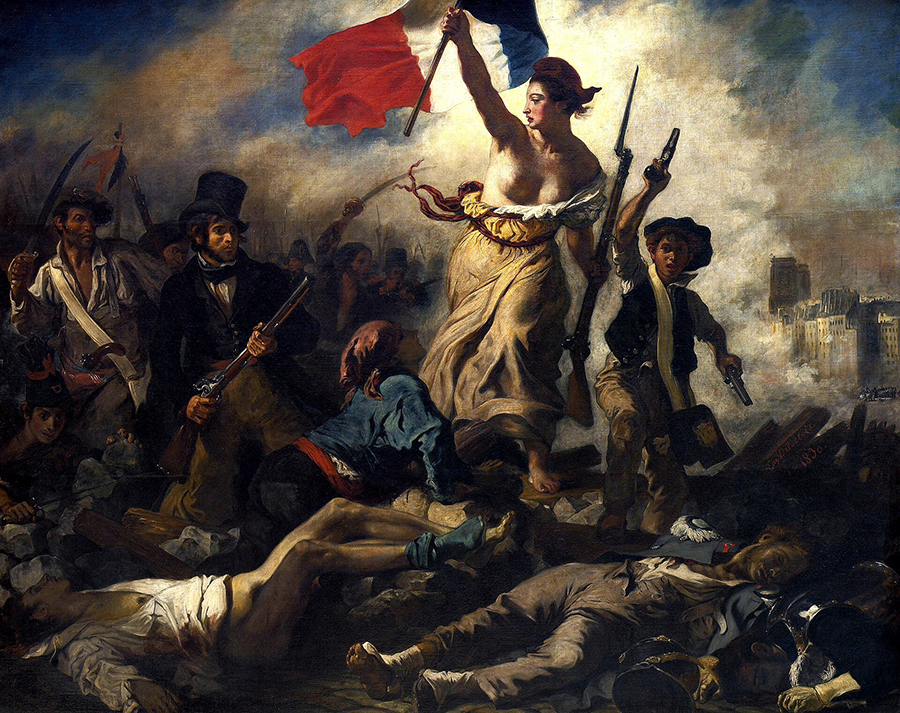
Even though the author wrote this essay almost a year ago, the riots in France have given it new urgency. What began in October as student protests with concrete demands has grown into a much larger and more violent wave of unrest, joined by groups that share no banner or ideology. The right reads the riots as a threat to the republic, while parts of the left repost footage of toppled statues and burning cars as the start of a twenty-first-century French Revolution. Chamas sets the riots aside and takes up the older question they raise, that of revolution versus reform, testing each of the radical left’s arguments for revolution against the historical record, from the short-lived soviet republics of Budapest and Munich in 1919 to the welfare states of the Nordic countries. If France were on the edge of revolution, could it succeed, and would it be worth having?
-&&&
Among self-styled revolutionary communists, non-reformist Marxists, and the various strains of contemporary radical leftism, there are two distinct arguments for revolution that need to be distinguished before either can be properly addressed. They are often run together in revolutionary rhetoric, but they make different claims and they require different responses.
The first argument is that revolution is the only path to genuine change.
Reform, in this view, cannot address the root causes of capitalist exploitation. Reformist parties may extract concessions from capital, but they leave the structural conditions of class society intact. Only a communist revolution, or a socialist transition leading to communism, can produce the kind of transformation that addresses the underlying problem. The classic citations here are Rosa Luxemburg’s Reform or Revolution (1900) and Lenin’s What Is to Be Done? (1902), and the canonical contemporary version is the position that social democracy is the real enemy of the left because it stabilizes capitalism through compromise, offers crumbs to the working class to prevent demands for the whole loaf, tames the revolutionary impulse and channels it into electoral routine, and ultimately makes peace with the bourgeoisie. This is why communists during the Stalin era, prior to the Popular Front, often called social democrats social fascists. By this reasoning, the only authentic left-wing politics is one that aims at the total overthrow of capitalist relations, and the moderate left is to be regarded with greater hostility than the conservative right because the moderate left forecloses the conditions in which authentic revolution becomes possible.
The second argument is that the prospect of revolution, as a credible political threat, is what compels capital to accept reform in the first place.
Without the existence of a credible left-wing alternative, capital concedes nothing. The Nordic countries got their generous social democracies because the labor movement built mass parties, mass unions, and credible political power. The American New Deal happened because Roosevelt’s advisers were genuinely concerned about the appeal of more radical alternatives. Britain’s National Health Service was built in the shadow of a powerful organized working class. By this logic, the revolutionary left and the reformist left are not enemies but allies: the revolutionary maintains the credible threat that compels concession; the reformist captures whatever concessions the threat extracts. Without revolution as a credible horizon, reform itself becomes impossible.
What is true in the second argument should be granted at once. Organized worker power matters for reform: mass unions and mass social-democratic parties built the Nordic settlements, and nothing comparable was built without them. The question is whether attempted revolution is the form that power has to take. It is not. Behind every successful workers’ party stands the prospect of more reform; behind every failed revolution often stands the prospect of fascism. The third section explains why.
The first argument, that revolution is the only path to genuine change, is the one this essay primarily targets. It is a foolish bet on a low-probability event with a payoff structure far worse than the wager assumes. What follows makes the empirical case against it, and then asks why communists keep making the bet anyway.
The Revolutionary Premise
The first reality the revolutionary wager fails to account for is the brute historical fact that revolution is extraordinarily improbable as an outcome. It is unlikely under almost all conditions, and it is a real possibility only in cases of complete state collapse. The closest Western Europe has ever come to revolution since the Russian one was during the immediate postwar moments in Italy and France, the Carnation Revolution in Portugal in 1974, and the Spanish Civil War of the late 1930s. Notice the pattern: every one of these moments occurred in the wake of catastrophic state failure, war, fascist collapse, or the dissolution of long-standing colonial empires. In ordinary peacetime conditions, revolution does not happen.
The reason is straightforward. Revolution requires popular support and the willingness of significant numbers of people to take up arms against their own government. That willingness materializes only when the government has substantially lost legitimacy or has already collapsed under external pressure. Revolution presupposes a crisis it does not itself create.
Furthermore, the fact that advanced capitalism did not produce a great collapse that led to revolution is why the vast majority of actually existing communist takeovers in the twentieth century occurred in national liberation contexts, where the enemy was a foreign occupier rather than an indigenous government, and where the call to revolutionary arms could be framed as resistance to colonial domination rather than as an attack on one’s own society. The Russian Revolution, the October Bolshevik takeover, remains the great outlier, and it occurred in the highly exceptional circumstances of the First World War, arguably the most destructive event in recorded human history up to that point, which had produced enough mass death, economic collapse, and imperial dissolution to drive significant portions of the European working class into the arms of any movement promising radical transformation. Even despite such exceptionally catastrophic circumstances, communist revolution did not succeed in most places, and in most First World capitalist countries the working class opted for reform anyway. The Chinese Revolution succeeded after decades of warlordism, Japanese invasion, and the collapse of Nationalist authority. The Vietnamese Revolution succeeded after a century of French colonialism and a generation of war against Japanese, French, and American forces. Although various Marxist theoreticians disagree with the immiseration hypothesis, the idea that a huge collapse in capitalist society is necessary to compel the masses toward revolution, it remains a tacit if not explicit premise in the way most communist radicals envision the revolution eventually occurring. The fact of the matter is that in ordinary peacetime conditions, revolutionary communism is supported only by a fringe minority. To the extent that communism is supported in First World countries during peacetime, and the polling does show such support, with sixty-seven percent of young Britons telling the Institute of Economic Affairs they would prefer to live under a socialist economic system, and the Fraser Institute finding net favorability toward socialism among eighteen- to thirty-four-year-olds in both Canada and the United States, it is largely an impotent luxury belief driven by nihilistic college graduates that does not manifest as a real political threat. Both surveys show why. The enthusiasm is thinly spread rather than deeply held, and it collapses the moment respondents are asked whether they would fund it out of their own income rather than out of somebody else’s. It becomes a majority position only when the alternatives have been physically destroyed.
Even where revolutionary movements did succeed, the leaders who eventually wore the communist mantle were often not communists at the outset of their struggles. They became communists later, sometimes from genuine conviction, sometimes from the simple fact that the Soviet Union was the only available source of arms. The communism of these movements was frequently a tactical adoption rather than a foundational commitment, which is precisely why their post-revolutionary regimes so often defended traditional cultural forms that European Bolshevism would have considered reactionary. Vietnamese communism was Vietnamese national socialism with Leninist characteristics. Cuban communism was Cuban nationalism in need of Soviet aid. African socialism explicitly invoked indigenous tradition against universalist Marxist categories.
The conditions under which revolution occurs, total state collapse, foreign occupation, civilizational disaster, are not conditions any sane person should wish for. To wish for revolutionary conditions is to wish for the collapse of one’s own society as the necessary precondition for one’s preferred politics, and the collapse, if it actually occurs, will produce far more suffering than any plausible revolutionary outcome could compensate for. This is one of the reasons why the moral case for revolution within Western countries has always been far more flimsy and questionable than the case for it in underdeveloped, highly undemocratic societies in the Third World, where revolution was seen as the only option against an unjustified and illegitimate government. Western communists are viewed as agents of chaos interested in the destabilization of society, whereas the communists of the Third World were able to present themselves as agents of order within a society already destabilized by the incompetence of an illegitimate regime that had shown no ability to reform itself.
Revolution Produces Reaction
Suppose, however, that revolutionary conditions arise. Suppose, against the historical odds, that a developed country reaches a point of state crisis severe enough to make revolution a realistic possibility. The next reality the revolutionary wager fails to account for is that every revolution produces a reaction at least as ferocious as itself, and often more so. Revolution does not destabilize merely the capitalist order; it destabilizes society itself. And capitalism, however much one despises it, is what people’s lives depend on. Any upheaval that produces more chaos than people are already enduring tends to be unpopular, and an unpopular revolution invites a reaction that capitalizes on its unpopularity.
The forces of reaction will mobilize regardless of the revolution’s success or failure, and they will do so with all the ruthlessness the revolutionary moment has authorized. The most consequential demonstration of this dynamic is the relationship between the rise of communism and the rise of fascism in interwar Europe. Ernst Nolte, in his comparative work on the two movements, made the argument with exceptional clarity. Fascism, in his analysis, was not merely a tool of the bourgeoisie deployed against the working class. It was a direct response to communism, inseparable from the communist context that produced it. The excesses of communism produced the ideological and emotional conditions that legitimated more aggressive fascist tactics, and the gulags preceded the concentration camps not only chronologically but causally.
Nolte demonstrates that what tipped many former Weimar German military officers and political figures into sympathy for Nazism was the news of the Bolshevik Red Terror and the Civil War liquidations of the Russian officer corps and the propertied classes between 1918 and 1923. The mass executions of officers and political figures terrified their German counterparts, who reasonably concluded that this could be their fate under a communist Germany. The toleration principle of liberal democracy buckled under the weight of credible communist threat, and the suppression of communist parties became politically possible because the communists themselves, when in power, had given the world reason to fear them. After all, the Marxist project of communist revolution is supposed to be a world revolution, in which the countries where revolution succeeds export that revolution to other capitalist countries.
What made so many people comfortable with the suppression of communists was the horrors that communists had committed when in power. The slippery slope was real, and the consequences for liberal democracy were catastrophic, but the slope began on ground that the communists themselves had helped to grease. None of this is to justify fascist counter-revolution, which produced its own catalog of atrocities far exceeding anything that came before. The point is more analytic: revolutionary communism, by its own conduct, made counter-revolutionary movements politically viable in countries where they would otherwise have lacked legitimacy.
None of this was incidental to communist doctrine. The export of revolution was not a Stalinist deformation or a wartime improvisation. It was written into the theory from the beginning. Marx and Engels closed the Manifesto with an appeal to the workers of the world rather than the workers of Germany, and the entire Marxist tradition before 1924 treated socialism in a single country as a contradiction in terms. A revolution that stopped at the Russian border would be strangled, and the Bolsheviks said so themselves, repeatedly, and then organized accordingly. The Communist International, founded in March 1919, existed for that purpose. Its Twenty-One Conditions, adopted at the Second Congress in 1920, set out what membership required. Every party had to maintain a parallel illegal apparatus capable of acting at the decisive moment, conduct systematic propaganda inside its own country’s army, purge reformists from every position they held in the labor movement, and treat decisions taken by the Executive Committee in Moscow as binding. This is not a caricature drawn by anti-communists. It is the membership application.
I raise this because the case that best demonstrates the argument of this section is not Russia at all. It is the two places where Bolshevism was exported directly into the heart of Europe and briefly held power. The reason interwar Europeans turned to the radical right was not that they had read Marx and disagreed with him. It was that they had watched communists govern, at close range, and had seen what communist government actually did. The Hungarian Soviet Republic was proclaimed on March 21, 1919 under Béla Kun and survived one hundred and thirty-three days. The Bavarian Soviet Republic followed in April, passing through a brief phase under anarchist and expressionist intellectuals before a communist putsch installed Eugen Leviné and a hardline second phase. Both were in direct communication with Moscow. Both understood themselves as the second and third fronts of a world revolution that had at last broken Russia’s isolation.
What these regimes attempted in their few weeks of power is the part contemporary Marxists never bring up. Their programmatic manifestos called for sex education, the dissolution of traditional gender relations, the collective rearing of children, and the deliberate destruction of inherited cultural forms. Kun, rather than dividing the great estates among the peasants who worked them, nationalized them outright and moved toward collectivization, which alienated the Hungarian peasantry so completely that food distribution collapsed and the army eventually refused to fight for him. Alongside all of this ran the purges of officers, policemen, civil servants, and clergy, arrested and in many cases shot by squads answerable to the party rather than to any court. Consider how that looked from outside. A European of moderate views in 1919, whatever he thought of capitalism, could observe that where communists had taken power they had expropriated farmers rather than enfranchising them, announced that the state would assume the raising of children, and begun shooting officers and policemen. He did not need to read Nolte to work out what awaited him and his family under a communist government in his own country. The fear that pushed ordinary Europeans toward the radical right was not manufactured by capitalist propaganda. It was manufactured in Budapest and Munich, by communists, and then reported accurately.
The reaction was proportionate to that fear and then vastly exceeded it, and the lineage matters here more than the body count. The Hungarian republic was destroyed by Romanian invasion and succeeded by Horthy’s White Terror. The Bavarian republic was destroyed by Freikorps units whose own White Terror killed considerably more people in Munich than the communists had killed during their entire rule. These were not regular armies acting under civilian authority. They were right-wing paramilitary formations raised in direct response to the revolutionary threat, which conducted counter-revolutionary violence on a mass scale and then discovered they had no intention of standing down once the communists were dead. Robert Waite’s study of the movement is called Vanguard of Nazism, and the title is the argument: the Freikorps supplied the personnel, the organizational habits, and the political temperament of what became the Nazi paramilitary apparatus. Ernst Röhm came out of that Munich milieu and went on to build the SA. Adolf Hitler was in Munich throughout the life of the Bavarian republic and its suppression. The men who crushed the soviets in 1919 became, in a substantial number of cases, the men who built fascism in the decade that followed. Revolution did not provoke reaction in some abstract structural sense. It called the reaction into existence, armed it, gave it its first victory, and handed it a founding grievance it would trade on for the next twenty years.
Germany shows the pattern most clearly, because the attempt was made more than once and Moscow was pushing each time. The Spartacist rising of January 1919 was put down by Freikorps units acting for a government led by Social Democrats, which is its own commentary on where the revolutionary left had placed itself. Two years later came the March Action of 1921, and here the Soviet role requires no inference. The Comintern dispatched Béla Kun, the same man who had just presided over the Hungarian collapse, to push the German party into an insurrection for which it had no mass support. The doctrine he carried, the theory of the offensive, held that a determined party could ignite a revolution by striking first and waiting for the working class to catch up. It failed within days. Roughly two hundred thousand members, half the party, left the German Communist Party (KPD) in the aftermath. Lenin called it leftist stupidity and Trotsky called it the greatest political crime. What it left behind was a durable impression that communism was a foreign operation run from Moscow by foreigners, an impression that in this instance happened to be accurate, and one the German right would trade on for the next quarter century. I develop this point at greater length in “The Myth of Marxist Internationalism” in my book Post-Left Theory.
The military dimension is left out of contemporary accounts altogether. In 1920, after Piłsudski’s offensive toward Kiev, the Red Army counter-attacked and did not stop, driving west past any defensible conception of Russian territory and reaching the outskirts of Warsaw by August. Whatever one concludes about who started that war, Tukhachevsky’s order to his troops settles what the westward march was for: over the corpse of White Poland, he wrote, lay the path to world conflagration, and the road ran through Vilnius, Minsk, and Warsaw. Poland was understood in Moscow as the bridge to Germany. The Red Army was broken outside Warsaw and the world revolution stopped at the Vistula, but the intention had been demonstrated to every government in Europe. Finland had already fought its own civil war in 1918 between Red Guards supported from Petrograd and Whites under Mannerheim, and the White victory produced a state whose anti-communism was foundational rather than imported. In 1939 the Soviet Union invaded both countries outright, taking eastern Poland under the Molotov-Ribbentrop Pact and attacking Finland in the Winter War. A movement that spends two decades demonstrating that it will carry its program across borders on bayonets cannot then profess surprise that the borders were fortified against it.
This inverts the story Marxist-Leninists have told about the interwar period for a century. In that story imperialist encirclement comes first, an implacable capitalist world moves immediately to strangle the workers’ state, and Bolshevik authoritarianism is the tragic but necessary answer to a siege the Bolsheviks did not choose. The financial history does not support it. As Hassan Malik documents in Bankers and Bolsheviks, Western capital’s relationship to Russia before and after the revolution was mercenary rather than ideological. The bankers of Paris, London, and New York financed Tsarist industrialization because it paid, not because they were defending a social order, and after the revolution annihilated their investments in the largest sovereign default in history, a number of them went back to doing business with the Soviet state as soon as the New Economic Policy made it profitable. Guaranty Trust was moving Soviet gold through the Swedish banker Olof Aschberg while the encirclement was supposedly under way. Capital was not ideologically committed to destroying the Soviet Union. It became committed once the Soviet Union mounted a concerted, organized, and openly declared effort to overthrow the governments of Europe. The encirclement was the response to the export of revolution rather than its cause, which means the Bolsheviks’ central alibi for what they did at home is a consequence of what they did abroad.
The second argument is partially correct but it confuses two different things. Organized worker power, expressed through mass parties, mass unions, and the political mobilization of the working class as an independent force, has historically compelled real reform from capital. The threat of attempted armed revolution, by contrast, has rarely produced reform and has frequently produced fascism instead. The interwar period in Europe is the proof: where revolutionary communist movements made armed insurrection a credible prospect, the response was typically not the welfare state but the rise of the right-wing strongmen who promised to crush the threat by any means necessary. Mussolini in Italy. Hitler in Germany. Horthy in Hungary. Behind each of them stood the failed or threatened communist revolutions whose example had terrified the propertied classes and the middle bourgeoisie into supporting whatever movement seemed most likely to extinguish the danger.
Revolution Fails Internally`
Suppose, against still longer odds, that the revolution succeeds and the immediate counter-revolutionary reaction is defeated. The revolution may then fail internally. It may produce a quality of life noticeably worse than what it replaced, or only marginally better at unsustainable cost. Whatever one thinks of the Soviet Union, it is difficult to argue with a straight face that life under actually existing communism in Poland, Czechoslovakia, or East Germany was meaningfully better than what those societies might have achieved under a different non-communist socialist trajectory. In those countries, communism was not even a chosen development path but an imposition by Soviet occupation, and the populations expressed their preferences clearly the moment the imposition lifted.
Where communism did produce real industrial transformation, as in the Soviet Union itself, it did so at staggering human cost: famines, mass deportations, gulags, and a death toll counted in the tens of millions. The rise of post-Mao China has demonstrated, if nothing else, that industrialization can occur without putting the peasantry at gunpoint, without slave labor, and without a permanent totalitarian apparatus in the name of socialism.
The revolution may also produce a new tyranny just as bad as what it replaced, or worse. It has more often produced outcomes whose costs are not obviously justified by their results. Marxist-Leninists and Bolshevik sympathizers make the apologetic justification of every atrocity their entire identity, treating each documented horror as inevitable, necessary, or a net gain. Most people on earth do not buy this, and communist apologetics seem to work primarily on people far removed from where communism was actually practiced, who have a great deal of free time, which is to say, on college students. Eastern Europeans express considerable nostalgia for communist-era life, but nostalgia is not support; it indicates only that the present is bad. The fact that almost no one in most former communist countries votes for communist parties in any meaningful number, and that even reformist socialist parties struggle in much of Eastern Europe, suggests that communism remains genuinely unpopular as a political program, however popular it may be as a wistful memory.
The development argument, taken at face value, has a further problem that has gone unexamined in radical-left discourse. The argument that communism delivered industrial development to societies that had been backward and poor has very little purchase on workers in already-industrialized countries. Why would the development argument move someone in Britain or the United States, whose economies were industrialized long before the Bolsheviks were born? America does not need a Bolshevik revolution to be industrialized. It already is. So what does communism offer the American worker, exactly? When pressed, the answer often comes back to abstractions about historical destiny and the abolition of alienation, none of which sound serious to a person whose life is materially organized by a workday and workweek they would prefer to be shorter, and by the absence of any real access to the conditions in which their human potential might be fulfilled.
This sense of insufficient improvement is captured by the famous joke often recited under actually existing socialism: capitalism is the domination of man over man, and communism is the exact opposite. The joke is that what communism delivered was indeed the opposite, in the sense that the relations of domination were inverted in some ways and reproduced in others, and the result was a different but recognizably oppressive society in which one stood in line for bread and read between the lines of state-controlled newspapers. There were genuine benefits to the Soviet system, and it is foolish to pretend otherwise. Free healthcare, low-cost housing, full employment, and by the 1960s relatively low measurable material inequality. The Soviet wage Gini coefficient was lower than that of most Western capitalist societies, and the official income distribution was genuinely compressed. But even granting all of this, the question any serious leftist must ask is whether these benefits required revolution to deliver.
Social Democracy Delivered Most of It Without the Bodies
The Bolshevik experiment discredited socialism for the hundred years that followed it. The dictatorship of the proletariat became, in practice, the dictatorship of the party, and the dictatorship of the party became, in practice, a new bureaucratic class regime that discredited every socialist promise it claimed to fulfill. An experiment of this character, conducted at imperial scale and presented to the world as the future of the workers’ movement, set back the cause of socialism wherever it was observed. We are now well into the second century of that damage, and it has not yet been undone.
The honest answer to the question raised at the end of the previous section, whether the benefits of communism required revolution to deliver, is no. Social democracy could have produced most of the same benefits at a fraction of the human cost, and in countries that adopted social-democratic settlements rather than communist revolutions, this is exactly what happened. The Nordic countries, the postwar German settlement, and the British welfare state under Attlee all delivered universal healthcare, cheap housing, full employment, and dramatic reductions in poverty and inequality, without gulags, without the secret police, without the suppression of dissent, and without the periodic mass killings of class enemies. For most people, the proposition that one must accept tens of millions of deaths to obtain a healthcare system that Sweden built without any of them is not a serious offer.
The comparison to actually existing communist regimes is starker still once one looks at what those regimes actually delivered. China and Vietnam, revolutionary communist regimes that survived the death of Soviet communism, abandoned the communist economic project and adopted state-led capitalism. They offer their workers less of a welfare state than Canada does, less of a social safety net than Denmark does, less labor protection than France does, and lessuniversal healthcare coverage than the United Kingdom does. What they offer instead is the promise of growth, enforced by political authority that no Western polity could replicate. They are social democracy with guns if you squint real hard and look from far away. But in many critical respects they are not even social democracy: they are state-led capitalism with a communist branding strategy.
This points to a deeper irony that revolutionary apologists have never adequately confronted. The communist regimes ended up doing capitalism’s foundational work, namely industrialization and labor discipline, in a more aggressive and more violent form than any liberal-democratic capitalist state had managed. They produced the proletariat that capital needed. They generated the infrastructure that capital required. They cleared the rural population that capital wanted off the land. And after decades of revolutionary upheaval, mass starvation, and political purges, they arrived at versions of state-led capitalism that the original reformists had been advocating from the beginning. They reached the same destination, through worse policy, across mountains of corpses.
The standard Marxist-Leninist defense of Bolshevik authoritarianism, that there was no path to democratic socialism in revolutionary Russia because the country was being invaded and besieged from all sides, fails on the chronology alone. The Bolsheviks dismantled democratic socialism before any foreign invasion gave them an excuse to do so. The Constituent Assembly elections of November 1917 were the first and last genuinely democratic elections in Russia before the Soviet collapse. The Socialist Revolutionaries won a clear plurality of around forty percent. The Bolsheviks came in second at around twenty-four percent. When the Assembly convened on January 5, 1918, it lasted less than a day before the Bolsheviks dissolved it by force. The Decree on the Press, issued within days of the October seizure of power, had already begun the suppression of opposition newspapers. The Cheka was established in December 1917 as a political police directed against socialist opposition as well as against capitalist counter-revolution. Allied military intervention did not begin in earnest until the summer of 1918. By the time foreign troops landed at Murmansk and Archangel, the multiparty socialist democracy that the Russian Revolution had briefly made possible had already been crushed by the Bolsheviks themselves. The argument that revolution was the only path to change because reform was impossible falls apart the moment one notices that reform was made impossible by the revolutionaries themselves.
So the question becomes: all this violence, all this dismantling of a real democratic socialist alternative, all the famines and purges and gulags, all of it for what? For the eventual implementation of state capitalism, which is what the reformists had been proposing all along. The Bolsheviks killed and exiled the Mensheviks, then implemented the Mensheviks’ program. Mao tortured and killed millions, then his successors implemented Deng’s reforms, which drew heavily on the East Asian developmental state model exemplified by Lee Kuan Yew’s Singapore and by Taiwan, the same Taiwan whose rapid postwar growth had become a recognized embarrassment to the Chinese Communist Party (CCP) under Mao. Deng’s pragmatism is not a refutation of reformism. It is reformism, just without the democracy that gives reformism its moral and political legitimacy. The Marxist-Leninist who defends the CCP’s pragmatic adoption of capitalist economic mechanisms while denouncing democratic socialism is incoherent. He is defending the substance of reformism, the gradual development of the productive forces under a mixed economy, while opposing the form, democratic accountability, that would make reformism morally serious. He has accepted the policy and rejected the means by which the policy would have to be legitimated to the people on whose behalf it is supposedly enacted. The whole twentieth-century communist project, in this sense, was a hundred-year detour to arrive at the policies of the people the communists shot at the beginning, with the small additional feature that nobody who arrived at the destination had any democratic mandate to be there. The reformists were right. They were murdered for being right. And the regimes that murdered them implemented their program anyway.
Karl Kautsky, the German Marxist whom contemporaries called the Pope of Marxism before the Bolshevik Revolution rendered him persona non grata in the international communist movement, came to a parallel conclusion from inside the socialist tradition itself. From 1918 onward, Kautsky argued in a series of polemics that the Bolshevik experiment was not the future of socialism but a catastrophe that would discredit the workers’ movement for generations. Lenin’s furious response, The Proletarian Revolution and the Renegade Kautsky, was the formal break between the revolutionary and reformist wings of the international left. Kautsky was right and Lenin was wrong, and the entire twentieth century has been a long unfolding of that fact. The reformists, sneered at by the revolutionaries as accommodationists, turned out to be the ones who actually delivered most of socialism’s promises. The revolutionaries, who promised everything, delivered famines, purges, and eventually capitalism with Chinese characteristics.
Revolutionary Communism Is No Longer a Threat
The historical argument of this essay has treated revolutionary communism as a live political force, because for the period under discussion it was one. That is no longer the case, and the change matters more than its critics usually admit. Revolutionary communism in the developed West today is not a threat to anything. It cannot mobilize the numbers required to make a dent in anything at all.
Who makes the revolutionary wager has always mattered, and the answer has changed completely. The original revolutionaries of the early twentieth century, the Lenins and the Luxemburgs and the Trotskys, genuinely put their lives on the line for their commitments. Many were killed for them. Luxemburg was murdered by Freikorps thugs in January 1919. The Old Bolsheviks were executed by Stalin in the Great Purges. The Comintern cadres dispatched to Hungary, Bavaria, and Spain died in the dozens. Whatever else one thinks of these people, they were not insulated from the consequences of their politics. They risked everything and most of them lost.
The advocates of revolution in the developed democratic West today are a different sociological category, and the difference is what makes the wager foolish in a way it was not foolish in 1917. They are drawn almost entirely from the professional-managerial class and its various subspecies of cultural bureaucracy. For them, the revolution functions less as a political program than as an imagined transformation of their social position. In the post-revolutionary society they imagine, their lives would not change much in any material respect. They would continue being intellectuals, writers, theorists, cultural workers. The factory worker, in their fantasy, would continue being a factory worker, but the graduate student would be the commissar.
There is a deeper structural feature of Western communism today that explains why this fantasy persists despite the record, and it requires returning to the relationship between revolutionary advocacy and liberal democracy itself. It is parasitic on the very liberalism it denounces. The low barrier to entry for political activism in liberal-democratic societies is precisely what allows people to advocate radical politics without genuine consequence. A graduate student can tweet from his laptop about how America is more authoritarian than Cuba, without facing the consequences he would face if he expressed equivalent dissent in China or North Korea. The actual residents of Cuba, China, and North Korea, having experienced what serious dissent costs under the regimes Western communists romanticize, are noticeably absent from its ranks.
Another factor is what I call, in my forthcoming book Freedom To Change Nothing: Managed Democracy Explained(Sublation Media), the paradox of competence. Liberal-democratic societies, by guaranteeing civil liberties and lowering the barrier to political expression, end up producing less serious political advocacy, not more. The absence of consequences allows ill-considered radical positions to circulate freely, because nothing in the immediate environment punishes their incoherence. People in more illiberal authoritarian regimes are more careful, more pragmatic, and more long-term in their political reasoning, because the cost of getting it wrong is much higher. The result is that the most extreme advocacy of authoritarian socialism takes place in the very societies furthest from authoritarian socialism, while the populations who have lived under authoritarian socialism are conspicuously uninterested in returning to it. The communism of the contemporary West is a shadow play conducted in the safety of liberal democracy, by people who would never dream of advocating its implementation if they had to live under it.
This is the central sociological fact about Western communism today, and it explains the distinctive combination that defines the form: maximally radical rhetoric, minimal personal commitment, total reliance on the protections of the system being denounced, and complete absence of working-class support. The advocates speak as if they were Bolsheviks while living as if they were liberal professionals, because they are liberal professionals, and the rhetorical mode of revolutionary commitment is, for them, a costume rather than a vocation. The accurate description of the revolutionary today is not the militant but the LARPer: a person whose political activity consists almost entirely of reading, posting, and observing, and whose revolution is a live-action role-play conducted at no risk in a country where the game is permitted. The Bolsheviks were a threat because they were prepared to do the thing. The people who invoke them today are not going to do the thing, do not intend to do the thing, and would be appalled by the thing if it arrived.
None of this amounts to good news, and this is where the argument turns. That the radical left poses no threat to the establishment does not mean it has no consequences. It means its consequences fall somewhere else. A movement that cannot damage the people it targets can still damage the people nearest to it, and the people nearest to the radical left are everyone else on the left. The LARPer does not bring down capital. He makes every serious left-wing proposal within earshot look like his proposal, which is to say unserious. He hands the establishment a free caricature of socialism and then complains that the caricature is unfair. He tells an audience of politically inexperienced young people that voting is pointless, that unions are collaboration, and that reform is betrayal, and the ones who believe him withdraw from the only activities that have ever produced anything. The damage is real. It is simply not being done to the enemy.
There is a precise sociological name for a politics like this. The advocates of revolution are bearers of a luxury belief: an ideology whose adoption signals educational attainment and cultural sophistication, whose costs are borne primarily by people other than those who profess it, and whose rewards accrue in the form of subcultural status and moral self-regard.
Across nearly every Western country, communist and Marxist identification concentrates not in the working class but among downwardly mobile professionals, frustrated academics, graduate students with stalled careers, artists unable to secure patronage, media professionals contemplating the collapse of their industry, and other fractions of the failed or failing professional-managerial stratum. The working class, whose interests communism claims to represent, is overwhelmingly indifferent or hostile to it. That indifference is the measure of the thing. A belief held almost entirely by people insulated from its consequences, and refused by the people who would bear them, is not a political program. It is a credential. Liberals tolerated it for a century because it was useful to them, reliably pushing public discourse leftward while the center-left collected the winnings. That arrangement has stopped paying. A politics that tells its adherents that voting is pointless and every reform a betrayal does not push discourse anywhere. It demobilizes the people who might have done the pushing. The liberals’ useful idiots have become, in the most literal sense, useless.
The claim that revolution is the only path was never true, and in the West it is no longer even a claim about politics. What remains of it is a posture, and the only people who still pay for that posture are the ones on the same side of the argument who were trying to build something.
Sources/Works Cited
Broué, Pierre. The German Revolution, 1917–1923. Leiden: Brill, 2005.`
Chamas, Tony. Freedom To Change Nothing: Managed Democracy Explained. Sublation Media, forthcoming.
Clemens, Jason, and Steven Globerman. Perspectives on Capitalism and Socialism: Polling Results from Canada, the United States, Australia, and the United Kingdom. Vancouver: Fraser Institute, 2023.
Communist International. “Conditions of Admission to the Communist International.” Second Congress of the Communist International, Moscow, 1920.
Davies, Norman. White Eagle, Red Star: The Polish-Soviet War, 1919–20. London: Macdonald, 1972.
Lenin, V. I. The Proletarian Revolution and the Renegade Kautsky. Moscow: Progress Publishers, 1972 [1918].
Malik, Hassan. Bankers and Bolsheviks: International Finance and the Russian Revolution. Princeton: Princeton University Press, 2018.
Niemietz, Kristian. Left Turn Ahead? Surveying Attitudes of Young People towards Capitalism and Socialism. London: Institute of Economic Affairs, 2021.
Nolte, Ernst. Three Faces of Fascism: Action Française, Italian Fascism, National Socialism. Translated by Leila Vennewitz. New York: Holt, Rinehart and Winston, 1966.
Tőkés, Rudolf L. Béla Kun and the Hungarian Soviet Republic: The Origins and Role of the Communist Party of Hungary in the Revolutions of 1918–1919. New York: Praeger, 1967.
Waite, Robert G. L. Vanguard of Nazism: The Free Corps Movement in Postwar Germany, 1918–1923. Cambridge, MA: Harvard University Press, 1952.
Originally published on 1Dime Review.