I.
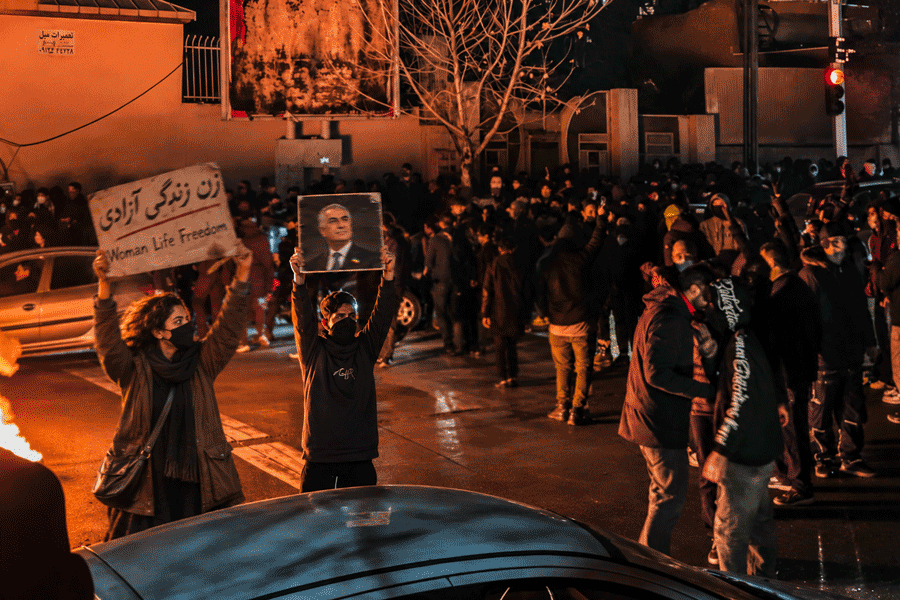
To understand how a large cross section of Iranian society travelled from “Woman, Life, Freedom” (2022) to “Long live the King” (winter 2025–26), we have to step back from the slogans and look at the question that has run beneath both movements.
SURVIVAL
By survival I mean more than staying alive, rather the possibility of a life worth living: a future, choices, human dignity, and above all a way out of a condition that defers life a little further each day.
Read this way, Iran’s recent history shows something that at first looks contradictory: a people who have taken to the streets at different moments, with different language and slogans, have at a deeper level been searching for the same thing, a narrative in which they could go on living with dignity.
In these years, Iranian society has wanted more than a reshuffling of factions or even a change in the form of the state; again and again people have looked for a way out of a life that had become hard and uncertain. Each time they took refuge in a narrative, tested it, and, having hit a wall, set part of it aside to look for another. Elections, street protests and the shifting of slogans can therefore be read as forms of one historical search for a way to return the future to life.
This does not mean that all protesters have wanted the same things. Iranian society is not a monolith with a single mind, and its political trajectory cannot be reduced to a straight, predetermined line. Yet within this plurality a thread of continuity runs from the demand for reform to the repudiation of reformism, and from the demand for social freedoms to the demand for fundamental change; its latest point is the return of the Pahlavi name in the cry of “Javid Shah.”
II.
The presidential election of June 12, 2009 has to be read in the atmosphere of its time, when a large part of Iranian society still believed the country’s course could be changed from within the Islamic Republic. For many who voted for Mir-Hossein Mousavi, the ballot chose a direction: out of political and economic isolation, toward a more ordinary relationship with the world in which official ideology would weigh less on daily life.
Mousavi’s voters had varied motives that cannot be collapsed into a single demand; still, across much of the social base of the Green Movement (June 2009 to early 2010), the wish to normalize Iran’s relations at home and abroad was a serious presence.
On its surface, “Where is my vote?” asked how the ballots were counted. Underneath, it asked who owns one’s fate: why should I, who voted, who work, who study, who call this country home, have no share in deciding its course?
The crushing of the Green Movement in the street, followed by the house arrest of its leaders from February 2011, damaged the very idea that gradual reform was possible, because a society that had turned to the ballot box learned that even the outcome of its vote could not stand against the will of the hard core of power.
Society had not yet left the narrative of reform behind, and some still hoped a new government or parliament might open a crack. In the elections of June 2013 and May 2017 that hope gathered around Hassan Rouhani, who promised an opening in foreign policy, less tension with the world and a better economy. For many, the JCPOA (concluded July 14, 2015) meant more than a nuclear agreement; it held out the belief that Iran might leave permanent confrontation behind and return to ordinary life.
In the protests that began on December 28, 2017 and ran into January 2018, the slogan “Reformists, hardliners, the game is over” marked a turning point, because it declared bankrupt the binary that had for years monopolized official politics as well as much of the analysis written about Iran. A society that had once hoped for change from one of the regime’s factions now saw both inside a single political order, one that resisted its fundamental demands whoever sat in government or parliament.
Rejecting reformists and hardliners, however, did not mean rejecting the values for which much of society had marched in 2009; those values could survive the loss of their political vehicle. Society no longer trusted the reformists, yet it still wanted freedom and a normal relationship with the world, along with a state that kept ideology out of private life and made living possible for its citizens instead of dictating to them. The slogan of 2017–18 therefore cannot be read as a turn toward an anti-Western worldview or a surrender of the demand for freedom. What collapsed was the reformists’ credibility as representatives; the horizon toward which part of society was reaching did not necessarily collapse with it.
III.
In the years that followed, social protest exposed the same problem in other forms. The protests that broke out on November 15, 2019, set off by a fuel price hike on top of economic crisis and long-accumulated rage over living conditions, showed that survival was no longer an abstract political demand; everyday life had become a direct arena of conflict with the state.
The uprising that began in September 2022 exposed it again, with an intensity rarely seen before. The killing of Mahsa Amini in morality police custody on September 16, 2022 was the spark, but “Woman, Life, Freedom” quickly grew from a protest over her death into a broader statement of society’s demands.
The slogan belongs among the deepest statements of the demand for life in Iran’s modern history, because its three words bind three levels of a single demand. Woman was the body for which the state legislated dress, conduct, even the manner of appearing in the street. Life was the protest against an order that had turned joy, love, music, dress, choice and human relationships into objects of surveillance and punishment. Freedom was the right to decide for oneself.
The movement put at the center of politics values tied to the liberal and secular political and cultural tradition of the modern world: individual autonomy, legal equality, freedom of choice, the right to one’s own body and limits on the state’s reach into private life. These values are not the exclusive property of the West; they are rooted in many strands of human experience, including the struggles of Iranian society itself.
Iranian society had fastened these values to everyday life through its own experience. A woman refusing compulsory hijab, a young person wanting to love freely, someone wanting to listen to music or walk down the street without fear of arrest was not necessarily reciting Western political theory; each was speaking of a right whose absence they had felt with their whole being.
By Westernism I mean a desire for a particular legal and social order, in which the individual is a citizen rather than a subject, the law limits power instead of serving as its instrument, and the state does not own its people’s lives. Imitating Western lifestyles or depending politically on Western governments is another matter.
In fact, part of Iranian society had long since left the Islamic Republic behind culturally and socially, but had not yet turned that departure into a broad political program or an imaginable alternative. The Woman, Life, Freedom movement gave this gap a language without being able, on its own, to resolve the questions of political organization, representation, the transfer of power and the building of an alternative order. Its values were strikingly clear, while its idea of a political alternative remained plural and disputed. A society that no longer wanted to live under the existing order would sooner or later have to ask what should replace this regime, and through which political force and historical possibility.
IV.
The wave that began on December 28, 2025, when merchants in Tehran’s markets closed their shops over inflation and the falling rial, spread to all 31 provinces and peaked on January 8–9, 2026. It differed from many earlier protests on exactly this point, moving from declaring the existing order impossible to proposing an alternative.
Earlier protests spent much of society’s political energy on saying what it did not want: who must not rule, which law must be repealed, which faction had lost all credibility, which restriction had to go. In the winter of 2025–26, slogans such as “Javid Shah,” “Reza Shah, rest in peace,” and those invoking Reza Pahlavi showed that across a considerable part of the protests, the name of a historical alternative had also entered the field.
Monarchist nostalgia plays its part in this, but reducing the shift to nostalgia misses what has happened in the historical memory of Iranian society, which over four decades has kept moving under the pressure of official propaganda, selective narratives, family experience and the rereadings of new generations.
From its first years after the revolution of 1979, the Islamic Republic built its legitimacy largely on negating the Pahlavis (1925–1979), who had to be cast as the emblem of despotism, dependency, corruption and gharbzadegi (“Westoxification”) so that the Islamic Republic could present itself as the bearer of freedom, independence, justice and liberation. The project held a contradiction: to legitimize itself, the regime had to keep retelling the past, while every retelling invited a comparison with the present.
A generation that never lived under the Pahlavis began to look for answers outside the Islamic Republic’s textbooks, in family experience, old photographs, films, documents, memoirs and comparisons between the ways life was lived in the two eras. In this rereading the Pahlavi era became the sign of a different historical path.
This rereading should not be confused with impartial historiography, since public memory, unlike a court of history, does not give every piece of evidence equal weight. It may play down the political repression, the restrictions on parties, the censorship and SAVAK (1957–1979) while bringing forward the building of infrastructure, the spread of education, the changing position of women and social modernization. Even with these selections in view, the change in society’s political memory cannot be ignored.
For a large part of society, Pahlavi has become the symbol of another Iran, where religion would not be the apparatus governing every detail of private and public life and where universities, schools, courts, art, music and social relations could follow a path of their own. That Iran would also hold an ordinary place among nations instead of defining itself in permanent opposition to the world. The image answers the needs of the present more than it reconstructs the past; in Pahlavi, today’s society imagines a future it feels the Islamic Republic took from it.
V.
Did the society that chanted “Woman, Life, Freedom” in 2022 change its values and become monarchist by the winter of 2025–26? In my view, for a large part of that society, it did not. What changed was its sense of how those values might be realized and which political force could carry them.
In 2009 part of society believed it could reach freedom and a normal place in the world through electoral reform; by 2017 it had concluded that the binary of reformists and hardliners could no longer represent it; in 2022 the demand for freedom moved past factional politics to the body, gender, ways of living and individual self-determination; in the winter of 2025–26 part of society tried to give these demands the shape of a political alternative and a historical symbol. These are not stages of a linear, inevitable progression, since different forces, demands and motives were present at every moment. Among them, though, runs one continuity: the search for a possibility of life against an order that has each time made part of it impossible.
Seen this way, “Woman, Life, Freedom” and “Javid Shah” need not be opposing slogans. The first expresses a horizon of values, the kind of life people want; the second has become, for part of society, the sign of a political passage beyond the existing order, an attempt in today’s context to answer which road might lead to that life.
No monarchy is guaranteed to realize those values, any more than a republic secures freedom and equality simply by being a republic. The final measure is the structure of power: the rule of law, citizens’ rights, freedom of parties, an independent judiciary, free elections and the ability to hold rulers to account and remove them. The historical worth of this transformation should therefore be judged by society’s capacity to turn its social demands into an accountable political order rather than by a change in the name of the state.