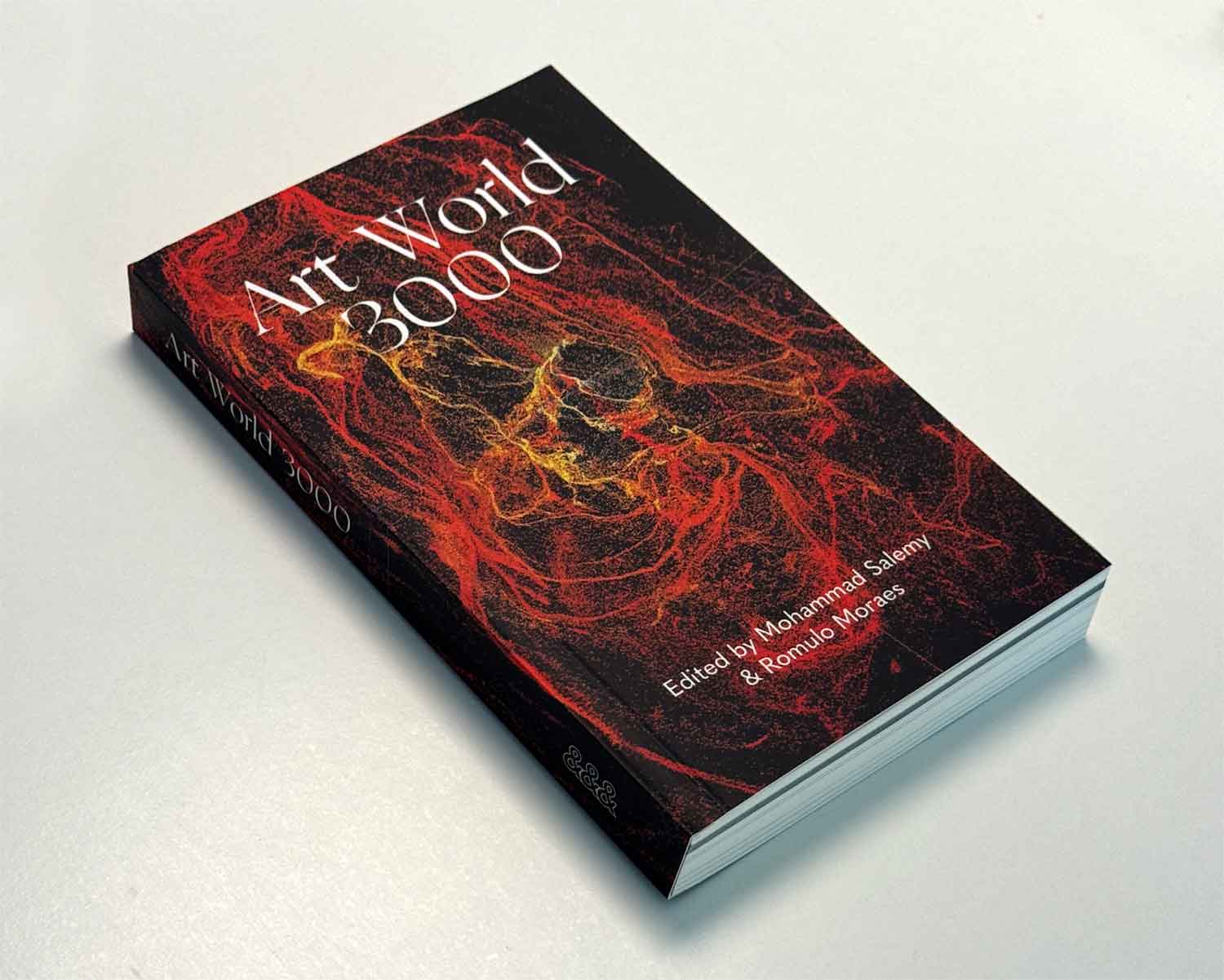
We are pleased to present Art World 3000, edited by Mohammad Salemy and Romulo Moraes, the culmination of the Seminar “What Now? Contemporary Art & the Post-Pandemic Condition,” taught at The New Centre for Research & Practice in the Fall of 2021.
The book borrows its name from a text by Mohammad Salemy, a work of speculative fiction that opens the volume with a vision of the art world in the year 3000.
At its center is “Notes on Future Conditions for Contemporary Art,” a text first drafted during the early months of the Covid-19 pandemic and revised here as a reckoning. Written before the fractures of the following years had fully revealed themselves, it returns to its own predictions in the light of what came after: the end of globalization as it had been collectively imagined, the wars in Ukraine and Gaza, the dissolution of the North Atlantic order, and the hollowing-out of the liberal international framework, including its “contemporary” art world, left standing “mostly as a facade, still loud and lit from within, but hollow nevertheless.”
Salemy and Moraes argue that contemporary art, as institutionalized across the North Atlantic and its peripheries, was the aesthetic expression of a specific historical bet on liberal capitalism, a world in which the display of ideological fluency came to substitute for both aesthetic risk and material security. They trace this condition through the cancel-culture era and its Dimes Square mirror image to the arrival of large language models: machines capable of reproducing the entire visual and textual grammar of contemporary art so fluently as to expose just how codified that grammar had become. Revisiting the four scenarios of their original text (algorithmic curation, AI composition, technological formalism, and technocapital as meaning), they ask “What Now?” once more, this time with genuine perplexity.
What survives, they suggest, is not the institution but the practice of authentic speculative thought, the willingness “to really think hard about the world,” without the smartphone, the doom scroll, or the chatbot. This was the task set for the students of the 2021 Seminar, who were asked after each session to invent a new facet of an imaginary art world of their own: a speculative history, an artwork from the future, a biennale, a set of artists, a controversy, an economy, a mode of sociality. The aggregate of their work forms the core chapters of this book.
DETAILS
Edited by Mohammad Salemy & Romulo Moraes
Cover by Nikos Sakkadakis
(Tax: 4.75 USD + shipping 7 USD) total: 36.75 USD