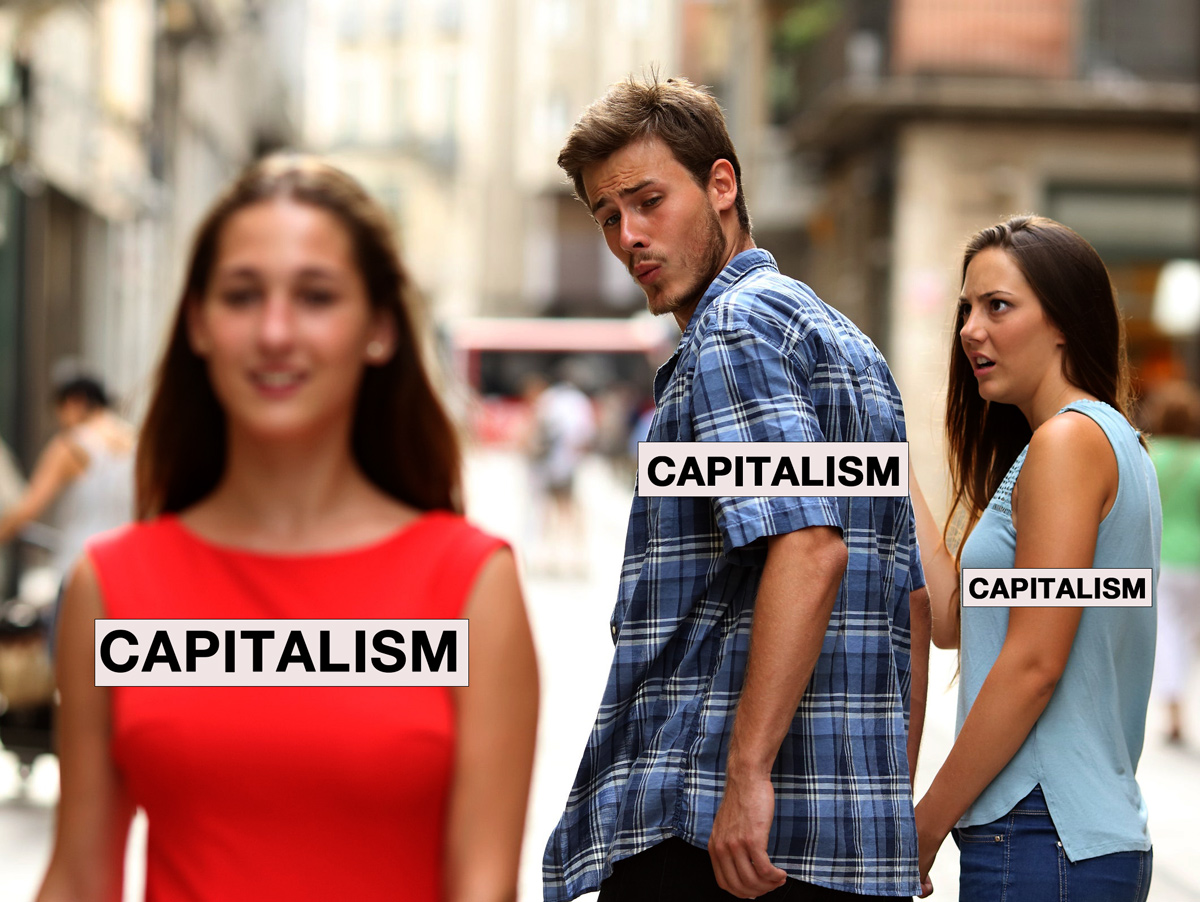
M. S. Yániz: Titled The Memeing of Mark Fisher: How the Frankfurt School Foresaw Capitalist Realism, your new book focuses heavily on how the internet derails any attempt at cogent responses to the biggest crises of our time. In so doing, it recalls the work of Adorno, Benjamin and Marcuse, who identified similar processes in the post war period. When did you first think about the possibility of writing about memes and Fisher? And more precisely, why associating this topic with Adorno and the Frankfurt School? Could you explain where such a confrontation comes from?
Mike Watson: Thanks for your question, I have known Fisher’s work since prior to the release of Capitalist Realism, when he kept the K-Punk blog. The way in which he addresses both theory and popular culture while accounting for the depressive malaise of our time always resonated with me. Aside from this, he was just very open to collaborating and holding dialogues with anyone acting to bring about the conditions of socialism. A large part of this was carried out online via his blog and even via Facebook meme pages. The theory blogging community was really strong then and it enabled a lot of unknown people getting into theory to converse with known theorists such as Fisher, but there was also a nefarious element, trolling and trying to derail conversation. Fisher identified this also on twitter, where he received a lot of trolling, which he saw generally as a wider part of capitalism’s tendency to co-opt and disrupt leftist dialog. The worst part is that it was often leftists of different factions attacking each other, as he identified in his famous “Vampire Castle” essay. This problem clearly hasn’t gone away.
Given Fisher identified the tendency for elements of the left to do the work of capitalism for it by attacking one another, the way in which Fisher memes often distort or plain misrepresent his theory is both ironic and troubling. Yet there is also another aspect, which is more positive. Fisher memes clearly encourage people to explore Fisher’s theory. We have this problem where the internet offers huge potential in terms of spreading class consciousness, but also in closing it down. I got to thinking about this during Covid lockdown, writing the book, in Autumn of 2020. Given the confrontation of political forces shaping our time, from Trump, Bolsonaro and Brexit to QAnon, I end with Fisher’s concept of Acid Communism as an antidote, discussing how that might take shape in the post Trump and post Covid age.
In considering these points, I saw parallels with the way in which Fisher identifies capitalism co-opting leftist thought and the theory of the Frankfurt School, who identified the same issue. Because Fisher’s book Acid Communism was unfinished, we can’t tell to what degree Fisher would have developed Adorno’s and Marcuse’s interest in abstract art as a means to derail the derailment brought about by data capitalism and internet algorithms, but from his introduction to that work it becomes clear retroactively just how indebted Capitalist Realism was to Frankfurt School theory.
SY: There are lots of aspects to be explored within this book.
In the first chapter, you talk about the narrative according to which Trump won the 2016 election thanks to “a few thousand votes cast by disaffected young men turned on to a white supremacist narrative by alt-right meme producers” (10). While you question the simplicity of this argument, you identify a creative aspect in right wing protest which turns desire outward in a way that chimes with Fisher’s Acid Communism. Arguably part of the reason for the failure of the counterculture of the 60s and 70s is that the wider left failed to embrace the creativity of the student, antiwar and psychedelic movements. Today, the right somehow knows that images are powerful – the case of the images coming out of the Capitol protests is an example of this. How would you imagine a left that could embrace desire and images for its ends?
MW: Adorno and Marcuse point in different ways to the power of abstraction. For both, the unintelligibility of the abstract image gives us a means of overcoming the false controlling reality of capitalism. Adorno sees this potential as occurring for the individual and refused to endorse mass movements as he felt they contained the seed of a future totalitarianism within them. Marcuse, however, wished to embrace the already developing abstraction of the psychedelic movement into the 60s counterculture movement.
Today I don’t think we have much time to deliberate over whether abstract art should be apolitical or whether it should be appended to a street movement. The fact is the right wing, particularly in its post truthism, is in any case embracing a wildly irrational narrative that appeals to the subconscious. QAnon came about as people have a need for narratives that scapegoat outsiders and append themselves to basic human fears, alleviating paranoia by projecting self-disgust outside. This process was described by Adorno and Horkheimer in relation to fascism in the Dialectic of Enlightenment (1944), which we can treat as a warning about the risks of irrationality in politics. What we need as a counter to this is a form of abstraction that leads people to reflect on the ways in which we are united with each other and nature. We’ve all had experiences of being lost in a piece of music or artwork, perhaps on drugs or alcohol, perhaps sober (either is good, I mostly prefer the latter recently). It’s this experience that Adorno identifies, though he feared mass movements, arguing they would return post war Germany to totalitarianism. Today we’re in a different situation however. We’re not recovering from fascism, we’re coming out of a pandemic lockdown and we’re trying to avoid a descent into the worst excesses of fascism. As such I think we need to take abstract art to the streets somehow, along with class consciousness raising exercises, talks, reading groups, etc. This is, I believe, what Fisher intended with Acid Communism.
SY: You also speak of memes and the internet as central to an ‘Acid Left’. How is it possible to make memes without nostalgia distracting people from politics, or what Fisher called a ‘depressive hedonia’? A positive and militant form of memetics. Would this in any case be against the Frankfurt School, whose negative dialectic is against a naive positivity towards the ideological use of art? Perhaps only via Benjamin one can embrace positivity while not running away from pessimism.
MW: Well I think it’s important to understand the historical context of the Frankfurt School at that time. They were largely writing either on the run from Nazism (as German Jews and prominent leftist academics), in exile from it, or returning to Germany to rebuild after the war. They had seen the descent of grand narratives into totalitarianism and genocide and they refused to endorse simple answers that would give false hope in the shadow of the bleakest moment. Given this, they turned to art not from a position of strength but as they believed that only via an act of the imagination could we sidestep the brutal reality of advanced industrialism and apprehend the true nature of material reality.
Neither thinker believed that the experience of viewing the cultural object was capable in itself of bringing about widespread social change. Rather, they argued that the cultural experience offered a rare, albeit limited, means to obtain distance from the economic mechanisms that are necessary to performing social critique. This falsified and fleeting autonomy from commodified society presents the only hope for these thinkers in a social situation that otherwise prohibited (in the case of totalitarian states such as Germany) or co-opted (in the case of the United States and post war Germany) opposition to capitalism.
For Benjamin this glimpse of another reality came about via assembling constellations of capitalist commodities and architectures which he called ‘phantasmagoria’. The term phantasmagoria was coined in the 1700s to describe simple mechanical scenes that aimed at evoking spiritual or spectral activity through an arrangement of lights, shadows and moving objects. Benjamin argued that we could assemble groups of objects ourselves in our minds and use them to draw a kind of map of capitalism and its underlying class structure. What I argue in The Memeing of Mark Fisher is that we can draw constellations of media objects, including memes, as well as video games, Netflix productions, social media feeds, etc, and use those to reveal the underlying architecture of capitalism.
SY: I sometimes think that the failure of critical thinking always leads to depressive nihilism. You need a bit of cynicism to survive. Is that the place of memes?
MW: In the sense that capitalism leads to depression then I can agree that the failure of critical thinking to oppose capitalism also contributes. If memes can point a way out we need to be able to see through them into the underlying economic reality that underpins them and the data economy. For the Frankfurt School abstraction in art allows for the narrative of capitalism to be disrupted. Maybe this can happen via memes, but I think for the most part they are consumed and produced at such a speed that their only purpose can be to feed the data economy and derail cogent critiques of capitalism. I argue in the book that we need to deccelerate production and consumption and create slow memes, which can be used alongside real life grassroots campaigning. The internet is both the best and worst thing that ever happened to us, we need to leverage the positives to help foster class consciousness.
SY: Before I go on, I’d like to drop a question that goes back to your past book. In Can the Left Learn to Meme? you write: “Today one might ask if it’s possible to read Adorno without stopping periodically to look at cat memes”. This is an update of the Jameson quote you cite shortly before, in which he asks in the 1990s if it’s possible to “read Adorno by the pool”. Both statements are effectively variants of the famous question from Adorno over whether it’s possible to “write lyric poetry after Auschwitz”.
What do you think would be the future of critical theory or the way in which it should be realized? Will memes be enough? Benjamin’s writing project is formally against the great philosophical treatise, as is Fisher’s to some degree. Benjamin focuses on the phenomena of loss and melancholy, on how to write and produce from the idea of incompleteness and the fragment without succumbing to sadness.
That’s where the right differs, I think. The Benjaminian left usually fails because it distrusts totality and making systems. Fascism, on the other hand, has a totalizing principle that allows them to do what they do. A totalizing left would be that of Lenin, who famously didn’t allow himself to listen to music because it made him feel distracted from the revolution, as Mark mentions in Acid Communism.
MW: We have more people thinking about theory today than at any point, firstly because we have a growing population and, secondly, because the internet has allowed us to share theoretical texts and ideas. The era of theory blogging that Fisher played such an active part in was crucial to this. Arguably, left theory memes and lefttube and breadtube, as well as live streaming are a logical next consequence of this. The question however is to what degree these media promote thought and to what degree they make cogent thought difficult. I think they do both, and this is where the internet is in many ways the best thing and worst thing to ever happen to us.
It is true that Adorno and Benjamin both use the philosophical fragment, writing short and/or fragmented texts to respond to a reality that was temporarily and spatially disjointed by capitalism. However, if you read those texts they are intensely thoughtful and reflective, causing the reader to oppose the act of thinking to the mindless commercial and industrial activity of capitalism. Sometimes we also see this in memes and it is this we should aim for. If memes trigger thought rather than impede it we have made progress.
I am positive generally about online discussions and reading groups where the aim is genuinely to further knowledge and not prove one’s own intelligence. The ‘debate bros’ style of discussion is damaging as it promotes competition, but there are many other forums where people genuinely wish to learn together. The Kapital Komrades facebook group is one example that is carefully managed to promote discussion while also employing memes and humor. On the Acid Left YouTube platform, which I run with Adam Ray Adkins, we run a regular reading group where we make memes about the reading as well as exploring the sometimes dense topics of a given text.
SY: With that I’d like to move on to what you think of the intellectual place of Zer0 Books. Also about your work on YouTube. Both seem to me to be critical platforms without believing in totalizations. Zer0 Books releases are unpredictable, shrewd, geo-localized and with great ideas. Do you think this is the format in which criticism should be carried out today? Are long philosophical treatises still necessary? Are they to be supplanted, or how would they coexist?
MW: Well, as an author I can’t speak for Zer0 Books itself, you’d have to speak to Doug Lain! However, as I signed my contract with them for my first book Towards a Conceptual Militancy when Mark Fisher, Tariq Godard and others were still there, I can see an element of continuity over the years. Put simply, the original Zer0 Books took authors from the theory blogging community, in an attempt to challenge the stifling practices of academic publishing. At first the big theoretical journals ignored them, yet now they have a number of the most important theoretical and critical books of the 21st century. Today, it is clear that they have continued to take inspiration and writers from the internet in its newest emerging forms. Many writers also keep blogs and YouTube channels while some have been found online. A prominent example is Matt Christman of Chapo Traphouse who signed a contract for a book this summer.
As for whether long philosophical texts are necessary, Zer0 Books’ texts vary in length. David Blacker’s Falling Rate of Learning and the Neoliberal Endgame and What’s Left of the World are two examples of longer texts. I tend to go for pretty short texts, it’s just how they come out! Obviously though in today’s attention-starved world many people will find shorter texts easier and I think we will see a return of the fragment soon. I am actually working on a book of fragments called Digital Moralia: Reflections on 21st Century Life (after Adorno’s Minima Moralia), but it’s still in its early stages.
SY: Will there be people who do not see memes again? What place is left for them? I mean, are there people who are still reading Hegel all day because they don’t even see memes? Are those two different worlds?
MW: Ok, actually I wrote on this very subject for Digital Moralia, mentioned above:
“In the preface to the Phenomenology of Spirit Hegel advises reading the prefaces to great philosophical works (paragraph 70). After all, you will find everything that comes into the wider book there, he jokes, almost bidding his reader to avoid reading the rest of his heavy volume. Or you might prefer, he continues to cast aside the casual dress of the hobbyist philosopher and ‘along in the robes of a high priest, on a road that is from the first no road, but has immediate being as its centre, the genius of profound original ideas and lofty flashes of inspiration.’ While many relieved readers may have felt ready at that point to don their High Priest (or priestess) garments, Hegel counters that the only course to philosophical understanding or insight is via Reason.
Adorno later saw Reason as unable to fulfill its promise, having been instrumentalized by humankind’s inherent lack of reason. As such only a fragmentation of the ‘false reason’ that has come to dominate nature and humanity can deliver a glimpse of ‘truth’, this being the main justification for writing philosophical ‘fragments’. Yet what are the limits of a fragment? Does it have to be a text? Even if we take conceptual elaborations to be superior to images in allowing us to glimpse truth, as Hegel argued, it remains that our culture is more than ever a visual one. Therefore the false rationality that reaches us is generally conveyed by images, from toothpaste white smiles on insta, to sardonic political memes. Would it not make sense to then counter these false fragments via true fragments, themselves taking on an image form? Maybe, we cannot really know except by engaging, which is why the injunction to read more and meme less (or produce less selfies) appears out of touch. Read more and meme more.”
SY: Why would the post Covid era be the moment of the reintegration of class consciousness, as you suggest in The Memeing of Mark Fisher? Is this because there has been a total fragmentation of the public sphere? Or do you think that the energy poured into the parties and meeting people after enclosure could trigger other forms of collective action? How do you imagine this scenario?
MW: I think we have to make the situation happen and not let the right wing dominate it. Naturally, the last two years has led people to be very dissatisfied and to distrust authority. We are seeing the results in mostly right wing movements around the vague notion of ‘freedom’. I think we are yet to see this dissatisfaction peak and I believe that a generation of young people who have been denied the usual socialization process may develop their own counterculture. The influence this has will depend to some degree on whether they meet up with disaffected unemployed and migrant groups.
In any case, the left needs to be part of this and already needs to get out and talk to people about class politics and capitalism. It is clear people are fed up with capitalist society but they are not joining the dots, instead scapegoating people and developing paranoid fantasies. Adorno and Horkheimer discuss precisely this scenario unfolding in the 30s and 40s in Dialectic of Enlightenment. Fortunately today we have new media outlets such as podcasts through which we can discuss leftist takes on societal issues, but it’s not enough to podcast or make memes. As I state in The Memeing of Mark Fisher, we need to use the online left to encourage people to meet in real life and to discuss and organise.
SY: In The Memeing of Mark Fisher, you write about the comforts of capitalism and the capacity to generate money by live stream gaming, or with one’s naked self-image. You say, however, that this economic and sexual freedom does not stop you from being subjugated. I think of that phrase from Anti-Oedipus that Deleuze & Guattari recover from Wilhelm Reich: “Why do men fight for their servitude as stubbornly as though it were their salvation?” Isn’t OnlyFans a form of self-exploitation sold as freedom?
MW: I think firstly it’s important to state that the capacity for people to earn money as minor celebrities or as theorists, etc., is no bad thing. In The Work of Art in the Age of Mechanical Reproduction Walter Benjamin argued that the media of his day gave people an appetite for more riches, which the fascists diverted into a disdain for the Other and a hunger for war. Today social media encourages a similar hunger for fame and money, yet the same platforms that promote this hunger also offer satiation, in the form of potential earnings and recognizability. However, many people will never become successful streamers, podcasters or models and those that do are only fulfilling a dream that capitalism in itself instills. As such I don’t judge the person who becomes ‘successful’ via online platforms, but the measure of success, which is distorted.
SY: You end the book stating that we need an incendiary subcultural movement. You advocate that this rupture can be made by creating constellations of objects from the internet. Could you elaborate on that? Because it seems to me that, if anything, it is precisely internet culture that impedes the idea of an incendiary left. Then you state that the job of the Acid Left is to reconfigure the debris of capitalism. Is there no alternative? Is there really only a better capitalism out there?
MW: The intention is not to reconfigure capital into a new form of capitalism but rather to reconfigure its material elements into something else entirely.
As I state in the book:
“Benjamin famously stated in his often quoted description of Paul Klee’s print, the Angelus Novelus, which he bought in 1921:
His face is turned toward the past. Where we perceive a chain of events, he sees one single catastrophe which keeps piling wreckage upon wreckage and hurls it in front of his feet. The angel would like to stay, awaken the dead, and make whole what has been smashed. But a storm is blowing from Paradise; it has got caught in his wings with such violence that the angel can no longer close them. The storm irresistibly propels him into the future to which his back is turned, while the pile of debris before him grows skyward. The storm is what we call progress.30
The almost cartoon-like ‘Angel of History’ that Klee depicted is portrayed as representing the present moment, facing backward upon the wreckage of the past. The implication is that we proceed not by looking onto a future of boundless possibility that we shape using the knowledge and tools we have accumulated around us. Rather, we look back upon the detritus scattered behind us, receding into a future that will be shaped by our reaction to this accumulation of past experiences. What Benjamin aimed to do is draw constellations from that cultural debris so as to understand how it came about. I think we can do this with the internet.”
SY: Finally, I wanted to ask you what will be the focus of your course at The New Centre. I mean, I get the theoretical part and the idea of researching the limits of capitalism, the meme as resistance, and the Acid Left as tools. But I wonder if, aside from exploring Mark Fisher’s theory, you will explore methods for producing online culture, and perhaps other forms of more critical art. In this sense, as part of a program on “research and practice”, will the course have a practical aspect? I saw some videos in which you explain how to make memes. Will the course feature some of that?
MW: The course will ask whether the ‘new normal’ we are emerging into might involve a culturally-oriented protest movement and how the tools of both the online left and officialized ‘political art’ culture might be used alongside grassroots initiatives. In addressing these issues, which will involve a look to art activist movements, we will discuss how the online realm might be used to encourage real life political participation. Students will be assessed based on a theoretical aspect and an online project involving memes or a short video. Certainly meme production will be covered though nothing will be asked that will require special skills beyond what most of us can achieve with freely available apps. Largely our conversations and reading around Fisher and the Frankfurt School will inform the process.
SY: And, for the bonus track: what’s next? I mean, you are writing another book, then? Do you believe other books around memes are possible for you? If so, are you writing an involuntary or voluntary trilogy on memes, theory, pop, and capitalism?
MW: As stated above, I am working on a book of fragments called Digital Moralia. I guess effectively it has a lot of texts on memes, but also on other digital media. Maybe it’ll be seen as the third in a trilogy. Other than that, I am most of the way through a first draft of a book based on my real life experiences as a critic and curator for major international magazines and venues. It’s a kind of theoretical-picaresque hybrid. Then finally, I am continuing production of podcasts, memes, and videos with Adam Ray Adkins as The Acid Left.