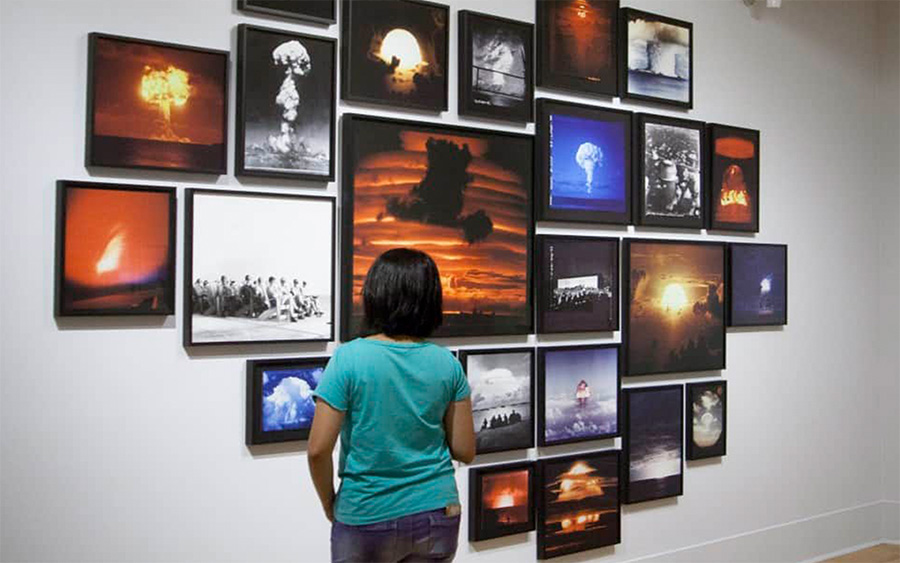
Often I wake in bed still half inside a dream in which I sometimes find myself walking through an exhibition. The mind, in that state, behaves like a curator: it gathers recent political pressures, private anxieties, social media garbage and stored images, staging them as rooms and objects. These imaginary exhibitions are neither pure fantasy nor pure argument, but a space in which the world is symbolically processed. An exhibition, even in waking life, already resembles a (good or bad) dream. It is separated from the ordinary world and reorganized into a charged sequence of objects, images, and experiences, each one intensified by framing, lighting, and attention.
One recent morning, while lying in bed and dreaming, I had a longer and more intense than normal experience of walking around an exhibition. I was in Ottawa, at the National Gallery of Canada, and the exhibition I was about to walk into was titled National Annihilation. The didactic argued that only with a nuclear weapon is a nation-state truly sovereign, and that Canada had become weak by being overly reliant on our southern neighbor, and that Canadian sovereignty had never been absolute but always borrowed. Reading the text, I wasn’t sure who produced the show and why. Was this a government think tank rehearsing policy, or pure propaganda?
The first room was organized by an artist duo who worked with an online community who specializes in war games. It showed in detailed maps over a number of tables and on the four walls how Canada would be invaded from the South. The didactic text stated that perhaps an economic war was the most likely, with a long term war of ultra high tariffs, but that for the sake of this exhibition, they were describing a military invasion: American special forces were already in Ottawa with diplomatic cover, and were able to quickly capture the government in a classic decapitation maneuver. The international airports were secured by helicopters and troop transports. Armored columns crossed the border in every province. The ports of Vancouver, Prince Rupert, Montreal and Halifax were blockaded. Internet and broadcast media were disrupted. Canada was effectively conquered in 24-48 hours.
It reminded me of what Russia attempted in Ukraine.
The second room detailed the argument of a classic nuclear deterrence of ground based missiles, bombs loaded on airplanes in the air, and submarines in the sea. This artist commission took a slightly retro style with a large map of Canada drawn on the long wall, with locations of the nuclear deterrence scattered across the country almost randomly, farther away from large cities. The two shorter walls had paintings of generic submarines and generic fighter jets, that did not look like the F-35. It felt like being in the cross of a corporate trade show for arms dealers and a high school, and perhaps a military recruitment center.
The first wall in the third room carried the doctrine of regime survivability, flowcharts of assured retaliation, continuity of government protocols, delegated command structures. The speculative premise being that Canada’s vast land mass was itself a strategic asset, distance and dispersed basing and Arctic routes, less a nation than a geometry of survival. The opposite wall was a commission from a Marxist artist collective. The work split in two. The upper diagram mapped the formal architecture of the Canadian state, the Privy Council at the centre, ringed by the PMO, Finance, National Defence, intelligence services, Crown corporations, and the consultant layer. It looked like a civics chart at first, something from a high school textbook. But the lines between nodes were weighted by thickness, personnel movement, contracts, institutional memory, and what came through was not a hierarchy but a circulation. The same people cycling through ministers’ offices, the senior civil service, think tanks, Bay Street, commissions. The lower half was harsher because it was more direct. Canadian class structure mapped not by income bracket but by structural position, who owns productive assets, who manages them, who sells labour into the system, who remains surplus to it entirely. The effect was: who benefits or owns the Canadian state.
On the shorter wall of this third room, six photographs were hung at different sizes, and up close the images became nearly abstract: corridors dissolving into color fields, the particular green of federal paint, switchboards that looked almost decorative, a late 1950s idea of survival technology that was now just a period aesthetic. There was no natural light in any of the six prints, an underground world sealed from weather and season, preserved with the accidental perfection of a place nobody ever really used for its intended purpose. The furniture was the strangest part: ordinary mid-century government chairs and desks and a coffee urn, waiting for the end of the world that didn’t come, or hadn’t come yet, made beautiful by the camera in a way that was the problem and possibly the point. At some point, I realized this was the famous Diefenbunker.
The fourth room felt like it wandered in from a different exhibition. A single long wall, one painter, a commission that must have seemed straightforward and clearly wasn’t. The works contained no faces and no bodies, only objects of governance rendered as still life: briefing binders, diplomatic seals, secure phones, passports, encrypted cables, icebreakers, breakbulk ships, server racks, spreadsheets. Governance itself appearing as an object-world, bureaucracy as a still life, responsibility distributed so thoroughly across things that no person needed to appear. What made the room was the brushwork. It was genuinely lyrical, loose in places, almost reluctant, and you got the strong impression that the painter found the subject matter beneath them and painted through that feeling rather than around it.
We entered the center of the exhibition through a door that stopped the sound. This space was called The Blast Chapel, an immersive chamber of low drones, distorted synth, and slow projection. Visitors experienced a stretched temporal simulation of being inside a blast event. The room framed nuclear death as secular sublimity, a civic theology of awe, fear, and submission. Unlike the wargame, this space did not invite control. It staged helplessness and then aestheticized it. The artist reportedly used Claude Code to generate the blast sequence, drawing on publicly available traces of American nuclear simulation imagery. Once live testing ended, the bomb entered a new regime of representation: it had to be simulated, visualized, and computationally maintained. The laboratories themselves would not release their materials.
The sixth room I thought of as the asteroid solution, and was shown on three vintage Sony Trinitron monitors with their convex screens and warm cathode glow, and articulated RGB pixels. The first monitor ran a continuous catalogue of near-earth asteroids: designations, trajectories, impact probabilities, dates. The second featured a figure, rocket scientist or actor playing one, the ambiguity deliberate, explaining planetary defense with the calm affect of someone describing a public works project, a problem of engineering and political will rather than catastrophe. The third showed a conceptual animation: a Canadian nuclear device intercepting an asteroid, altering its trajectory, saving the earth. The animation was clean and unhurried. It looked like a solution. Canada could not test a bomb domestically. So testing was displaced onto a passing asteroid and reframed as planetary defense. The bomb was no longer a national weapon. It was a contribution to the survival of the species.
I was wondering when we would arrive at the Indigenous content. Here it was, from a collective of Cree and Anishinaabe artists. One wall held five words in large black letters: SETTLER COLONIALISM = CATASTROPHE. The opposite wall was covered floor to ceiling in a salon-style hanging of approximately forty portraits in different styles of Indigenous Canadian soldiers dating back from the war of 1812. I didn’t know about the Second Boer War in South Africa (1899 to 1902). The bulk of the portraits were soldiers in World War One and Two. This double consciousness was an effective artistic strategy.
The final room was a bit incongruous. The largest wall carried a diagram of the world-system of the bomb, which countries held nuclear weapons, which sheltered under extended deterrence, which were simply unprotected, the whole global architecture of who got the guarantee and who didn’t rendered as a map of membership and exclusion. The shorter wall was an elegy. Road signs, municipal documents, photographs from city hall, the archive of Vancouver’s nuclear-free zone declaration, the grassroots movement that believed a city could opt out of the logic the opposite wall described. It looked dated now, which was partly the point. The language of nuclear-free zones belonged to a particular moment of political imagination that had not survived intact. The remaining walls and display cases held a selection from John O’Brian’s Camera Atomica, the first comprehensive exhibition on postwar nuclear photography, organized for the Art Gallery of Ontario in 2015. Canada was a member of the Manhattan Project, the consortium that developed the atomic bombs dropped on Hiroshima and Nagasaki, contributing uranium from the mines at Port Radium, contributing scientists, contributing the raw material of the American century before stepping back into its shadow. Canada was in all of them, just off frame.
I have told multiple friends about this long lucid dream. They couldn’t believe how detailed it was and how slightly rambling.
One asked if I didn’t have something better to dream of. This was a bit embarrassing. The second asked: was it a good show? Kind of. Perhaps more interesting as an institution breaking progressive taboos than as an exhibition by including the gentle mockery of Nuclear Free Canada responsible for bombings, and the war games.
I wasn’t surprised by anything, didn’t experience the sublime, didn’t encounter a masterwork.
There were a few good works of social reflection. But the paintings and photographs were genuinely artful, and the gallery did a lot of administration and logistics to assemble all the portraits of Indigenous Canadian soldiers.
The third friend asked who the curator was. He thought maybe former curatorial staff from Berlin’s Haus der Kulturen der Welt (HKW).
The fourth friend thought it sounded more like a media event than a show, and wondered whether there was any real politics to it or whether Canadian institutions were just sensing a shift in the national mood and getting there first.
I told him it was only a dream.