I.
The first time I stood before Lee Ufan’s From Line (1978) series was at Museum MACAN in Jakarta. The museum framed Ufan’s work as offering an Asian post-war critique of Eurocentrism and as belonging to the Mono-ha movement. The series’ lines and intervals were here cast as refusals of Western painterly gesture, a resistance to fullness or plentitude. Six years later at Tate Modern in London I stood before another work from the same From Line series—the institution having completely recontextualized it. Here Ufan was placed within a Western narrative of painting’s evolution, cited alongside Richter as fitting into or exemplifying a different genealogy of restraint. What had clearly changed was the field of articulations or legibility surrounding this series, and with it the work’s temporal address.
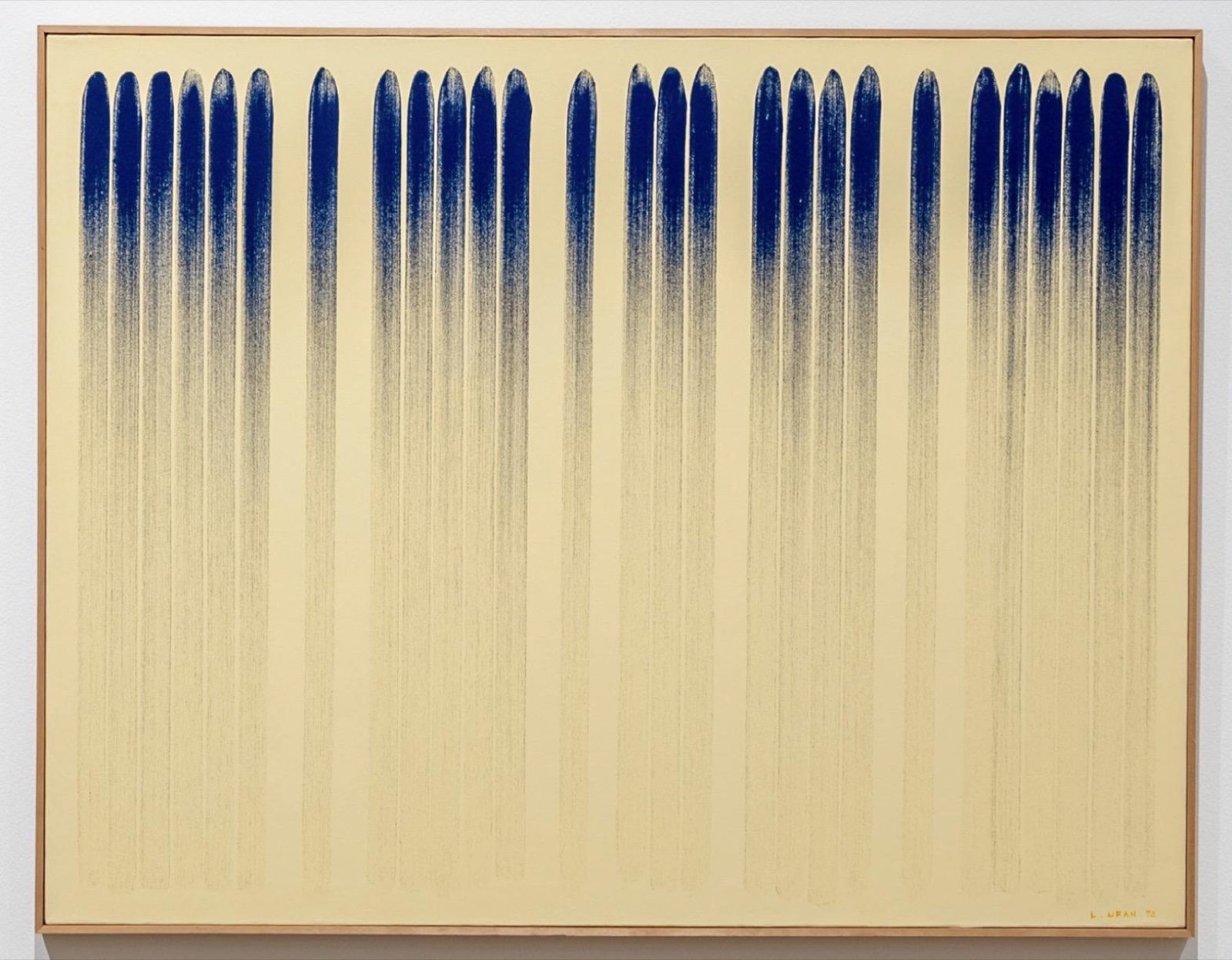
Lee Ufan, From Line, 1978. Courtesy Tate, London.
My dear friend Ina replied to the photo of the Tate collection I posted online—I had quietly wondered whether anyone would recognise this same series in Jakarta. She implied that I did not have to go so far to see this particular series for we can see it at home, in Indonesia: “This exists even in Museum MACAN, haha.” She recognised Ufan’s work, and we did not have to name either the series or the artist in the chat. In this instance of intersubjective beholding, recognition is named through the encounter of shared memory—having stood before the same object in the same institution, in the same city, by grace of the same proximity.
Were I to define “institutional,” I would include those who build and inhabit such public spaces: the curators, educators, guards, critics, and the public itself—all of whose habits and styles of looking give those rooms their precise temporality. I’ve recently found Vishmidt’s account helpful of the shift from institutional to infrastructural critique, the latter which grasps the institution as a mesh of conditions which make certain forms appear as frictions instead of totalities. The positions of institutions, on this view, are not located outside the work but are understood as part of how the work appears.
II.
I’ve been circling for months around our desire to behold and how an object, in turn, seems to behold us back. In many of our artistic projects, in curating and organizing, in writing, etc., we become so consumed by our understanding—of justifications, conditions of possibility, and so forth—to be seemingly all-seeing. Like anything else, vision is itself of course historically constructed as a field, and its internal division may be named, per Foster’s collection Vision and Visuality, as the difference between vision as physiological capacity and visuality as the social and political organisation of seeing.1 To speak, as I will, of lust for seeing is to speak from inside that desire structured by the regimes that decide which images circulate, which objects become visible, and to whom they become visible.
Lust—as the drive that is structured by norms and the imaginaries prior to seeing; how it is possible to encounter one another through the thin theory of time we have at hand. Is the time of beholding simply given by the work, is it entirely situated in the beholder, or is it a conditional field which neither side owns? I keep returning to the sense that the concept of beholding itself is such a wired tension, full of relay. Every encounter with an object folds back and forth between address and reception.
This paper contends that beholding is time-given and structurally uneven—and so criticism, as a consequence of this fact, must remain answerable, I would like to suggest, to specific encounters. Any vocabulary for cultivated receptivity (rasa) must be paired with a demand on the infrastructures which gatekeep, enframe, or police the act of seeing. Lust, in this paper, means a charged way of finding oneself directed toward certain works and certain histories of looking.2 Lust, as our way to feel, press, and sense that is never innate or innocent, the impulse or demand to render objects and worlds totally legible; rasa, as one lexeme that explores many.
Rasa originates from the Sanskrit root ras- (taste, sap, juice) and now lives in Malay and Indonesia as a word describing feeling, mood, flavour, atmosphere, intuition. The word provides ways for us to anticipate, believe, and register how judgment is entangled before, during, and after encounters—even when objects remain unseeable within inherited lines. We submit ourselves so readily to the temptations to see, learn, and understand, temptations that have been sedimented through those who taught us how to…lo(ok) and behold.3
Writing on Minimalism’s aftermath, Melville and Alberro have each clarified how the problem and meaning of beholding itself may become real or legible to beholders themselves.4 Beholding, I would like to suggest, works within the specific time given by the objects we behold. Bodies of the beholders are consequently oriented and re-oriented—and the work, in turn, gives a duration that the beholder may or may not be able to inhabit. Within such unequal arrangements, the desire to see is itself thus time-given. Beholding is never fixed, for the conditions allowing it to happen have already occurred prior to the encounter. The scale of that given time extends, it turns out, further back than any institution, and presses the problem differently across the thin, tenuous theory of time we have at hand.
III.
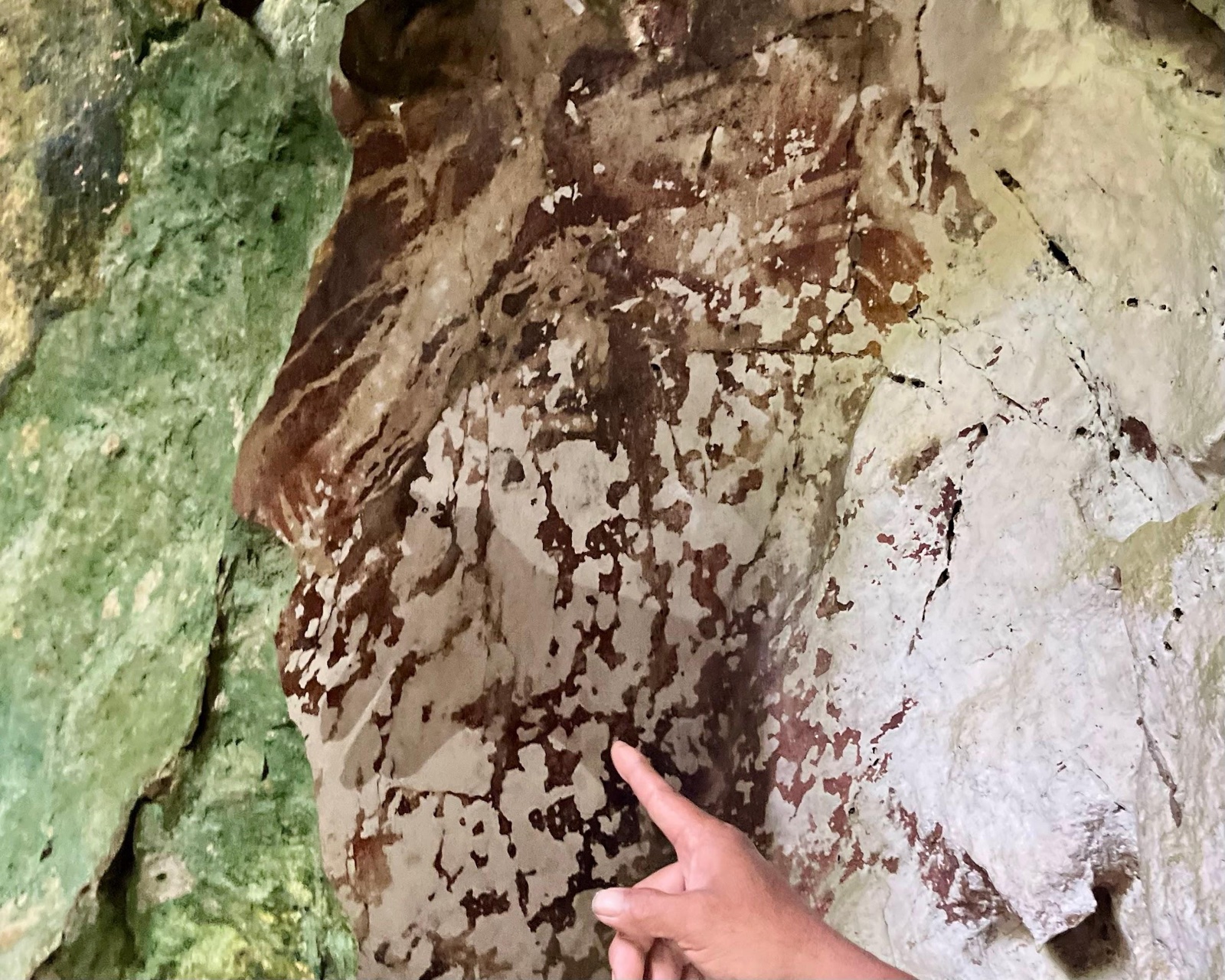
Hand painting surrounding rock surface, Leang Pettae, Maros, South Sulawesi. Photograph by Christine Toelle.
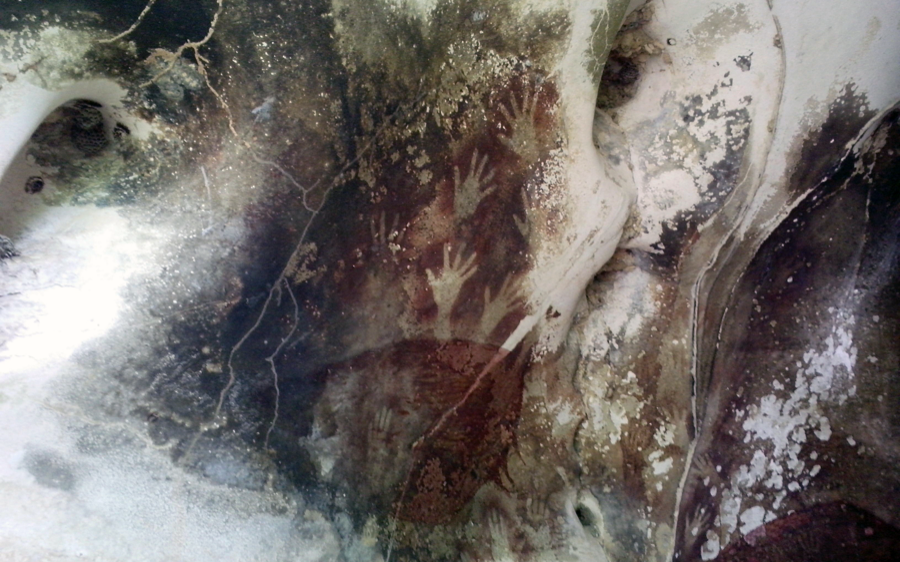
Encounters between the same objects and the same person are of course never identical. The differing meanings of each encounter fold and imbricate, and the difference between what each receival is perhaps just is the irreducible content of specificity. My process of writing this paper spanned three months, lengthened after my encounter at some of the world’s oldest paintings—the hand-stencils at Leang Pettae (Pettae Cave) and Leang Pettakere (Pettakere Cave). These images carry some forty millennia of undissolvable contingency. They were placed by specific bodies in a specific place for reasons we can only read as indexical. None of these phenomena are new in their deepest structure and history. That a work makes a claim on whomever stands before it has, of course, a history far longer than modernism’s espousal of that fact.
Pettae and Pettakere are part of the Maros-Pangkep hand-stencil complex, whose images span roughly 40,000–17,000 years ago, with the oldest dated hand-stencil in the region at 39.9 kyr (Leang Timpuseng).5 People once stood before a wall and placed a hand against it, blowing pigment stencils around their palm. These pre-verbal gestures cannot be understood through any decoding or semiotic gaze. Their registered presence is held by markings on a surface which have existed longer than any individual. And if we follow Melville’s notion that appearance is conditioned by the terms of publicity, then these walls have received and held presence for unknown others, outlasting their maker by tens of millennia.
The body at both Leang Pettae and Pettakere was no less conditioned than the body at a gallery or museum—bringing its own histories of proximity, preparedness. What the hand-stencils, Mono-ha movement, the ‘60s Minimalists shared is then not a universal theory of beholding but something of a structural condition. Gell’s reformulation attends to how an object—image—is indexical to the material residue of an (imputed) intentional act. Beholding entangles the beholder in a web of inferred intentionality,6 and the index makes the primordial and the contemporary continuous.
Across other dark humid walls in Chauvet, Altamira, Lascaux, images receive and handle the perspectives and pressures of its beholders. Images register presence—but they no doubt outlast and outstrip every interpretive framework brought to them. The prehistoric, the primordials, and the contemporary do not yield a universal theory of beholding but they do describe a structural condition that outlasts their various encounters. Which raises the question: what constructs or fashions the arriving body, and what does it have prior to its arrival?
IV.
I was led to visit the sites as a result of my very own training, having only seen these paintings before via representations shown in classes. To study art in the “majority world” means inheriting histories which are already wrested out of shape by colonial modernity, a project that is an ecological catastrophe for worlds and bodies alike.7 My education was shaped by the colonial institutional inheritance of the Technische Hoogeschool te Bandoeng and its successors—which transmit interpretation as a sequence of inherited methods. We studied Fry’s formalism, Greenberg’s opticality and medium specificity, and T.J. Clark’s social history.8 Yet no matter how much these theories are experienced as liminal thresholds of sorts, critical vocabularies nevertheless first arrive before teachers or students have any chances to encounter the objects. We had to write in order for us to experience them, absorbing the methods before any encounters. The colonial relay produces a particular preparedness to read works from certain distances, a structurally uneven distribution of access.
I’d say this mishandling has been so pervasive that even postmodernist art discourse perpetuates it. Experience becomes so thoroughly marked as mediated that presence itself turns suspect. While the postmodernist insight is that experience is contingent and constructed, we may push back here and say contingency is not the same as unreality. Constructed or manufactured experience is still an experience, and the weight of an institutional formation at a specific moment is real precisely in its construction. What postmodernist reflexivity mishandled, then, is perhaps the inference that contingency makes immanence impossible.9
In the present this reflexive tendency has further abstracted into a contemporaneity which turns inward deeper still. Mi You tracks how contemporary critique loops back onto art’s own infrastructures—producing a “circular logic” that diagnoses institutions while leaving the social and political mechanisms outside the art world untouched. Boris Ondreička’s “second contemporary” has similarly helped me relate to such a condition—through his thought on an art field which eagerly ingests every new theory and politics as content, but tends to keep that ingestion at the level of style and discourse, rarely allowing it to disturb the stakes of life.10
The object’s publicity is itself a site of permanent risk, which serves to reframe and clarify Fried’s deep anxiety—announced in the ‘60s—surrounding theatricality. What perhaps initially looked like a failure of absorption now reads as the exposure of art’s unavoidable relation to others and the world, with the beholder already internal to the work’s conditions of legibility. Drawing on Cavell, Melville locates meaning’s survival in the uncertainty and the durability of its claim—despite and sometimes through misreading.11 The attachment I brought to the work the first time was formed in proximity to a different field of materiality, and that formation is not a deficit but a specific and situated sedimentation. “Art and Objecthood” and Melville’s rereadings of it may then perhaps be read as staging a struggle over how much theory the encounter or experience can bear before it stops describing what the work actually does.
Materiality as a critical vocabulary, however sophisticated, still has not answered this question satisfactorily—indeed it defers it by generalising the beholder. The intervention Melville names as “the reemergence of allegory” marks or registers something of a structural necessity (hence not a stylistic shift), whereby allegory appears when direct address falters—and conviction can no longer be guaranteed by form alone.12 This is not a collapse into relativism but more nearly a recognition or acknowledgment that modernism’s claim to self-evidence required an enormous rhetorical labour. Allegory, on Melville’s account, restores attention to the unresolvable labour of reading, mediation, delay.
V.
We unabashedly desire to see and understand. I recently encountered the flipside of this desire in my fantasy of “stripping away” the apparatus of knowledge and returning to some shared or communal experience through the notion of unlearning. I would argue this is often mistakenly implied to mean that holding knowledge and its limits simultaneously should consist of arriving at the works as a knowing beholder who knows that knowing is never enough. A tale as old as time—à la Meno’s Paradox or the Ānanda—of one who has accumulated vast intellectual knowledge and ends up missing its practical realisation or transformation entirely: the liability of knowledge operating as a barrier.
To interject here and say, maybe we were all schooled incorrectly, would no doubt be hyperbolic and deflationary; but, we may ask, could inquiry begin neither from ignorance nor from knowledge but perhaps from the middle passage in trusting what one sees?13 Begin, that is, with an acknowledgment that some things have been there before one can even speak. The object, on this view, issues its own recurrences of duration, and the beholder either inhabits them or doesn’t. For understanding the pre-verbal aspects of things we behold, I personally quite enjoy the idea of aesthesis, which captures how the object carries dimensions that discourse tries and ultimately fails to access, capture, or do justice to. Such beholding would not consist of disinterested aesthetic judgment but instead the raw, sentient, body-level encounter with the world.
We can identify multiple vocabularies for this, such as the Ṣaḍāyatana or the Buddhist Abhidharma’s six impermanent and conditioned senses. Freed from the constructions engendered by one’s received pedagogy, beholding here comes before its organisation into any discourse.14 The question is then perhaps, what did we not know when faced with the works multiple times? After all, it’s not only historical and geological time which separates Jakarta from London, or the cave paintings from the present—but the time that is given in and by the encounter itself.
Fried names one version of this problem when he makes duration central to “Art and Objecthood.” Deleuze and Guattari name another with the plateau which sustains intensity without culmination.15 The second encounter perhaps activates what the first leaves dormant. Haraway and Barad’s new materialism sees this as diffraction; rather than reflecting, diffraction tracks patterns of interference. In that sense, the Ufan encounter, the hand-stencils, and Ina’s recognition do not (merely) confirm one argument from different angles. Yet how, might we ask, can we actually allow for these encounters to generate a different idea of beholding?
Beholding shaped by inherited vocabulary already in a sense occurs before physical proximity is even possible, and so the gap between the two may be seen as properly infrastructural. It would be convenient here to invoke Brathwaite’s tidalectics or Glissant’s opacity, which are corrective non-hierarchical/-universalist ways of seeing and beholding. Wynter’s account of the overrepresentation of Man gives the above question a certain pressure, where agential realism redistributes agency across matter and relation, while the genres of the human that authorise proximity, speech, and interpretation remain unspecified.16
And yet these critics would, in the final analysis, repeat the substitutional move whereby one framework replaces another. For us, this ambiguity would be yet another indicator that we’re stuck or embedded in the debates of uneven bodies, processes, and objects. It’s here that we might ask, to what extent should we question or interrogate our lust to see such that these critical debates might, in themselves, register or account for how pre-verbal experiences differ within each encounter?
Encounter might be thought closer to cultivation—as a way of arriving at the work with knowledge while loosening knowledge’s claim to totality.17 Rather than submitting things to complete radicalisation or genealogical critique, we might need to take them slowly.18 Between accumulated frameworks and pre-verbal aesthesis, the task is not to empty knowledge out but perhaps to cultivate another way of sensing and experiencing its given time.
VI.
Rasa, prior to any Malayan/Indonesian uses of the word, appeared in Abhinavagupta’s theories from his 10th century Kashmir Shaivite aesthetics. He centers on the sahridaya, or the one “with heart,” as the spectator who has cultivated receptivity via repeated exposure, nearness, and acts of attention. Rasa is transmitted from the work into the beholder and into being in the consciousness (the sahridaya)—awakened by its prior latent form. The dormant impressions (vasana) left by prior encounters are activated through the multiplicity of subsequent encounters.
This offers, I would suggest, a vocabulary for primordiality sans naïveté. To behold, then, is not to recover innocence, nor is it to triumph via mastery, authority, or truth-claims. Rather, it is to enter an encounter in which sensing precedes explanation and purity. In my hometown, rasa subtly registers the pre-verbal; the lexeme holds together body and thought, impression and judgment, nearness and after-effect. To close these ambiguities we have charted with rasa is to say that beholding has always had this primordial dimension; mediation never exhausts what sensing first sets. The objects, beholder, and articulation resolve and reproduce time. Through trust and sense, rasa may hold the tension whereby all these aspects meet and intermingle before any prior understanding.
Rasa, however, is not a solitary carrier of such accountability; individual cultivation is limited, and it somewhat inevitably leaves intact the gates which make certain proximities structurally unavailable. If beholding is prior-shaped, the demand made by critique that follows should also be in some way or sense structural. We cannot dissolve such problems by perceiving epistemological fallacy alone, for radicalised unlearning would be but a fantasy. Yet nevertheless a disruption of the self-conviction of the ubiquitous constructivism is perhaps needed to create and furnish the conditions under which encounters can occur. The lust to be all-seeing asks of us to know where lust comes from, and rather than remaining as mere interior retreat, the iterative practice of rasa could act as a wedge within the infrastructure itself; turning our shared, pre-verbal encounters into an active refusal that fractures the origins of our lust—to be all-seeing.
Special thanks are due to my late friend Dian Ina (1993–2024) whose recognition of Ufan’s work at MACAN and our shared time of standing before those paintings remain some of this paper’s deepest reasons and motivations for being written.
NOTES
- Hal Foster, ed., Vision and Visuality (Seattle: Bay Press, 1988), esp Foster’s introduction. ↩
- Lust as an affectively and socially organised orientation toward objects. On lust as emotion, see Larry A. Herzberg, “On Sexual Lust as an Emotion.” On orientation as a mode of access and exclusion, see Sara Ahmed, Queer Phenomenology: Orientations, Objects, Others. ↩
- Adorno describes artworks as having a ‘sediment of history in [their] core,’ where social suffering and historical experience are compacted into forms. ↩
- Stephen Melville, ‘Art and Objecthood Word by Word,’ nonsite.org 21 (2017); Alexander Alberro, Conceptual Art and the Politics of Publicity (Cambridge, MA: MIT Press, 2003). ↩
- M. Aubert et al., “Pleistocene cave art from Sulawesi, Indonesia,” Nature 514 (2014): 223–227. The 39,900 BP date is the minimum for a hand stencil at Leang Timpuseng in the same Maros-Pangkep complex. Subsequent work has substantially revised the broader Sulawesi record upward: a 2021 Science Advances study dated a warty pig to at least 45,500 years ago, a 2024 Nature study dated a figurative scene to 51,200 years ago, and a 2026 Nature study led by Adhi Agus Octaviana dated hand stencils on Muna Island to at least 67,800 years ago. The philosophical point about duration and the claim of presence only deepens with each revision. ↩
- Alfred Gell, Art and Agency: An Anthropological Theory (Oxford: Clarendon Press, 1998), 6–7, 13. ↩
- Fred Moten and Stefano Harney, The Undercommons: Fugitive Planning & Black Study (New York: Minor Compositions, 2013). ↩
- The Technische Hoogeschool te Bandoeng (founded 1920, precursor to Institut Teknologi Bandung) shaped the institutional formation of art education in postcolonial Indonesia. On the pedagogy: Edmund Burke Feldman, Practical Art Criticism (Englewood Cliffs, NJ: Prentice-Hall, 1970); Roger Fry, Vision and Design (London: Chatto and Windus, 1920); Clement Greenberg, “Modernist Painting” (1960), in The Collected Essays and Criticism, vol. 4, ed. John O’Brian (Chicago: University of Chicago Press, 1993); T. J. Clark, The Painting of Modern Life: Paris in the Art of Manet and His Followers (Princeton: Princeton University Press, 1985). ↩
- Stephen Melville, “Compelling Acts, Haunting Convictions,” in Seams: Art as a Philosophical Context, 197: “The conviction established in us by such works and by their interpretations is neither more nor less contingent than we are ourselves, which is not therefore to say that what is established in us is anything less or other than conviction.” ↩
- Mi You, Art in a Multipolar World (Berlin: Hatje Cantz, 2024); see also “The Problems with the Critique of Political Economy in the Arts,” Lateral. For Boris Ondreička’s notion of a “second contemporary,” see “AD HOC: The Next Contemporary,” Triple Ampersand. ↩
- Stanley Cavell, The Claim of Reason (1979), as mobilised by Melville. ↩
- Stephen Melville, “Notes on the Reemergence of Allegory, the Forgetting of Modernism, the Necessity of Rhetoric, and the Conditions of Publicity in Art and Criticism,” October 19 (1981). ↩
- Milindapañha (The Questions of King Milinda), trans. I. B. Horner (London: Pali Text Society, 1963–1964), on saddha as preparatory trust rather than belief. ↩
- The term aesthesis (from the Greek aisthēsis, sensation) is used here in distinction from aesthetics as a formal discipline of judgment. It names the primary, sentient capacity to be affected. See Alfred Gell, Art and Agency: An Anthropological Theory (Oxford: Clarendon Press, 1998), 6: “objects cannot be apprehended exclusively within a visual-aesthetic response-theory.” See also Elizabeth Edwards et al., Sensible Objects, 3–4. ↩
- Gilles Deleuze and Félix Guattari, A Thousand Plateaus: Capitalism and Schizophrenia (1980), trans. Brian Massumi (Minneapolis: University of Minnesota Press, 1987), 22. ↩
- Sylvia Wynter’s work on the overrepresentation of “Man” is a reminder that no account of matter or relation is innocent of the genres of the human. ↩
- Abhinavagupta, Abhinavabhāratī (commentary on the Nāṭyaśāstra), as discussed in Raniero Gnoli, The Aesthetic Experience According to Abhinavagupta (Varanasi: Chowkhamba Sanskrit Series, 1985). ↩
- Something closer to the pace of Melville’s reading practice — in his lectures and his readings of others, as a way of staying with the work long enough for their pressure to register. ↩