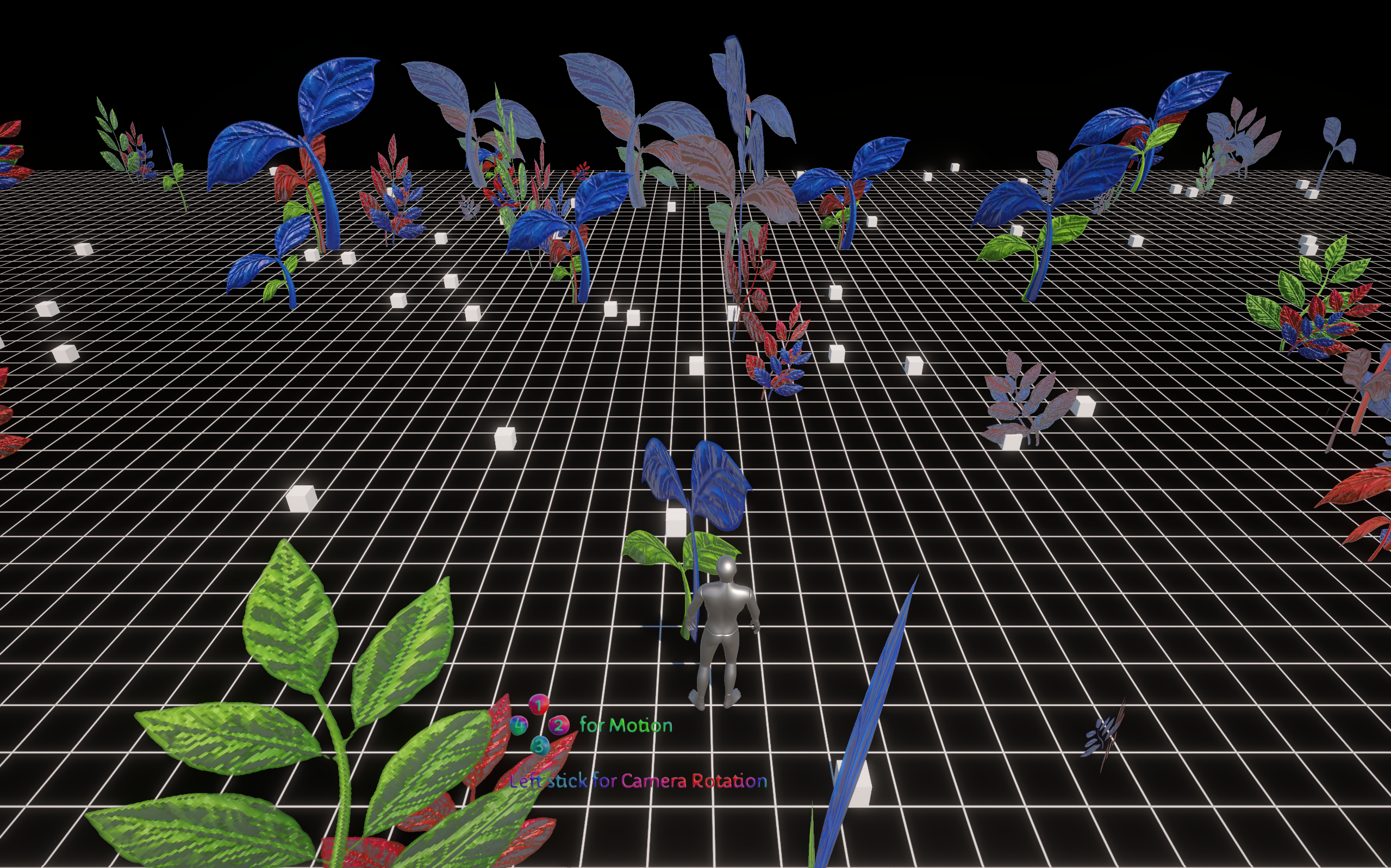
The goal of this brief text is to introduce the theoretical concept of a procedural essay, which would encompass a subset of popular culture artifacts (video games, predominantly) as well as contemporary artworks, ranging from 90s net-art to post-internet art and further on. Crucially, theory here is fueled with — and intertwined with — my artistic practice; thus, my artistic works become a sort of a commentary for this text, or vice versa.
Put shortly, a procedural essay is a computer program that generates arguments in an imaginary reasoning — which may happen to be human-comprehensible, but is not bound to be so. A procedural essay may well be a machine thought experiment for the machine itself.
I am not aiming at defining what a procedural essay is; rather, my points below demonstrate what it does. These points are also followed by an appendix with a list of digital artworks that function as procedural essays, each work accompanied by a brief critical overview.
1.1. A procedural essay is a spatial, non-linear structure — contrary to the text as a sequence of signs (as one finds it in a book, for instance). When engaging with a procedural essay, readers find themselves in the inside of a machine that generates meaning, rather than merely skimming the surface of meaning. Multiple trajectories of reading are available to them — or, rather, multiple choreographies of reading, each with a distinct set of motions and a distinct tempo. The artist’s role is solely to establish the general design principles of this meaning-generating machine.
1.2. “Writing always has been a spatial activity”, claimed Espen Aarseth1. By this he means that there have always been spatial alternatives to linear writing, such as the wall inscriptions in the temples in ancient Egypt (they were connected either two- or three-dimensionally). A procedural essay is indeed a multi-dimensional structure, since it has a complex software architecture behind it; in this way, it has much in common with Aarseth’s theoretical concept of cybertext.
And yet the theoretical concept of a procedural essay is, in one way, broader than the concept of cybertext. Within the latter, “the text is seen as a machine — not metaphorically but as a mechanical device for the production and consumption of verbal signs”2. A procedural essay, however, does not necessarily produce verbal signs; in fact, its output need not to be limited by human-comprehensible signs at all. One can imagine a procedural essay which is a performance of the machine run solely for the machine itself, not to be seen by humans.
2. A procedural essay may include fragments of natural language (although it’s in no way compulsory). They may actually combine into larger narratives — either linear or with aleatoric elements. Yet the true language of a procedural essay is the language of code, which is itself an interface between natural language and computation.
In other words, a procedural essay is somewhere in between the “traffic between language and code”, to put it in Katherine Hayles’ terms3; and yet, in its essence, it has to do more with code than with language.
3.1. The functioning of any piece of software is made possible by computational procedures. Procedures may combine into procedural tropes, which may be found unchanged across different pieces of software. Just like literary works consist of literary tropes, videogames are made of procedural tropes; they also give rise to procedural rhetoric — a term coined by Ian Bogost in his monograph on a procedural approach to video games criticism4. In a parallel fashion, Alexander Galloway conceptualizes video games as grammars of action5.
And yet the downside of rhetoric is sophistry, and the downside of grammar is discipline of language, thought and body. The goal of a procedural essay is to use procedures not for discipline, but for emancipation.
3.2. A procedural essay is not a rhetorical machine, since it does not convince anyone of anything. On the contrary, it generates doubt and dissensus, since dissensus is present in its very algorithmic nature. Natural language structures are in permanent conflict with binary logics of calculation — to the point where, eventually, calculation wins over language.
4.1. A procedural essay is more of a frame than a window. It does not create an illusion of immersion, but rather elucidates how the calculations behind it give rise to the effects of digital presence.
Digital interfaces characteristic of societies of control pretend to be transparent thresholds, as shown by Alexander Galloway6. A procedural essay uncovers the hidden multidimensional structure of those thresholds, revealing complex choreographies of procedures that run the interface.
4.2. Software and ideology have much in common: software does not trick anyone and does not pretend to be something it isn’t, but, rather, it establishes the very boundaries of the “real”7. In this regard, a procedural essay is critical of the very mode of existence of computer software. It is not a disciplinary grammar of actions to be enacted by users. It is a map of the invisible instead: a spatial metaphor of how procedures give rise to discipline.
The author of a procedural essay is, thus, more of an ordinary user than an engineer; they are more of Rancière’s ignorant schoolmaster than an academic8.
5. A procedural essay emerges where the protocols of control fail. From the failures of interpretation it derives its expressive and political power. It is, thus, as much a procedural failure as it is an essay.
Appendix
This appendix comprises four short critical accounts of the existing procedural essays. I aim at uncovering the procedural reasoning behind each one and highlight the political and philosophical narratives that they give rise to.
One may deem it an ever-unfinished glossary of procedural essays.
Death Stranding (Kojima Productions, PS4, 2019)
The original trauma of the interface
The player acts as a courier delivering supplies to isolated cities in post-apocalyptic United States. However, delivery itself is not the main goal here: more importantly, once arrived in a new location, the player is able to connect it to the global Chiral network. It is similar to the Internet in that it allows the instantaneous transportation of immense amounts of data between the nodes, which allows, in turn, even for the reproduction of physical objects. In other words, between the nodes of the Chiral network, iridescent mediation may occur, in Alexander Galloway’s terms: “the mediation is as fast as the light itself — or as fast as Iris, the goddess of light in ancient Greek mythology9.
And yet the Internet network is quite literally present in Death Stranding, too. Once the area is connected to the Chiral network, it is also connected to the Internet: the player can see the items other players have left. In this way, players can indirectly help each other: they can build useful infrastructures such as bridges or electricity generators. Players cannot observe each other acting; however, they have access to the consequences of each other’s actions.
Crucially, even though both networks in the game allow for instantaneous mediation between players (as well as NPCs), this mediation is heavily limited by the invisible thresholds of the software. Those thresholds reduce the action to its consequence — as much as the communication to the decryption of spatial traces made by others; and this is exactly what Galloway called “the original trauma of the interface itself”10.
LSD Dream Emulator (Asmik Ace Inc., PS1, 1998)
Machine dreams, or Synthesized Algorithmic Uncanny
LSD Dream Emulator is a first-person game without any competitive mechanics — probably one of the first exploration games or, as they call it now, walking simulators. Once the game is launched, players find themselves inside a dream scene: fragments of someone’s experience are collaged together in a glitchy 3D location. The only way to interact with the environment is to move around the scene; touching some objects may cause the dream to end.
This game does not have any narrative structure, and the emulated dreams do not have any relationship with each other. Each dream is tied to a certain location on a larger map, which the player explores. The map, however, is more of a diagram of the lived experience than an instrument of navigation: the player is unable to travel back to the visited scenes (with the sole exception of the previous scene). Every dream has some aleatoric elements: some objects appear in a scene with a certain probability, and some textures may be swapped with other ones; the more time a player spends in the game, the more variation occurs.
From a rhetorical point of view, LSD Dream Emulator is not about the dreams or the experience the player encounters. If we translate its message from the language of procedures to the natural language — however inaccurate the translation might be — we’ll face a question rather than a proposition: who dreams? And, more importantly, for whom? Whose dreams does the player access, and why are those dreams even accessible? A tentative answer would be that those dreams are pieces of the surrealist uncanny, as analyzed by Hal Foster11; or, rather, a synthesized algorithmic uncanny, or the dreams without the dreamer.
Katamari Damacy (Namco, PS2, 2004)
Everything is stuff, or, The Economy of Digital Objects
The player controls The Prince, whose father, The King of All Cosmos, destroyed all the stars in the universe. It appears that this destruction was not intentional, and the father orders his son to rebuild what he ruined. To do so, The Prince is given a Katamari — a magical ball, the ability of which is to glue everything it touches to its surface. With one restriction, though: the ball can attach an object that is smaller than itself.
The Katamari is, in effect, a snowball: the player’s role is to push it to the right direction, so that the ball glues the smaller objects and gradually becomes bigger. The levels are lined up with respect to the scale of the objects to be rolled up: in the beginning, the player glues together pennies and pushpins, while in the end, they are able to roll up the whole buildings. Every object, thus, represents potential material from which the future stars are to be made.
Everything in this world is thus made of the same stuff12, and is subject to the universal rule of the economy of digital objects. The bigger the ball is, the bigger are the objects that it can attach. This is exactly the logic behind today’s web: everything is turned into the flux of data, and the flux of data is essentially the flux of the global capital13. The only difference between the world of Katamari Damacy and the networked digital world is that the latter is structured by the will of multiple agents, both human and non-human, whilst the world of Katamary is more schematic and organized around the player’s agency.
Everything (David O’Reilly, PC/PS4, 2019)
A Spectacle for a Camera Obscura
In Everything, players may act on behalf of any creature in the universe — from subatomic particles to bacteria to plants to celestial objects. The only rule is that you may control only one entity at a time. Players are unable to produce any systemic change in the ecosystems of the game world, but they may witness them from any viewpoint.
This disembodied, and yet omnipresent eye reifies the Cartesian mode of seeing, as conceptualized by Jonathan Crary14. Cartesian gaze is non-human: it ignores the physical limitations of the human eye; instead, it is modeled after a camera obscura. The digital world of the game is a mere spectacle, which unfolds as long as it is seen; creatures there do not exist for themselves, but, rather, their existence is organized around the invisible, and yet omnipresent figure of a mechanized eye.
Everything here is nothing but an automaton, while the player is an embodiment of Descartes’ cogito. Their mind is autonomous from the physical properties of the bodies it controls, since every creature follows the universal mechanistic order. Consequently, any body follows the same universal motion patterns and may be controlled in the same way15.